【安藤忠雄建築】水の教会|自然を閉ざし、最後にすべてを開く安藤忠雄の教会(Church on the Water|Tadao Ando’s Church That Conceals Nature Before Revealing It)
建築概要
Architecture Overview
- 名称:水の教会
- 設計:安藤忠雄
- 所在地:北海道勇払郡占冠村字中トマム
- 竣工:1988年9月
- 用途:教会
- 階数: 地下1階・地上1階
- 敷地面積: 6,730.00㎡
- 建築面積: 344.94㎡
- 延床面積: 520.04㎡
- Name:Church on the Water
- Architect:Tadao Ando
- Completed:September 1988
- Location:Tomamu, Shimukappu, Hokkaido, Japan
- Type:Church / Chapel
- Floors:One above ground, one below ground
- Site Area:6,730.00 m²
- Building Area:344.94 m²
- Total Floor Area:520.04 m²
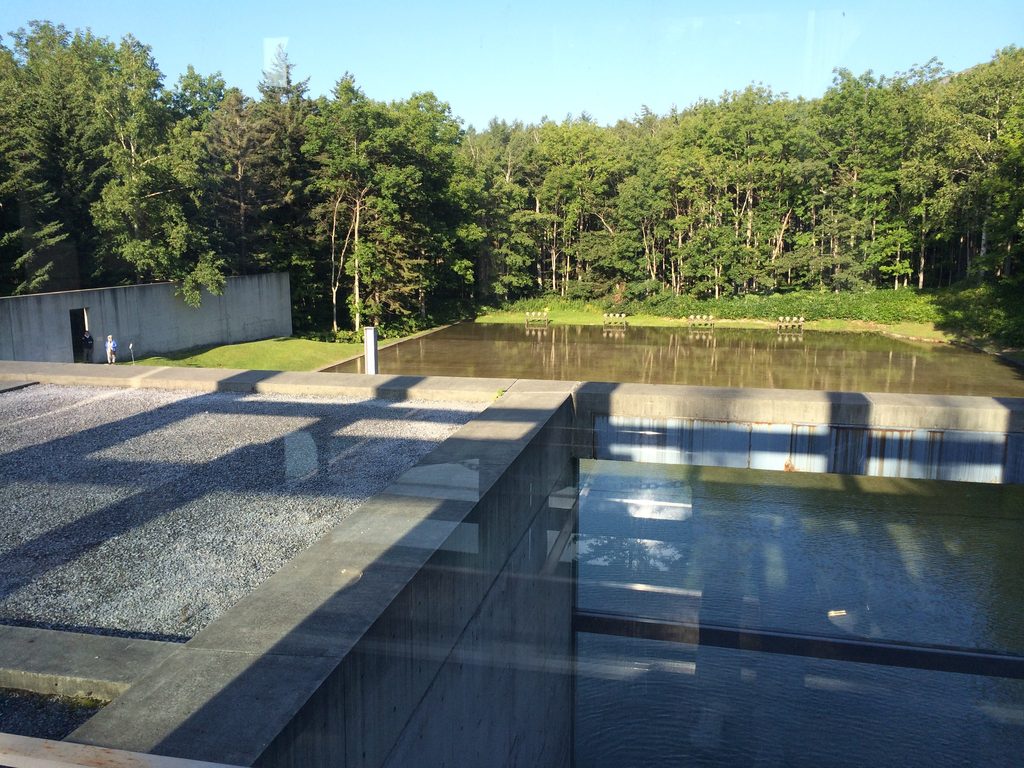
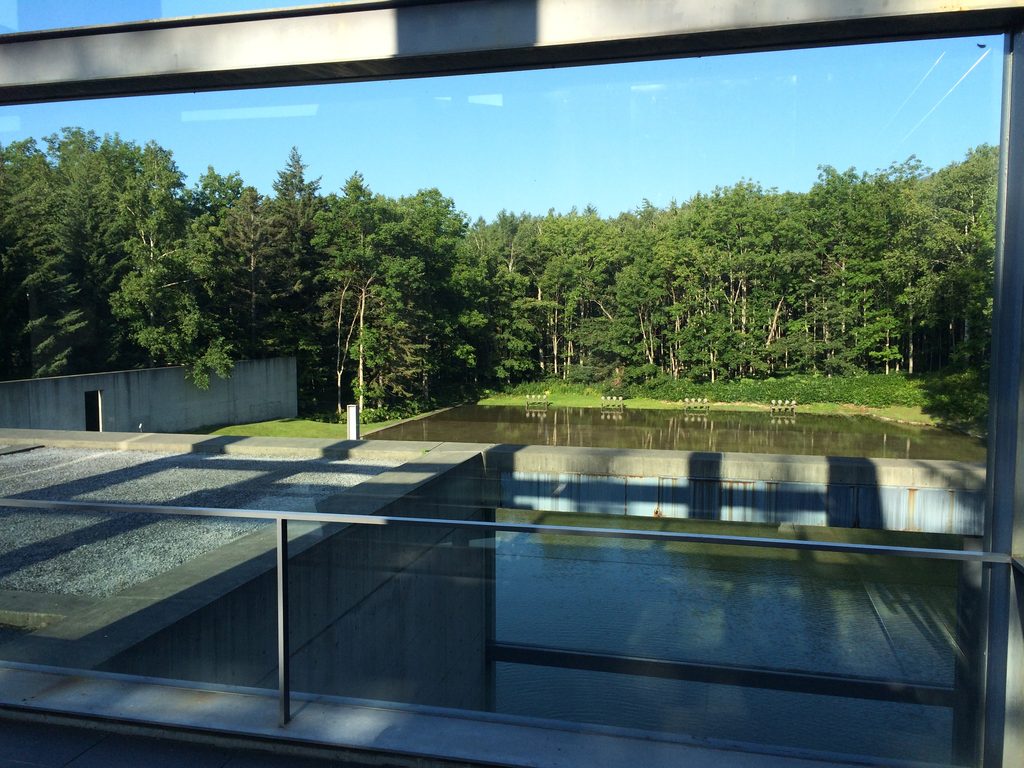
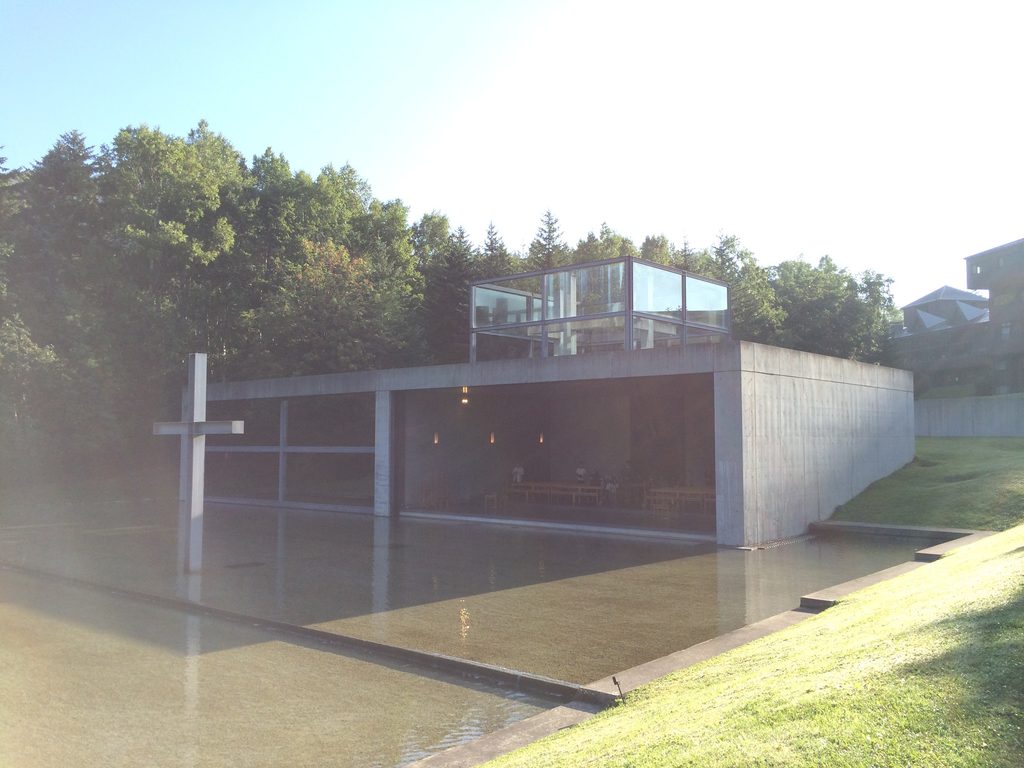
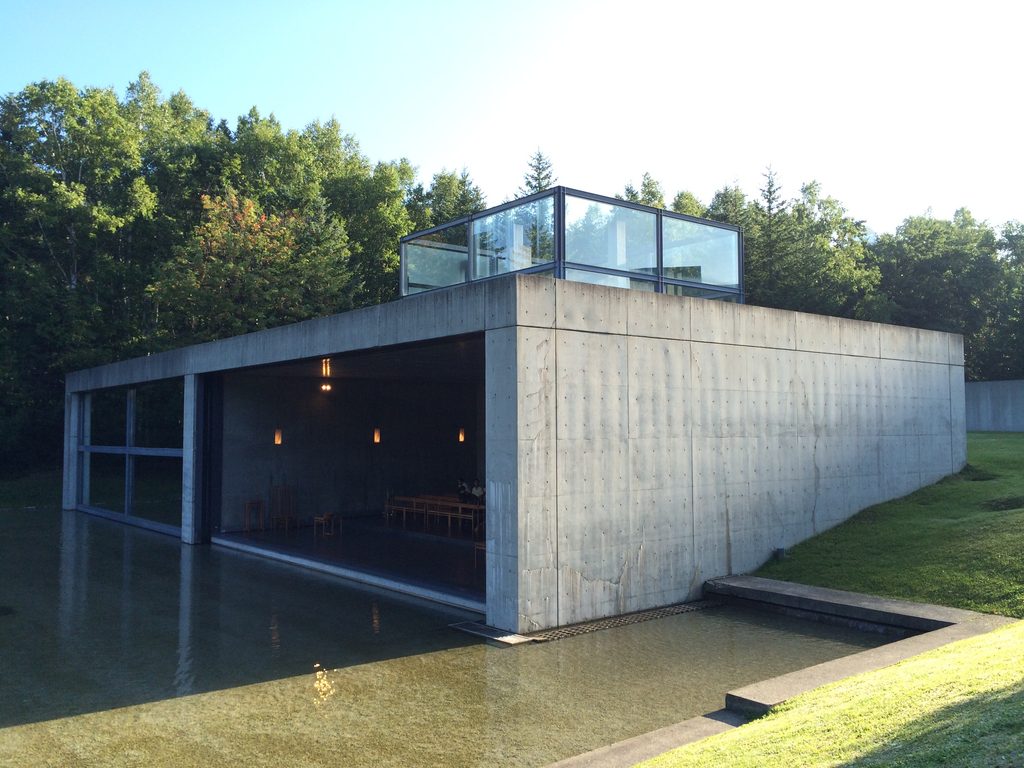
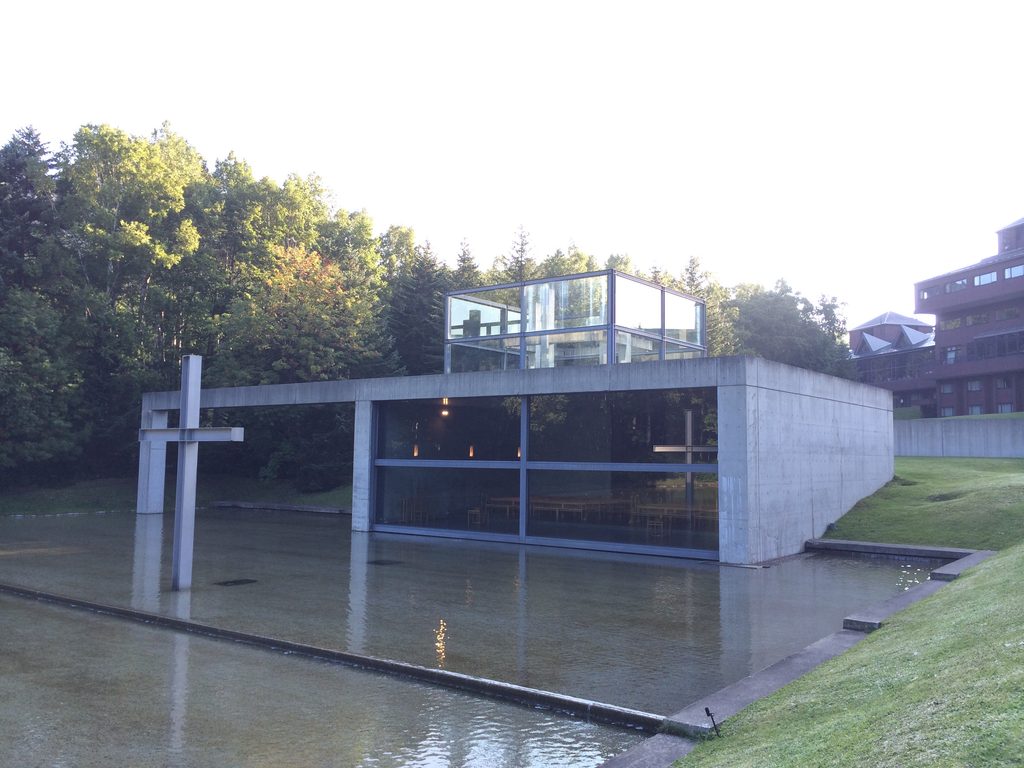
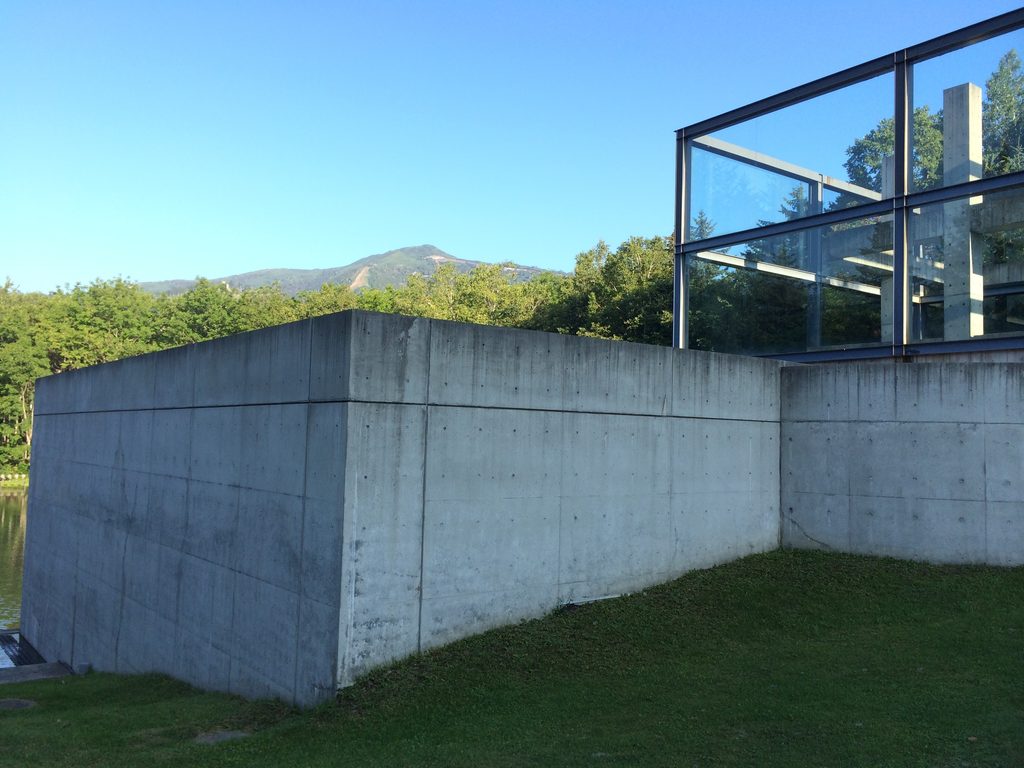
北海道・トマムの森に建つ「水の教会」は、1988年に完成した安藤忠雄の代表的な宗教建築の一つである。建築は約90m×45mの水面に向かって配置され、二つの正方形を基本とするヴォリューム、L字形の打放しコンクリート壁、ガラスの立方体、曲面壁に沿って下降する階段、そして水の中に立つ十字架によって構成されている。打放しコンクリート、明快な幾何学、光と影という安藤建築の基本的な言語を持ちながら、この作品で最終的に人の意識を向ける対象は建築そのものではなく、水、森、空、光、風という北海道の自然である。
しかし、水の教会はその自然を最初から開放的に見せる建築ではない。敷地へ入った人はコンクリートの壁によって視線を遮られ、進行方向を変えながらガラスの立方体へ導かれ、さらに曲面壁に沿った階段を降りて礼拝堂へ向かう。その過程では、すぐ近くに存在する水面や森の全体像を容易に捉えることができない。そして礼拝堂へ到達したとき、それまで建築によって抑制されていた視界が一気に開かれ、水面と十字架、その背後に続く森と空が一つの風景として現れる。水の教会とは、美しい自然の中に建築を置いた作品というだけではなく、自然を一度遠ざけ、建築を通過する時間によって人の感覚を整えたうえで、もう一度その自然と出会わせる建築として理解することができる。
Church on the Water, completed in 1988 in the forests of Tomamu, Hokkaido, is one of Tadao Ando’s most representative works of religious architecture. The building faces an approximately 90-by-45-meter body of water and is composed of volumes based on two squares, an L-shaped exposed-concrete wall, a transparent glass cube, a curving stairway descending along a concrete wall, and a cross standing in the water. Although the architecture employs Ando’s fundamental language of exposed concrete, clear geometry, light, and shadow, what ultimately commands our attention is not the building itself but the natural environment of Hokkaido—the water, forest, sky, light, and wind.
Yet Church on the Water does not reveal this landscape immediately. Visitors encounter concrete walls that obstruct their view, redirect their movement, and lead them toward the glass cube before they descend along a curved wall toward the chapel. Throughout this sequence, the water and forest remain close at hand, yet their full presence is deliberately withheld. Only upon reaching the chapel does the restrained field of vision suddenly open, revealing the water, the cross, and the forest and sky beyond as a single landscape. Church on the Water can therefore be understood not simply as architecture placed within beautiful nature, but as architecture that first distances us from nature, prepares our perception through movement, and then allows us to encounter that same nature again.
1. 森の中で、まず一枚の壁に出会う
In the Forest, the Journey Begins with a Wall
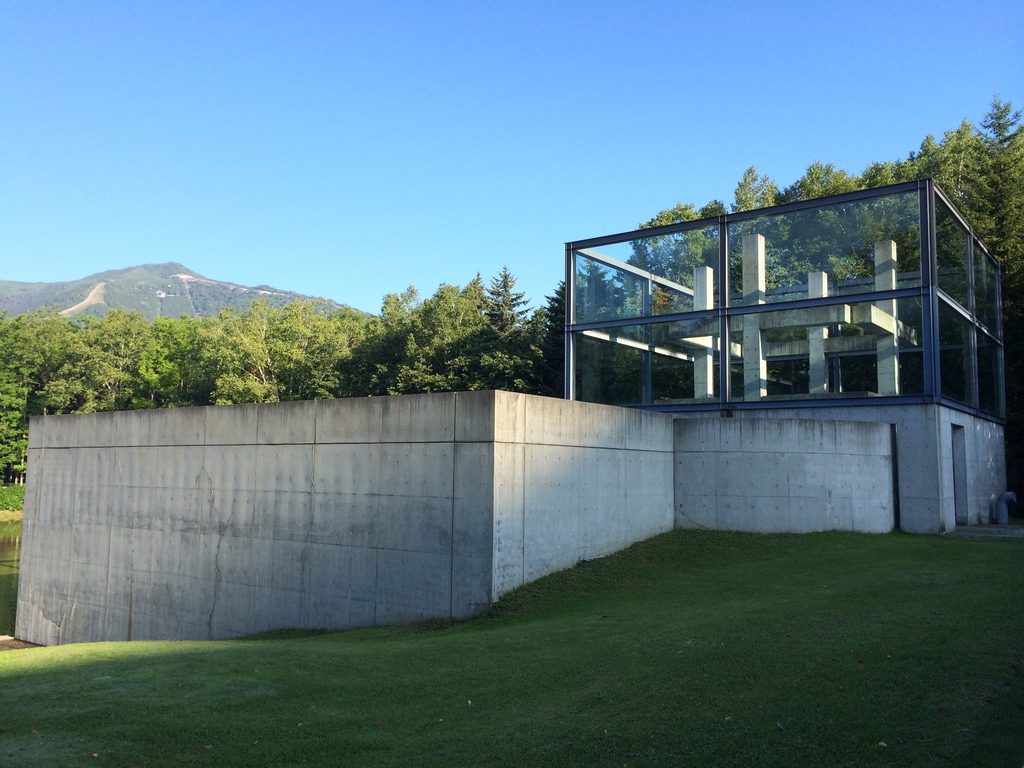
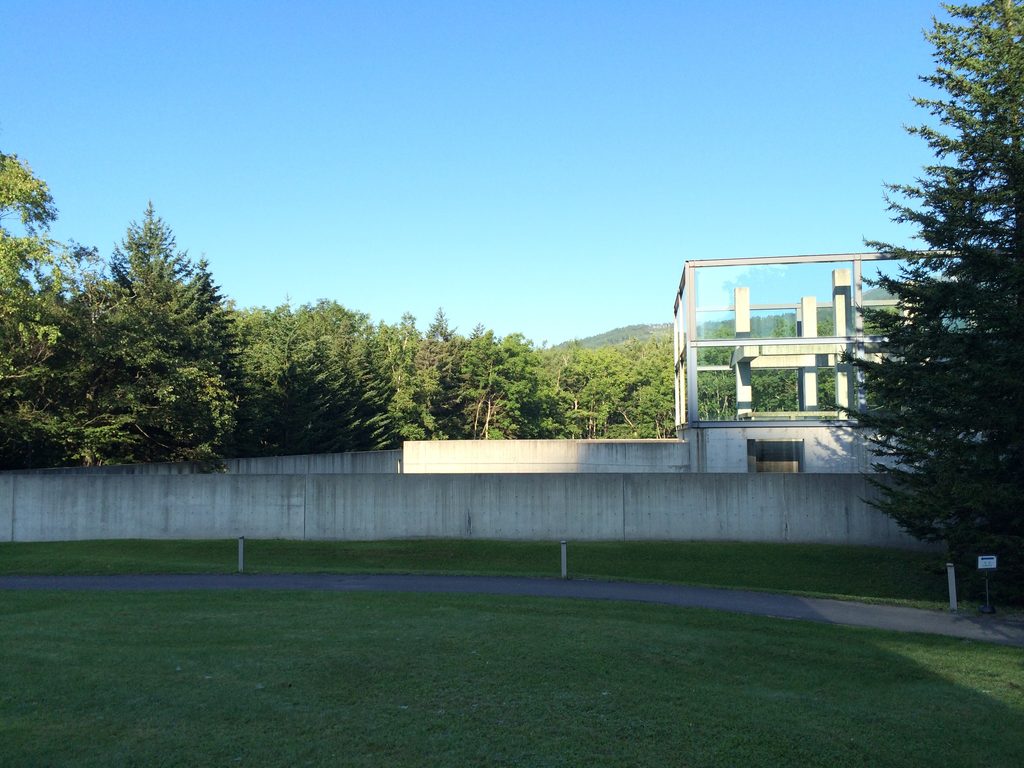
北海道・トマムの森の中に置かれた水の教会は、一般的な教会建築のように遠くから正面性を示すことがない。尖塔が空へ伸びるわけでも、入口へ向かう明確な軸線が用意されているわけでもなく、広大な自然の中に低く抑えられたコンクリートのヴォリュームと透明なガラスの立方体が静かに置かれている。背後に広がる森や山と比較すると建築の高さは驚くほど低く、自らを風景の主役として押し出すのではなく、北海道の大きな水平性の中へ身体を沈めるように配置されている。
Set within the forests of Tomamu, Church on the Water does not announce itself from a distance in the manner of a conventional church. There is no spire rising above the trees and no ceremonial axis leading directly toward an entrance. Instead, low concrete volumes and a transparent glass cube are quietly positioned within the vast landscape. Against the scale of the surrounding forest and mountains, the building remains remarkably low, embedding itself within the horizontality of Hokkaido rather than attempting to dominate it.
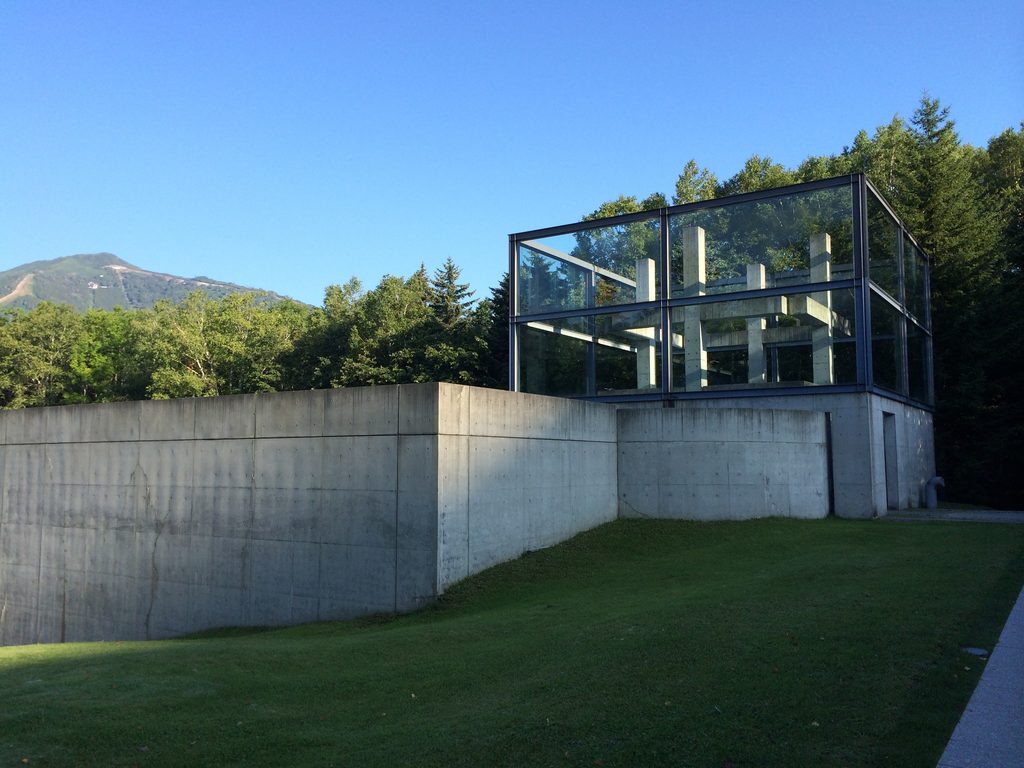
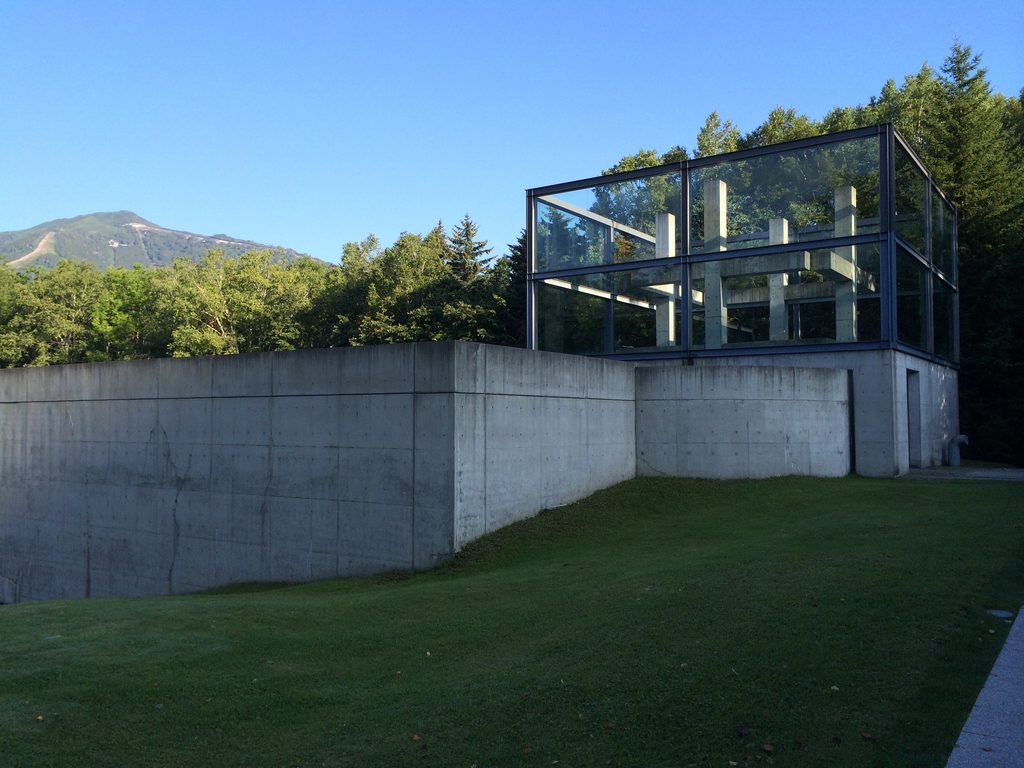
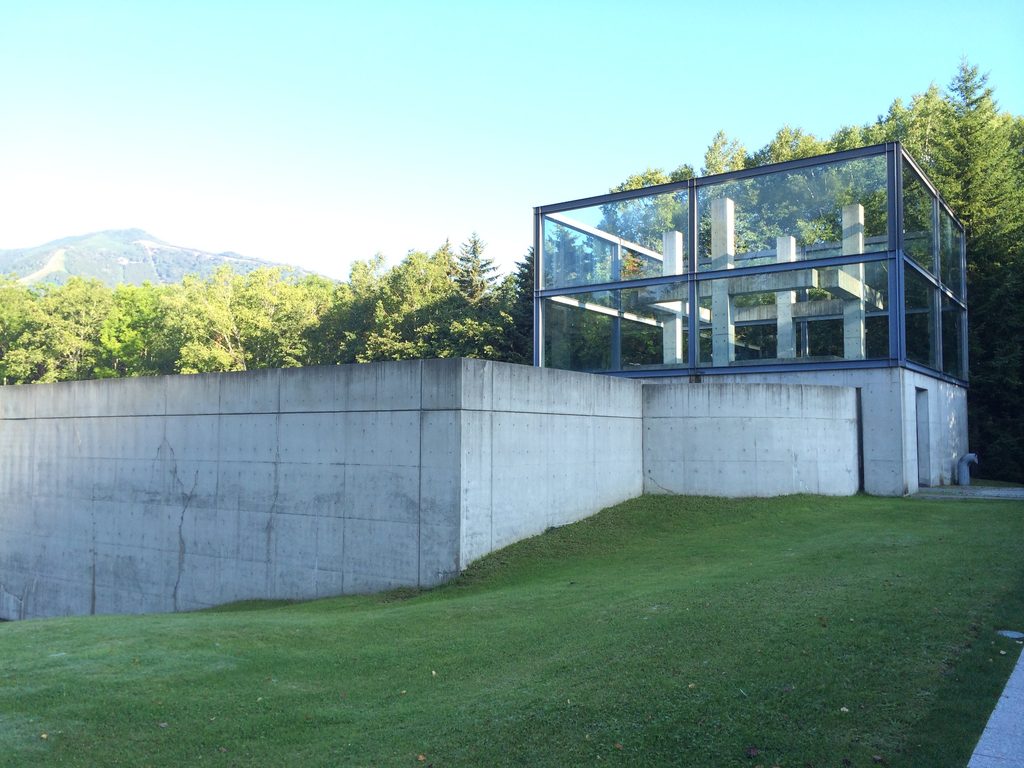
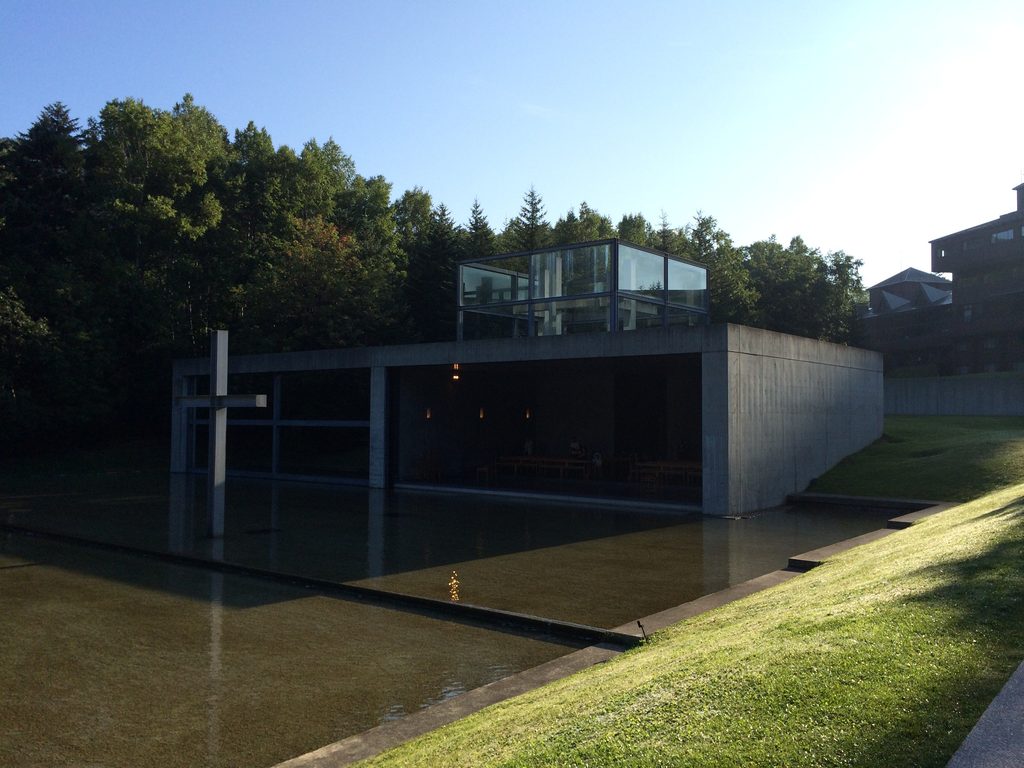
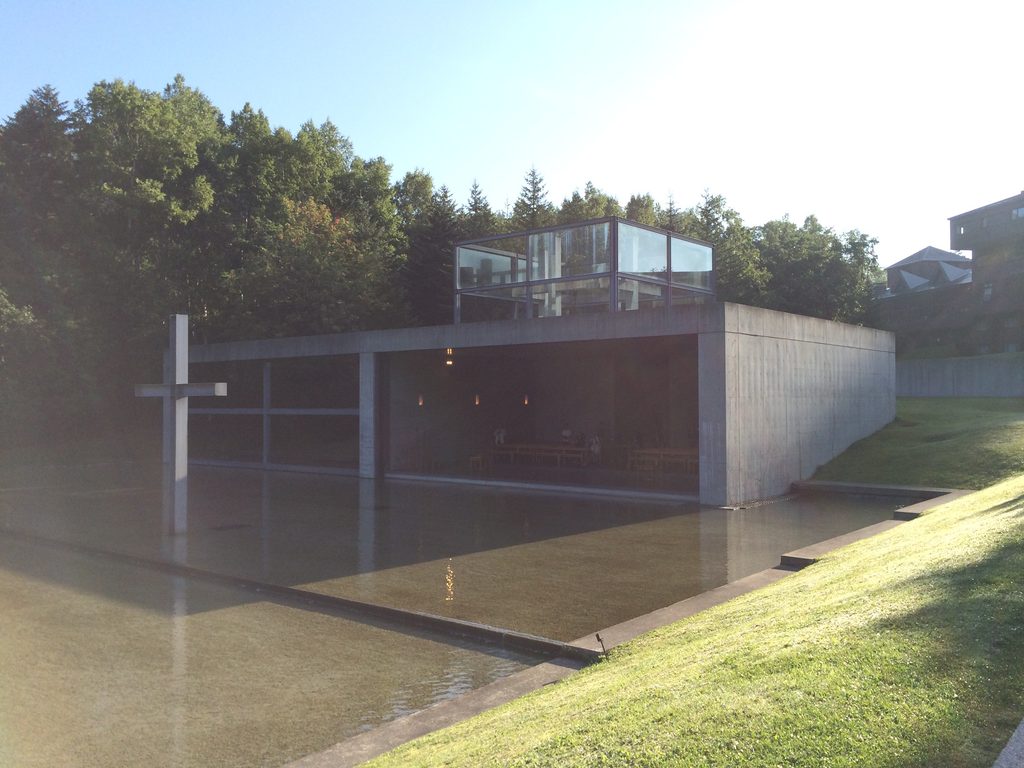
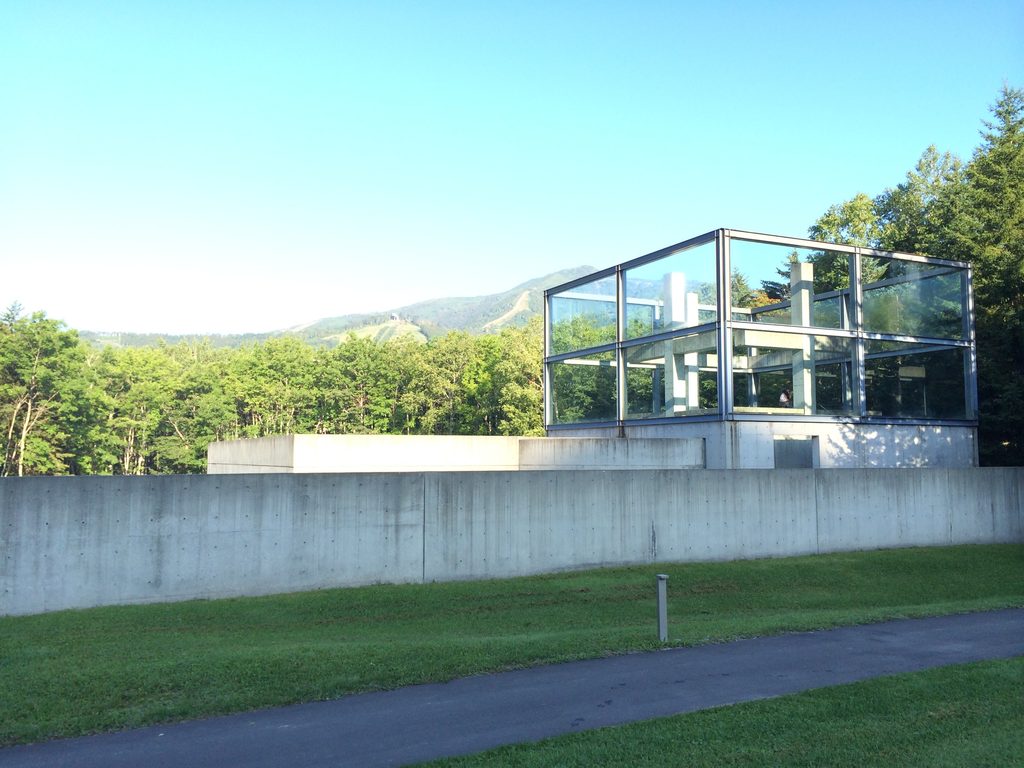
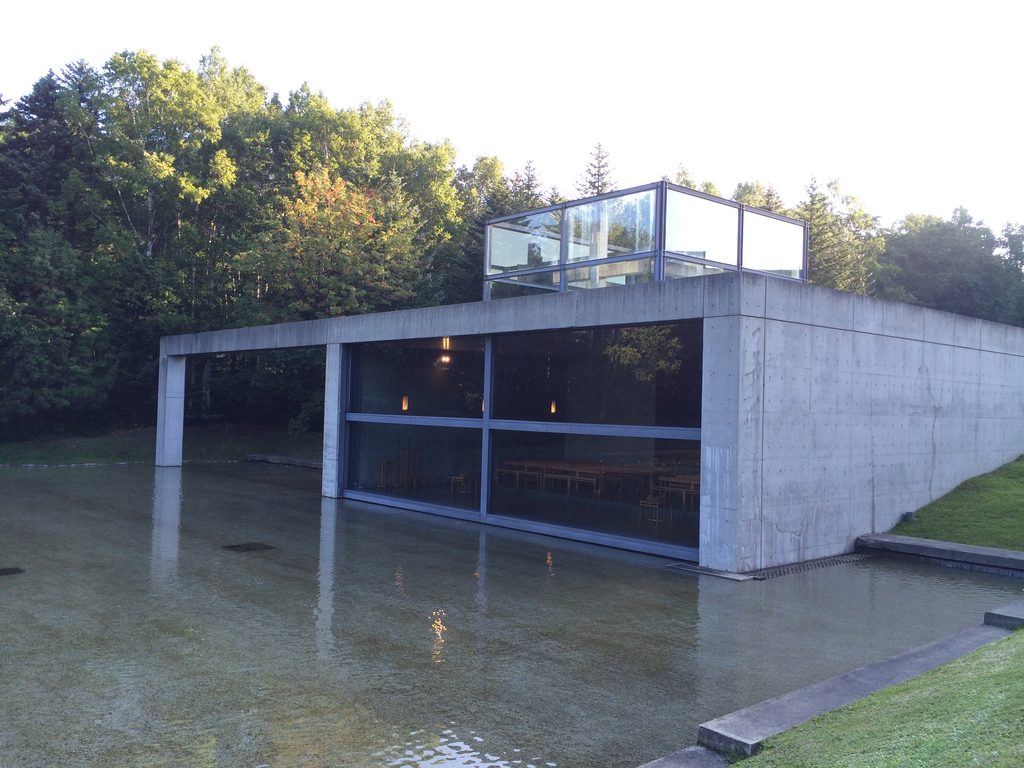
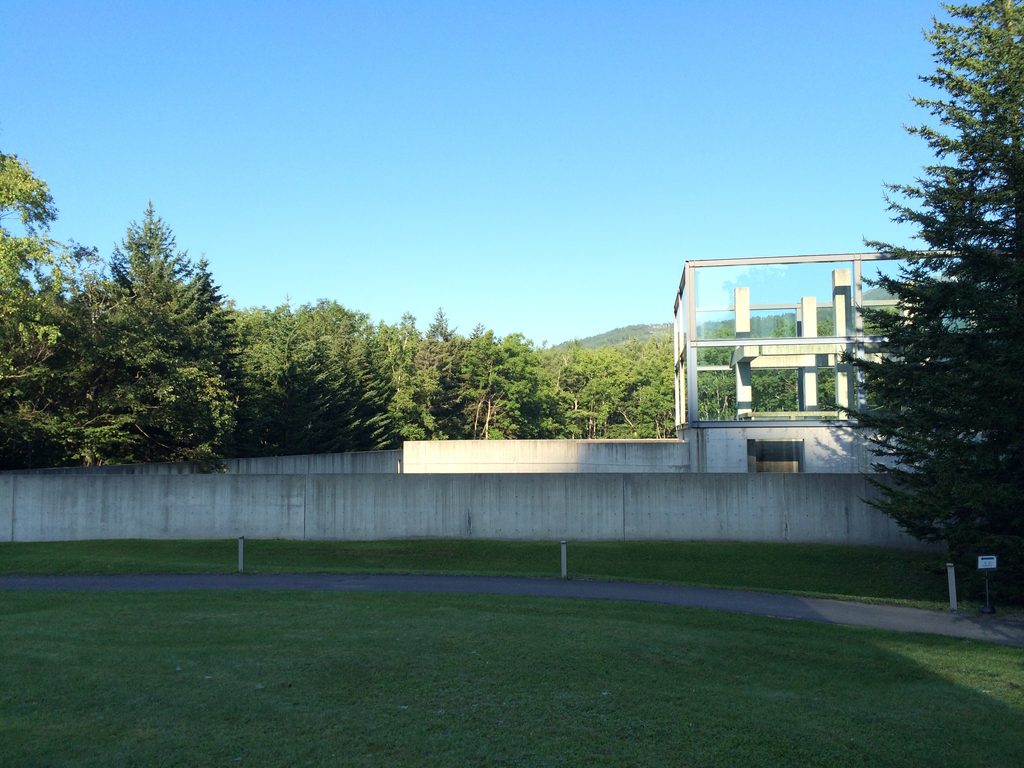
少し距離を置いて眺めると、建築を構成する要素は非常に明快である。水平に伸びる打放しコンクリートの壁、その上に現れる透明なガラスの立方体、そして周囲を取り囲む森。それぞれは自然とはまったく異なる幾何学的な輪郭を持ちながら、建築全体の高さが抑えられているため、森や山のスケールを損なうことなく一つの風景をつくっている。
Seen from a distance, the principal elements of the composition are remarkably clear: an exposed-concrete wall extending horizontally, the transparent glass cube rising above it, and the forest surrounding both. Each possesses a geometric order entirely different from that of nature, yet because the architecture remains low, it does not diminish the scale of the landscape. Instead, the artificial geometry and the expansive natural setting begin to define one another.
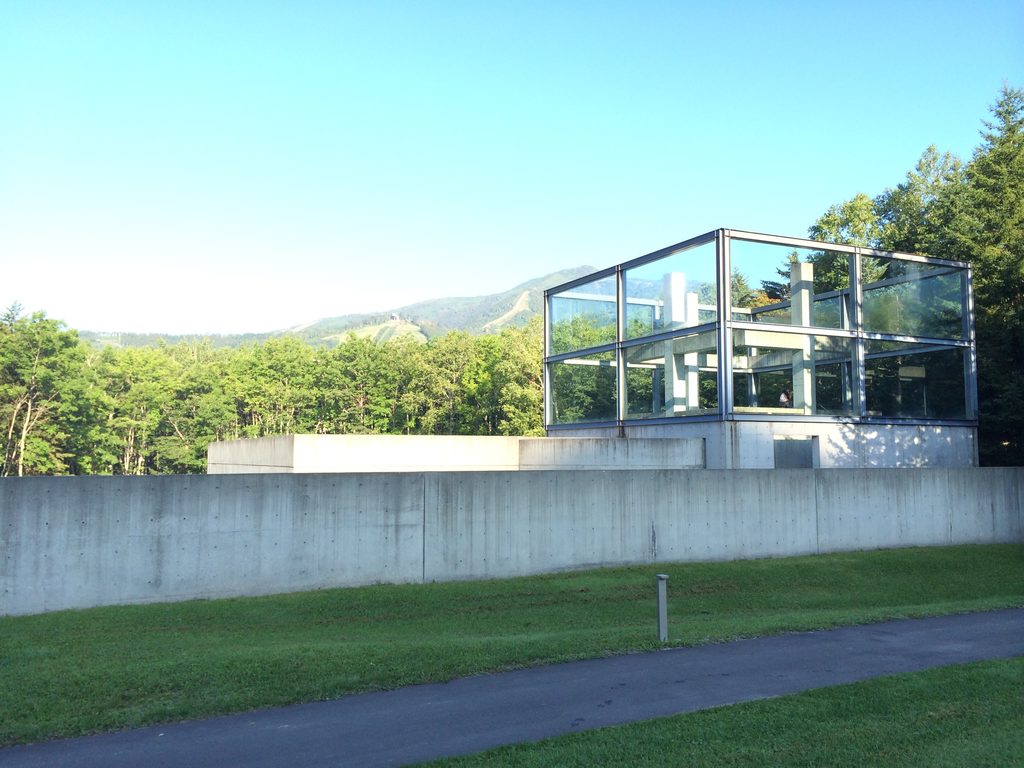
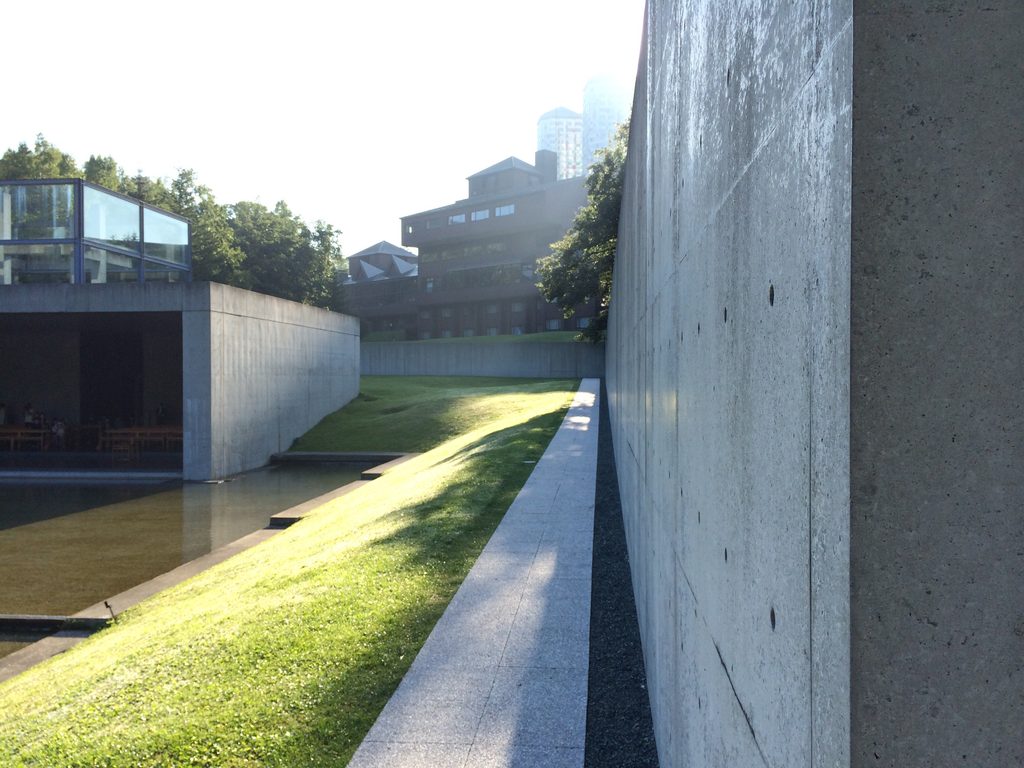
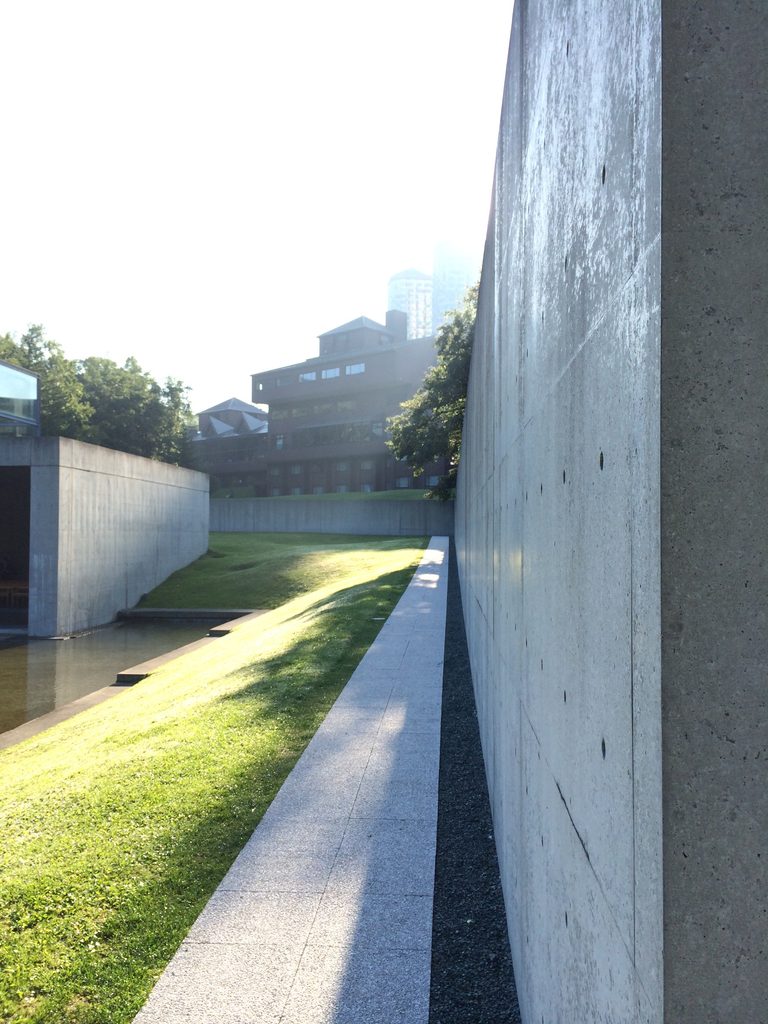
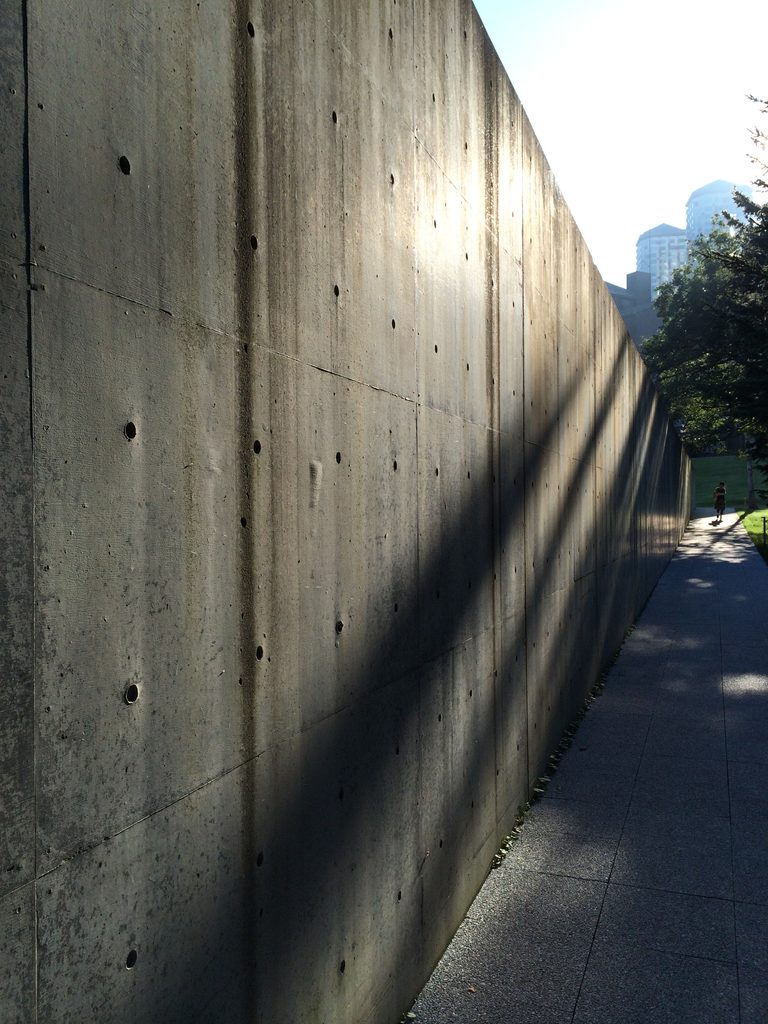
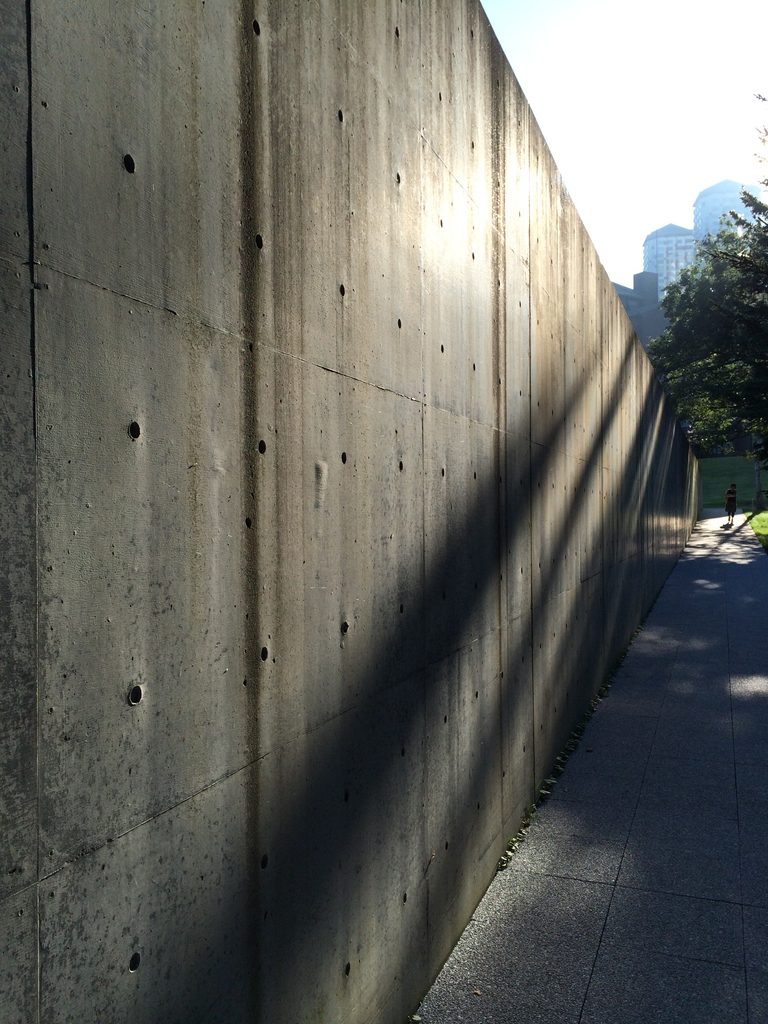
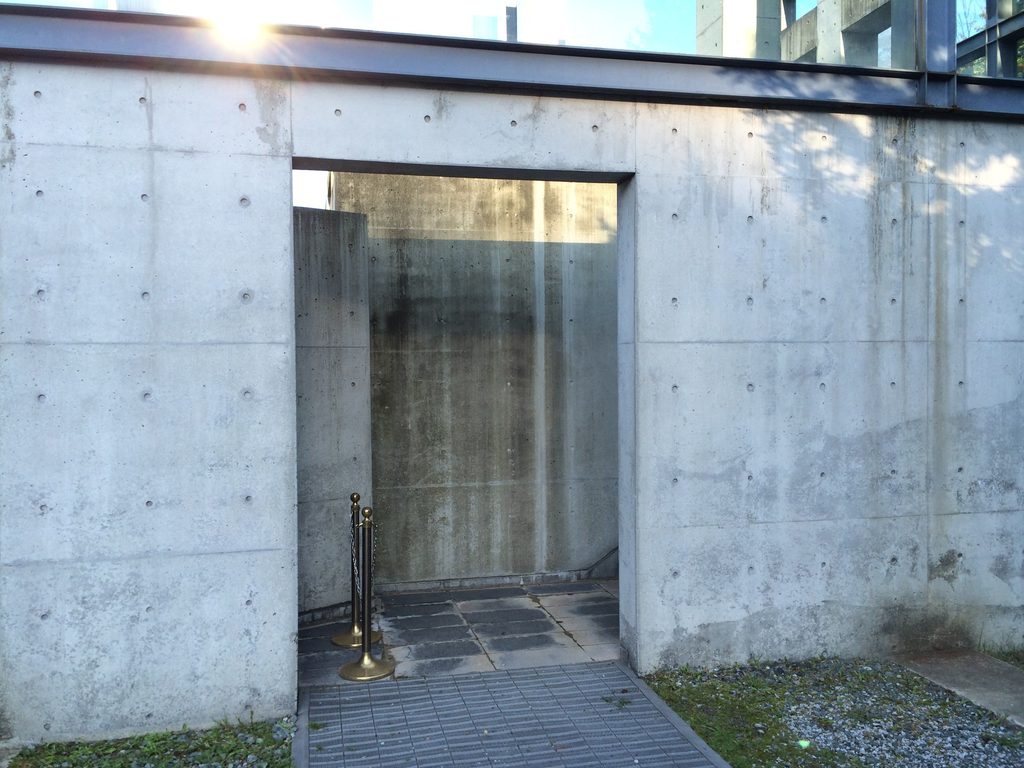
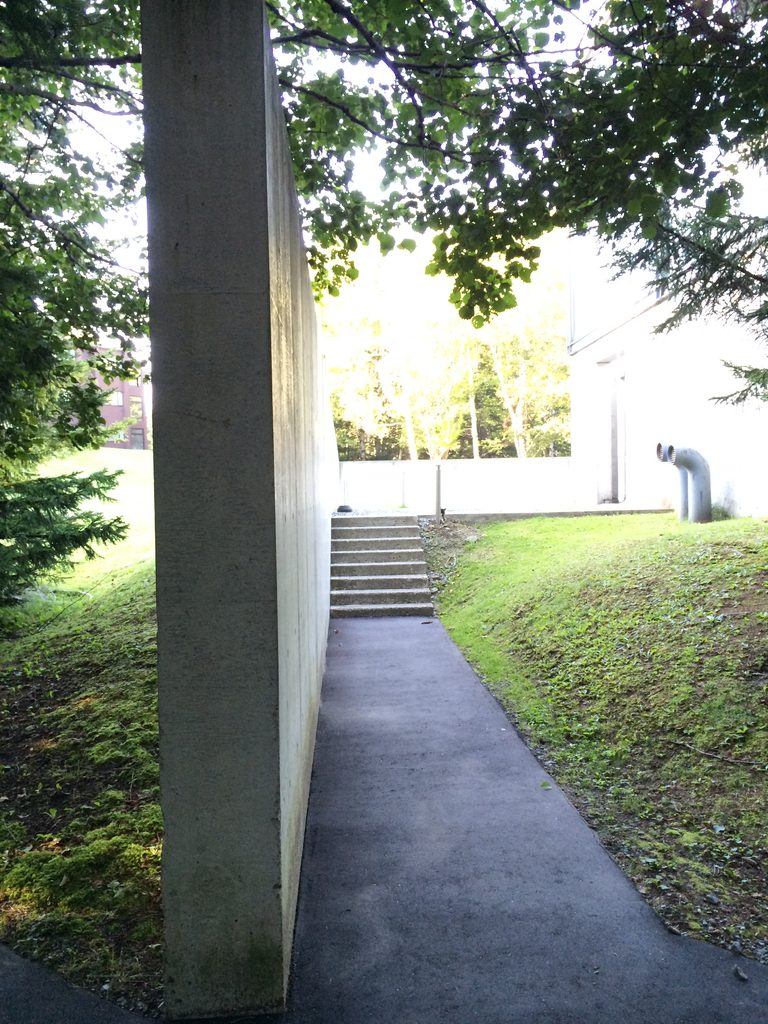
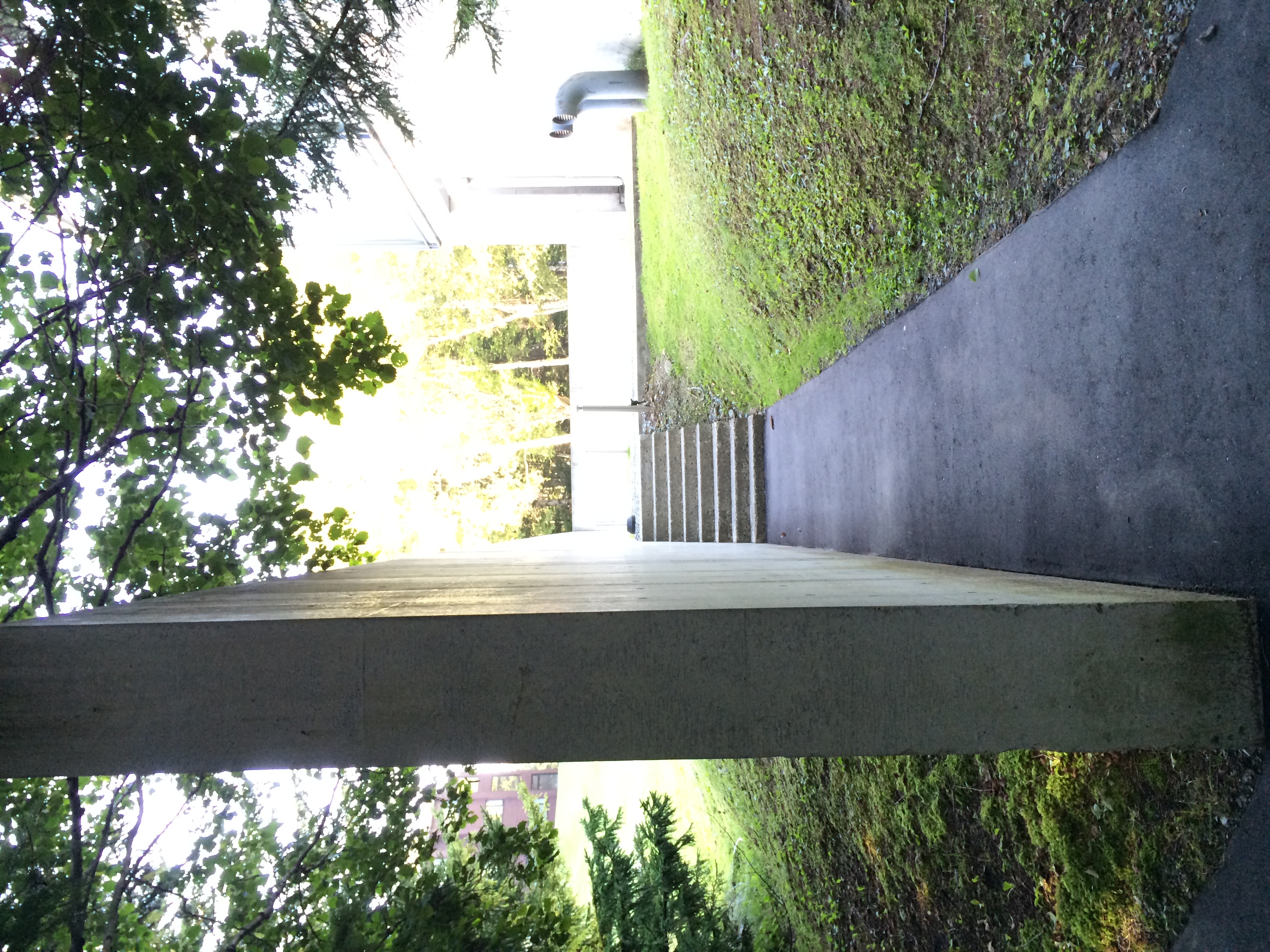
ところが建物へ近づいていくと、遠景から受けた開放的な印象は次第に変化する。目の前に現れるのは、長く伸びる打放しコンクリートの壁である。水面や十字架、森がすぐ近くに存在していることは分かっていても、この壁が視線と進行方向を遮るため、訪れた人は目的の場所へ直接向かうことができない。北海道の豊かな自然の中にありながら、建築はまず、その自然との
As one approaches, however, the initial sense of openness begins to change. A long exposed-concrete wall appears directly ahead. Although the water, cross, and forest are known to be nearby, the wall interrupts both sight and movement, preventing visitors from proceeding directly toward them. Even within the richness of the Hokkaido landscape, the architecture begins by establishing a deliberate boundary between the visitor and nature.
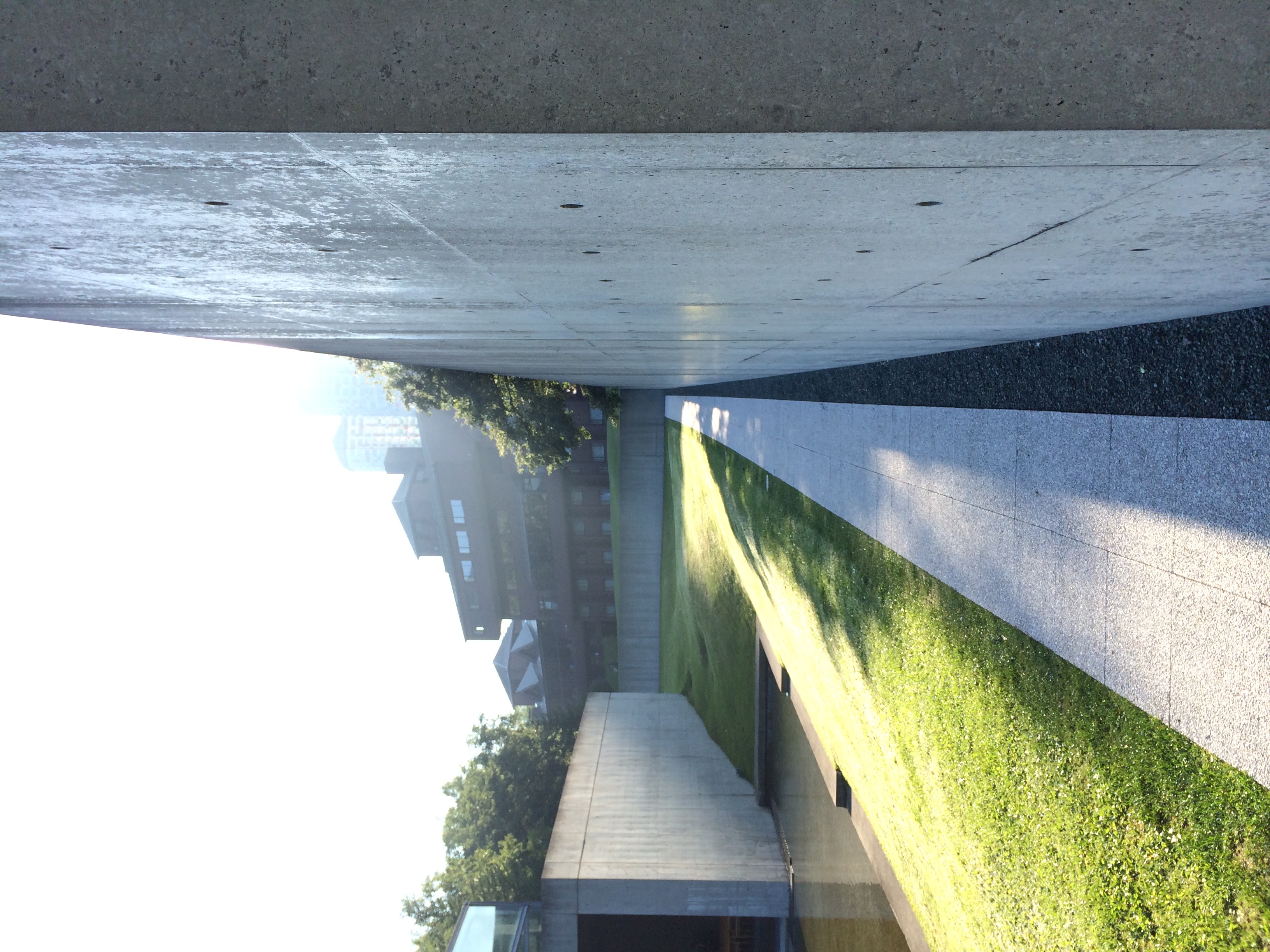
通常であれば、これほど恵まれた風景を持つ敷地では、大きな開口を設けて自然を最大限に見せることを考えるだろう。しかし安藤はここで、見せることよりも先に「見せないこと」を選択している。壁によって風景を一度遮断することで、それまで無意識に見ていた森や空を背景から切り離し、次にそれを見る瞬間への意識を高めているのである。
On a site blessed with such scenery, the conventional response might be to open the architecture as widely as possible toward its surroundings. Ando does almost the opposite. Before revealing the landscape, he conceals it. By temporarily removing the forest and water from view, he separates them from the status of an ordinary background and heightens our awareness of the moment when they will eventually return.
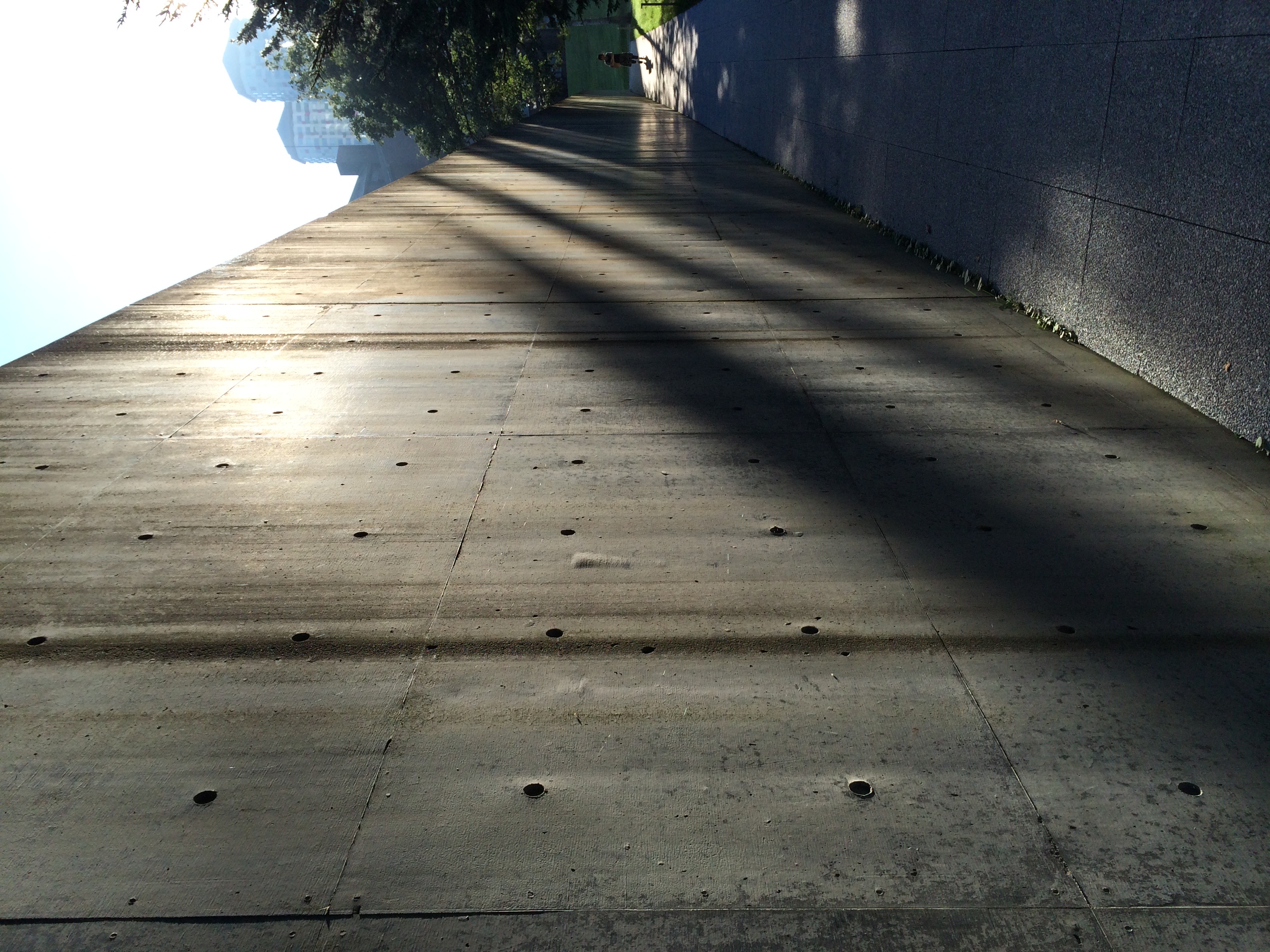
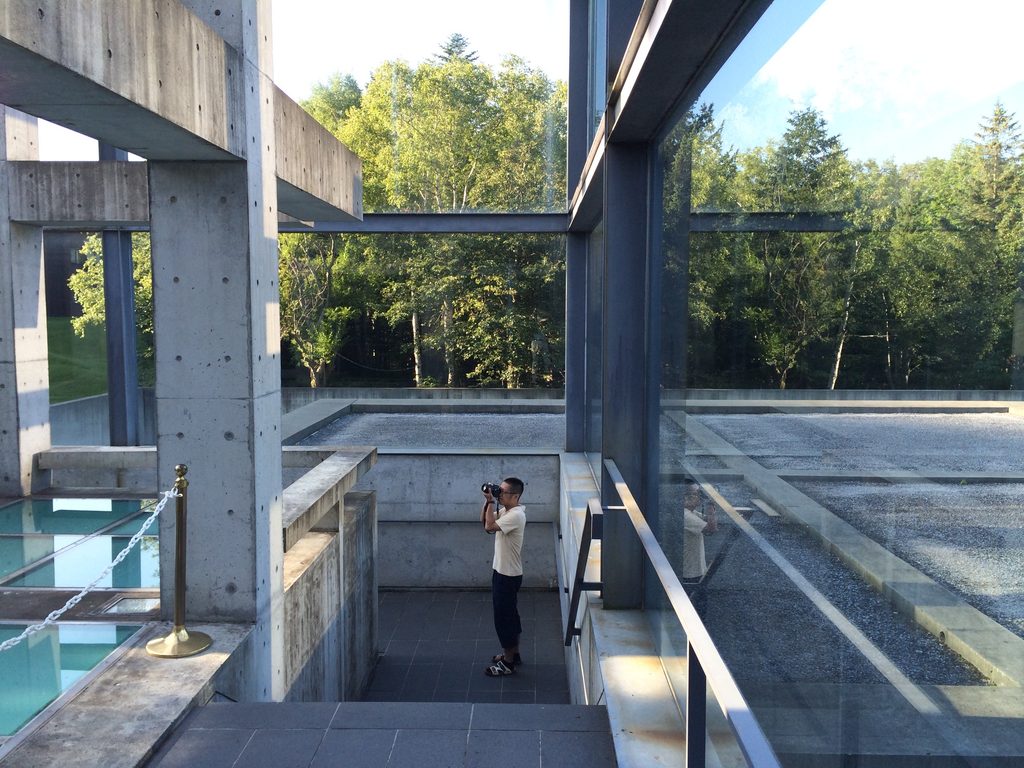
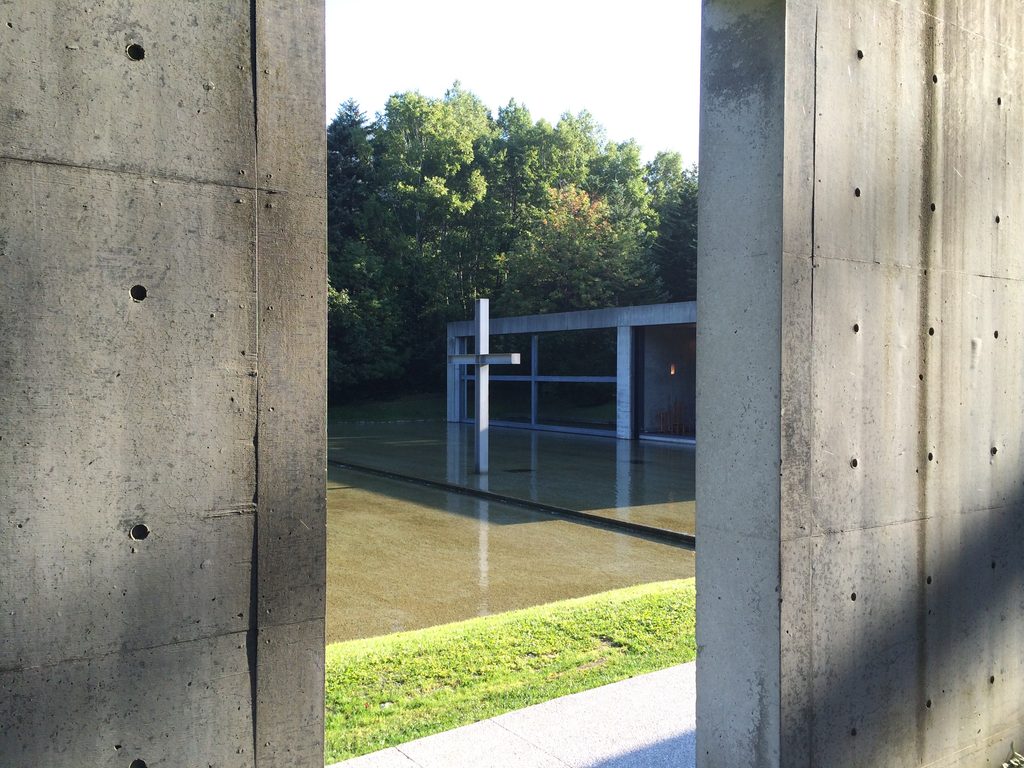
壁に沿って歩くと、その切れ目や建物との隙間から、ガラスや水、周囲の緑が断片的に姿を現す。一つの場所から建築全体を把握することはできず、身体を動かすたびに異なる要素が見えたり消えたりするため、訪れる人は建築の形を眺めるというより、自らの歩行によって少しずつ空間の構成を理解していくことになる。
Walking alongside the wall, fragments of glass, water, and vegetation begin to appear through openings and gaps. The architecture cannot be comprehended from a single viewpoint. Instead, its elements appear and disappear as the body moves, so that understanding the building becomes less an act of looking at a finished object than a process of gradually assembling it through movement.
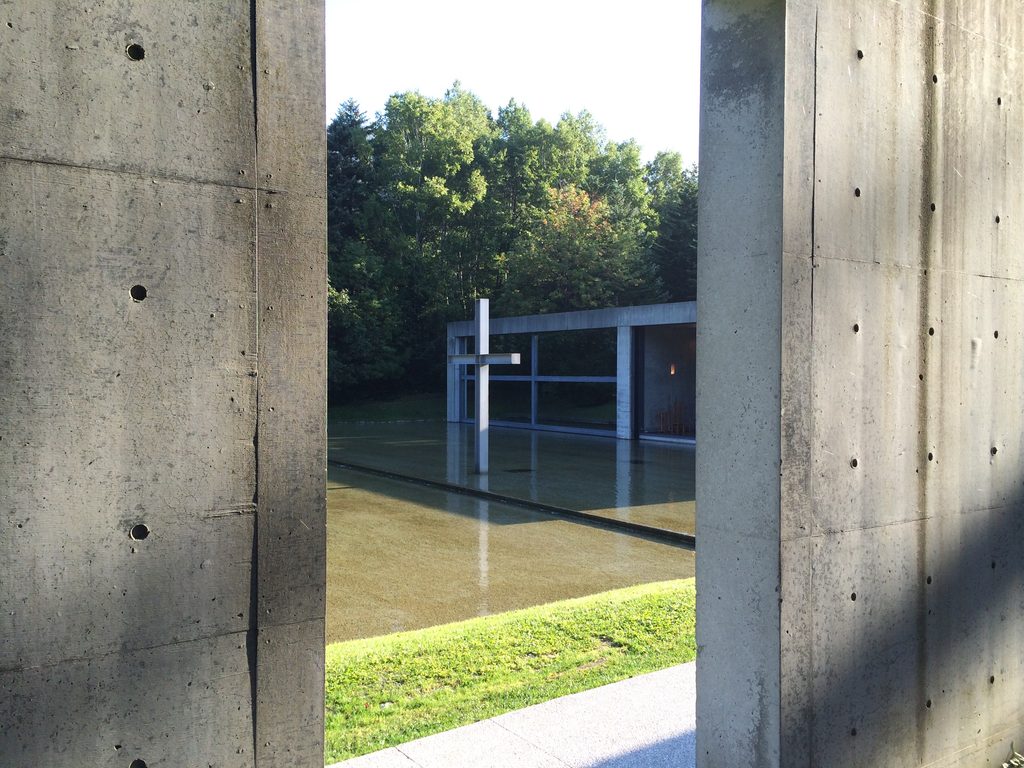
安藤忠雄の建築において、壁は単に内部と外部を分ける境界ではない。視線を止め、身体の方向を変え、ときには目的地から遠ざけることで、その先にある空間の意味を変化させる装置として使われる。水の教会でも、北海道の自然を最も強く感じさせるために、その自然をいったん視界から遠ざけるという逆説的な操作から、建築の体験が始まっている。
In Ando’s architecture, a wall is rarely only a boundary between inside and outside. It can arrest the gaze, redirect the body, and even lead visitors temporarily away from their destination, transforming the meaning of what lies beyond. At Church on the Water, this strategy reaches an unusual clarity: the experience of nature begins with its temporary disappearance.
2. 空だけを残した、透明な祈りの場所
A Transparent Place of Prayer Open Only to the Sky
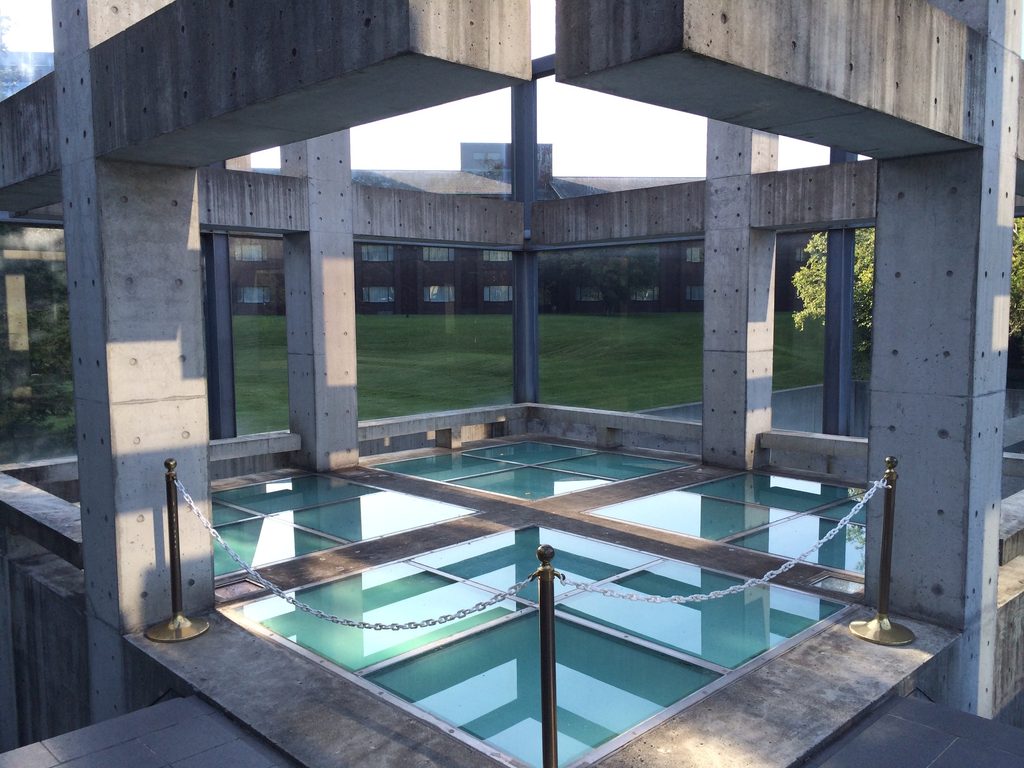
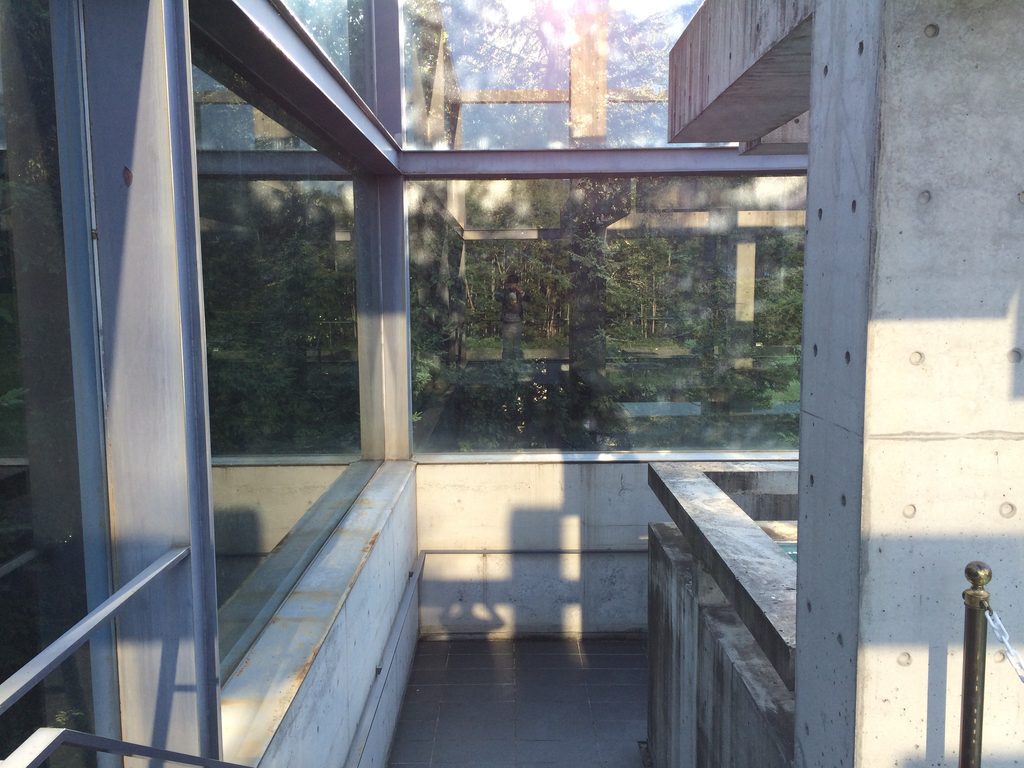
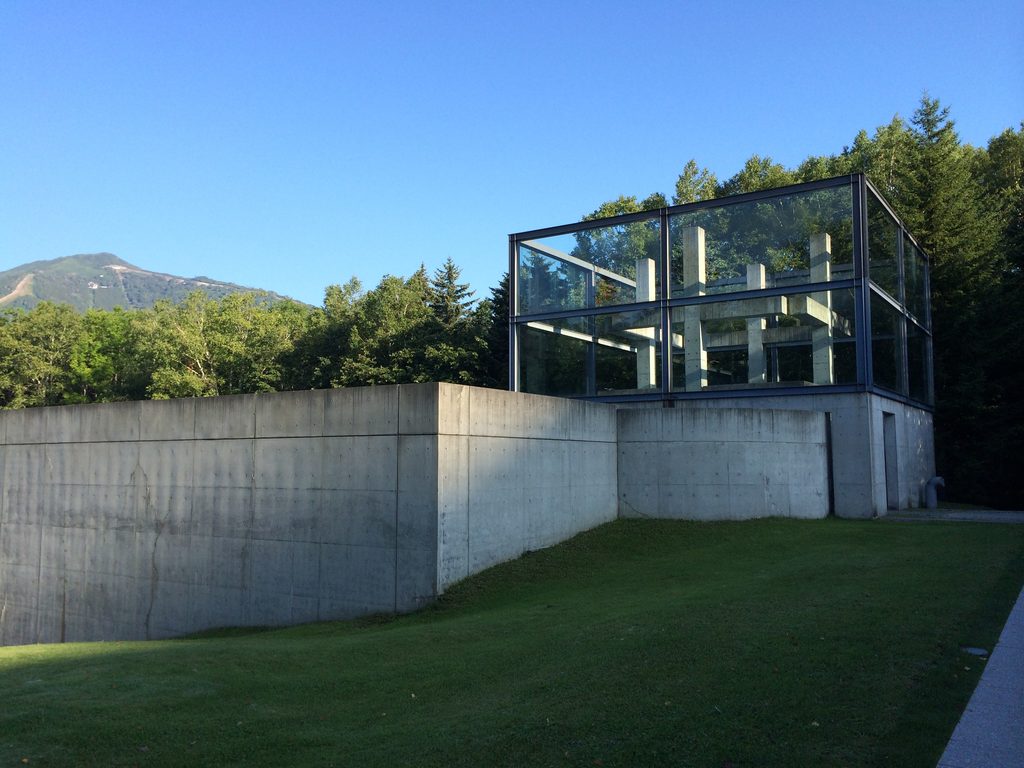
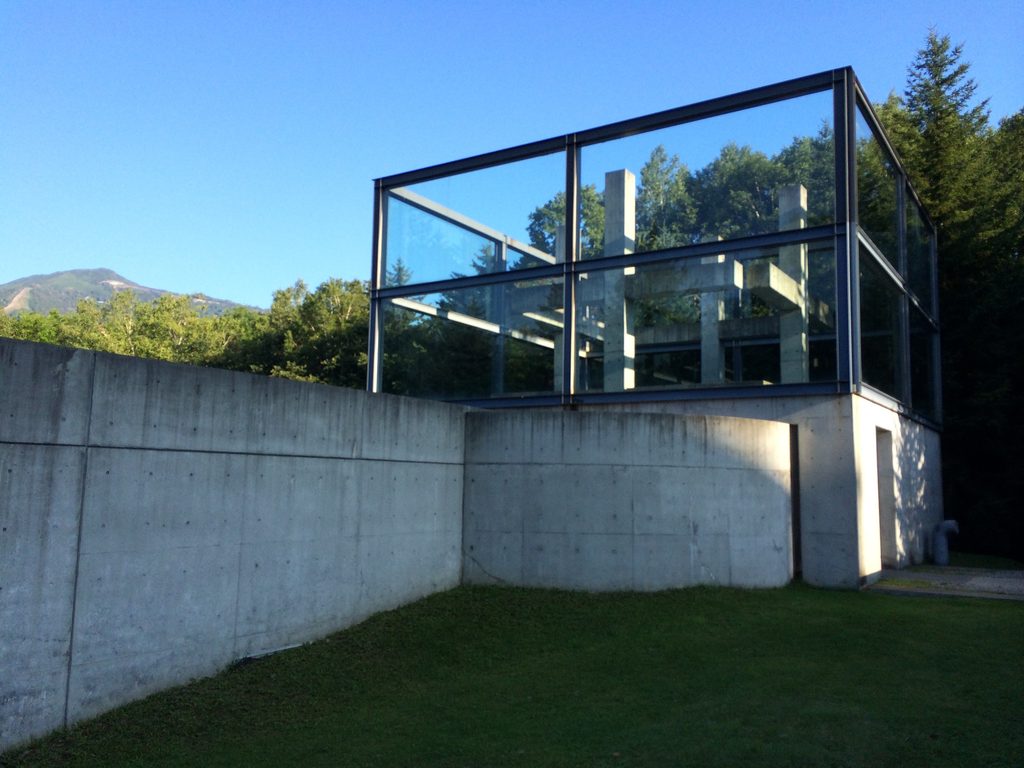
コンクリートの壁に導かれながら建築へ入ると、それまでの重く閉じた感覚とは対照的な、透明なガラスの立方体が現れる。水の教会を構成する二つの基本的なヴォリュームのうち、小さい方にあたるこの空間は、外部から見るとコンクリートの建築の上に軽やかに載せられているようにも見え、水平に伸びる壁に対して垂直方向への意識を生み出している。
Following the concrete wall into the building, one encounters a transparent glass cube whose character contrasts sharply with the weight and enclosure experienced moments before. Corresponding to the smaller of the two principal square volumes that organize the plan, it appears from outside almost weightless above the concrete architecture, introducing a vertical emphasis into a composition otherwise dominated by horizontal walls.
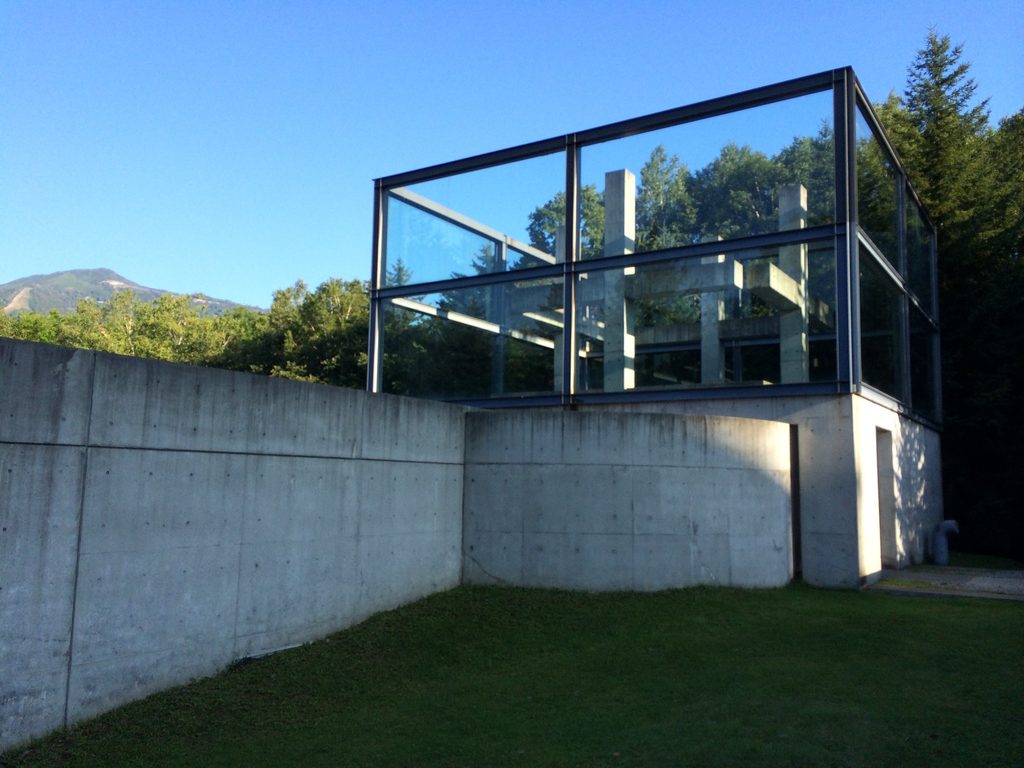
透明なガラスは周囲の森や空を映し込み、見る位置や光の状態によって建築の輪郭を曖昧にしていく。打放しコンクリートが重さと不透明さによって人の身体を導くのに対し、このガラスの空間では視線が壁の向こうまで抜け、建築の内部にいながら周囲の自然と連続しているような感覚が生まれる。
The glass reflects the surrounding trees and sky, causing the boundaries of the volume to shift according to viewpoint and changing light. Whereas exposed concrete directs the body through weight and opacity, the glass allows vision to extend beyond the enclosure, producing a sense of continuity with the surrounding forest even while one remains within a rigorously geometric space.
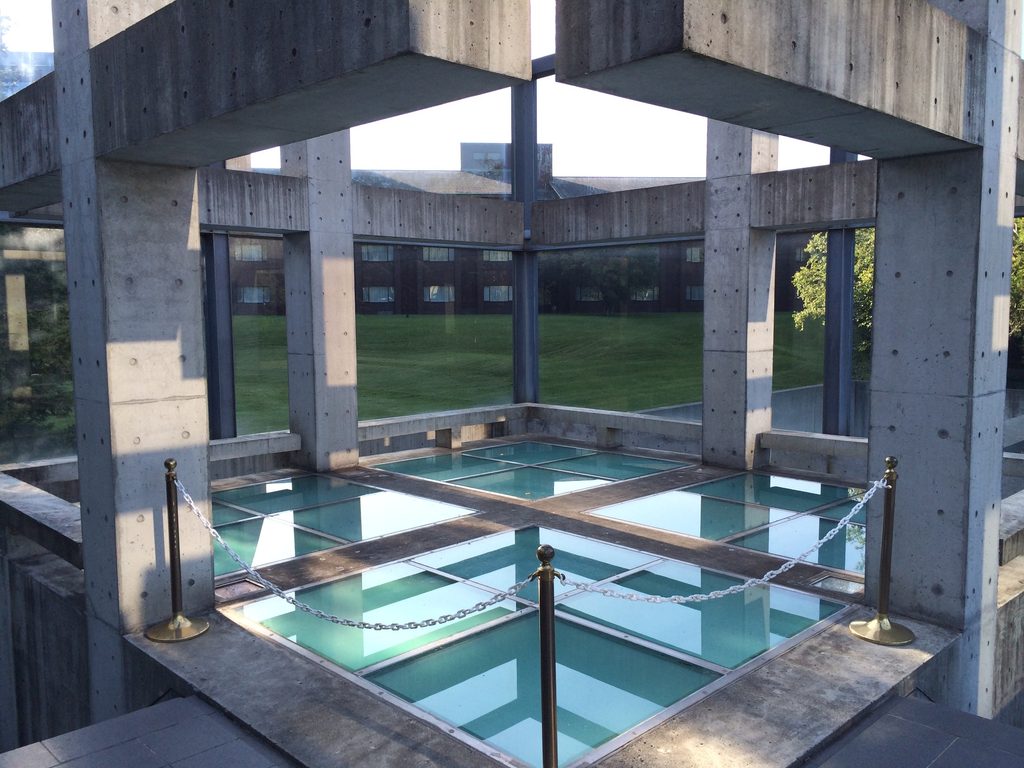
その内部には四つの十字架が配置されている。十字架は壁に掛けられた装飾ではなく、透明な空間の中に独立した幾何学として立ち上がっており、その向こうにはガラス越しに空や森が重なる。宗教的な象徴を閉じた室内へ置くのではなく、自然と視覚的に重ねることで、十字架そのものの輪郭と、その周囲に広がる世界を同時に意識させる構成になっている。
Four crosses stand within this transparent enclosure. Rather than functioning as decorative objects attached to a wall, they exist as independent geometries within the space, with forest and sky visible through the glass beyond them. Religious symbol and natural landscape therefore occupy the same field of vision, allowing the cross to be perceived together with the world surrounding it.
見る位置を変えると、四つの十字架は互いに重なったり離れたりし、その背景となる森や空の見え方も変化する。ここでも一つの正面から完成した構図を見るのではなく、身体を動かすことで関係が変わるようにつくられており、厳密な幾何学として置かれた十字架と、絶えず状態を変える自然との対比が鮮明になる。
As the viewer changes position, the four crosses overlap and separate, while the forest and sky behind them also shift. Once again, the architecture avoids offering a single privileged frontal composition. The relationship must be experienced through movement, making the contrast between the precise geometry of the crosses and the continuously changing natural world particularly vivid.
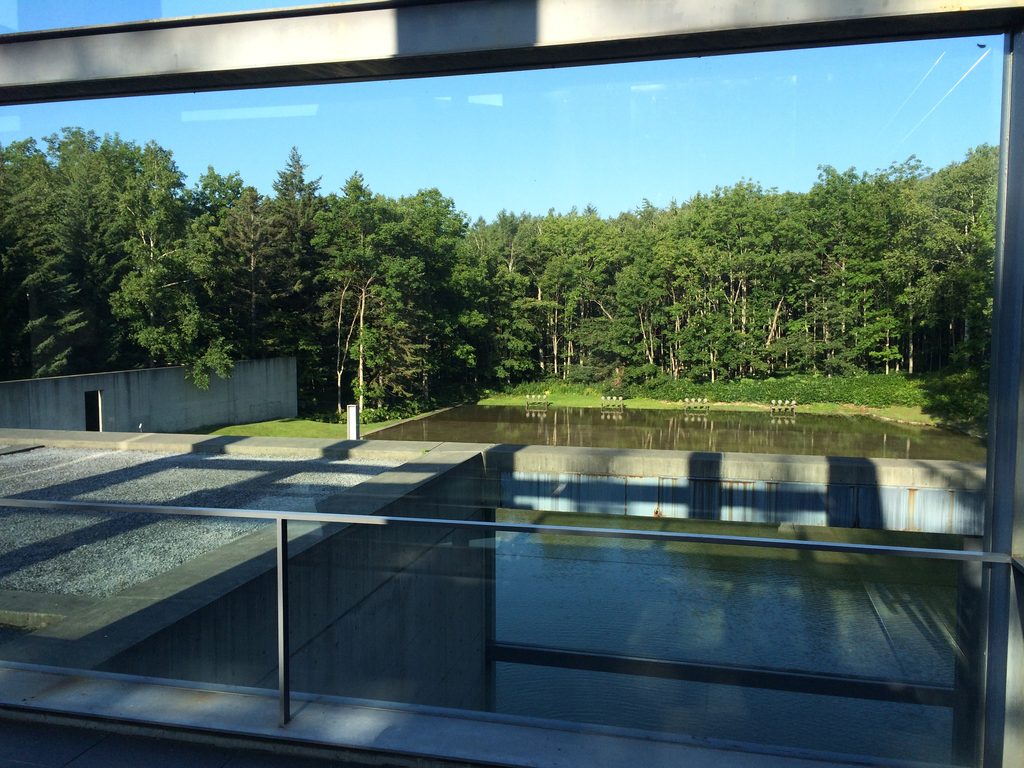
この場所は、礼拝堂の正面にある水面の十字架へ到達する前に経験する空間であることも重要だと思う。まだ最終的な風景を見せないまま、コンクリートの壁によって閉じられていた視線を一度空へ解放し、透明な空間の中で十字架と自然を重ねて見せる。その時間が挿入されることで、建築のシークエンスは単純な「閉鎖から開放」ではなく、異なる種類の開き方を段階的に経験するものになっている。
It is also significant that this space is encountered before reaching the famous cross standing in the water. The architecture still withholds its final landscape. Instead, after restricting vision with concrete, it briefly opens the gaze upward and outward, allowing the visitor to experience another kind of openness before descending toward the chapel. The sequence is therefore more complex than a simple transition from enclosure to release; different degrees and qualities of openness unfold one after another.
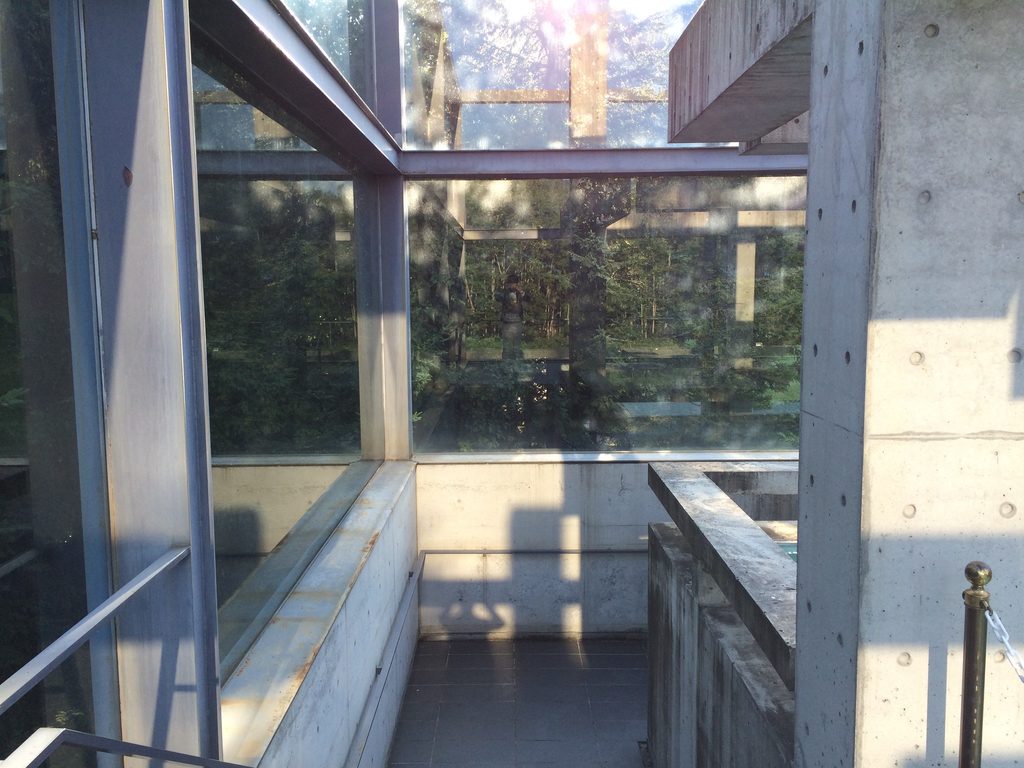
ガラスの立方体は自然へ溶け込もうとしているようにも見えるが、その内部に置かれた十字架や正方形の平面は極めて人工的である。水の教会では、建築が自然の形を模倣することによって調和を求めるのではなく、人工的な幾何学を明確に示したまま、その向こうにある森や空と向き合わせている。その違いが保たれているからこそ、建築を見ることと自然を見ることが互いを強め合っている。
The glass cube may appear to dissolve into nature, yet the square geometry of the space and the crosses within it remain unmistakably artificial. Church on the Water does not seek harmony by imitating natural forms. Instead, architecture retains its geometric clarity while confronting forest and sky directly. Because their differences remain visible, the perception of architecture and the perception of nature intensify one another.
3. 光を背にして、暗がりへ降りていく
Leaving the Light Behind and Descending into Shadow
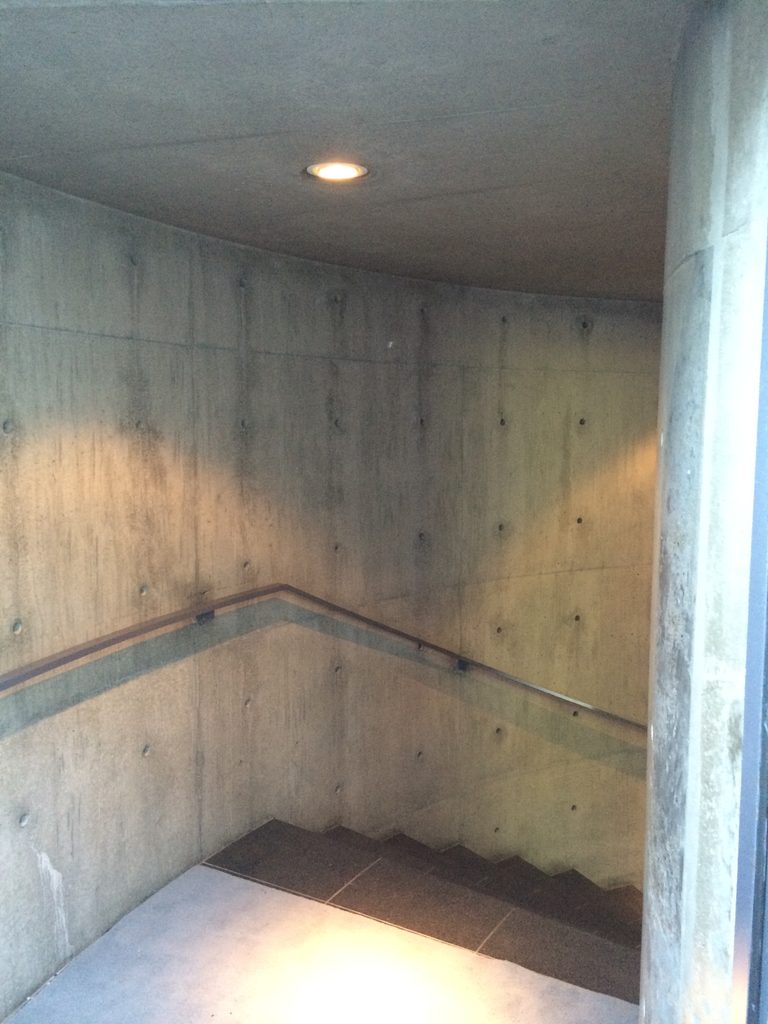
ガラスに囲まれた明るい空間を離れると、身体は再び打放しコンクリートの内部へ導かれる。ここから礼拝堂へ向かう動線では、それまで周囲に広がっていた北海道の風景が徐々に視界から失われ、外部から届く光の量も抑えられていく。空間の変化は単なる移動ではなく、これから向かう場所に対して身体と意識を切り替えていくための時間として組み立てられている。
After leaving the luminous glass enclosure, the body is drawn once again into exposed concrete. From this point toward the chapel, the expansive landscape of Hokkaido gradually disappears from view and the amount of natural light is reduced. The transition functions as more than circulation: it creates a period in which the body and the senses are prepared for the space that lies ahead.
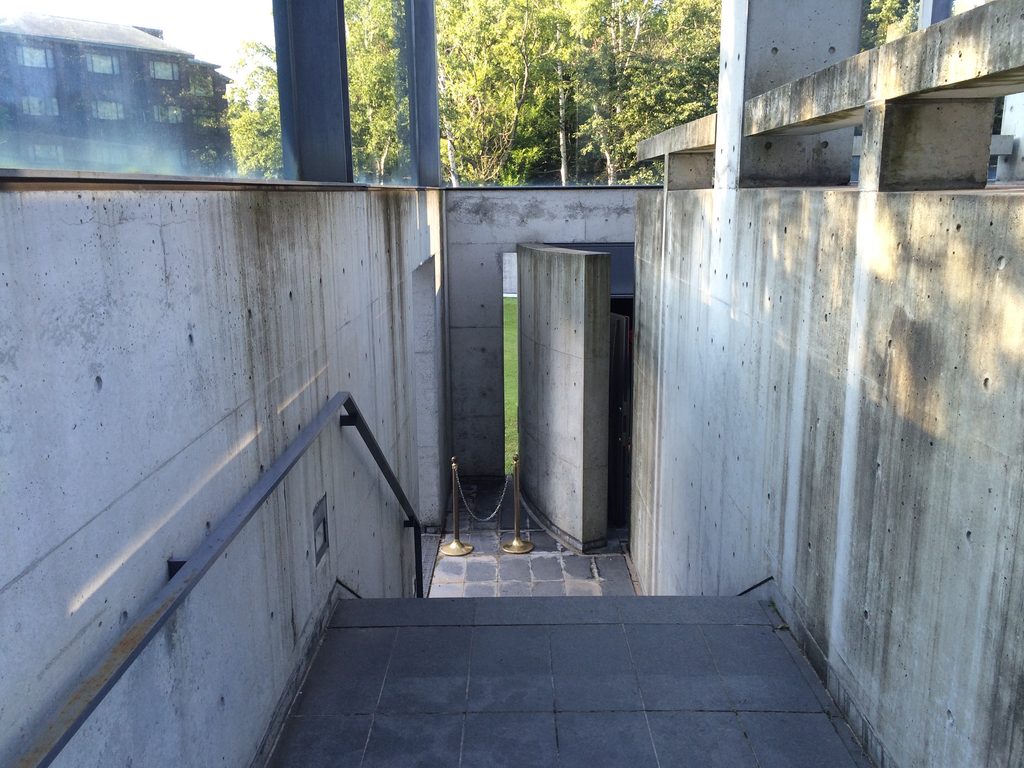
外部では長く水平に伸びていたコンクリートの壁が、内部では身体のすぐ近くまで迫り、視界を限定する。どこへ向かっているのかを一度に理解することができないため、外の景色を眺めていた意識は、次第に自分自身の歩行や壁との距離、光の変化へ向かっていく。建築を見るというより、建築によって自分の身体がどのように動かされているかを感じる時間が始まる。
The concrete walls that stretched horizontally through the exterior now approach the body at close range and restrict the field of vision. Unable to understand the destination at a glance, attention shifts away from the distant landscape toward one’s own movement, the proximity of the walls, and subtle changes in light. The experience becomes less about observing architecture and more about becoming conscious of how architecture is directing the body.
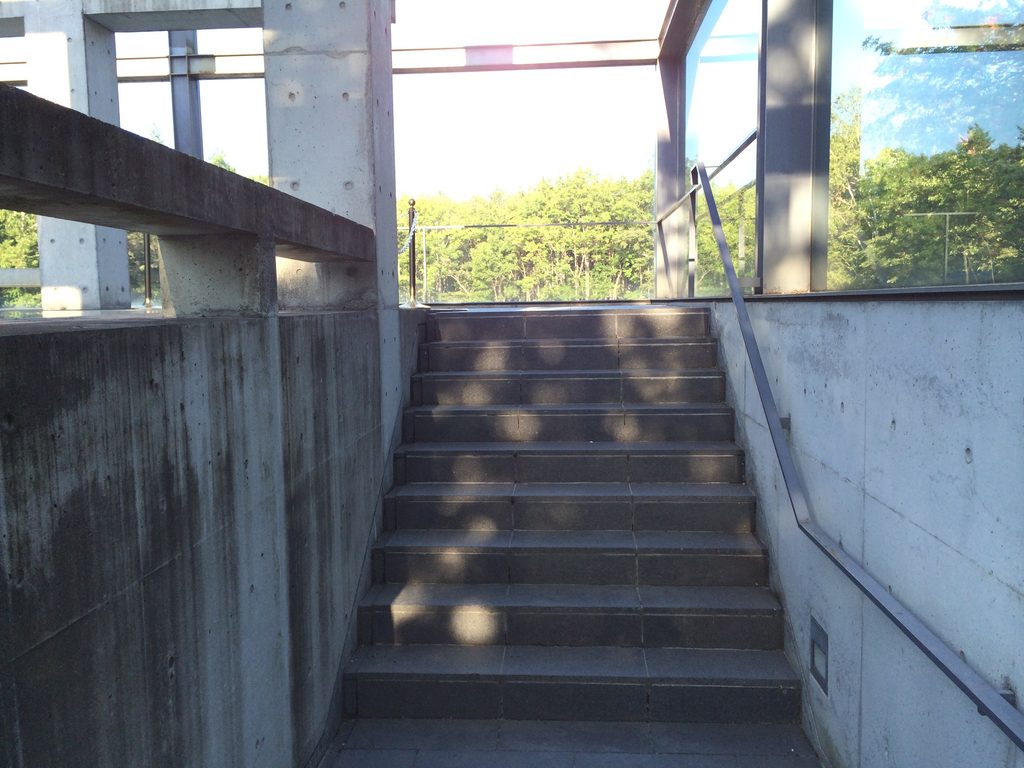
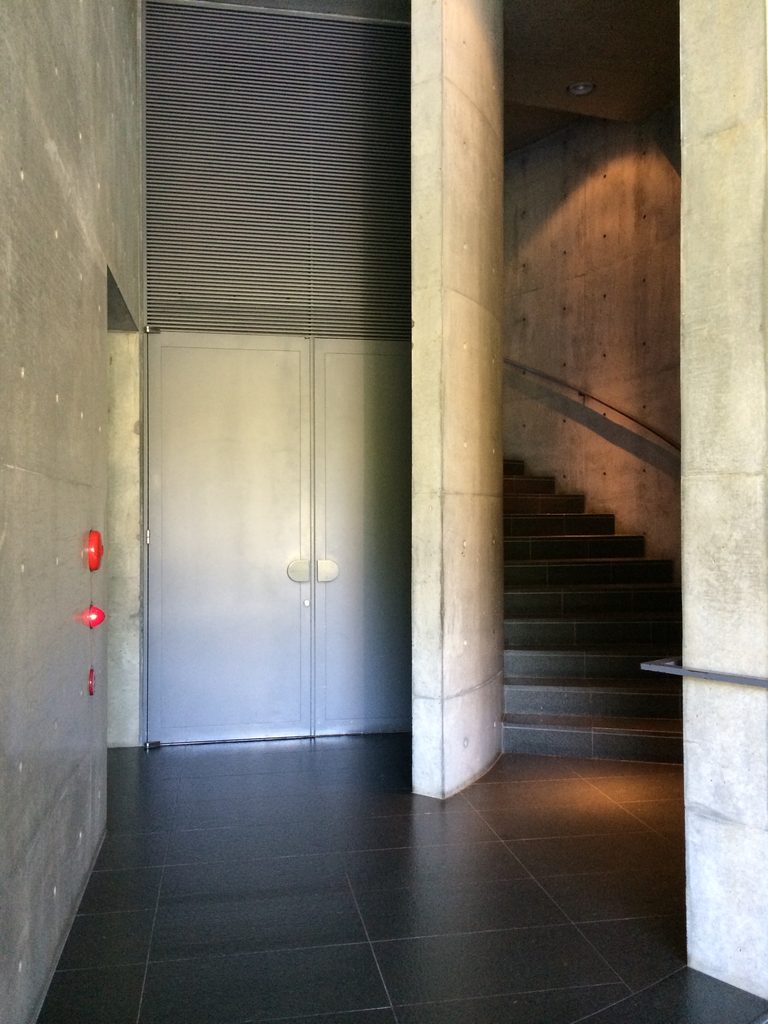
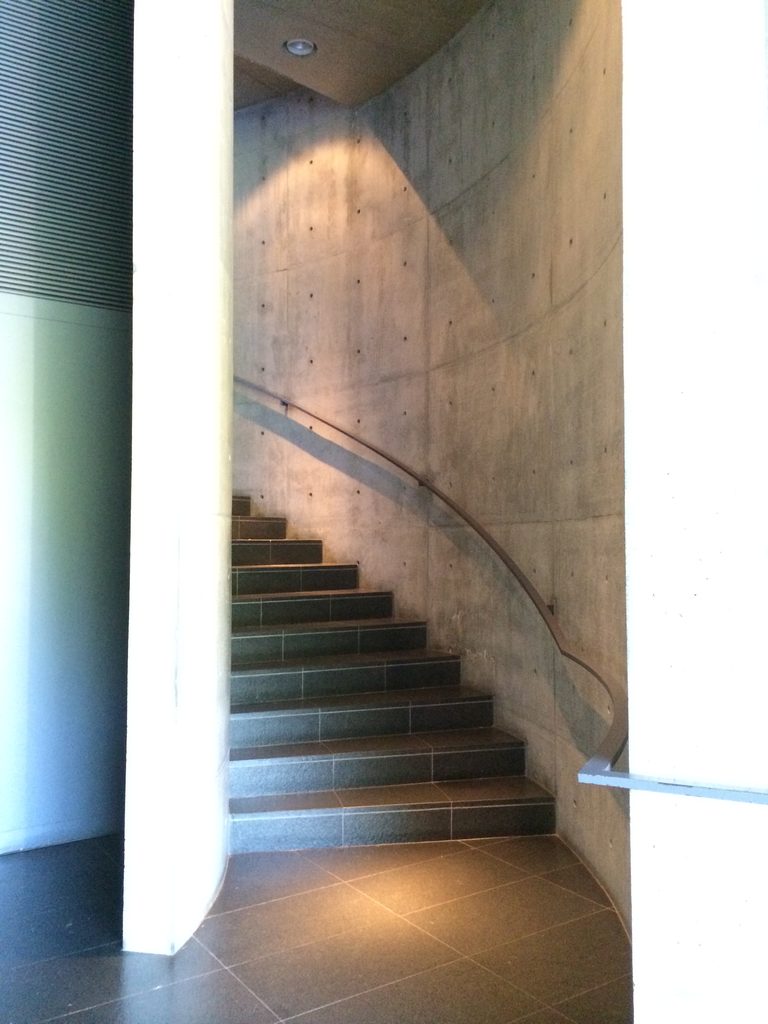
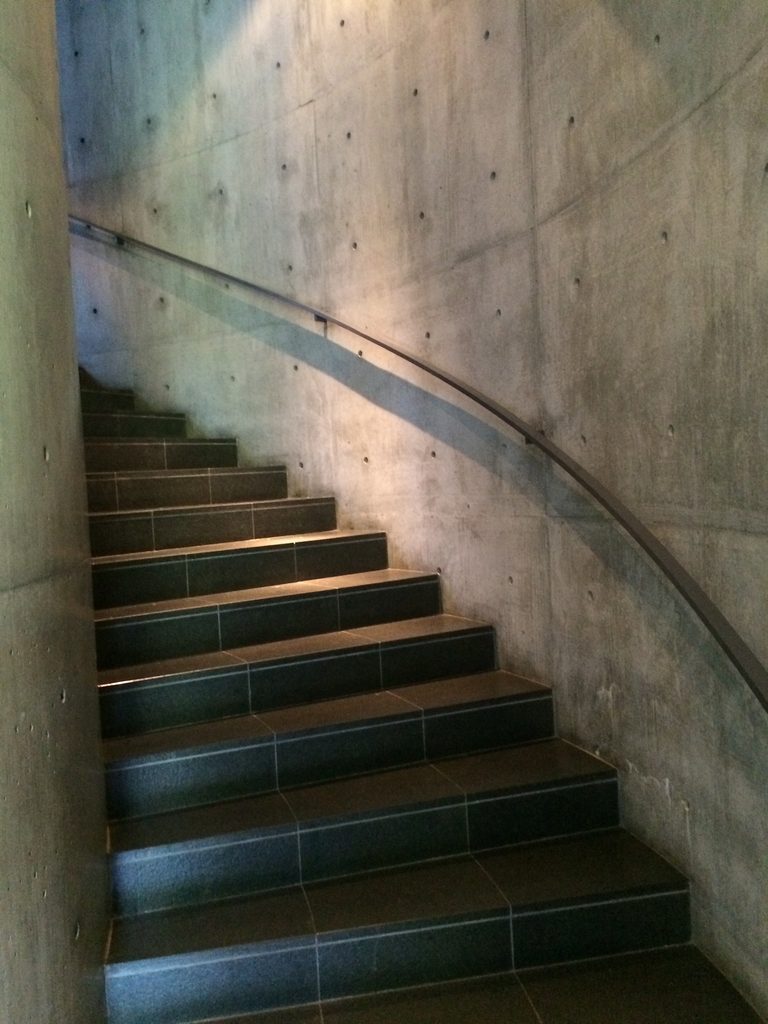
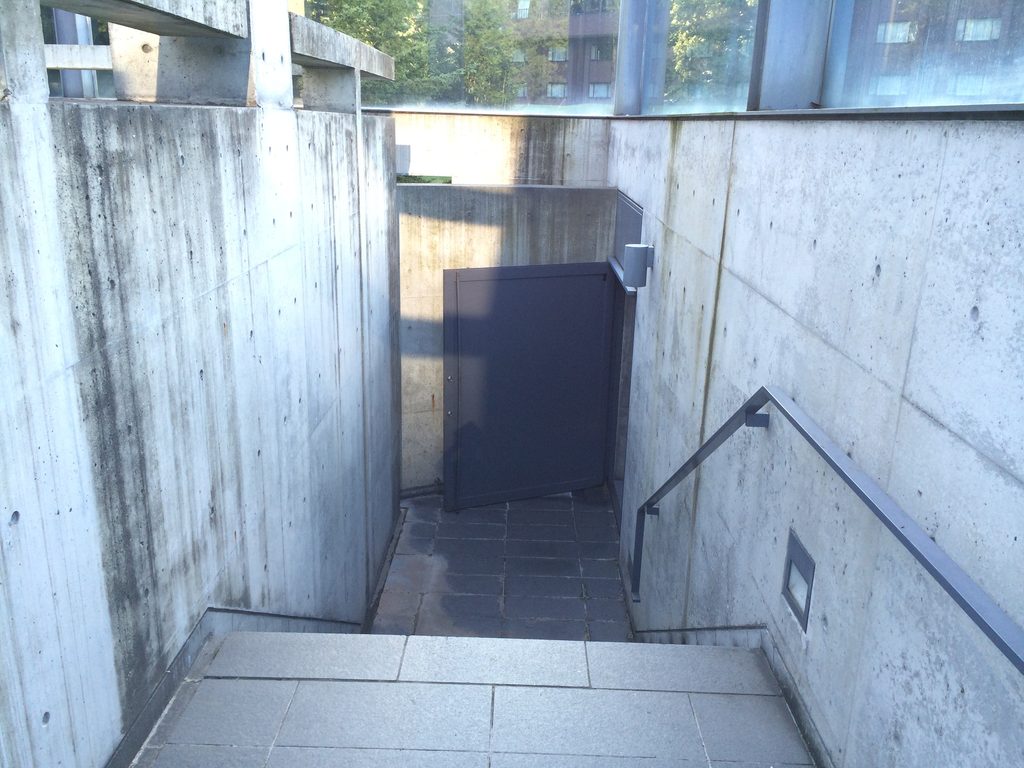
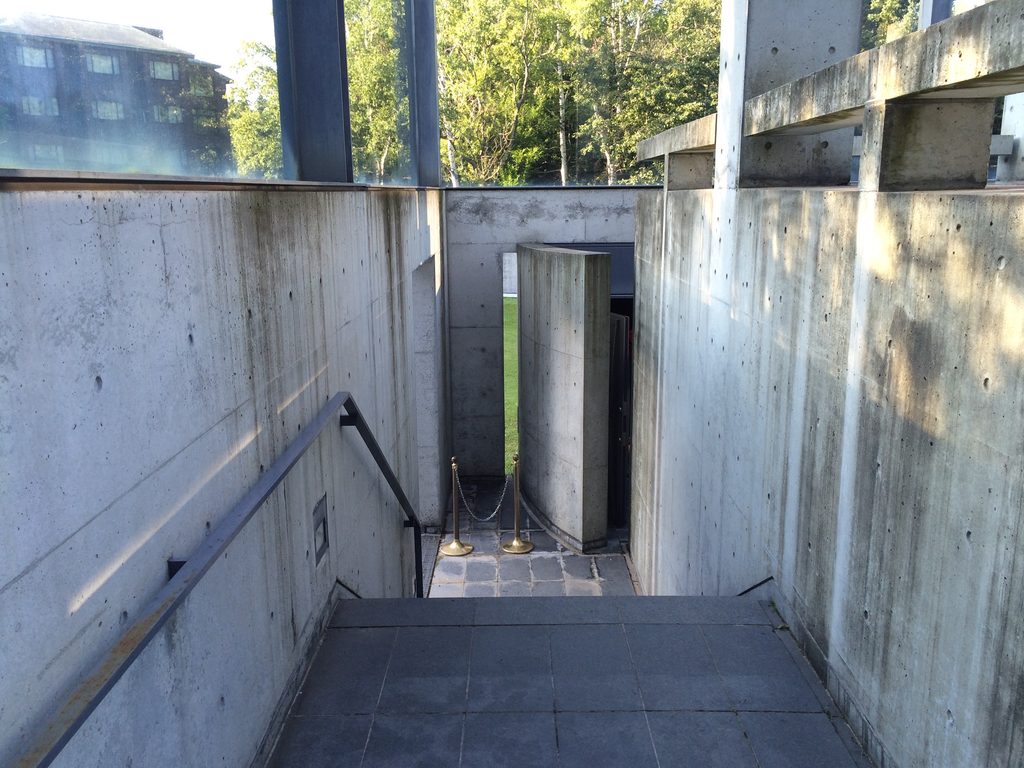
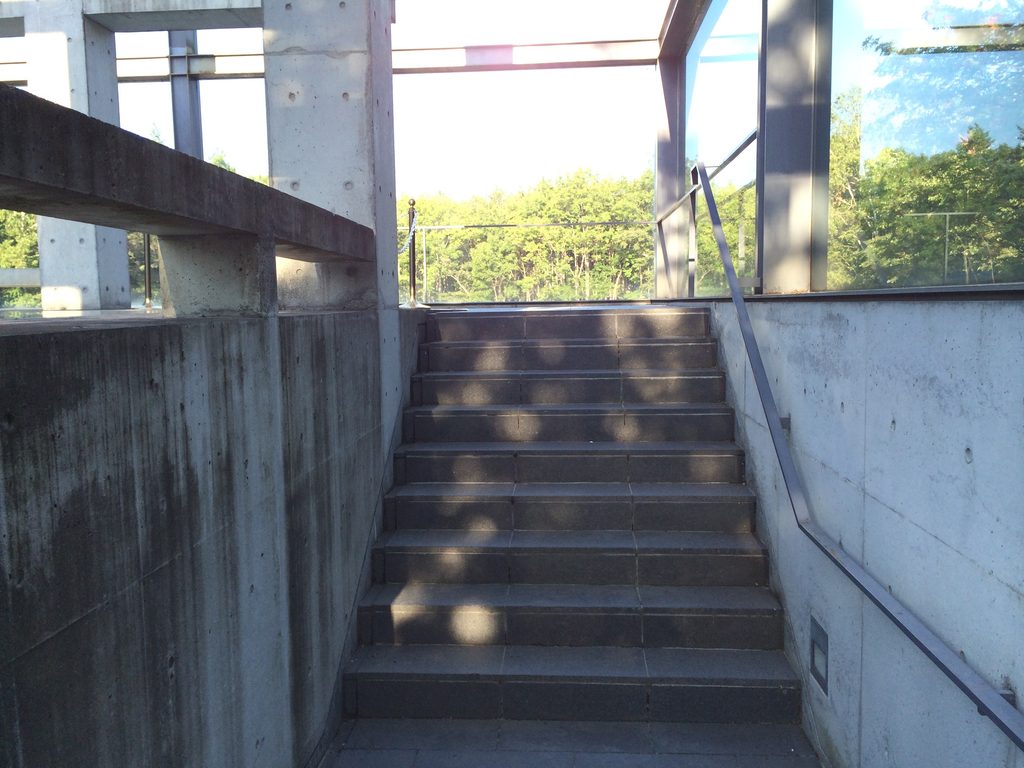
その先に現れるのが、コンクリートの曲面壁に沿って下降する階段である。直線的な壁と正方形を中心に構成されてきた空間の中で、この曲面は身体の方向を滑らかに変化させながら、礼拝堂がある下層へと人を導いていく。
A stairway descending alongside a curved concrete wall then appears. Within a composition otherwise dominated by straight walls and square geometries, this curve redirects movement gradually, drawing visitors toward the lower level where the chapel is located.
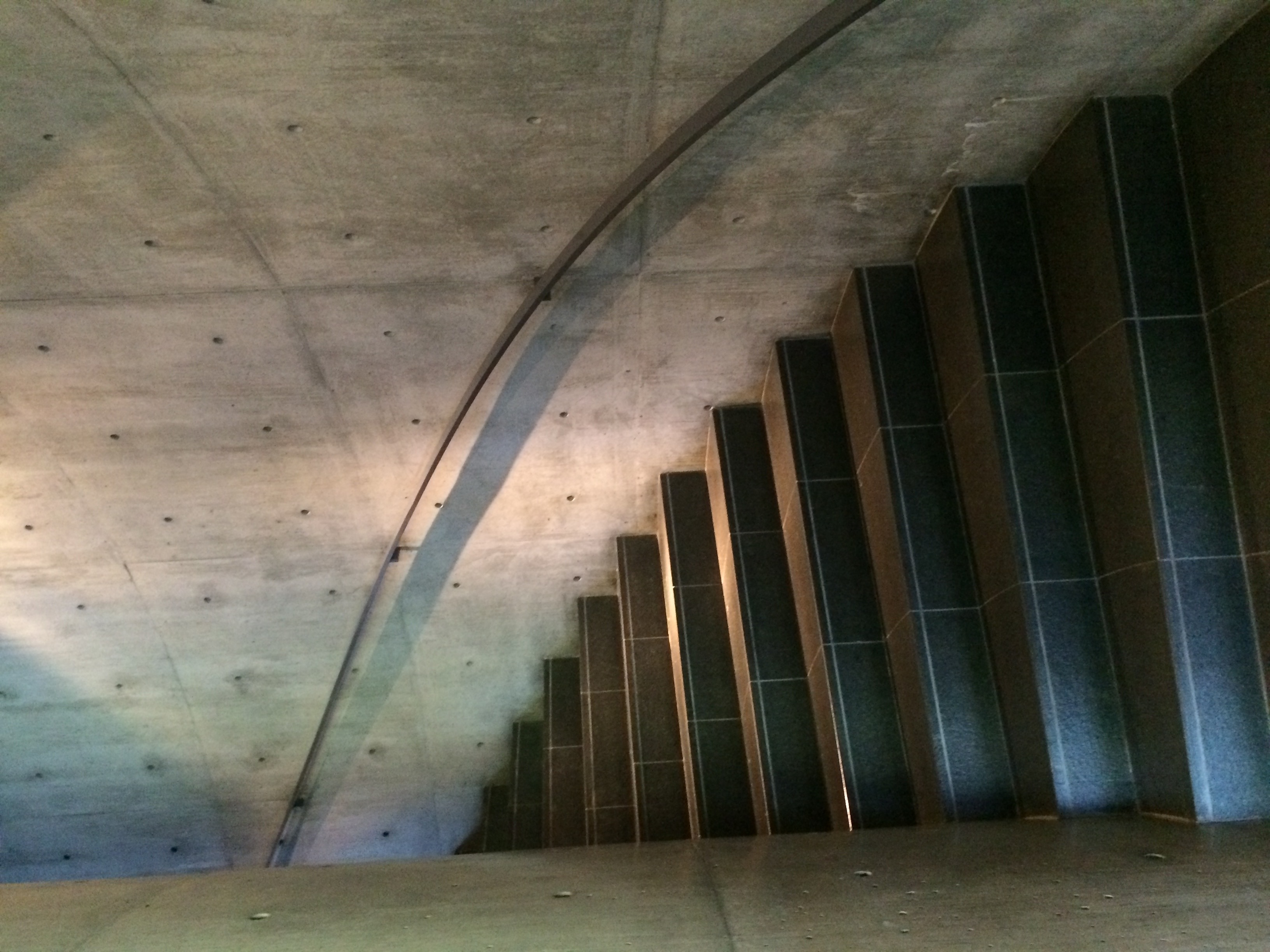
上方から光は差し込んでいるものの、曲面壁によって階段の先を見通すことはできない。目的地が視界から隠された状態で壁の形に従って下降するため、数値としてはわずかな高低差であっても、心理的には明るい外部から別の世界へ沈んでいくような感覚が生まれる。
Although light enters from above, the curving wall prevents a clear view of where the stairs lead. Descending without seeing the destination produces an impression of moving away from the bright exterior and into another spatial condition, even though the actual change in level is relatively modest.
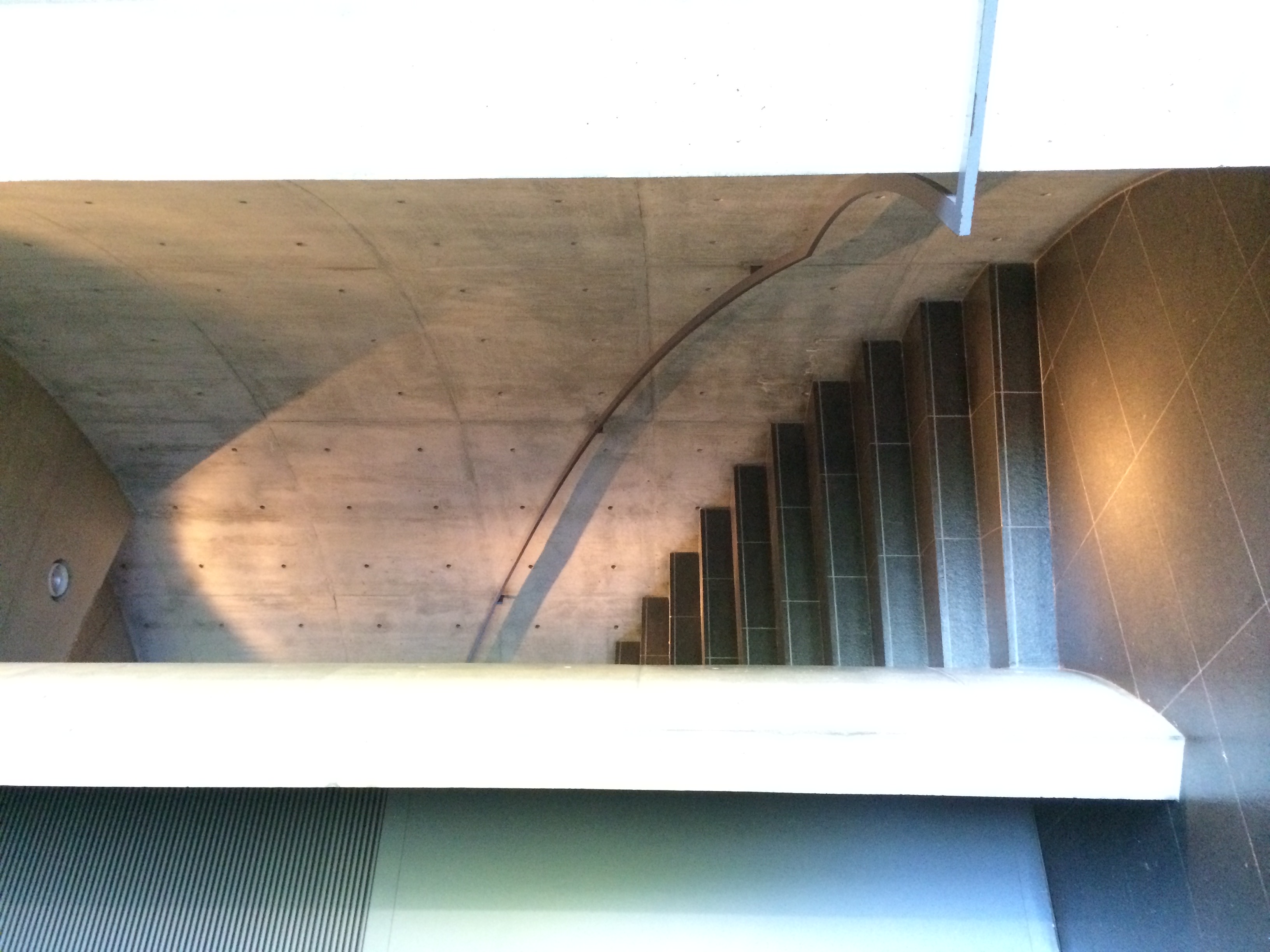
この階段を単なる上下階の移動装置として考えると、水の教会の空間構成の重要な部分を見落としてしまう。ガラスの空間で空と光に触れたあと、あえて暗いコンクリートの内部へ入り、視界を失った状態で下降する。その時間によって、それまで見ていた自然はいったん記憶の側へ押し戻され、次に現れる風景を受け止めるための感覚が整えられていく。
To regard this stair simply as a device connecting two levels would overlook its importance within the sequence. After encountering sky and light within the glass cube, visitors are deliberately brought back into shadow, deprived of the landscape, and led downward. Nature, which had remained physically close throughout, is pushed temporarily into memory, allowing perception to be recalibrated before it returns.
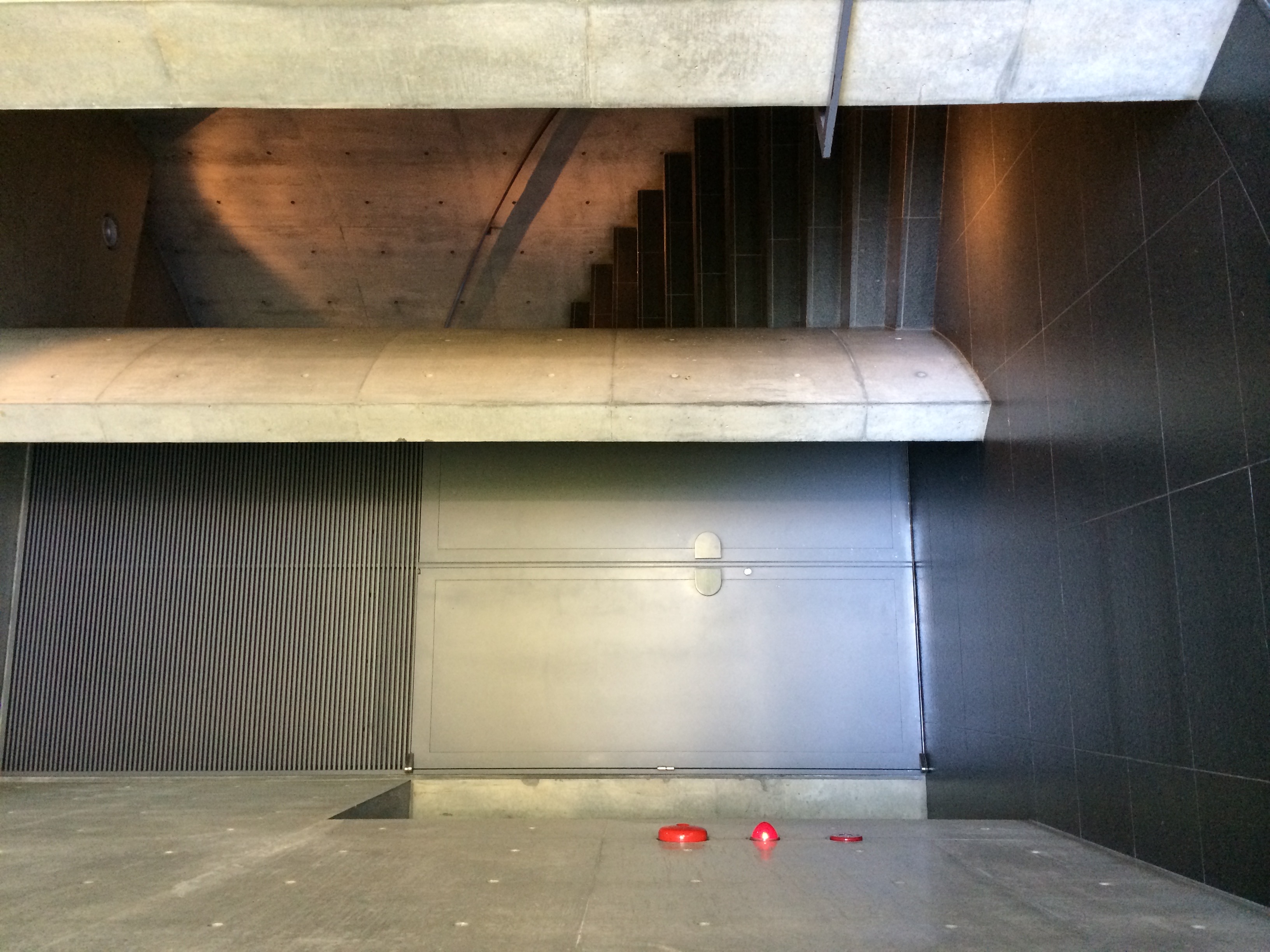
安藤建築では、目的の空間へ最短距離で到達させない構成が繰り返し現れる。壁にぶつかり、方向を変え、高低差を移動することで、それまで見えていたものが一度消え、次の空間へ入ったときの感覚が変化する。水の教会では、この方法が宗教建築のシークエンスと結びつき、日常の風景から礼拝の場所へ向かう身体的な移行として使われている。
Ando repeatedly avoids the shortest possible route to an important space. Walls interrupt movement, directions change, and levels rise or fall, allowing what was previously visible to disappear before another spatial condition is revealed. At Church on the Water, this method becomes part of the transition from everyday surroundings toward a place of worship.
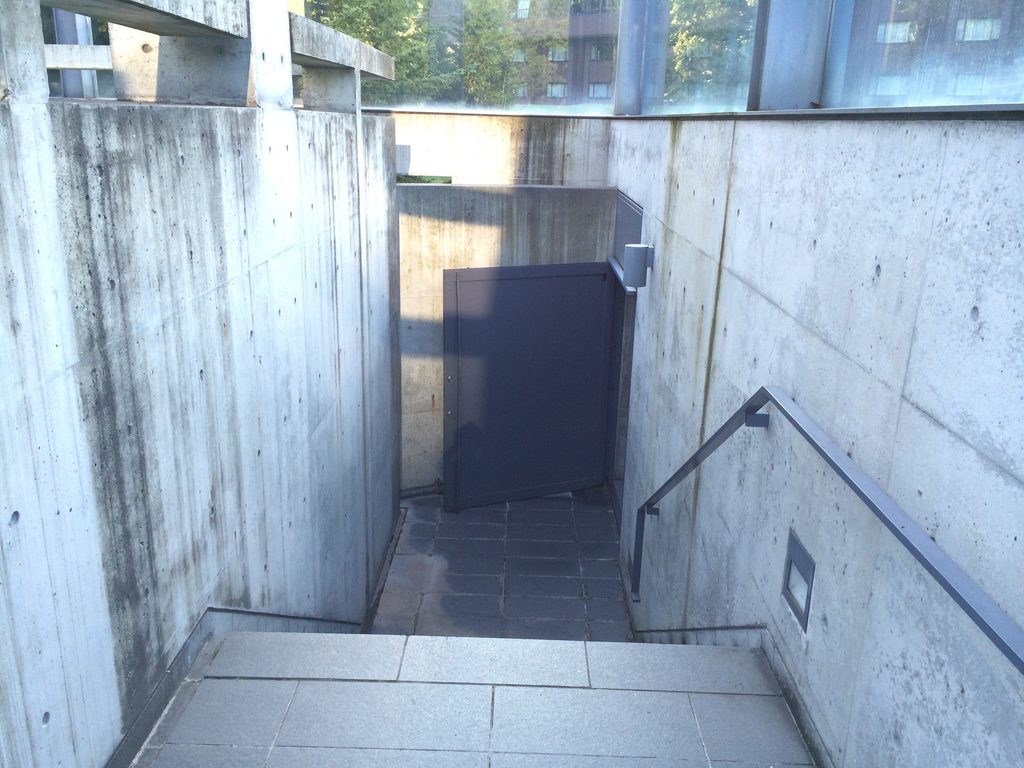
この暗がりを通過している間、水面や森はほとんど見えない。しかし、その不在こそが重要なのだと思う。北海道の自然は建築の外にずっと存在し続けているにもかかわらず、一度それを見えなくすることで、礼拝堂で再び現れたときには、それまでとは異なる密度を持った風景として知覚されることになる。
During this descent, the water and forest are almost entirely absent from view. Yet that absence is precisely what gives them greater intensity when they reappear. Nature has remained outside all along; what architecture changes is not nature itself, but the condition in which we perceive it.
4. 壁が消えたとき、水と森が祭壇になる
When the Wall Disappears, Water and Forest Become the Altar
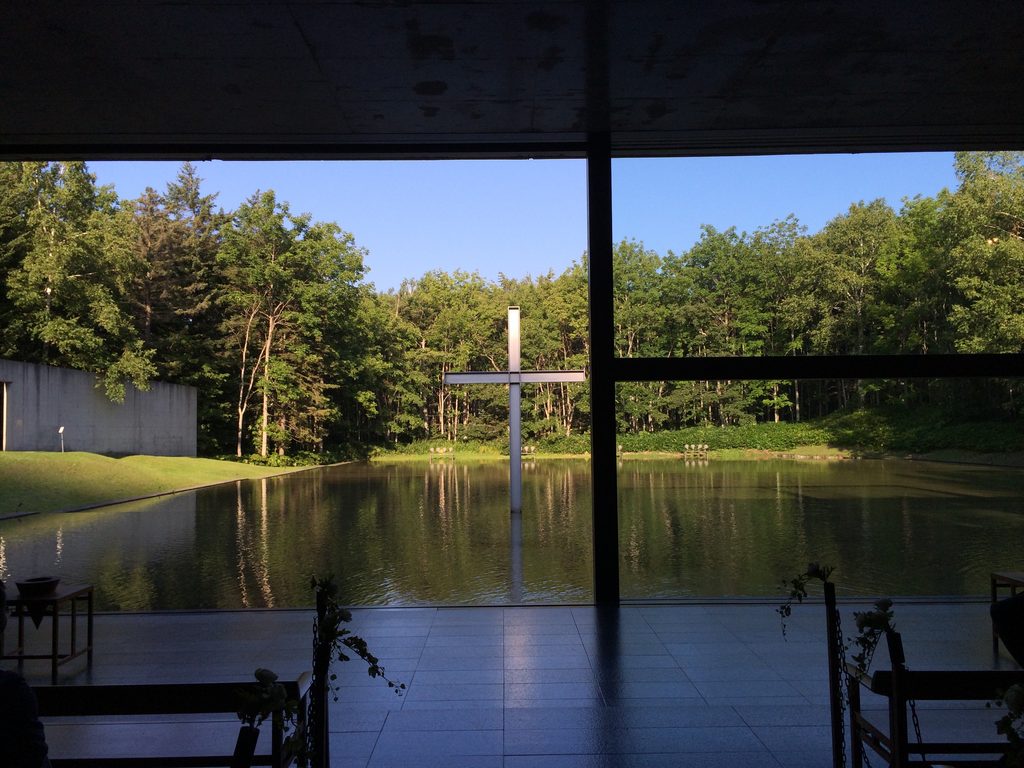
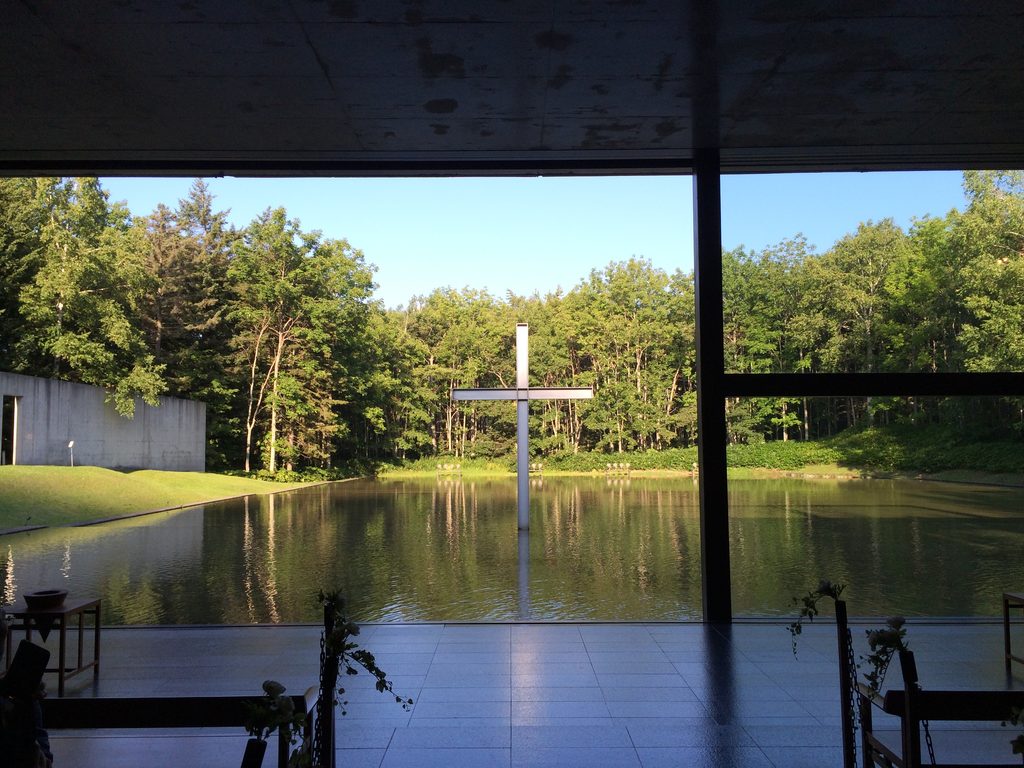
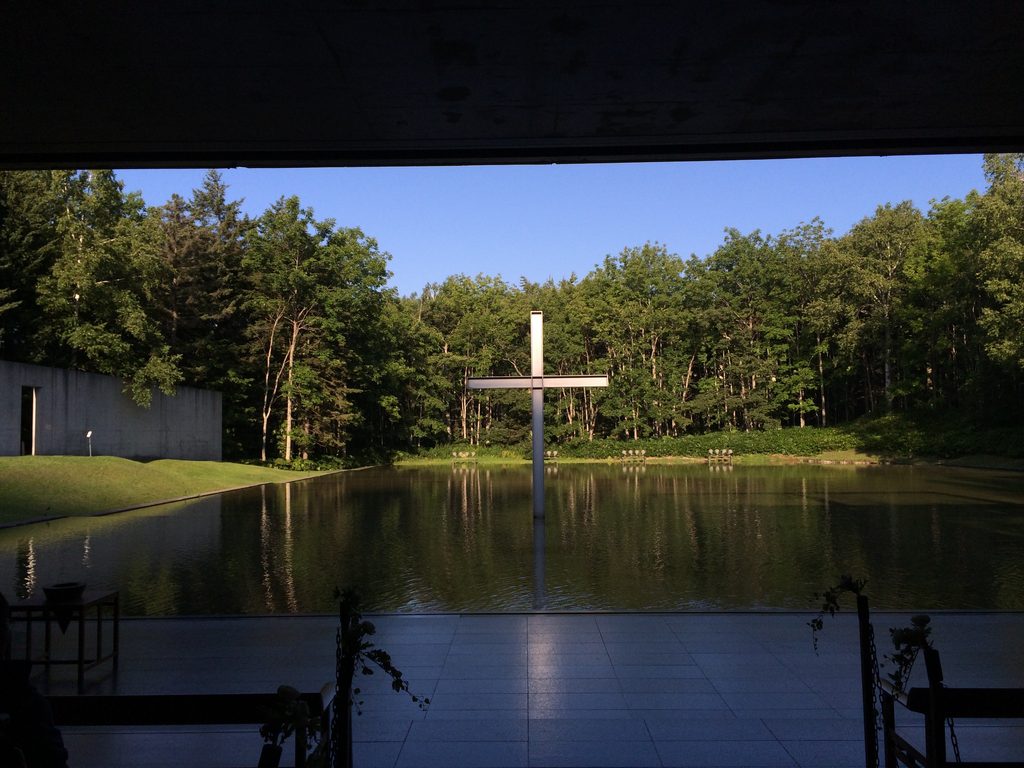
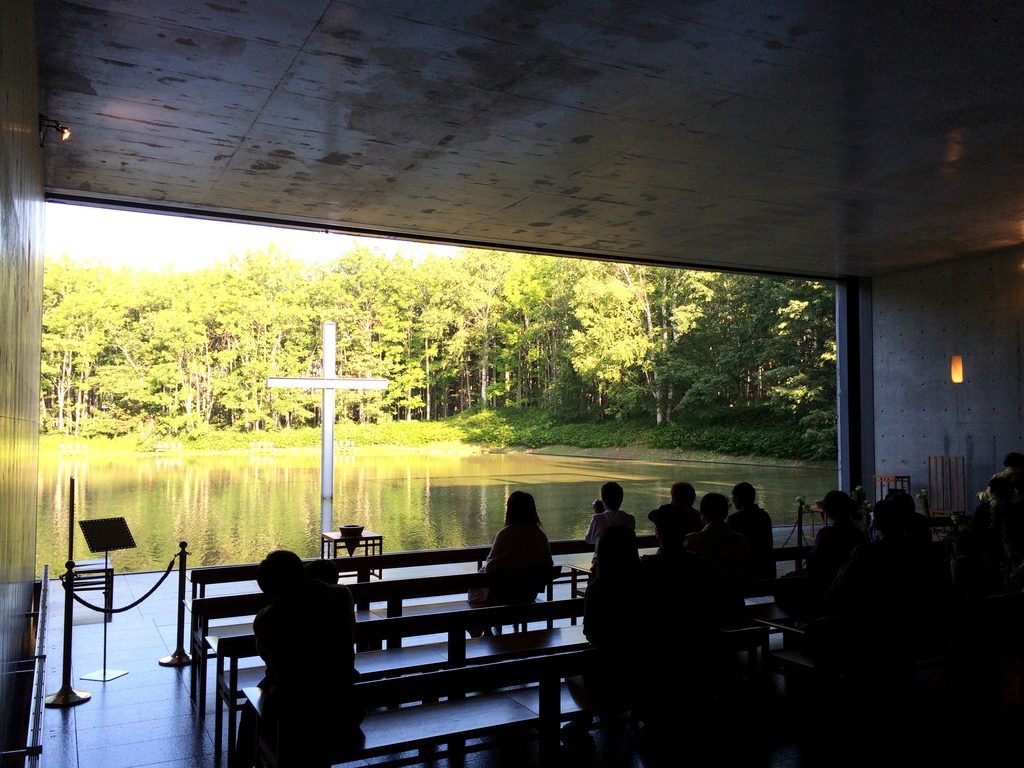
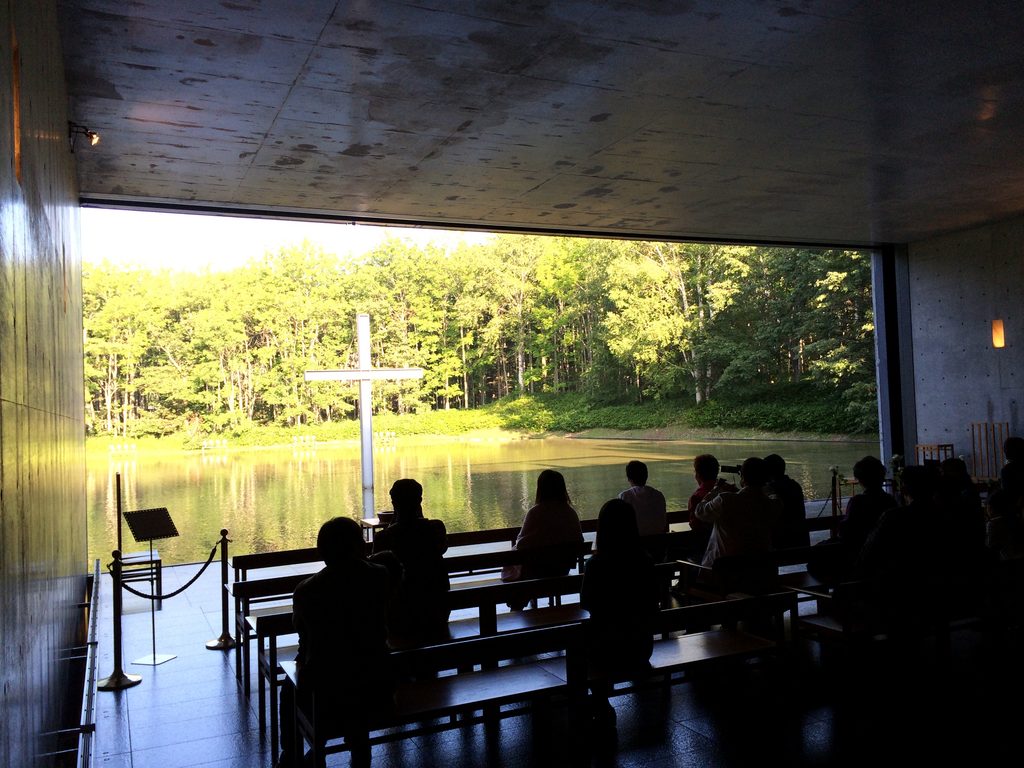
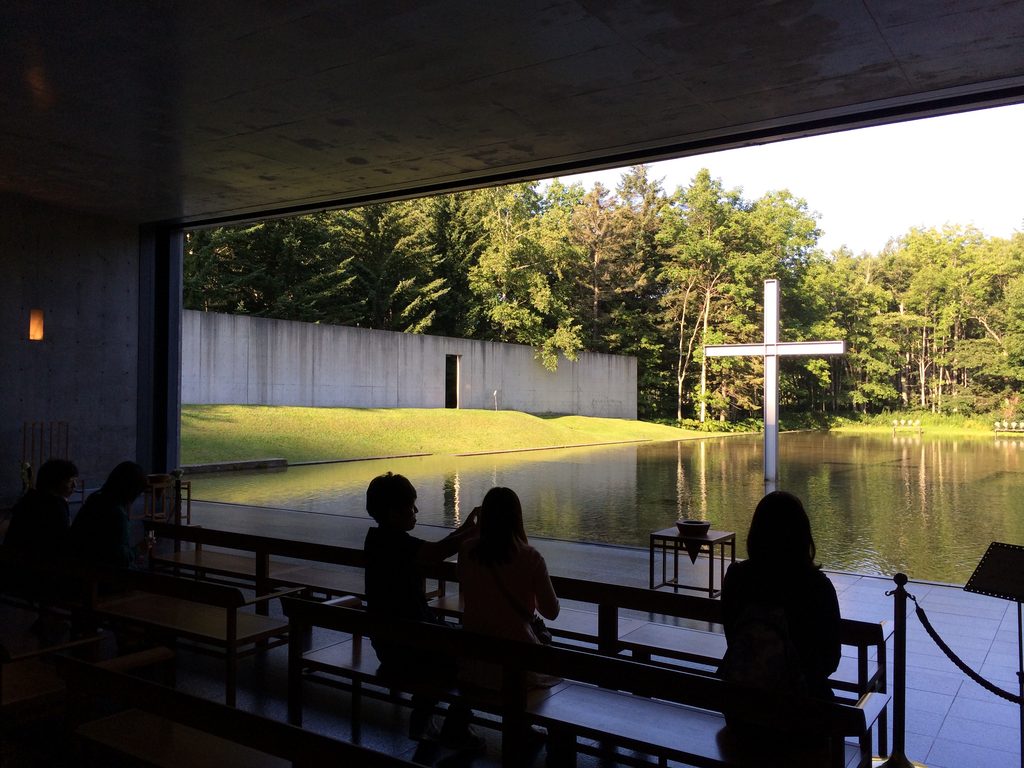
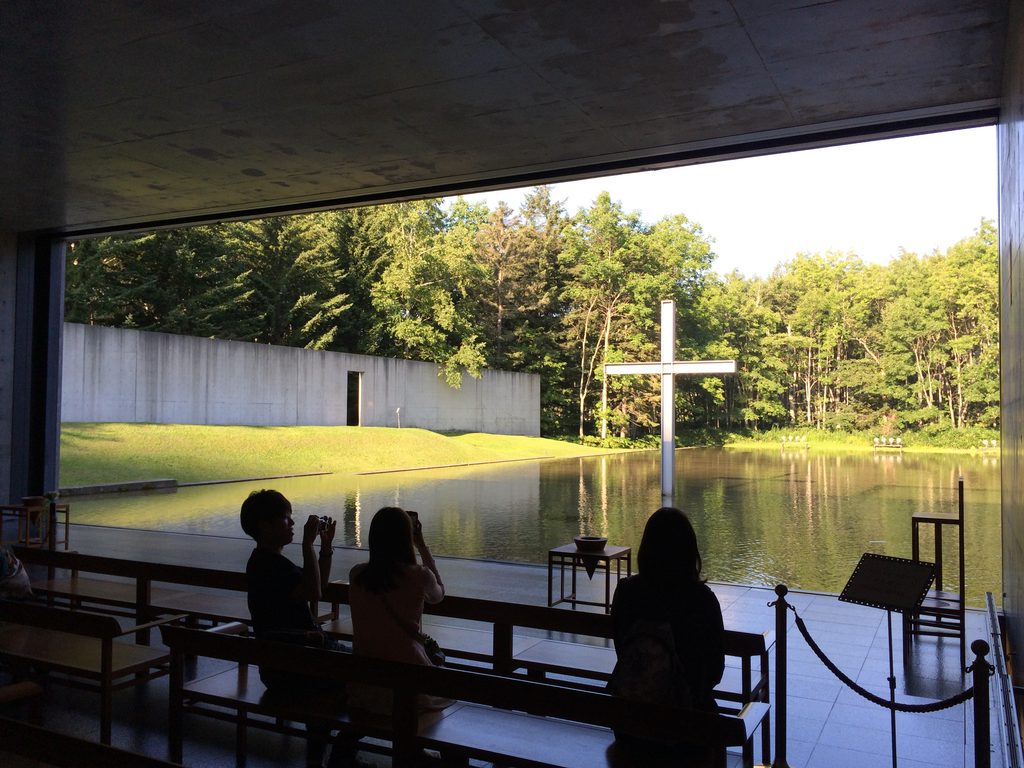
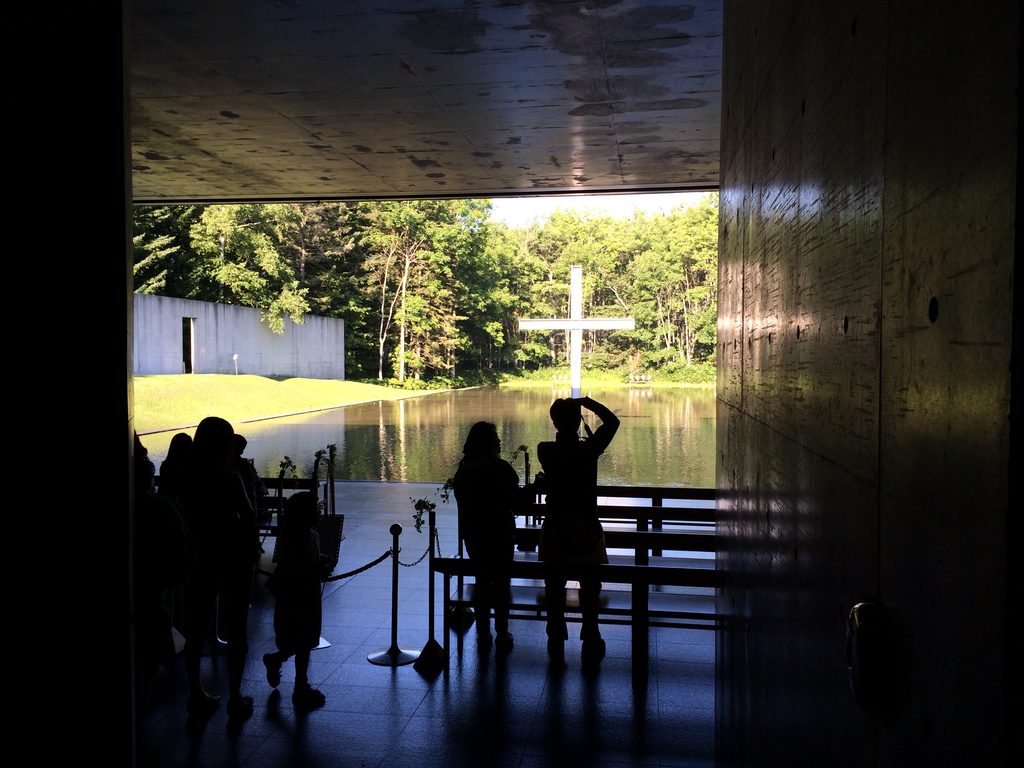
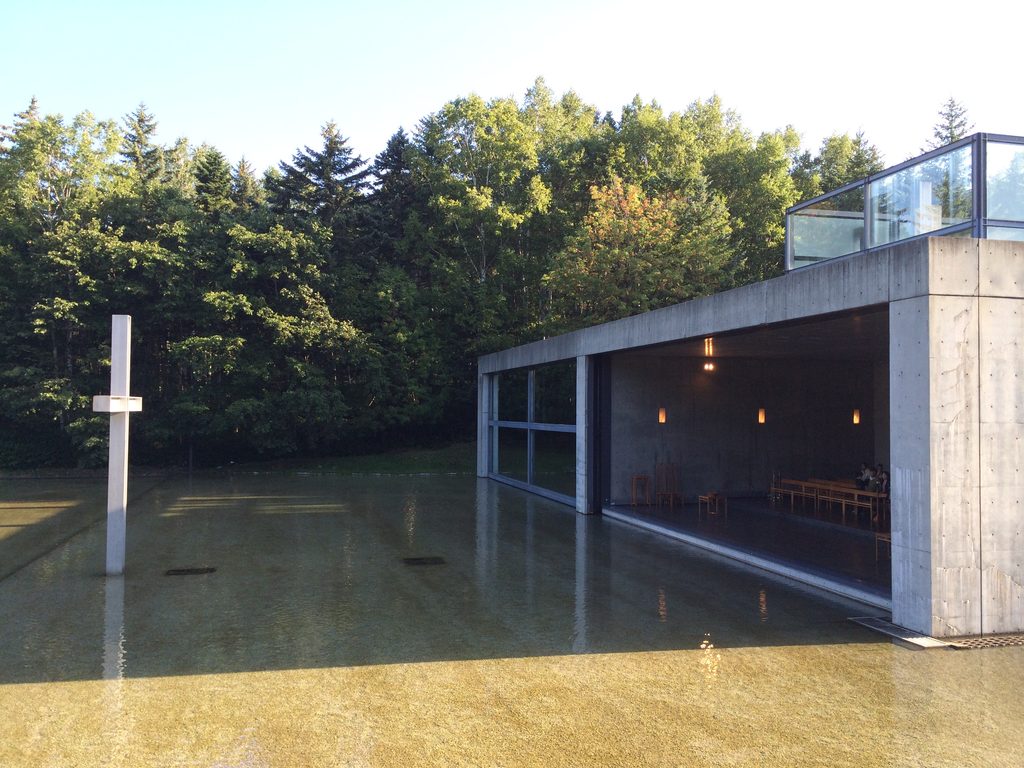
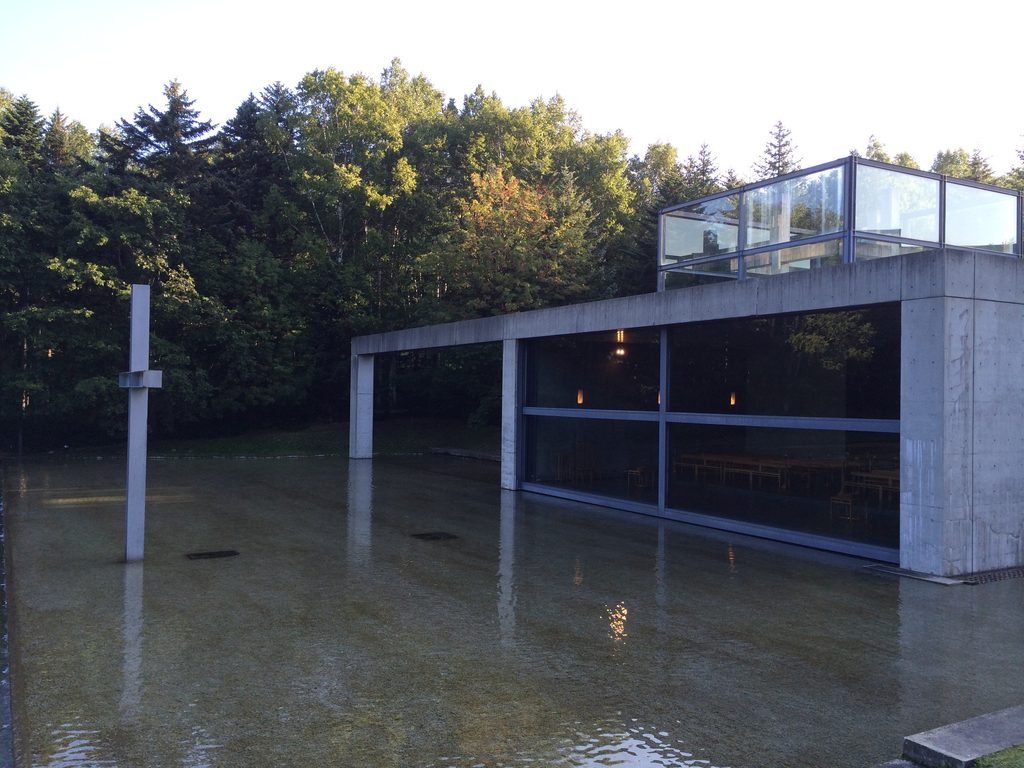
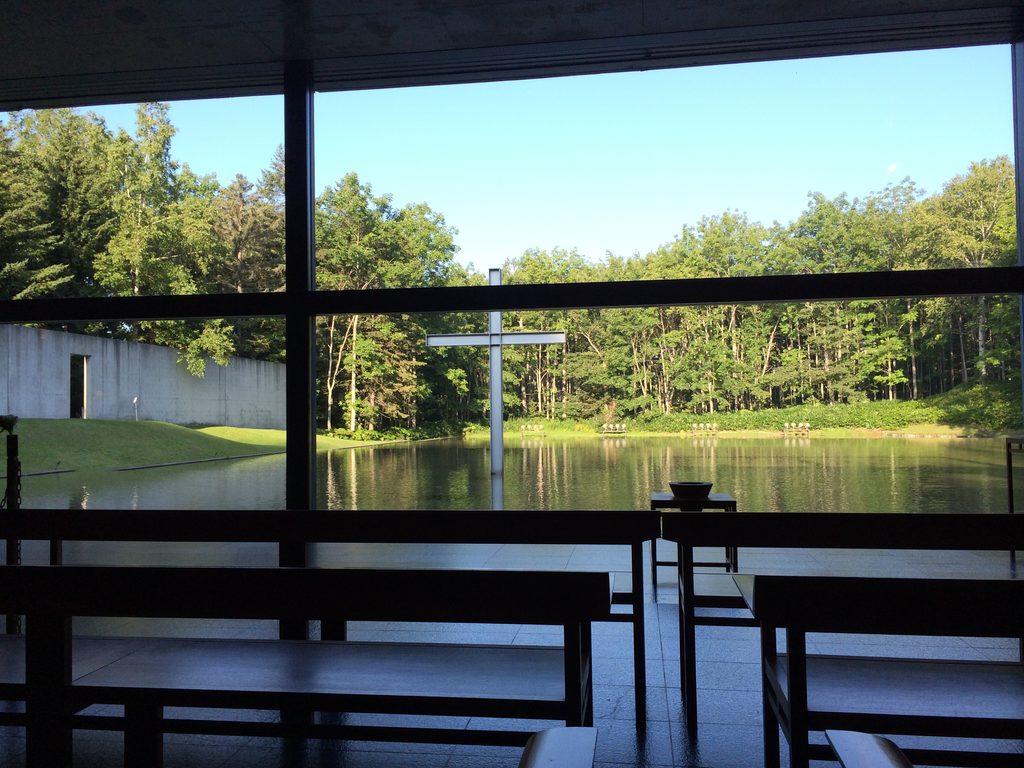
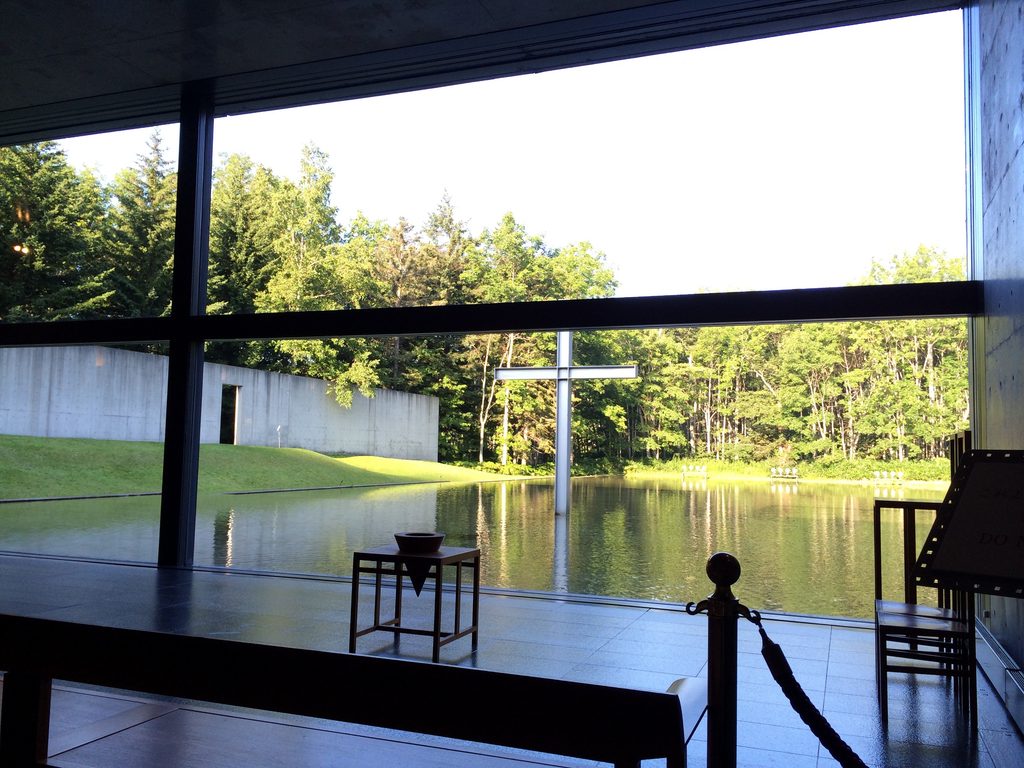
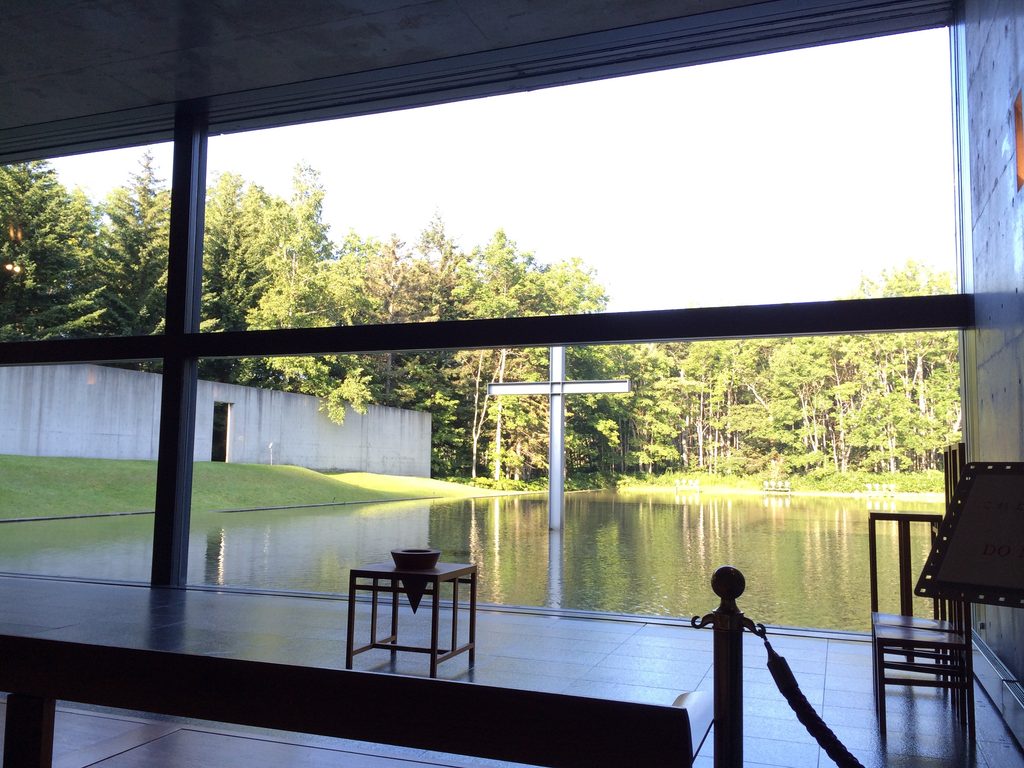
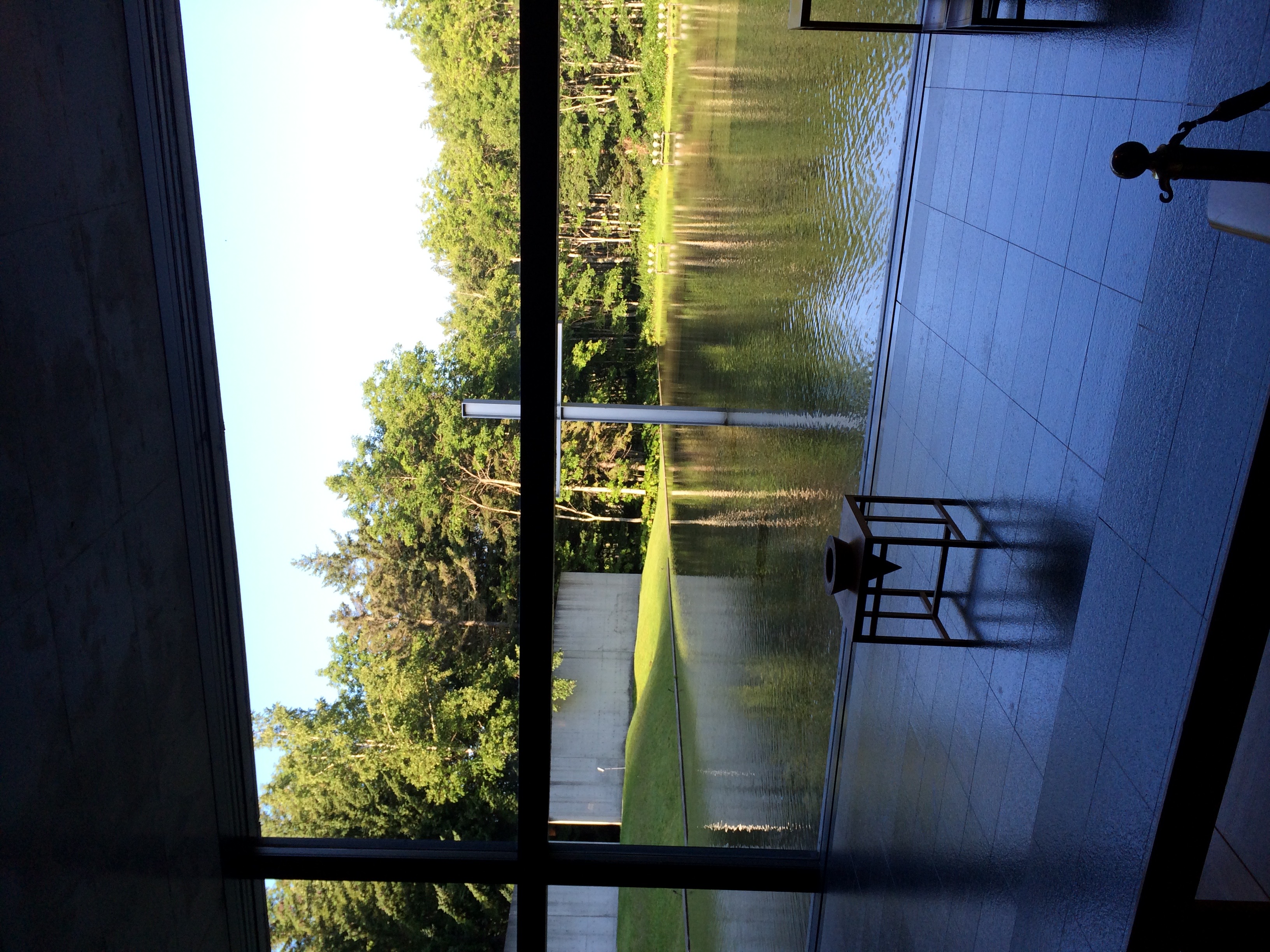
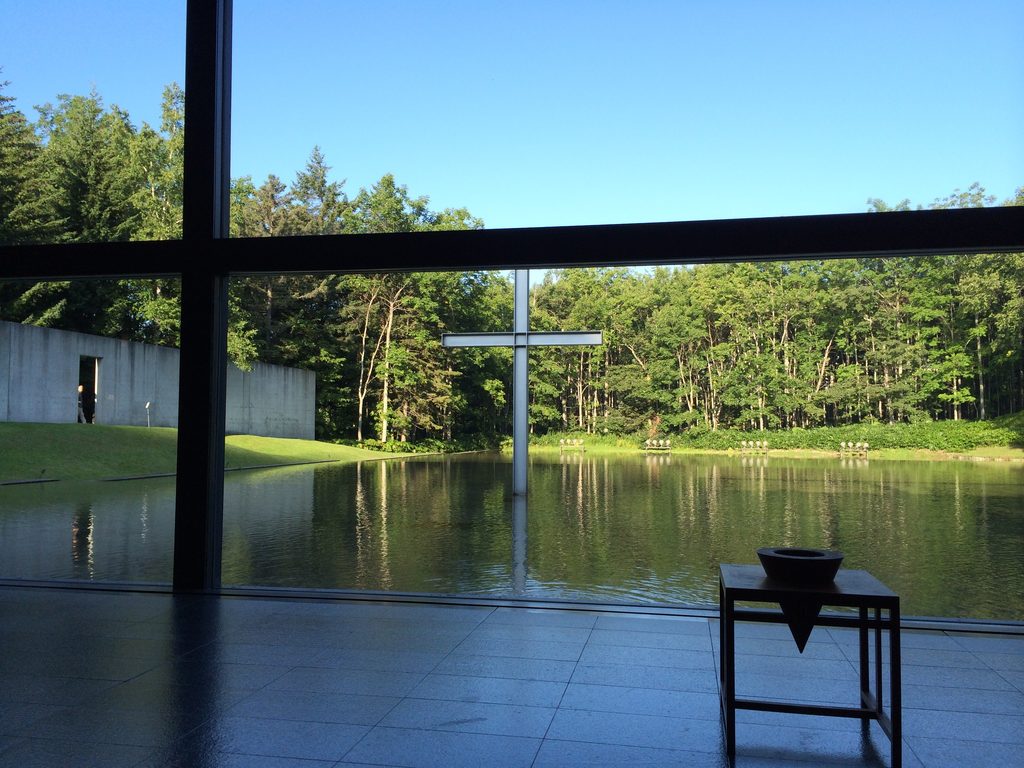
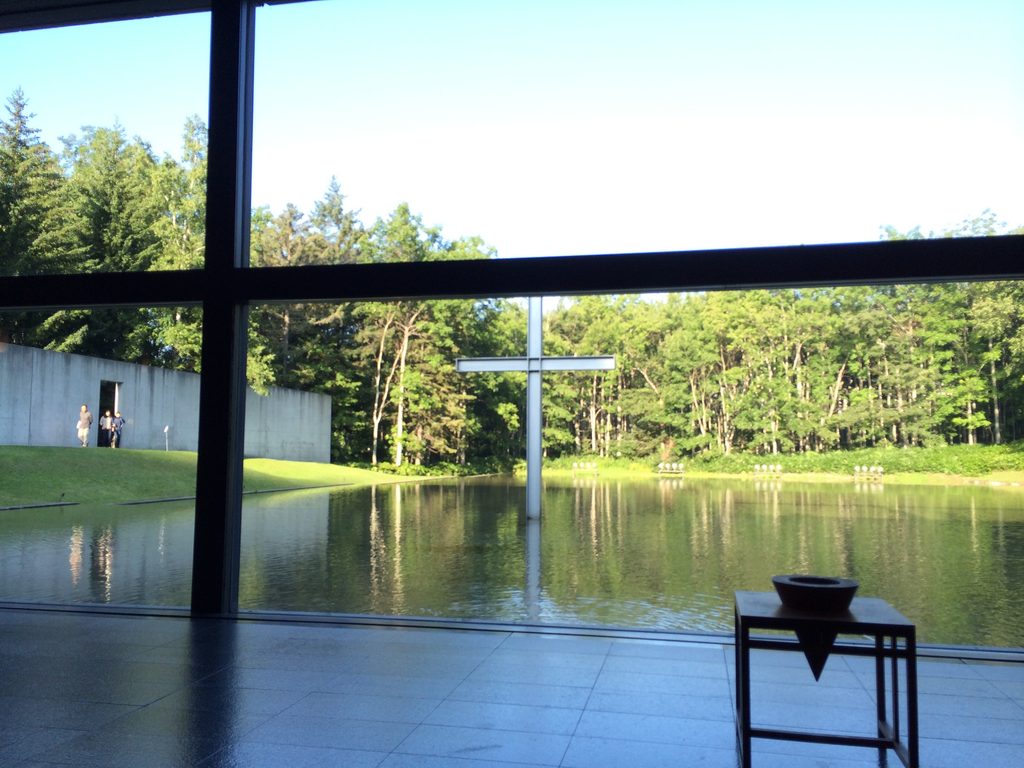
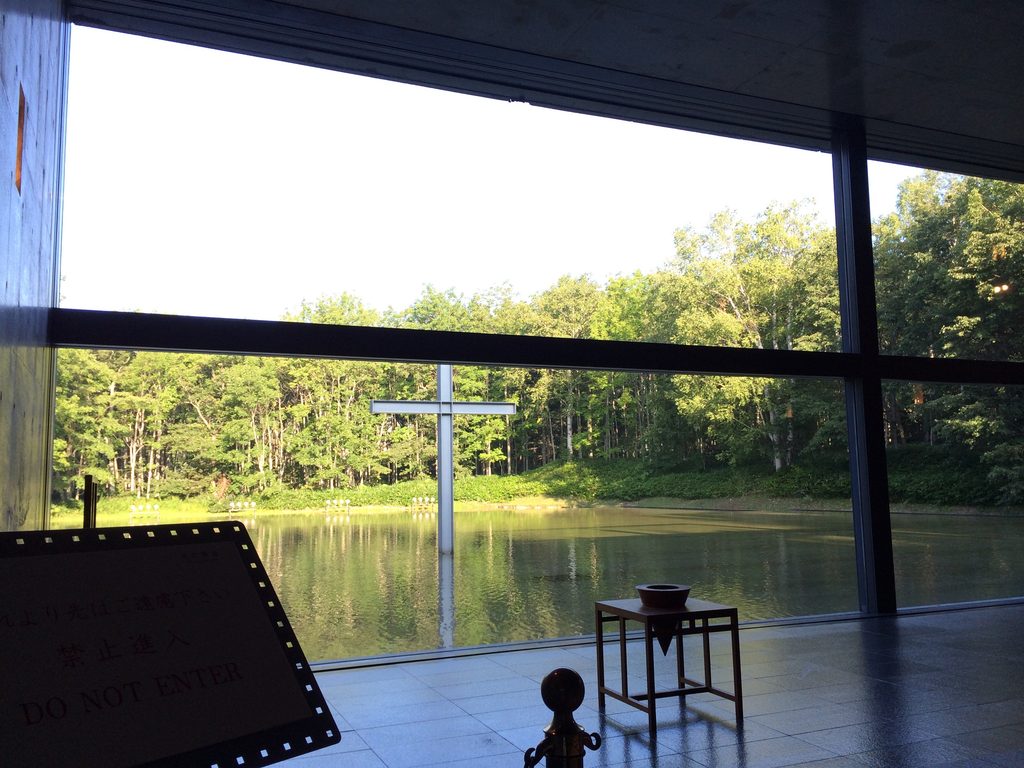
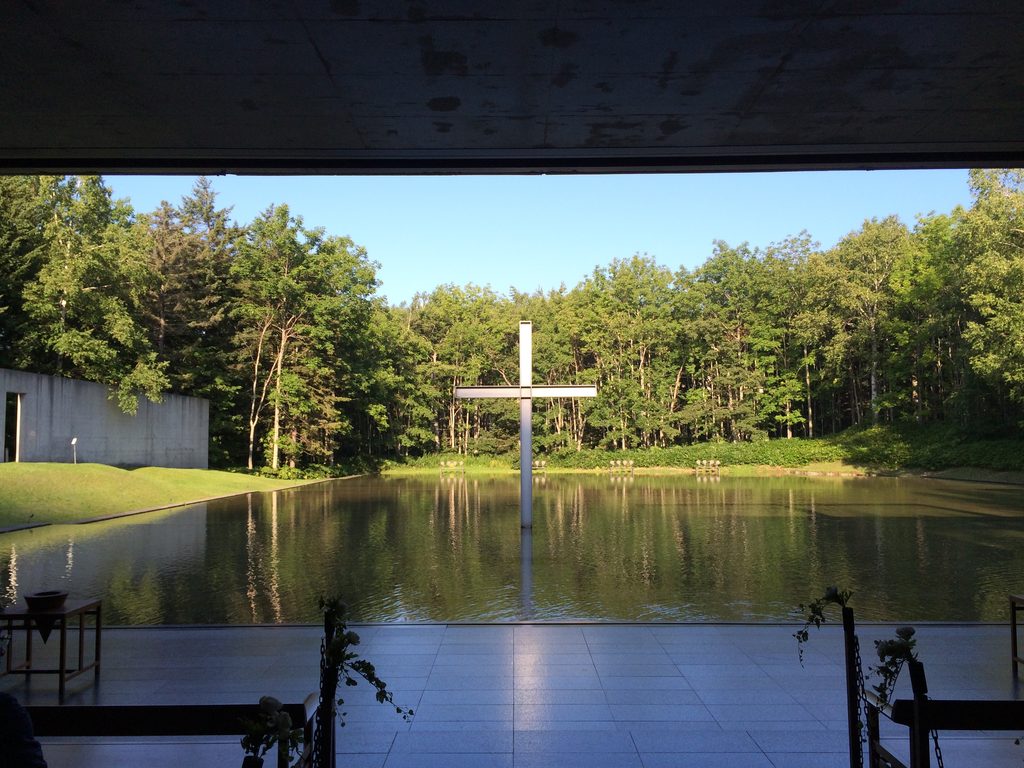
曲面壁に沿って階段を降り、礼拝堂へ入ると、それまで建築によって抑えられていた視界が突然大きく開かれる。正面には水面が広がり、その中央には一本の十字架が立ち、さらに奥には北海道の森が連続している。暗く抑えられたコンクリートの内部から見るその風景は、単に大きな窓から外を眺めているという感覚とは異なり、礼拝堂そのものが水と森へ向かって開かれているように感じられる。
Descending along the curved wall and entering the chapel, the field of vision that architecture has carefully restrained suddenly opens. Water stretches across the entire front of the space, a single cross stands within it, and beyond lies the forest of Hokkaido. Seen from the subdued darkness of the concrete interior, the landscape no longer feels like a view through a large window; the chapel itself seems to extend toward the water and forest.
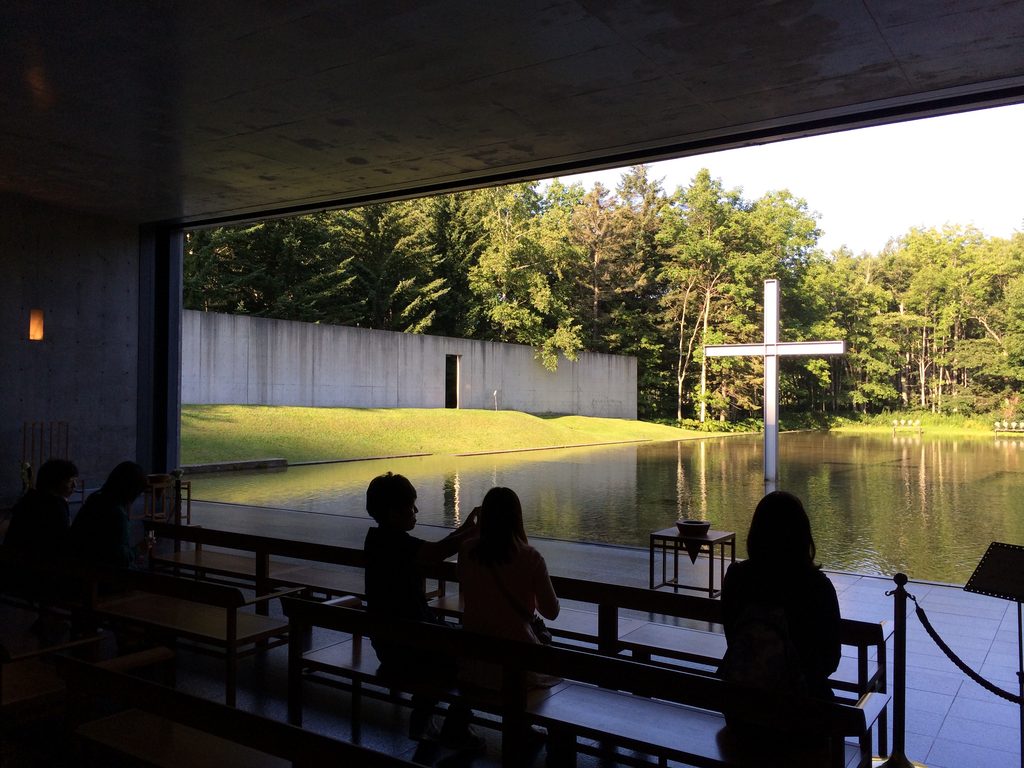
一般的な教会であれば祭壇や宗教画が置かれる正面に、ここでは水、十字架、森、空という極めて少ない要素だけが存在している。人工的な装飾を加えるのではなく、もともとそこにある自然を建築の正面へ取り込み、その中心に一本の十字架を置くことで、風景全体が礼拝の対象となるような構成が生まれている。
Where a conventional church might place an altar, religious painting, or elaborate symbolic object, Church on the Water presents only a few elements: water, cross, forest, and sky. Rather than adding decoration to create sacredness, the architecture draws the existing landscape into the central axis of worship and places a single cross within it, allowing the entire scene to assume the role normally given to an altar.
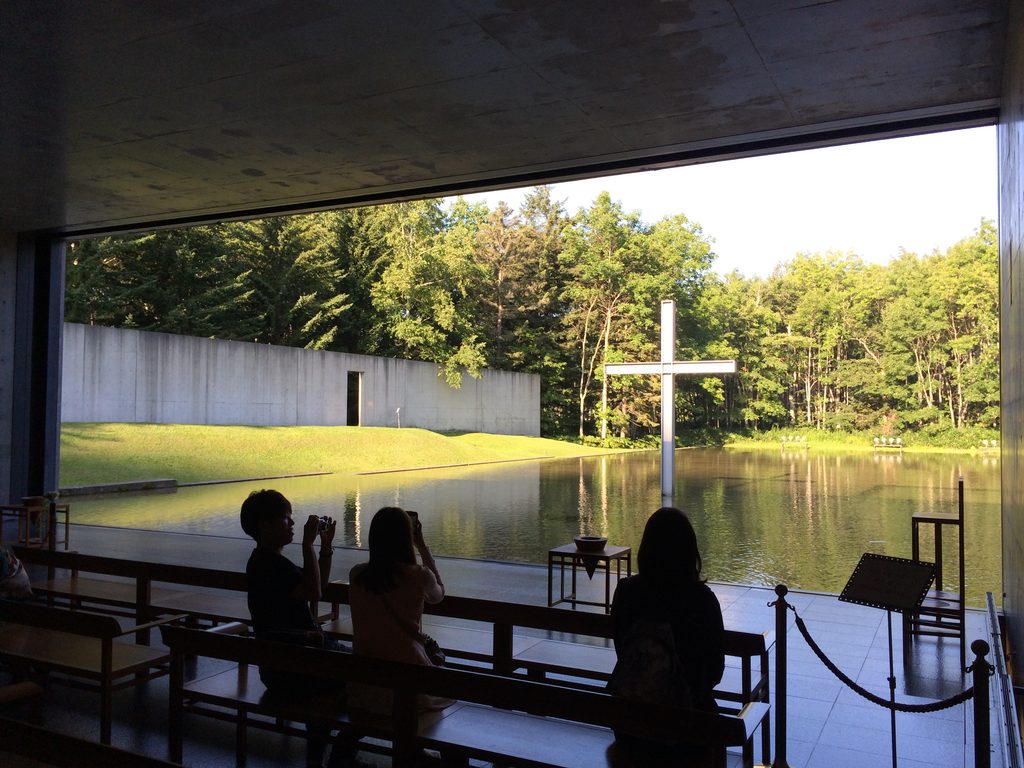
水面は建築の外側に付加された景観ではない。礼拝堂から見ると、その水平線が空間の奥行きを決定し、水の中に立つ十字架と背後の森が正面性をつくっている。内部と外部の境界は確かに存在するが、視覚的には水面が礼拝堂の床の先へ連続していくように感じられ、建築内部の空間が自然の中へ拡張されていく。
The water is not scenery appended to the exterior of the building. From within the chapel, its horizontal surface determines the depth of the space, while the cross and forest beyond establish its frontal focus. A physical boundary between interior and exterior remains, yet visually the water seems to continue beyond the floor of the chapel, extending the interior into the landscape.
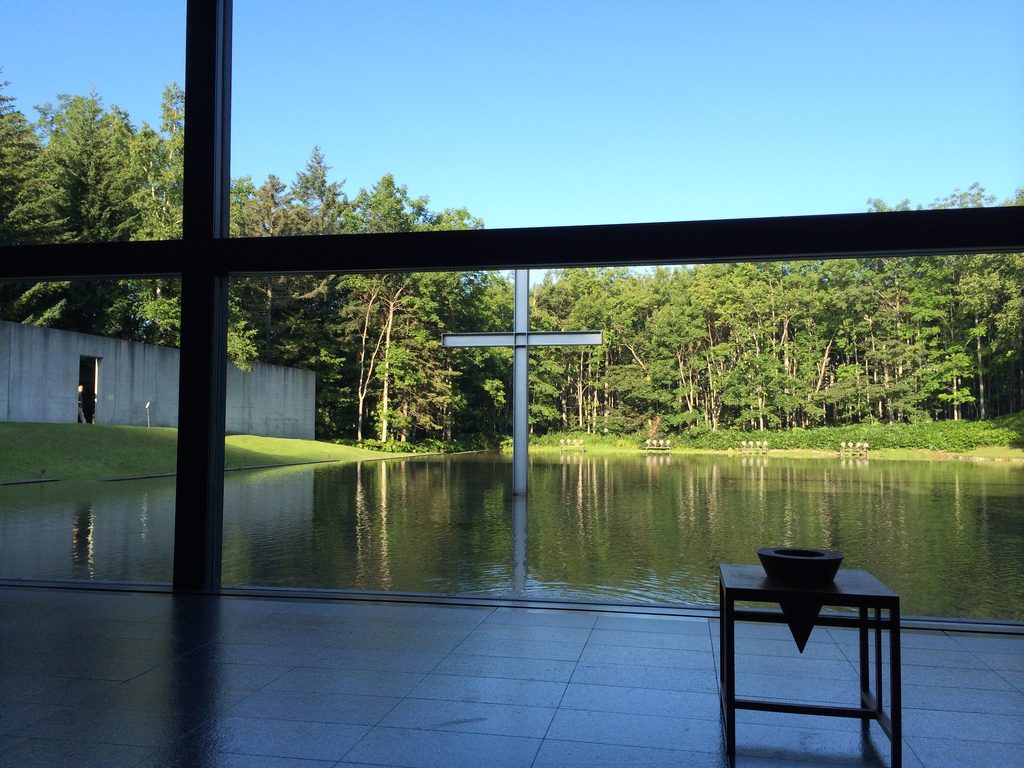
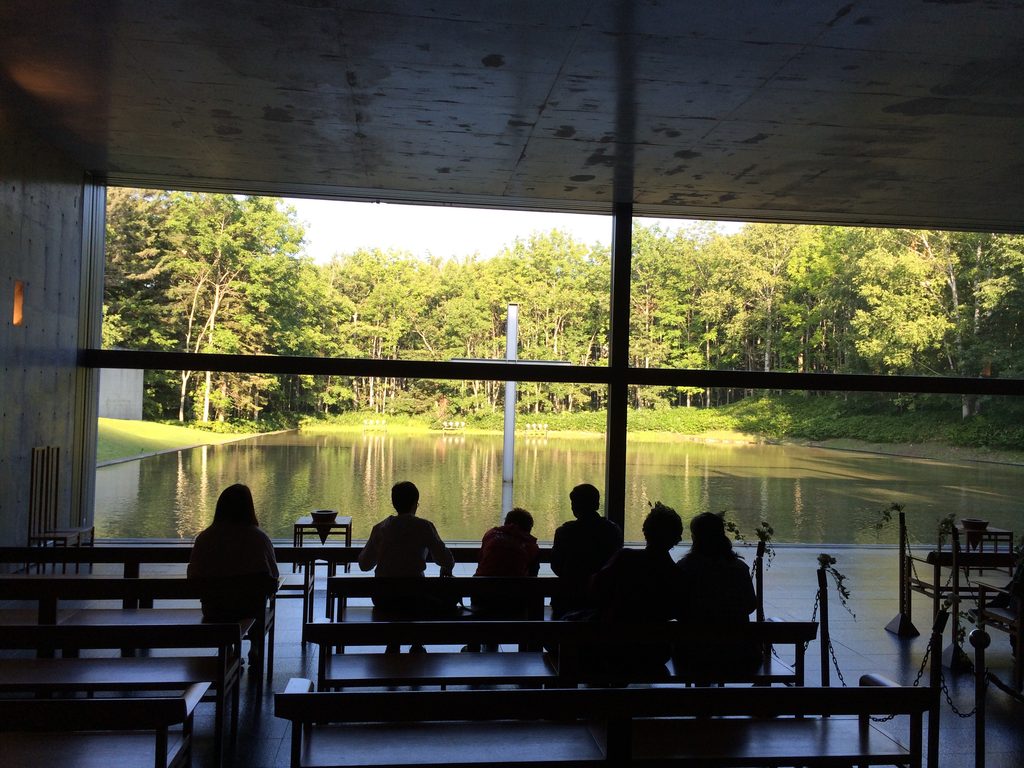
この風景を強くしているのが、礼拝堂内部の暗さである。打放しコンクリートの天井と側壁は光を抑え、内部の情報量を極端に少なくすることで、人の視線を自然に正面へ集中させる。その先にある水面は外光を受けて明るく輝き、森の緑や空の変化も、直接屋外に立って見るとき以上に鮮明に感じられる。
The darkness of the chapel is essential to the intensity of this view. Exposed-concrete walls and ceiling suppress the amount of visual information inside, directing attention toward the brighter exterior. The water receives the daylight, while the greens of the forest and the changing sky appear more vivid than they might if experienced directly outdoors.
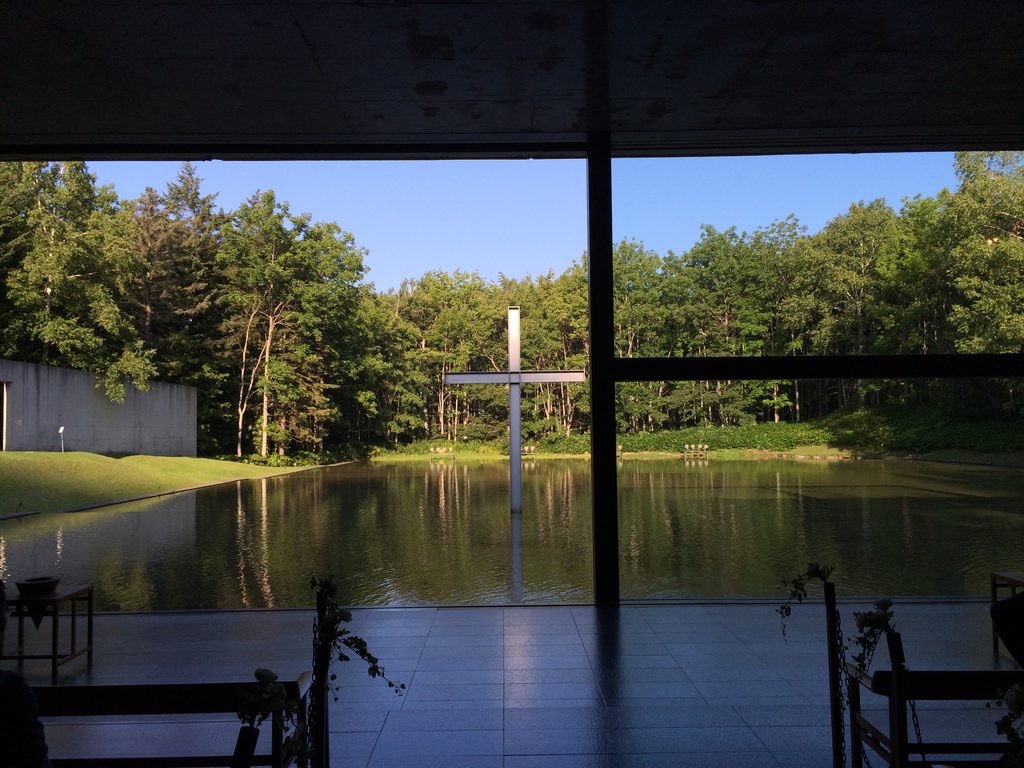
安藤は自然を模倣した形を建築へ持ち込んでいるわけではない。むしろコンクリートという明らかに人工的な素材で強いフレームをつくり、その内部を暗くすることによって、フレームの向こうにある本物の水や森を際立たせている。建築と自然を曖昧に混ぜ合わせるのではなく、両者の違いを明確にしたうえで一つの視界の中に重ねることで、自然そのものの存在を意識させている。
Ando does not imitate nature within the architecture. Instead, he constructs a powerful artificial frame from concrete and keeps its interior dark, allowing real water and forest to become more pronounced beyond it. Architecture and nature are not blended into ambiguity; their differences remain clear, and it is precisely through this contrast that the presence of nature becomes more intense.
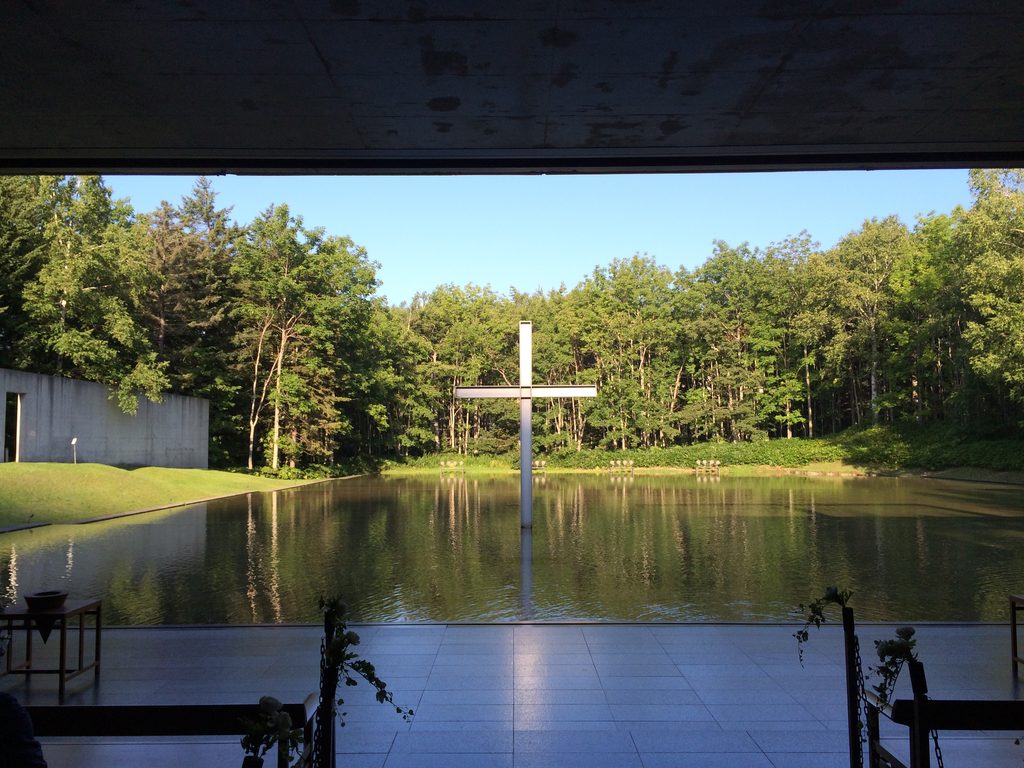
水面に立つ十字架へ目を向けると、その背後には森が広がり、水には空から届いた光が映り、風が吹けばその像もわずかに揺らいでいく。それらはすべて建築の外部に存在する自然の要素でありながら、暗く抑えられた礼拝堂から眺めることで、内部空間を構成する不可欠な存在へと変わっている。
Looking toward the cross, one simultaneously sees the forest beyond it, the sky reflected on the water, and the slight movement of those reflections whenever the wind passes across the surface. All of these elements exist outside the building, yet when seen from the darkened chapel they become indispensable components of the interior experience.
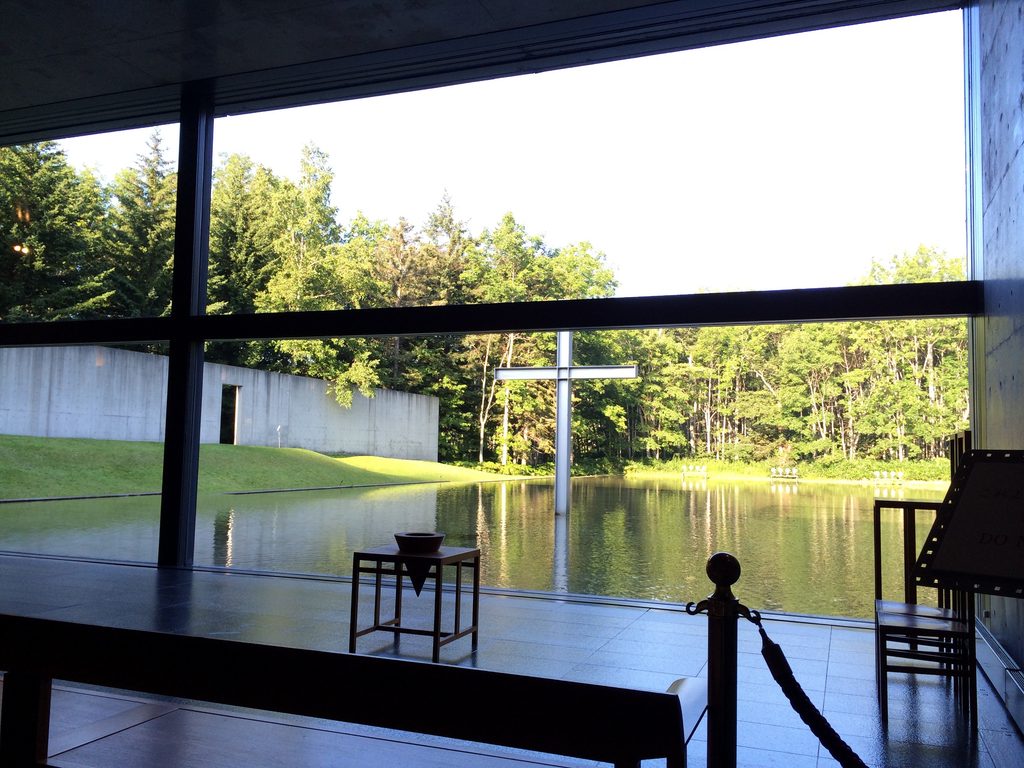
ここでは自然が建築の背景として利用されているのではなく、水と森と空そのものが祭壇となり、建築はそれを切り取り、人の意識をそこへ向けるための静かなフレームへと後退している。建築そのものの造形を強く感じながら、最終的には建築の向こう側にあるものを見ることになるという関係が、水の教会を安藤忠雄の宗教建築の中でも特別な作品にしている。
Nature here is not employed merely as a backdrop for architecture. Water, forest, and sky become the altar itself, while architecture withdraws into the role of a quiet frame that concentrates human awareness upon them. One remains acutely conscious of Ando’s concrete and geometry, yet ultimately finds oneself looking beyond the building. This reversal is one of the qualities that makes Church on the Water such a distinctive work within his religious architecture.
5. コンクリートの暗がりが、光を深くする
Concrete Darkness Gives Light Its Depth
水の教会について語るとき、どうしても水面に立つ十字架の風景が中心になる。しかし実際に礼拝堂に身を置いてみると、その明るい風景を成立させているのは、周囲を包む打放しコンクリートの暗さであることに気づく。正面だけを切り取れば自然が主役に見えるが、その自然の見え方を建築が極めて精密に制御している。
The image most commonly associated with Church on the Water is understandably the cross standing in the water. Yet when spending time inside the chapel, it becomes clear that this luminous landscape depends upon the darkness of the exposed-concrete enclosure surrounding it. Nature may appear to be the protagonist when one looks straight ahead, but architecture is carefully controlling the conditions under which that nature is perceived.
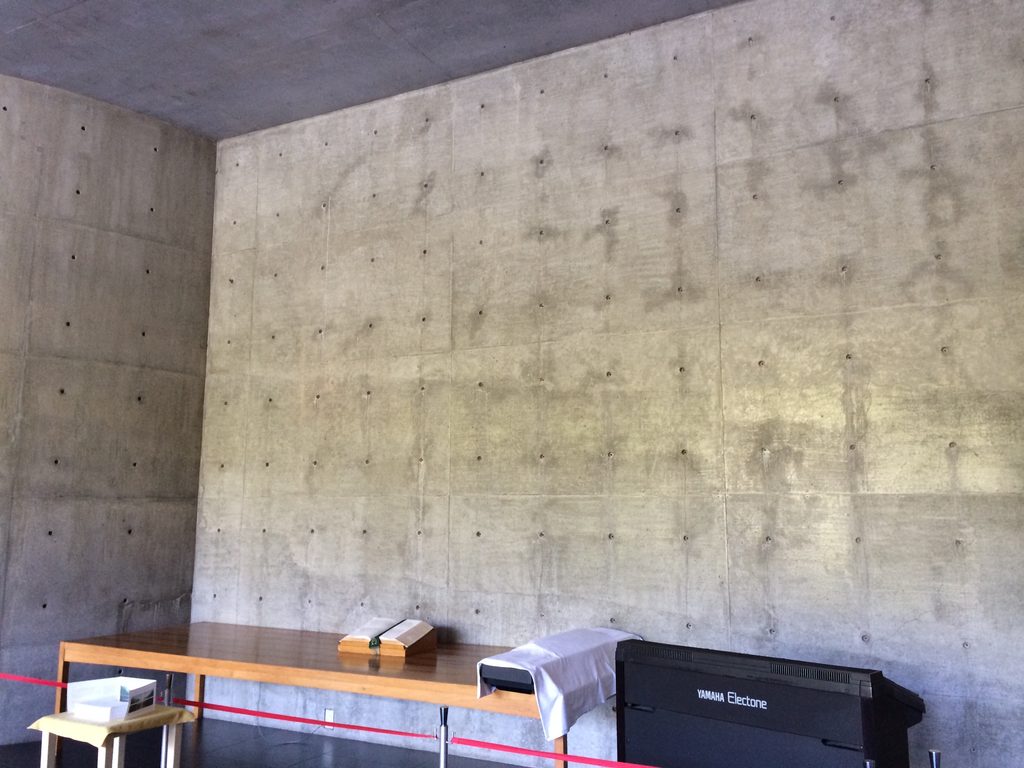
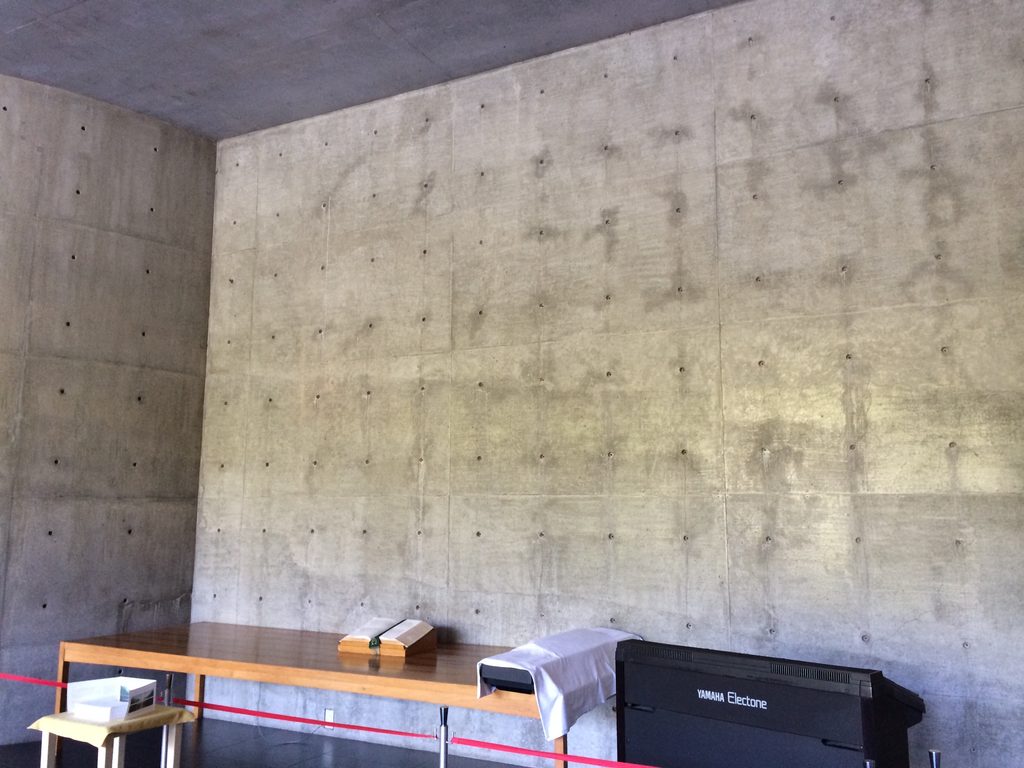
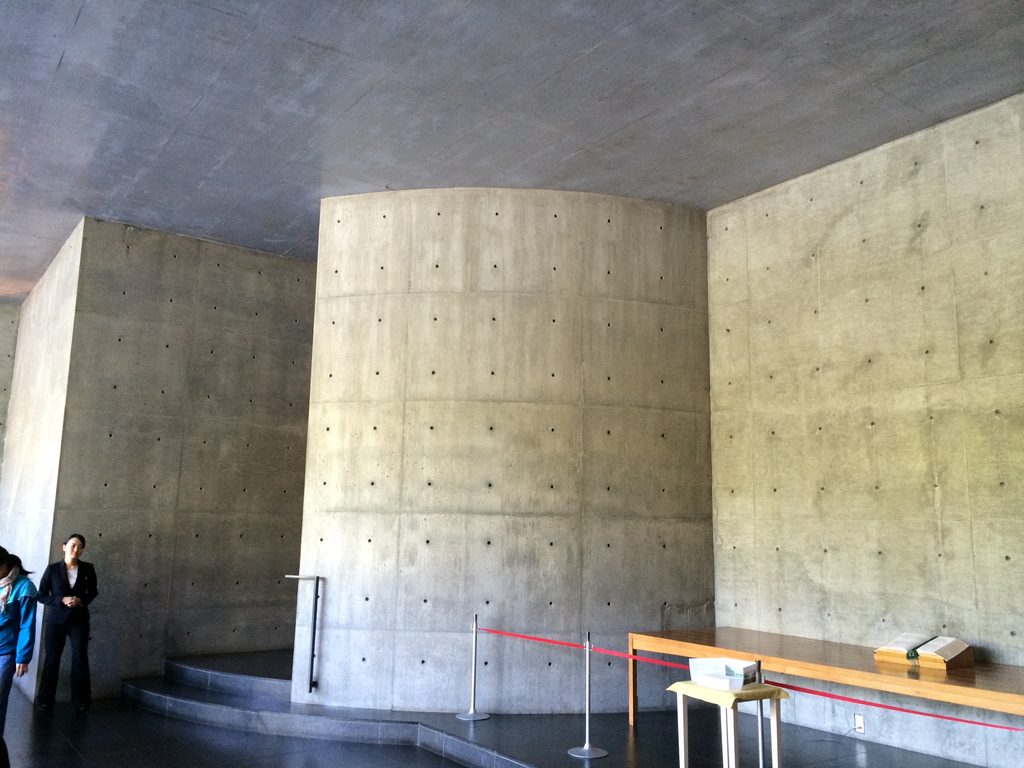
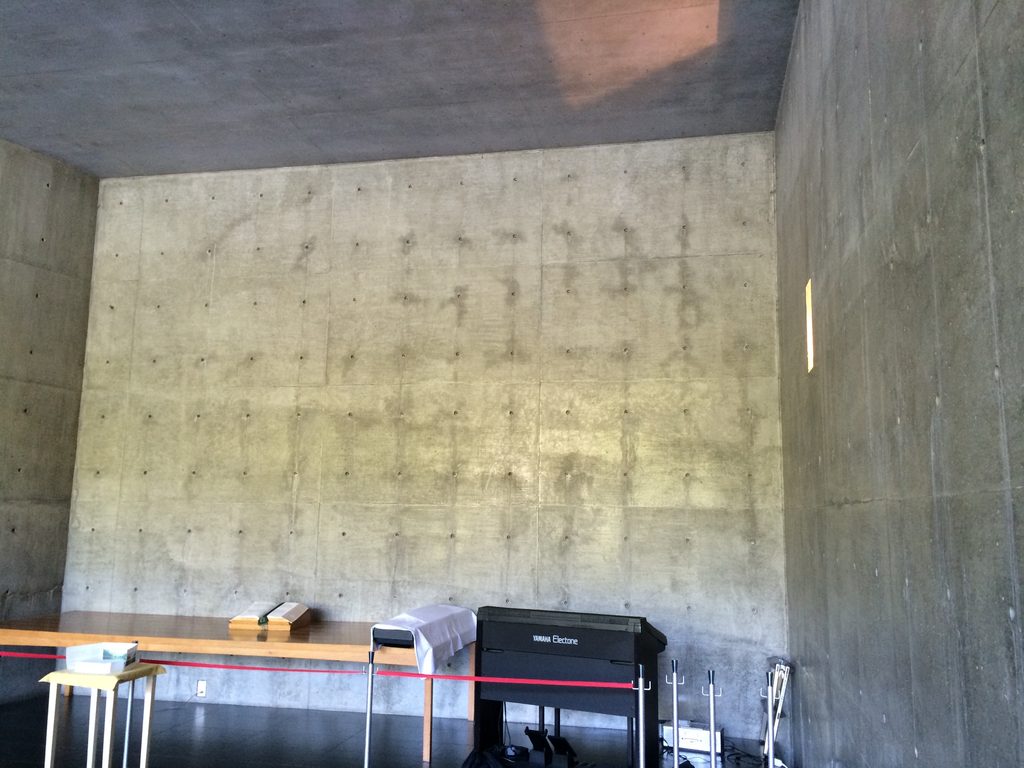
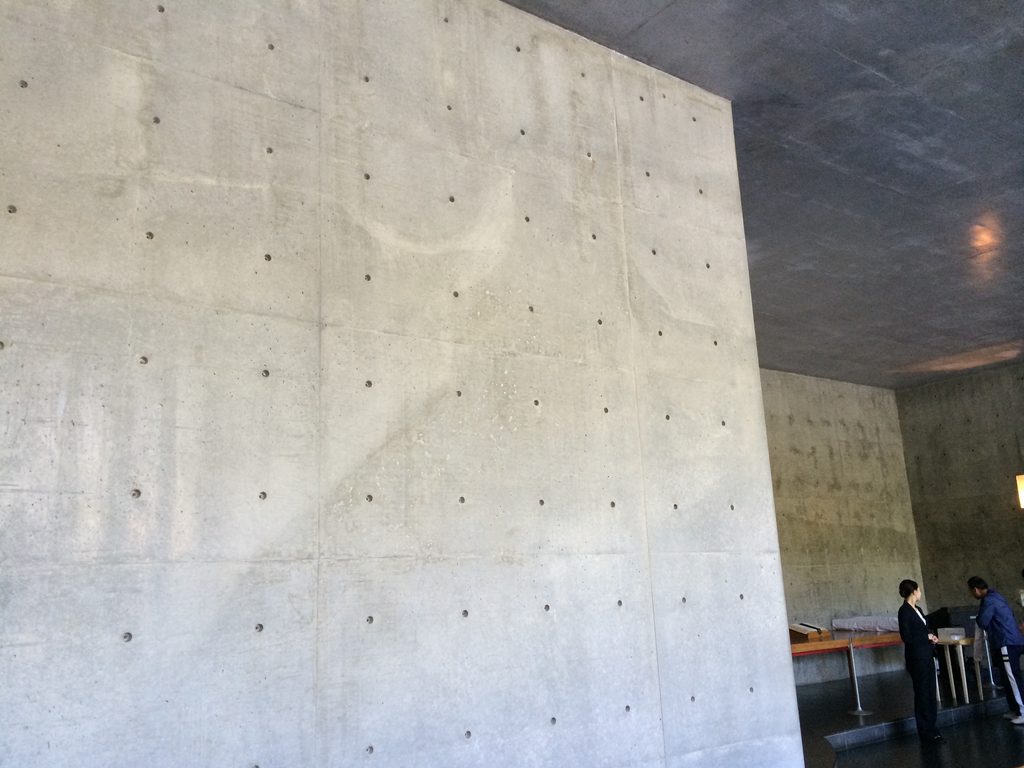
側壁には型枠による規則的な割付けが残り、天井も装飾を排した均質なコンクリート面として広がっている。素材そのものは重く強い存在感を持っているが、光量が抑えられた内部では、その強さが建築自身を主張する方向ではなく、正面にある水面と森を際立たせるために働いている。
Regular formwork joints remain visible across the side walls, while the ceiling extends as an undecorated concrete plane. The material possesses weight and physical intensity, yet within the low light of the chapel its strength does not primarily call attention to itself. Instead, it becomes a restrained background against which the water and forest can acquire greater visual presence.
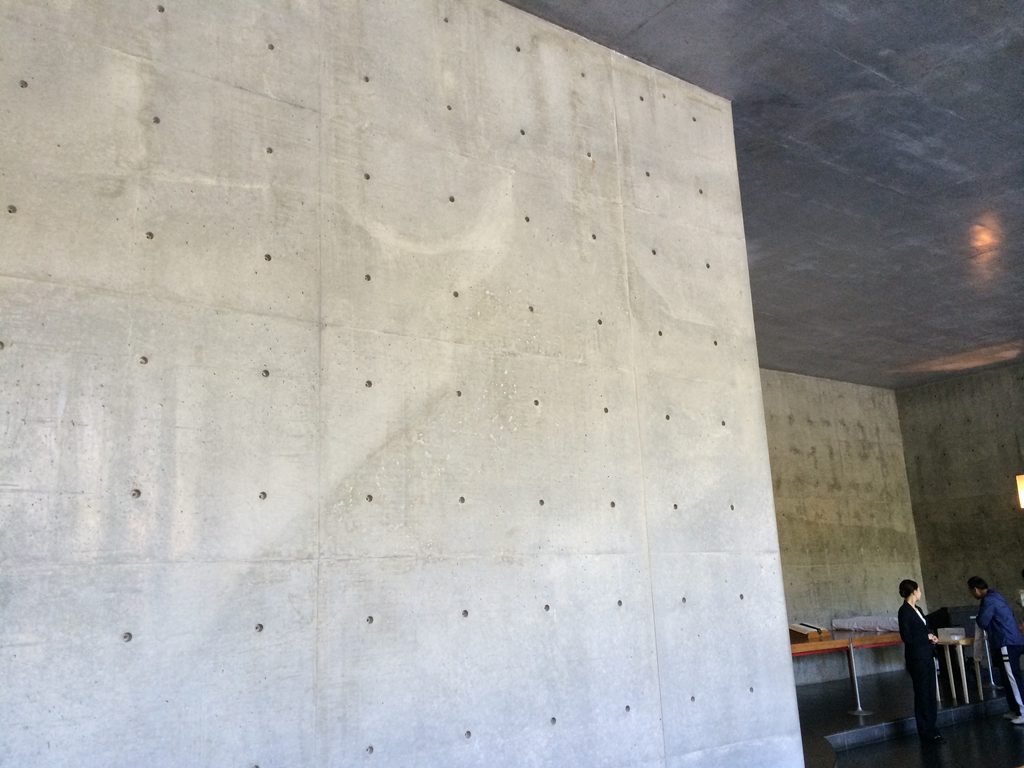
外部から届くわずかな光は、コンクリート面の微妙な色や質感、型枠跡の凹凸を浮かび上がらせる。同じ壁であっても光の方向や強さによって表情が変化するため、固定された幾何学の内部へ時間の変化が入り込んでくる。安藤建築のコンクリートが単なる無機質な背景ではなく、光を受け止める面として機能していることがよく分かる。
The limited daylight entering the interior reveals subtle differences in the color and texture of the concrete and catches the slight irregularities left by construction. As the direction and intensity of light change, the same wall takes on different expressions, introducing the passage of time into an otherwise fixed geometry. Ando’s concrete operates not simply as a neutral surface but as a plane capable of receiving and registering light.
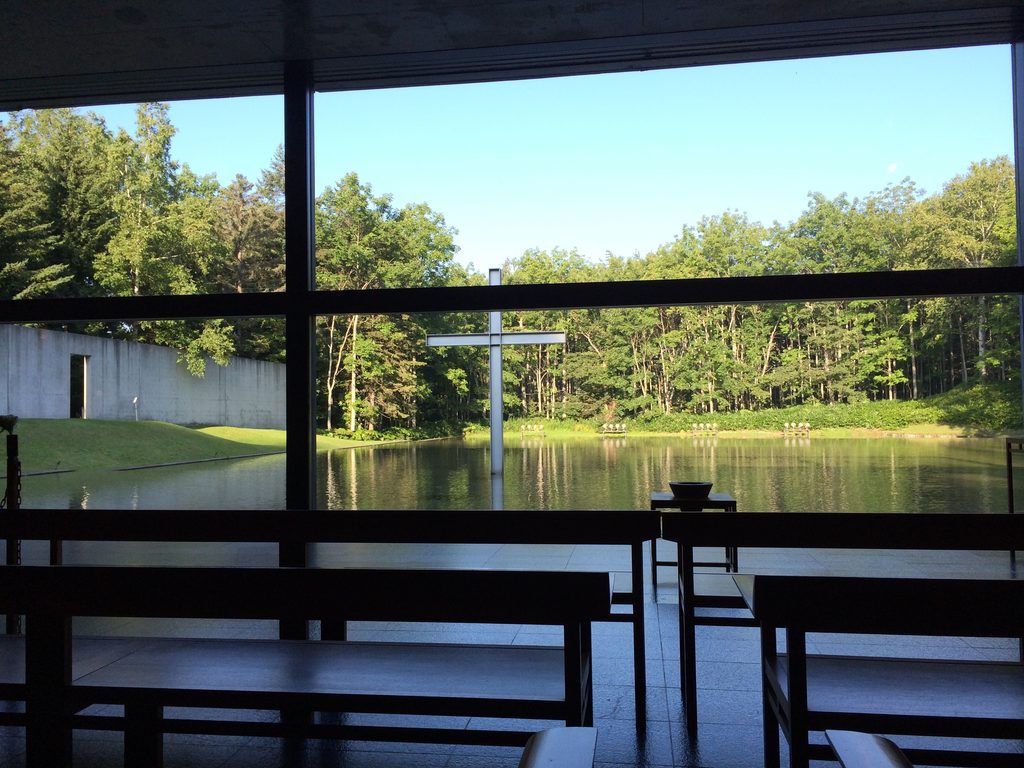
礼拝堂の内部が暗いほど、正面の緑や水面は明るく感じられる。建築が光そのものを増やしているわけではないにもかかわらず、暗さとの対比によって、外から届く光が通常以上の密度を持つように知覚される。光を直接デザインするのではなく、光が現れるための暗さを建築によってつくるという方法である。
The darker the chapel becomes, the brighter the greenery and water outside appear. Architecture does not increase the amount of light; instead, by constructing darkness around it, it alters the way light is perceived. The effect depends not on treating light as decoration, but on carefully creating the shadow from which light can emerge.
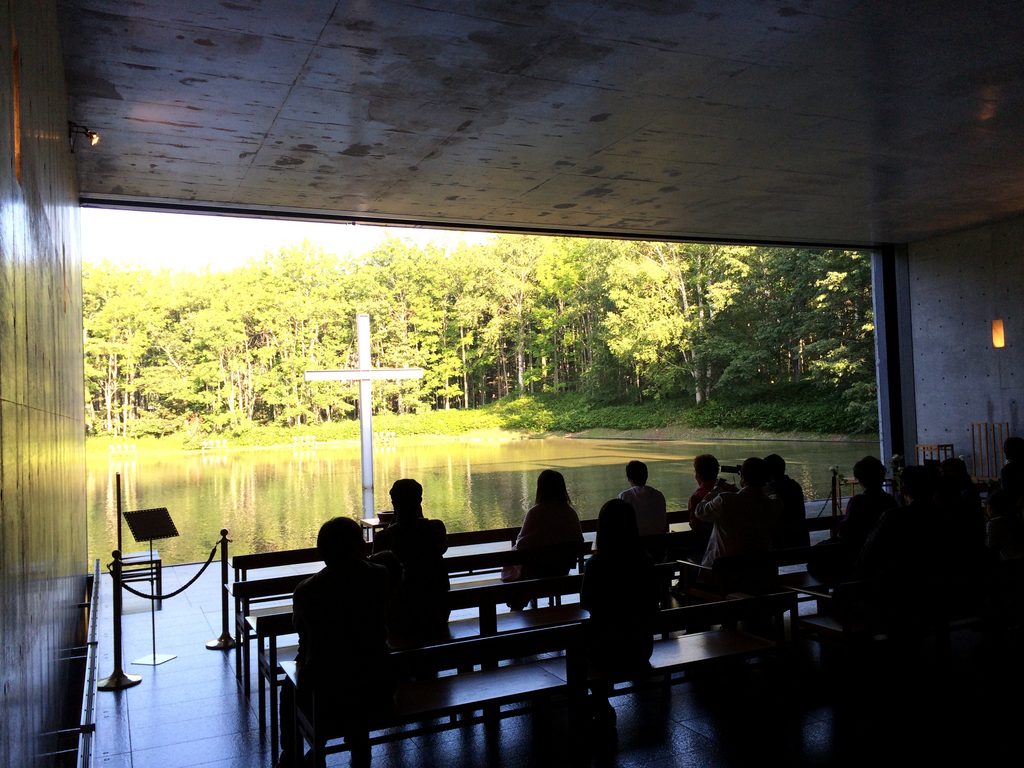
さらに水面があることで、自然光は一方向から入るだけではなく、水に反射しながら揺らぎを伴って知覚される。空や森の状態、風の強さによって水面の表情は絶えず変化する一方、礼拝堂を囲むコンクリートの幾何学はほとんど変わらない。
The water adds another layer to this relationship. Natural light is not experienced only as illumination arriving from a single direction; it is reflected across a surface that moves with the wind. The sky, forest, weather, and water therefore remain in continuous change, while the concrete geometry surrounding the chapel remains comparatively still.
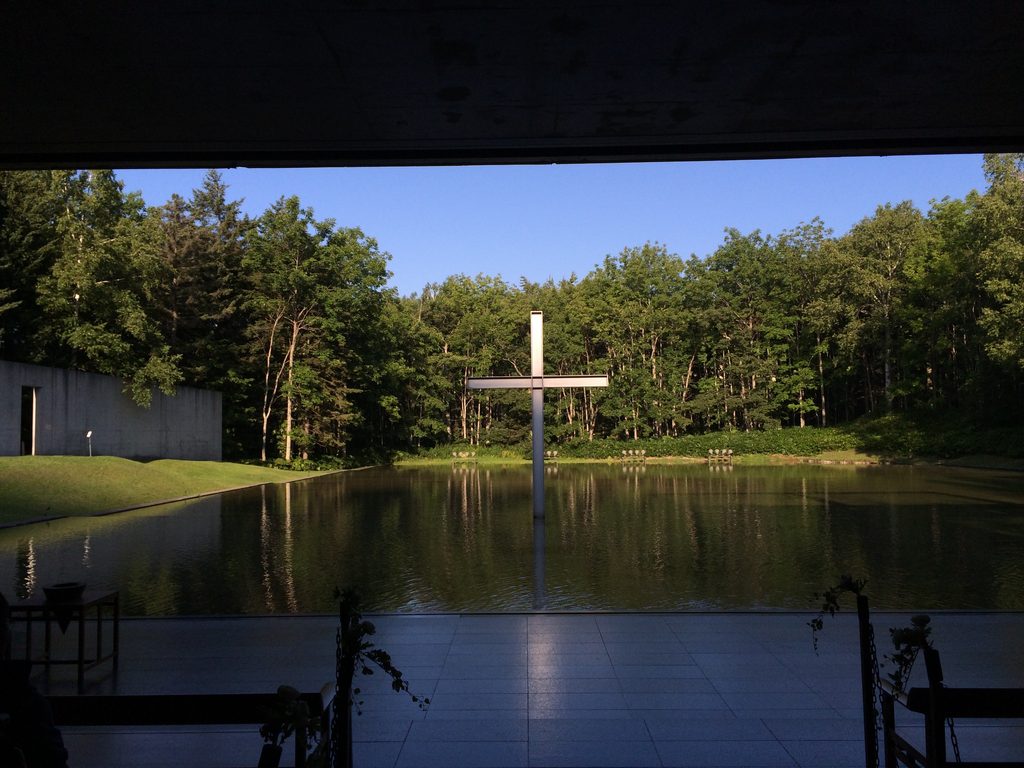
変化しない人工的なフレームと、一瞬として同じ状態に留まらない自然。その二つを同時に経験することで、水の教会には小さな建築でありながら、季節や天候、時間によって何度でも異なる表情が現れる余地が残されている。完成した建築を一度見るというより、変化し続ける自然を受け止める場所として建築が存在しているのである。
The encounter between an unchanging artificial frame and a natural world that never occupies exactly the same state twice gives this relatively small chapel an unusual temporal depth. Church on the Water is not merely a completed object to be seen once. It is an architectural framework capable of receiving different seasons, weather, hours, and conditions of light long after the building itself was finished.
6. 十字架は建築の中ではなく、風景の中に立つ
The Cross Stands Not Within Architecture, but Within the Landscape
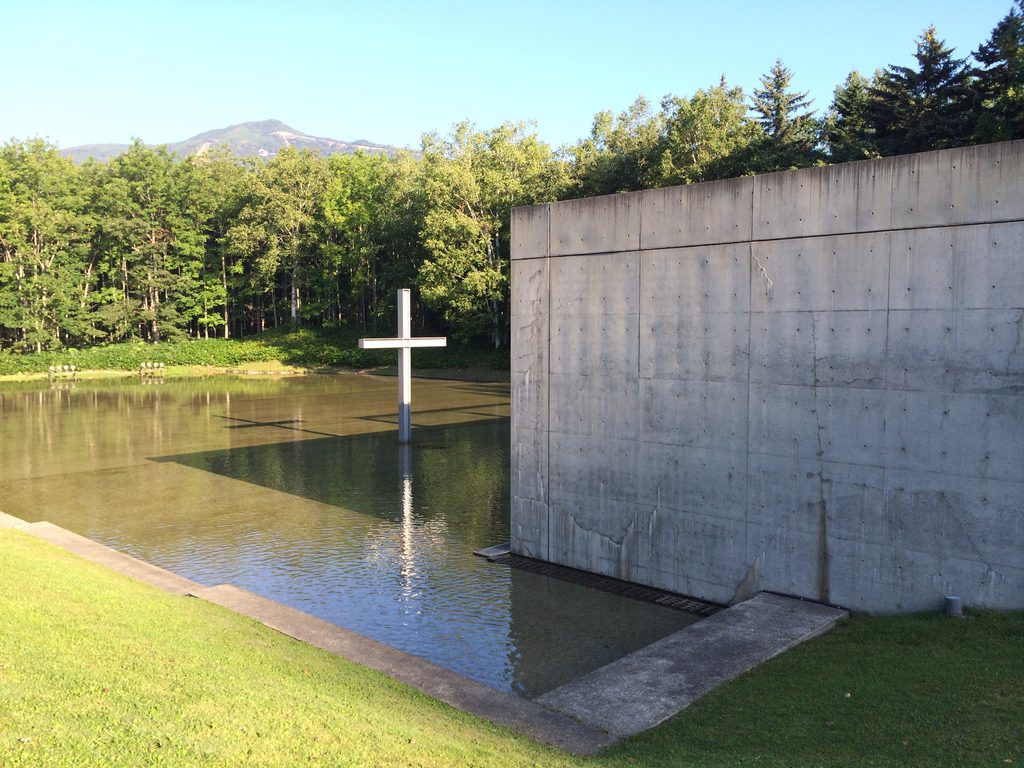
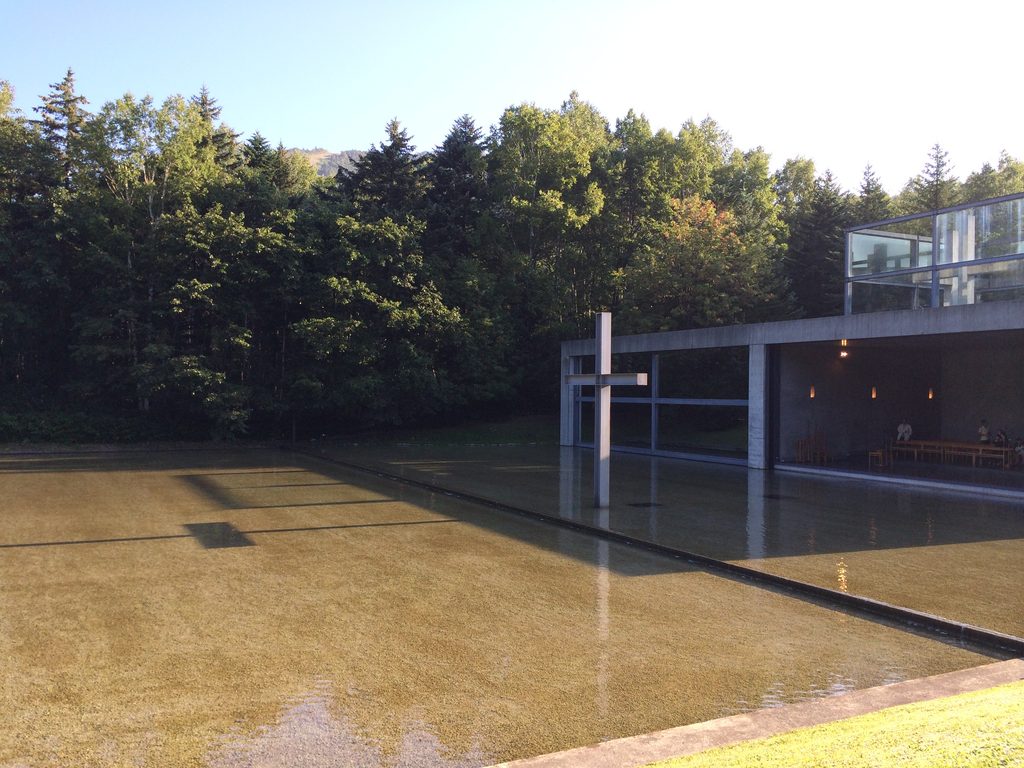
礼拝堂から正面を見ると、水の中に立つ十字架は建築内部の壁に固定された宗教的な記号ではなく、風景の中に独立した存在として置かれている。その背後にはコンクリートの壁ではなく森があり、上には天井ではなく空が広がるため、十字架を見ることは同時に北海道の自然を見ることでもある。
From the chapel, the cross in the water does not appear as a religious symbol fixed to an interior wall. It stands independently within the landscape, with forest rather than concrete behind it and sky rather than ceiling above. Looking at the cross therefore means simultaneously looking at the natural world of Hokkaido.
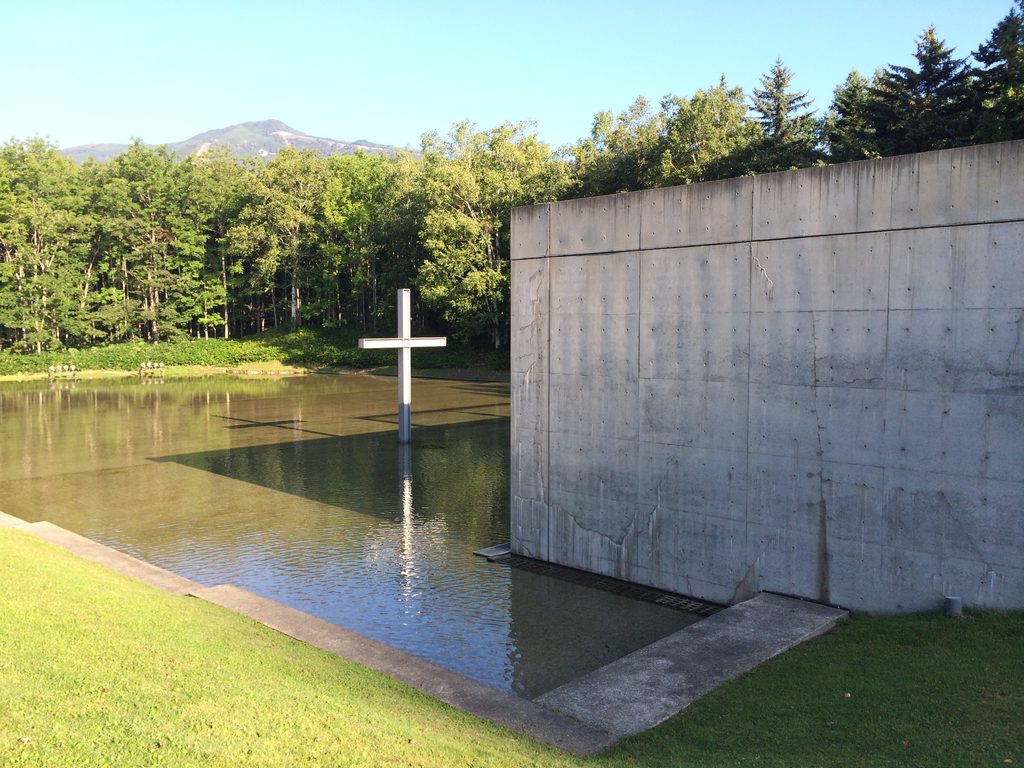
外部へ出て水面の近くから見ると、その関係はいっそう明確になる。十字架は水と森の間に立ち、季節や天候によって絶えず変化する自然の中で、唯一変わらない垂直と水平の幾何学を示している。建築の内部では正面性をつくっていた十字架が、外から見ると広大な風景の中に置かれた非常に小さな人工物として見えることも興味深い。
Seen from outside near the water, this relationship becomes even clearer. The cross stands between water and forest, maintaining an unchanging vertical and horizontal geometry within a natural environment that transforms with season, weather, and light. What establishes a powerful frontal axis from inside the chapel becomes, from the exterior, a comparatively small artificial object within a much larger landscape.
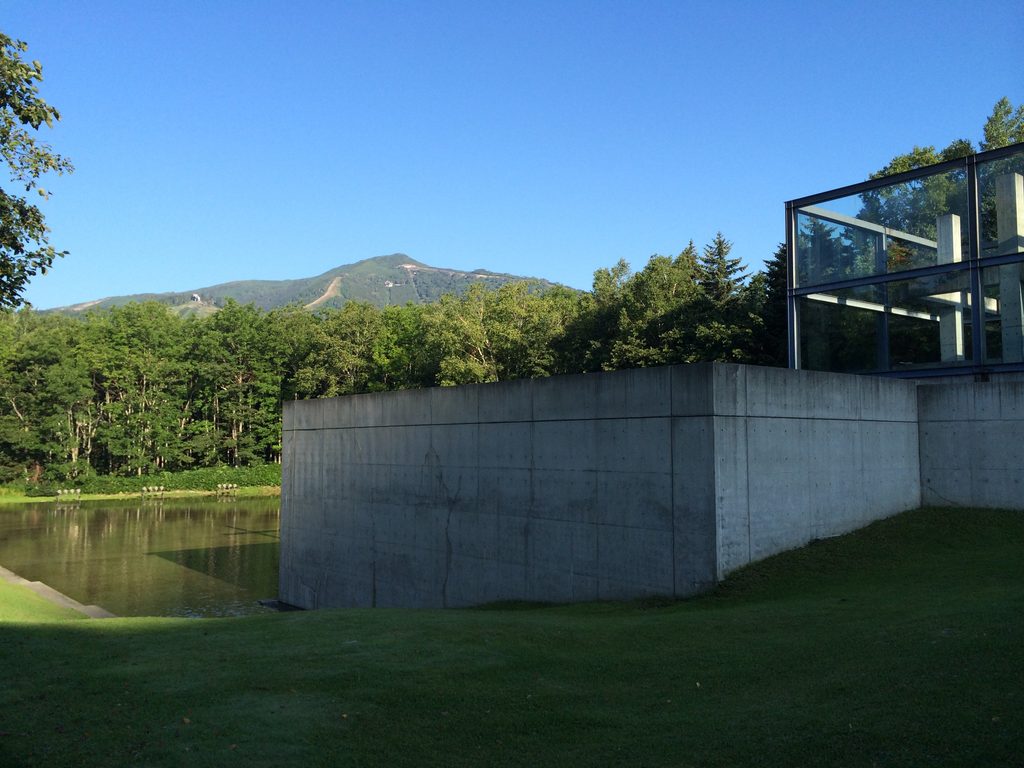
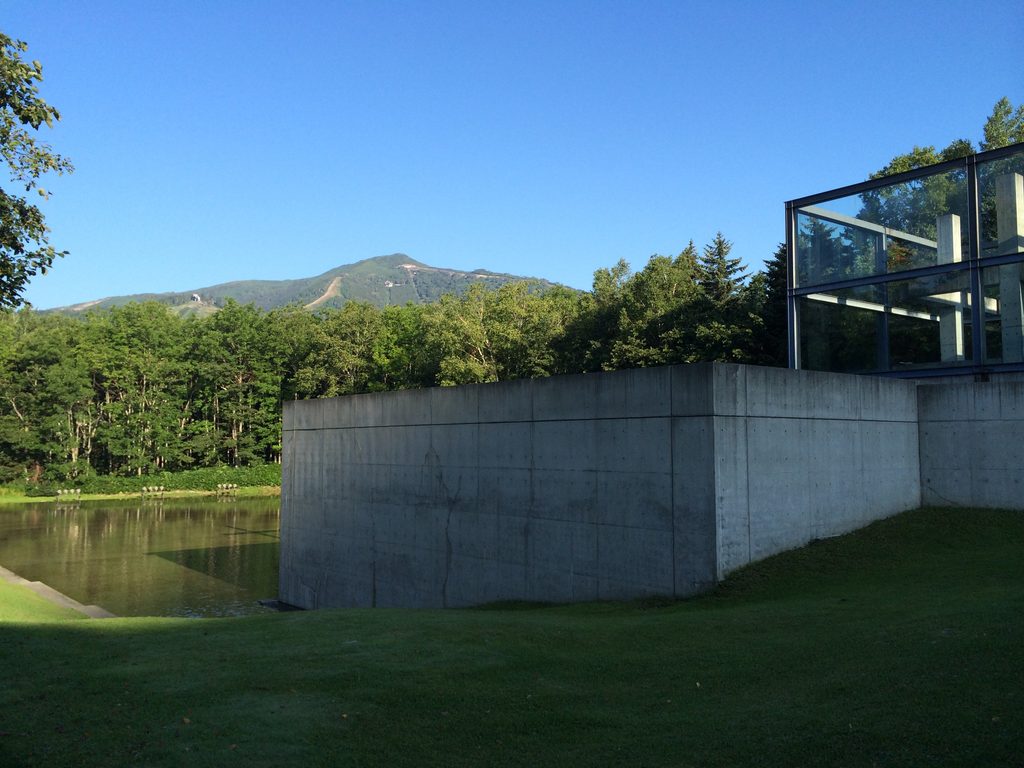
さらに距離を取ると、水面、十字架、低く伸びるコンクリート、透明なガラスの立方体、森、そして山までが一つの風景として収まる。それぞれは異なる素材とスケールを持っており、建築が自然の形へ似せられているわけでもない。それでも全体が一つの場所として感じられるのは、建築が周囲の自然を支配するのではなく、その水平性や広がりを読み取りながら自らの位置を決めているからだろう。
From farther away, the water, cross, low concrete walls, transparent glass cube, forest, and mountains can all be read within a single scene. Each belongs to a different material and scale, and the architecture makes no attempt to imitate the shapes of nature. Yet the composition nevertheless feels coherent because the building does not seek to dominate its surroundings; its low horizontality responds to the scale and extension of the landscape.
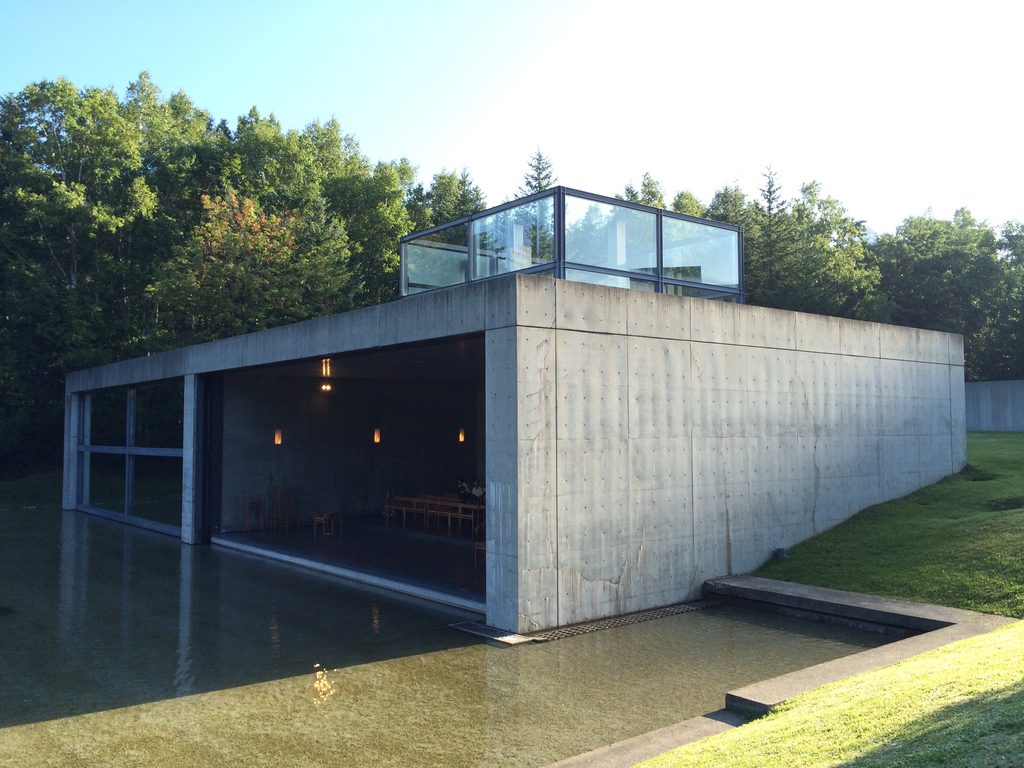
安藤忠雄の建築はしばしば「自然との調和」という言葉で語られるが、水の教会を見ると、単純に自然へ溶け込むこととは異なる関係が見えてくる。コンクリートの壁もガラスの立方体も明確な人工物であり、森の不規則な形とは対照的な幾何学を持っている。自然と建築の境界を消すのではなく、むしろ違いを明確にすることで、それぞれの存在を強くしている。
Ando’s architecture is often described in terms of “harmony with nature,” but Church on the Water suggests a relationship more complex than simply blending into the landscape. Both the concrete wall and glass cube remain clearly artificial, defined by geometries entirely unlike the irregular forms of the forest. Rather than erasing the boundary between architecture and nature, the design makes their differences explicit and allows each to intensify the other.
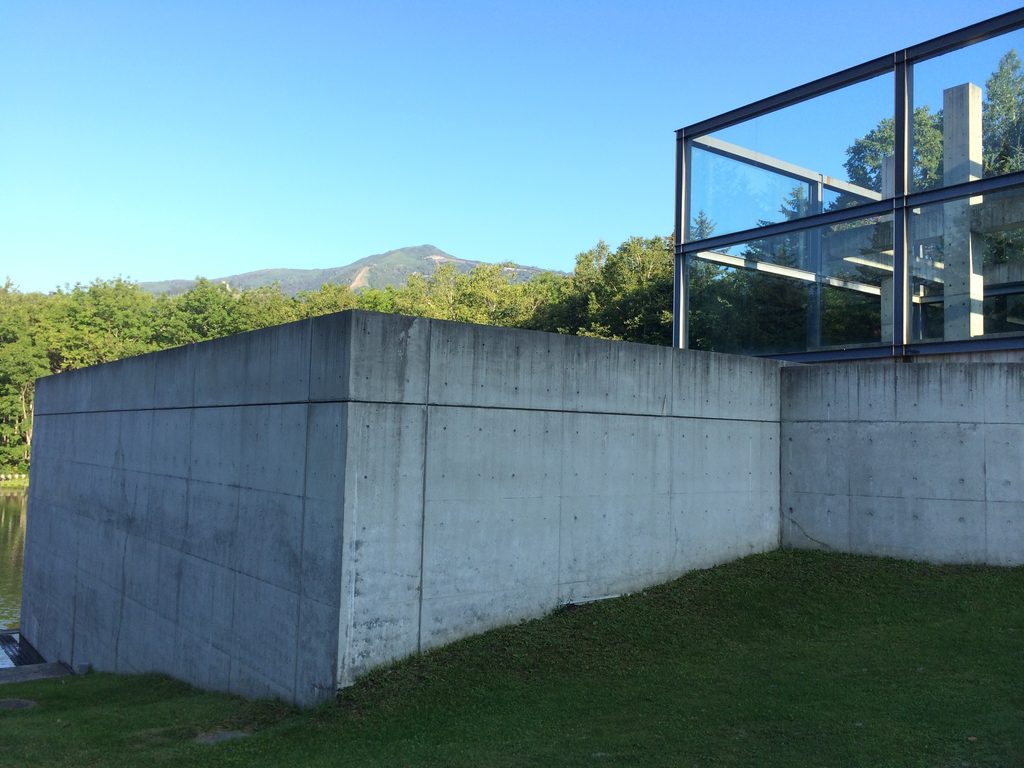
人工的な直線の隣に森の複雑な輪郭があり、水平なコンクリートの向こうに水面が続き、透明なガラスには空や木々が映り込む。建築が自然とは異なる秩序を持っているからこそ、その周囲にある自然の自由さや変化が鮮明になる。
Beside an artificial straight line appears the complex silhouette of the forest; beyond horizontal concrete lies the surface of the water; across transparent glass are reflected trees and sky. Because architecture maintains an order distinct from nature, the freedom and continuous transformation of the surrounding landscape become more perceptible.
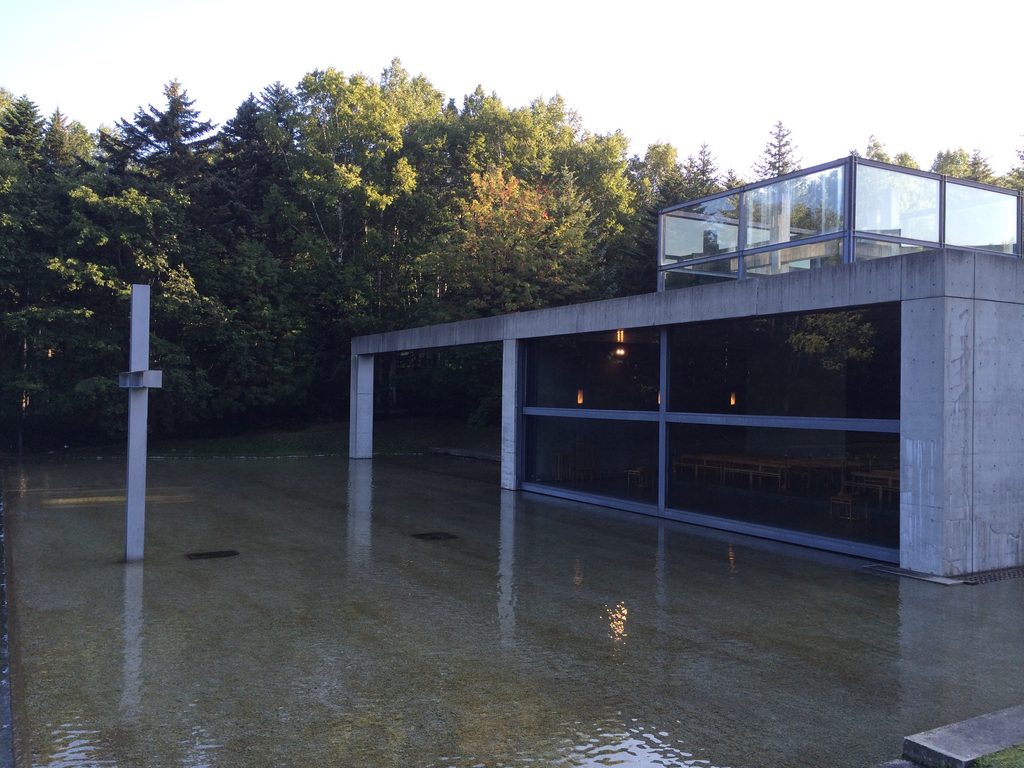
水の教会における自然と建築の関係は、一方が他方へ溶け込むことで成立しているのではない。人工物と自然がそれぞれの性質を保ったまま向き合い、その間に生まれる緊張によって、水や森や空といった普段なら背景として見過ごしてしまうものを、改めて意識させる。その関係の中心に十字架が置かれることで、この場所の自然そのものが宗教的な空間へと変換されている。
The relationship between nature and architecture at Church on the Water is therefore not one in which either dissolves into the other. Each retains its own character, and the tension between them causes water, forest, and sky—elements that might otherwise recede into the background—to emerge with renewed presence. By placing the cross at the center of this relationship, Ando transforms the surrounding landscape itself into sacred space.
7. 建築を通り抜けたあと、自然をもう一度見る
After Passing Through Architecture, We See Nature Again
礼拝堂を出て再び外部から水の教会を見ると、最初にこの場所へ到着したときと同じ建築であるにもかかわらず、その見え方が少し変わっていることに気づく。訪れた直後には特徴的なコンクリートの壁やガラスの立方体、水面の十字架という個々の造形として見えていたものが、内部を歩いたあとでは、一つの連続した体験をつくるために配置された要素として理解できるようになる。
Leaving the chapel and looking at Church on the Water once more from outside, the building appears subtly different from the way it did upon arrival. The concrete wall, glass cube, and cross in the water that initially registered as individual architectural forms can now be understood as elements arranged to construct a continuous experience.
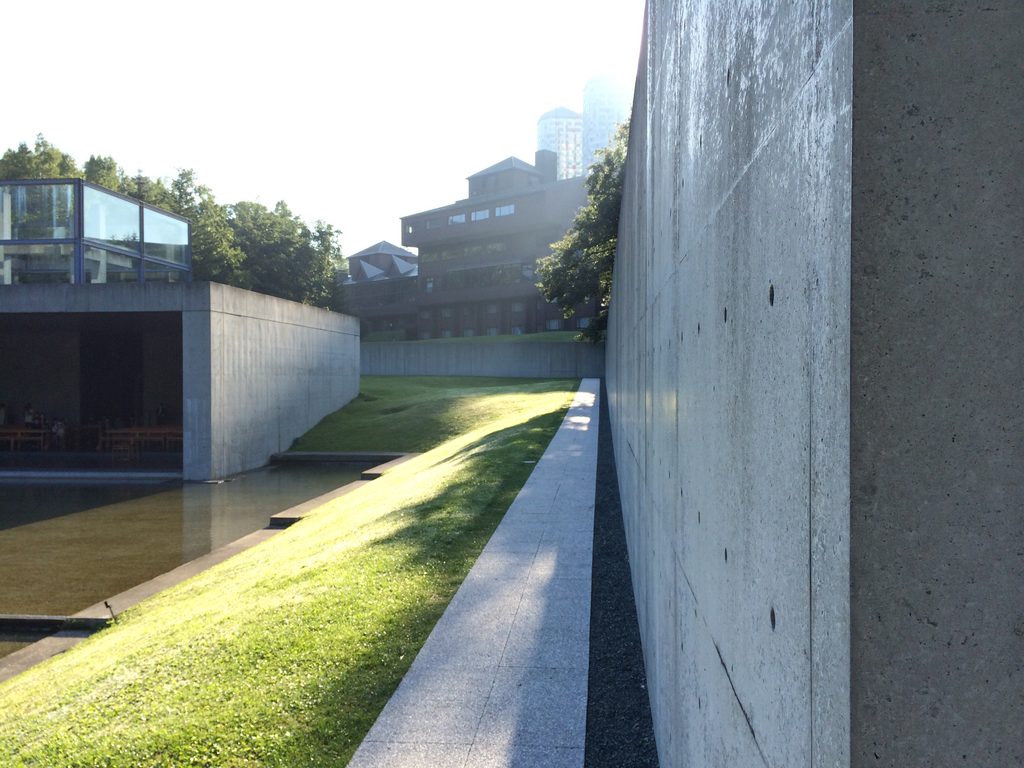
長く伸びるコンクリート壁は、単に外観を特徴づける造形ではなく、最初に水や森を隠すためのものだった。透明なガラスの立方体は、閉ざされた視線を一度空へ開く場所であり、曲面階段の暗さは、礼拝堂へ到達する前に外部の風景を意識から遠ざけるための時間だった。そしてそれらを通過した最後に、水面と十字架、森が正面へ現れる。
The long concrete wall was not simply a formal gesture; it concealed the water and forest at the beginning of the journey. The transparent cube offered a temporary opening toward sky and light, while the darkness of the curved stair removed the landscape from consciousness before the chapel finally revealed the water, cross, and forest directly ahead.
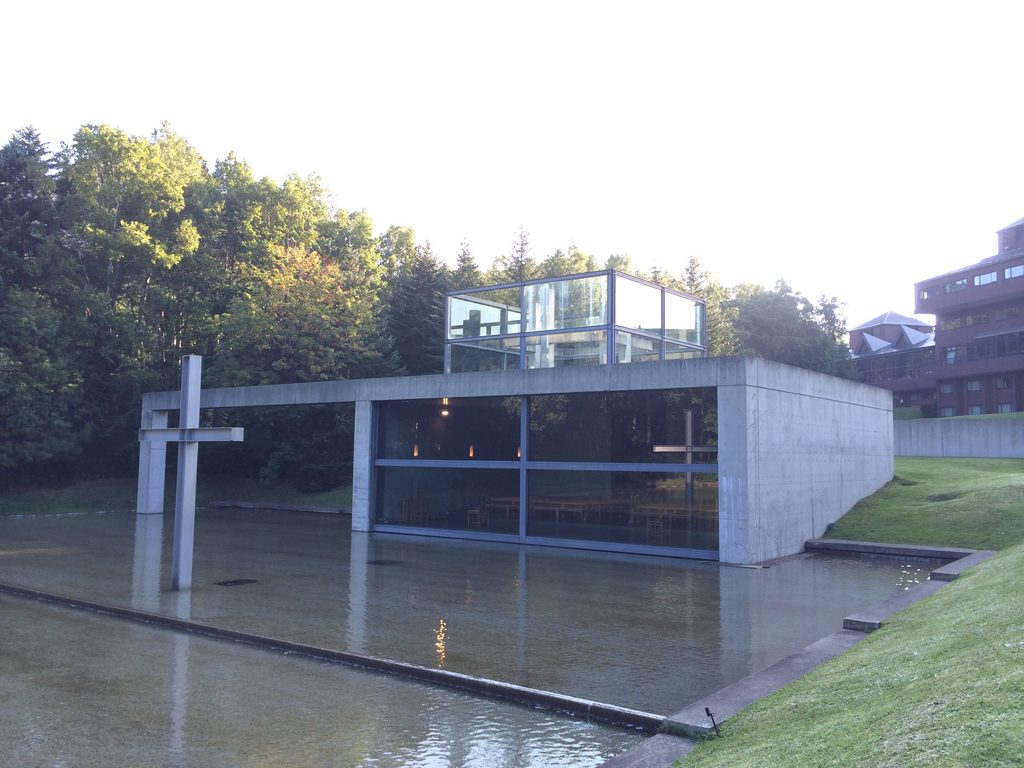
それぞれの場所だけを写真で切り取れば、安藤忠雄らしいコンクリート、幾何学、光の美しさとして見ることができる。しかし実際に歩いてみると、それらは独立した「見どころ」ではなく、視界を閉じたり開いたりしながら人の感覚を変化させる一連のシークエンスとして結びついている。
Seen separately in photographs, each of these places can be appreciated for the qualities commonly associated with Tadao Ando—concrete, geometry, and light. Walking through them, however, reveals that they are not independent architectural highlights. They form a sequence in which the field of vision repeatedly closes and opens, gradually altering the visitor’s perception.
水面に立つ十字架の写真は、水の教会を象徴する一枚として非常に強い。しかし、この建築の本質はその完成された一つの構図だけにはないと思う。その風景へ到達するまでに何を見せず、どの方向へ身体を動かし、どの程度の光と暗さを経験させるのかという「時間」まで含めて、初めて水の教会という建築が成立している。
The photograph of the cross standing in the water is unquestionably a powerful image and has become synonymous with Church on the Water. Yet the essence of the building cannot be reduced to that single completed composition. What is withheld before the view appears, how the body is redirected, and how light and darkness are experienced along the way are equally fundamental to the architecture.
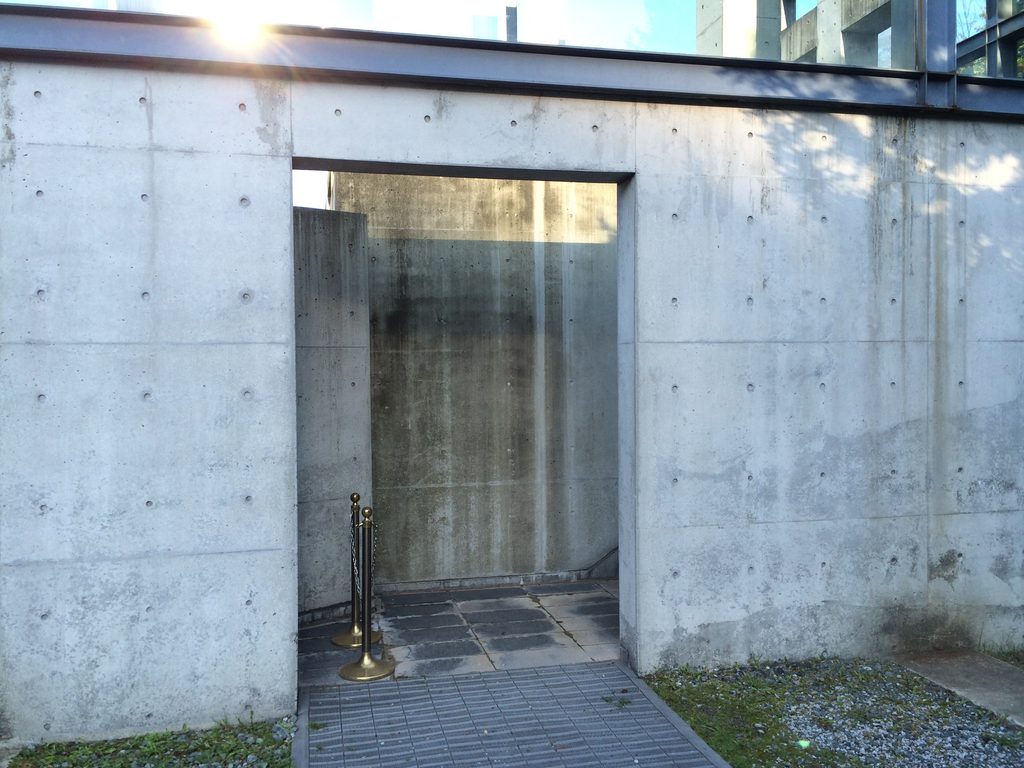
建築を通り抜けたあとにもう一度森や水を見ると、それらは最初からそこにあったものなのに、訪れたときよりも存在感を増して感じられる。建築が自然に何かを付け加えたからではなく、壁や光、暗闇、歩行によって人の見方そのものが変化したからだろう。
水の教会では、建築を体験したあとに残るものがコンクリートの形だけではない。水面の静けさ、森の奥行き、空の明るさ、風によるわずかな揺らぎまでが、建築の記憶と分けることのできないものとして残っていく。建築を見るために訪れた場所で、建築を通して自然をもう一度見ることになる。その反転こそが、この作品の最も深い魅力なのだと思う。
After passing through the building, the forest and water are the same forest and water that were present from the beginning, yet they seem to possess greater intensity. Architecture has not added anything to nature itself. Instead, through walls, movement, darkness, and light, it has altered the way the visitor perceives what was already there.
What remains after experiencing Church on the Water is therefore not only the memory of concrete geometry. The stillness of the water, the depth of the forest, the brightness of the sky, and the subtle movement produced by wind become inseparable from the memory of the architecture. One comes here to see a building, yet through that building one learns to see nature again. It is in this reversal that the deepest power of Church on the Water can be found.
My Impression
水の教会は、実際に訪れる以前から何度も写真で見ていた建築だった。水面の中央に一本の十字架が立ち、その背後に北海道の森が広がる光景はあまりにも有名で、自分の中にもすでに「水の教会とはこういう場所だ」という完成されたイメージがあった。だから現地へ行けば、あの風景を実際に目の前で見ることが最大の体験になるのだろうと思っていた。
ところが実際に歩いてみて強く印象に残ったのは、その有名な風景だけではなく、むしろそこへ簡単には辿り着かせない建築のつくり方だった。森の中に建物を見つけても、コンクリートの壁が視線を遮り、見たい方向へそのまま進ませてくれない。壁に沿って身体の向きを変え、透明なガラスの空間を通り、そこから再びコンクリートの内部へ入り、曲面壁に沿って暗い階段を降りていく。その間、すぐ近くに存在しているはずの水面や十字架は、断片的に感じられるだけで、あの完成された風景としてはほとんど姿を現さない。
建築写真であれば最初に見せたくなるような光景を、実際の建築は最後まで簡単には見せない。そして礼拝堂へ入り、それまで閉じられていた視界が一気に水面へ開いた瞬間、それまで歩いてきた壁やガラス、階段、暗がりの意味が一つにつながったように感じた。
Long before I visited Church on the Water, I had seen photographs of it many times. The image of a single cross standing in the water with the forests of Hokkaido beyond is so well known that I already carried a completed image of the building in my mind. I expected that seeing this famous landscape in person would naturally become the central experience of the visit.
What stayed with me most strongly, however, was not only that view, but the way the architecture refuses to let you reach it easily. Even after finding the building within the forest, a concrete wall blocks the line of sight and prevents you from simply walking toward what you want to see. You follow the wall, change direction, enter the transparent glass enclosure, return to concrete, and descend along the curved wall into a darker space. Throughout this sequence, the water and cross that you know must be close remain present only as fragments rather than as the complete image familiar from photographs.
A view that an architectural magazine might place on its opening spread is withheld by the actual building until almost the end. When I finally entered the chapel and the restricted field of vision opened toward the water, the wall, glass, stairway, and darkness I had just passed through suddenly seemed to belong to a single idea.
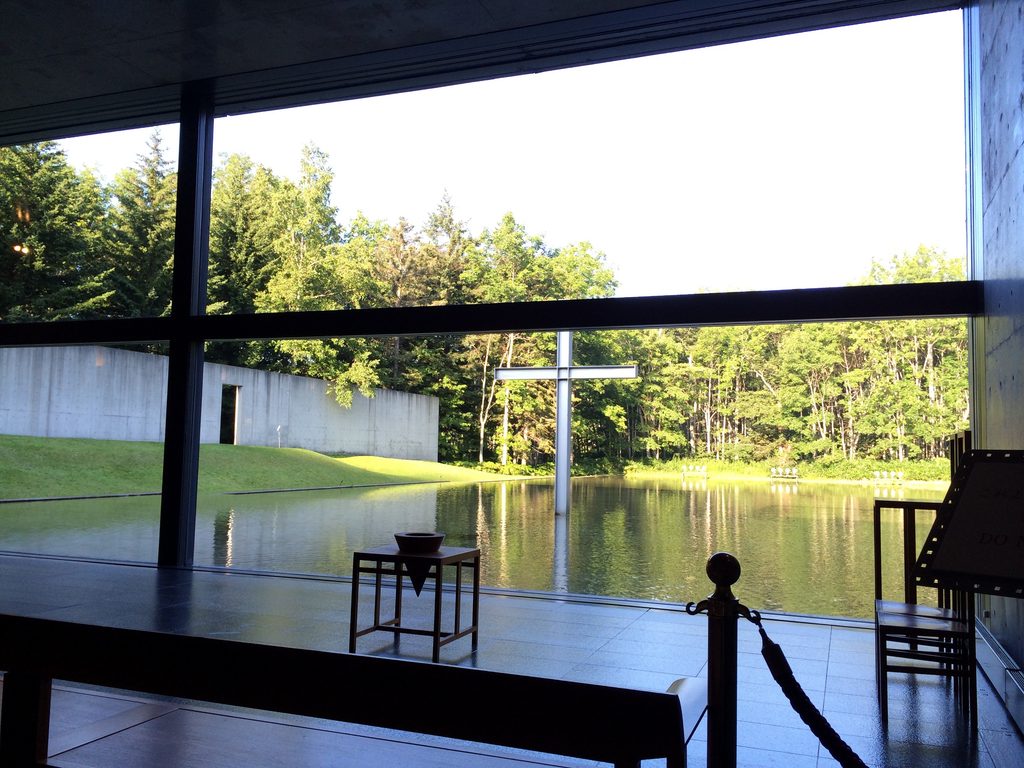
暗いコンクリートの内部から見る水面は、屋外から直接眺めるよりもはるかに明るく感じられた。森の緑も、水の中に立つ白い十字架も、その場所だけが強い光を持っているように鮮明に見える。しかし実際には、そこにある自然そのものが変化したわけではない。建築によって一度風景から切り離され、暗い空間を通過したことで、自分自身の見方が変えられていたのだと思う。
この体験から改めて感じたのは、安藤忠雄が北海道の美しい自然をそのまま見せるためだけに、この教会をつくったのではないということだった。自然は最初からそこにある。だからこそ、ただ大きな窓を開けて見せるのではなく、一度壁によってその存在を遠ざけ、身体を動かし、光の量を変えたうえで、もう一度自然と向き合わせる。その過程を建築によってつくることで、見慣れているはずの水や森や光が、それまでとは異なるものとして立ち上がってくる。
水の教会を訪れて、安藤建築の魅力は打放しコンクリートそのものの美しさだけではないことも、改めて強く感じた。もちろんコンクリートの壁も、ガラスの立方体も、曲面階段も、一つひとつを切り取れば非常に安藤らしい強い造形を持っている。しかし、それらの造形は最終的に自分自身を見せるためだけに存在しているのではなく、水や森や空を見るための条件をつくり、人の身体と視線をそこへ導くために使われている。
外へ出て最後にもう一度建物を振り返ると、低いコンクリートの壁と透明なガラスの立方体の向こうに、北海道の森と山が広がっていた。訪れる前であれば、その風景を見て「安藤忠雄らしい美しい建築だ」と感じただけだったかもしれない。しかし一度その内部を歩き、壁によって自然を失い、暗がりを降り、礼拝堂から再び水と森に出会ったあとでは、建築だけを切り離して見ることができなくなっていた。コンクリートを見ることと、水や森や空を見ることが、一つの体験として結びついていたからである。
Seen from the dark concrete interior, the water appeared far brighter than when viewed directly from outside. The green of the forest and the white cross standing in the water also seemed unusually vivid, almost as if that part of the landscape possessed its own light. Yet nothing in nature itself had changed. What had changed was my perception after being separated from the landscape and led through darkness before encountering it again.
That experience made me feel that Ando did not create this church simply to display the beauty of Hokkaido. Nature was already there. Rather than opening a large window and presenting it immediately, he temporarily distances the visitor from it, changes the direction of the body, reduces the amount of light, and only then allows the landscape to return. Through this architectural process, water, forest, and light that might otherwise be accepted as ordinary scenery acquire an unexpected intensity.
Visiting Church on the Water also reinforced for me that the appeal of Ando’s architecture cannot be reduced to the beauty of exposed concrete. The walls, glass cube, and curving stair are all unmistakably powerful architectural forms when seen individually. Yet they are not there only to be admired as objects. They establish the conditions through which water, forest, sky, and light can be perceived, guiding both the body and the gaze toward something beyond architecture itself.
When I stepped outside and looked back at the building one final time, the low concrete walls and transparent glass cube stood against the forest and mountains of Hokkaido. Before walking through it, I might simply have thought that this was a beautiful and unmistakably Ando-like composition. After having lost sight of nature behind the walls, descended through darkness, and encountered water and forest again from the chapel, however, I could no longer separate the building from its surroundings. Looking at the concrete had become inseparable from looking at the water, forest, and sky.
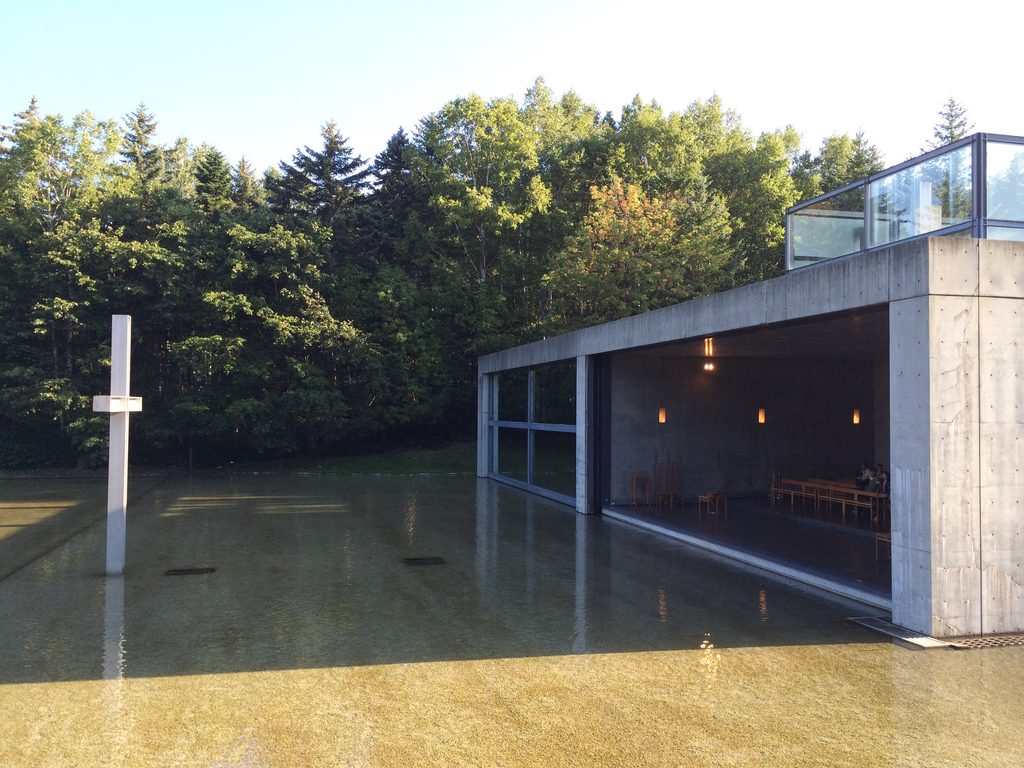
安藤忠雄の建築を見に来たはずなのに、最後に記憶へ残るのは、建築だけではない。水面の静けさや森の深さ、ガラスに映った空、暗い礼拝堂の先に見えた光までが、コンクリートの記憶と重なっている。
水の教会は、自然の中に美しい建築を置いた作品ではなく、建築を通して自然を見るという行為そのものをつくり直した作品なのだと思う。
そして建築を見終えたあと、それまで背景だったはずの北海道の自然が、訪れる前よりも少し鮮明に見えていた。その感覚こそ、今回この場所を実際に歩いたことで初めて理解できた、水の教会の最も大きな魅力だった。
I had come to see the architecture of Tadao Ando, yet what remained in my memory was not architecture alone. The stillness of the water, the depth of the forest, the sky reflected in glass, and the light beyond the dark chapel had all become intertwined with the memory of the concrete.
Church on the Water is not simply a beautiful work of architecture placed within nature. It is a work that reconstructs the very act of seeing nature through architecture.
After leaving the building, the landscape of Hokkaido that had previously seemed like a background appeared somehow more vivid. That change in perception was something no photograph had prepared me for, and it was perhaps the most important thing I understood only by walking through Church on the Water myself.
Archive Gallery