【安藤忠雄建築】頭大仏|見えないことで、存在を深くする安藤忠雄のランドスケープ(Hill of the Buddha|Tadao Ando’s Landscape That Deepens Presence Through Concealment)
建築概要
Architecture Overview
- 名称:頭大仏
- 設計:安藤忠雄
- 所在地:北海道札幌市南区滝野2番地・真駒内滝野霊園
- 完成: 2015年
- 一般公開: 2016年
- 用途:礼拝空間
- 大仏高さ: 13.5m
- 大仏重量: 1,500t
- トンネル長: 約40m
- Name:Hill of the Buddha
- Architect:Tadao Ando
- Completed:2015
- Public Opening:2016
- Location:Makomanai Takino Cemetery, Sapporo, Hokkaido, Japan
- Type:Sacred space
- Height of Buddha:13.5 m
- Weight of Buddha:1,500 tons
- Tunnel Length:Approximately 40 m
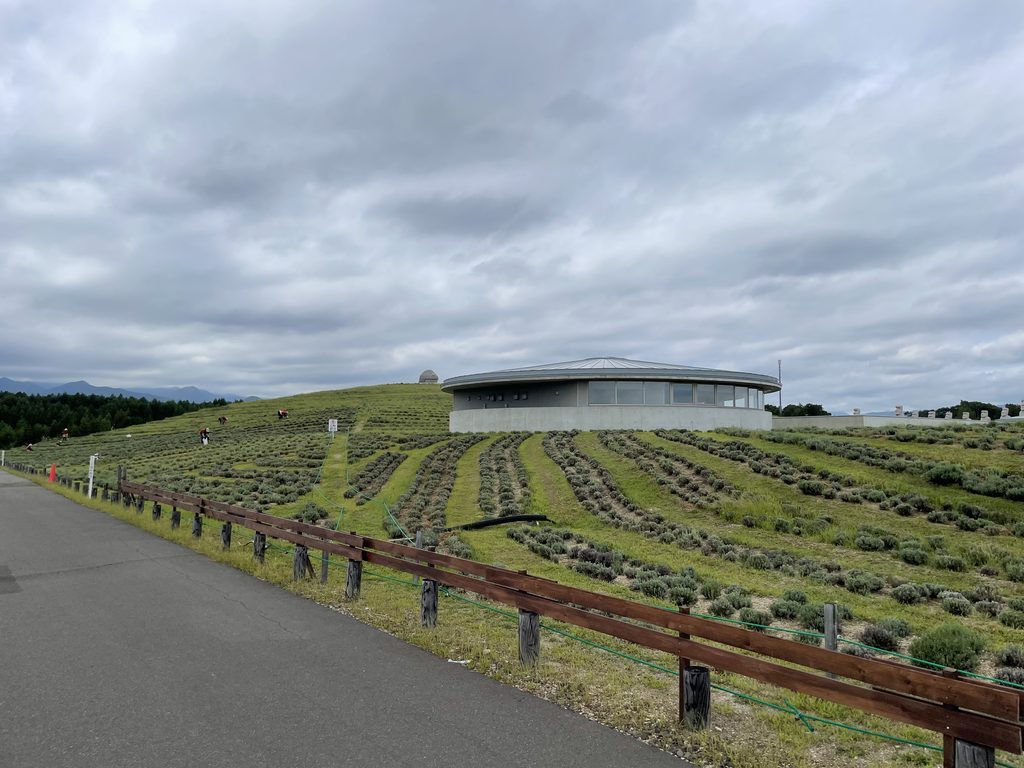
北海道札幌市の真駒内滝野霊園にある「頭大仏」は、すでにこの場所に存在していた巨大な石像大仏を中心に、安藤忠雄が新たな礼拝空間とランドスケープをつくり上げた作品である。高さ13.5m、重量1,500tの大仏は、計画以前から広大な霊園の中に単独で立っていたが、安藤が選んだのは新しい建築をその隣に付加することではなく、大仏の身体を丘で包み、遠くからは頭部だけが地上に現れる風景へと変える方法だった。丘の内部には約40mのトンネルと、大仏を囲む円形のロタンダが設けられ、地表には約15万株のラベンダーが植えられている。建築というよりもランドスケープのスケールで考えられたこの計画では、コンクリートの形そのもの以上に、地形、植栽、水、暗闇、空、そして人が歩く時間が一体となって大仏との出会いを構成している。
この作品で特に興味深いのは、巨大な対象の存在感を強めるために、安藤が「より大きく見せる」ことではなく、「大部分を見えなくする」という方法を選んだことである。遠くからは丘の上に頭だけが現れ、近づくと水庭やコンクリートの壁によって進路を変えられ、大仏の姿そのものも次第に視界から消えていく。その後、薄暗いトンネルを進み、遠くの光の中から少しずつ大仏の全身が現れ、最後には円形に切り取られた空の下で巨大な石像と向き合う。頭大仏とは、既存の大仏を囲うための建築ではなく、「見るまでの時間」と「見えない時間」を設計することで、すでにそこにあった存在の意味をもう一度つくり直した建築として読むことができる。
Hill of the Buddha, located within Makomanai Takino Cemetery in Sapporo, Hokkaido, is a project in which Tadao Ando created a new sacred landscape around a monumental stone Buddha that had already stood on the site. The 13.5-meter-high, 1,500-ton statue existed before Ando’s intervention, but rather than adding a new building beside it, he chose to cover most of the Buddha’s body with an artificial hill, leaving only the head visible above the ground from a distance. A tunnel approximately 40 meters long and a circular rotunda surrounding the Buddha are embedded within the hill, while the surface is planted with roughly 150,000 lavender plants. Conceived at the scale of landscape rather than as a conventional building, the project is formed through the interaction of topography, planting, water, concrete, darkness, sky, and the time required to move through them.
What makes Hill of the Buddha particularly compelling is that Ando strengthens the presence of a monumental object not by showing more of it, but by making most of it invisible. From afar, only the head rises above the hill. As visitors approach, a water garden and concrete walls redirect their path, while the Buddha itself gradually disappears from view. A dim tunnel then leads toward a distant point of light, where the full figure slowly emerges before the visitor finally reaches the circular rotunda and stands beneath an open sky. Hill of the Buddha can therefore be understood not simply as architecture built around an existing statue, but as a work that redesigns the act of encountering what was already there by carefully controlling what can be seen, what remains hidden, and how long it takes to arrive.
1. 見えているのに、まだ出会えない
Visible, Yet Not Encountered
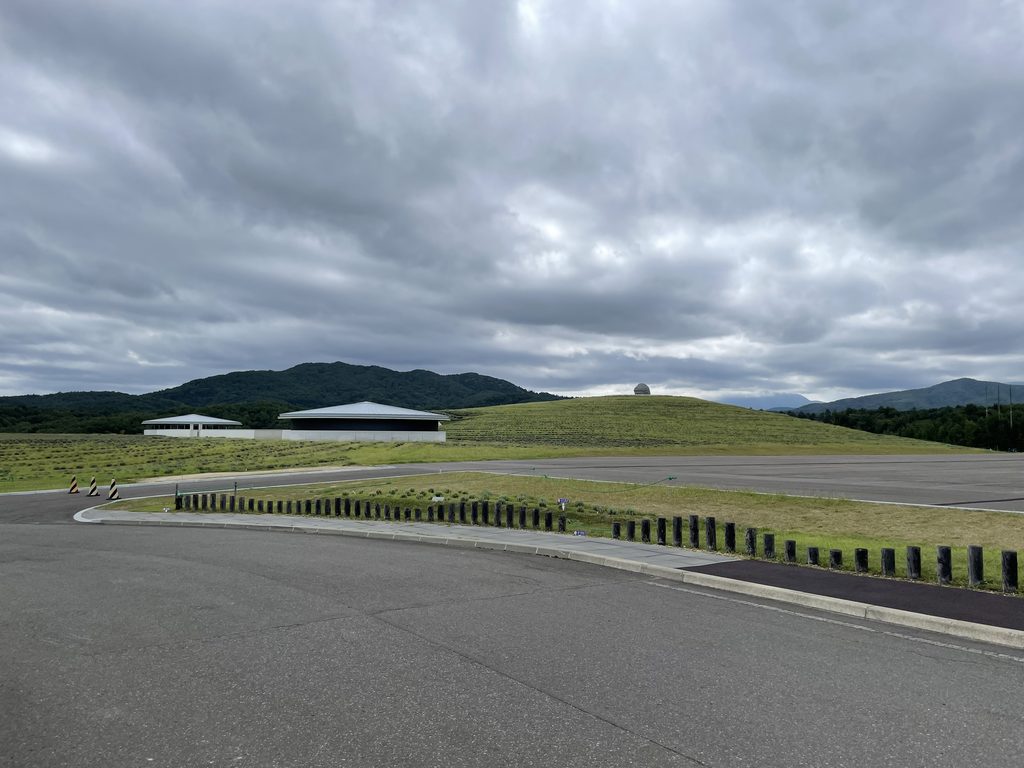
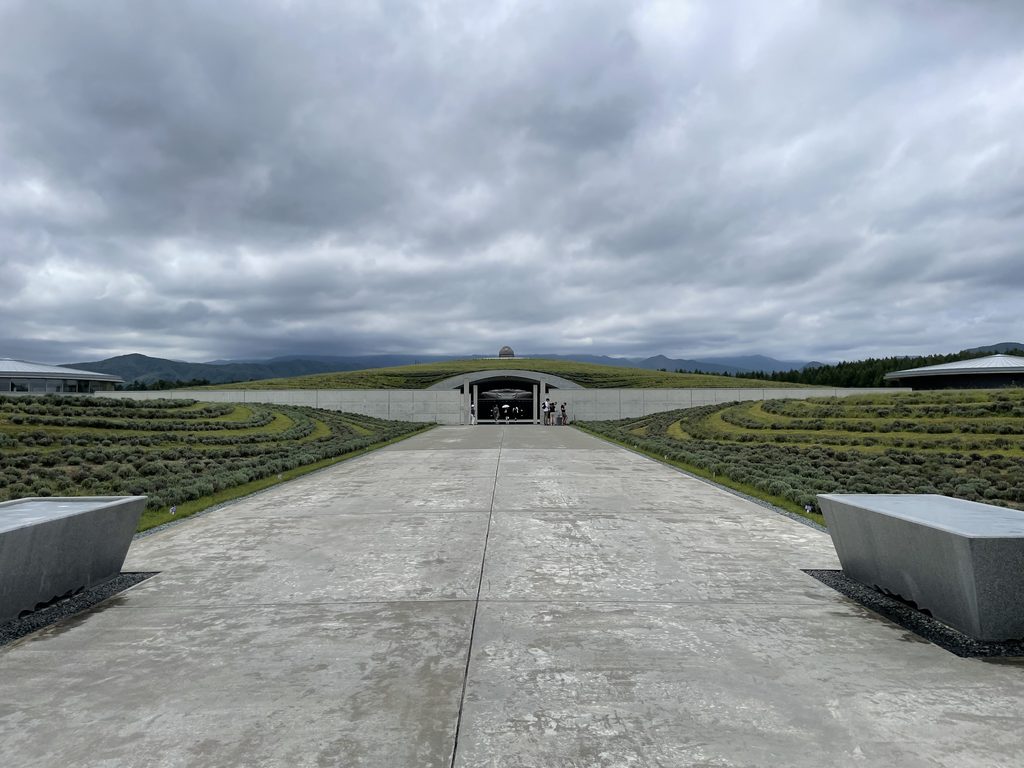
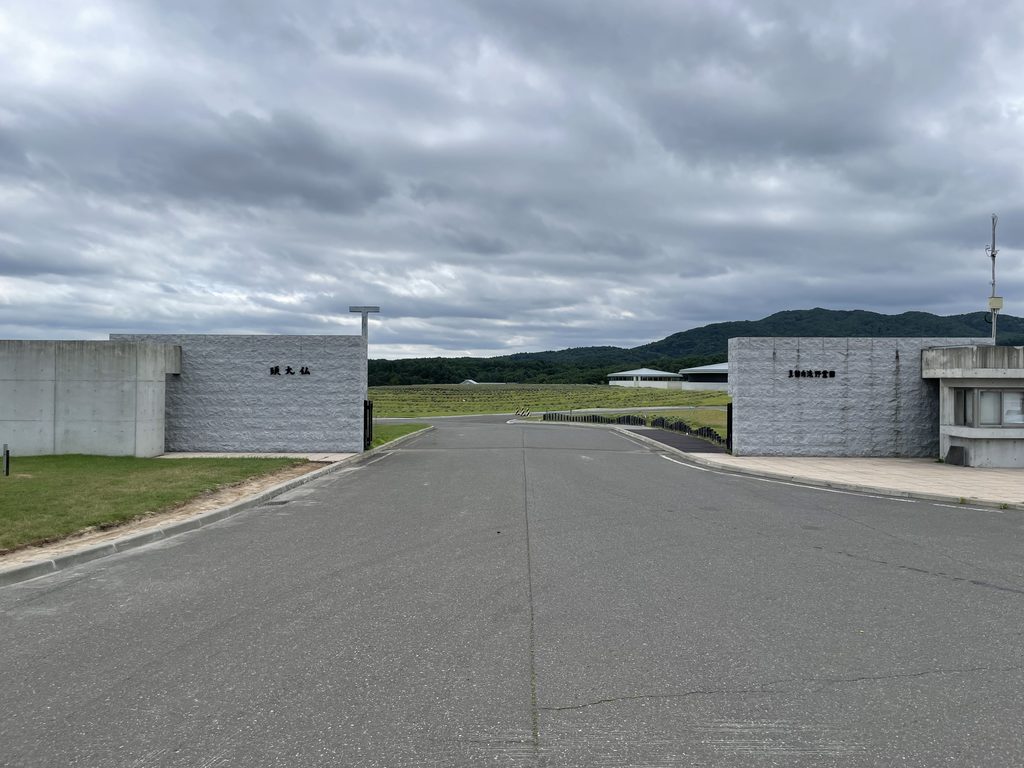
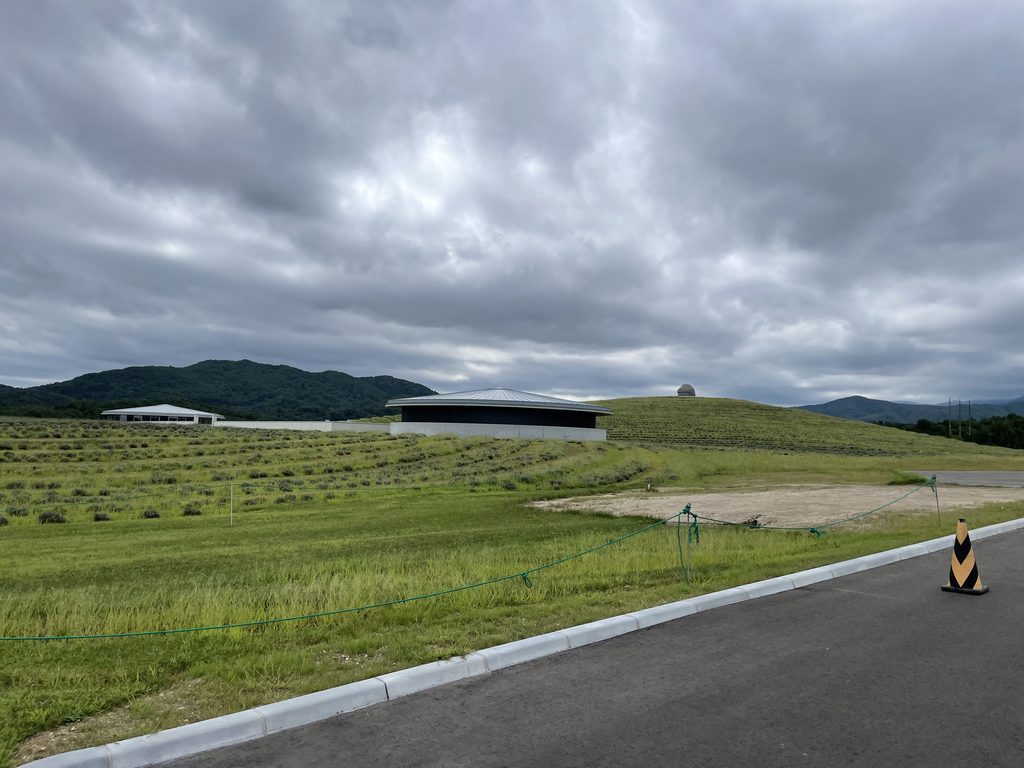
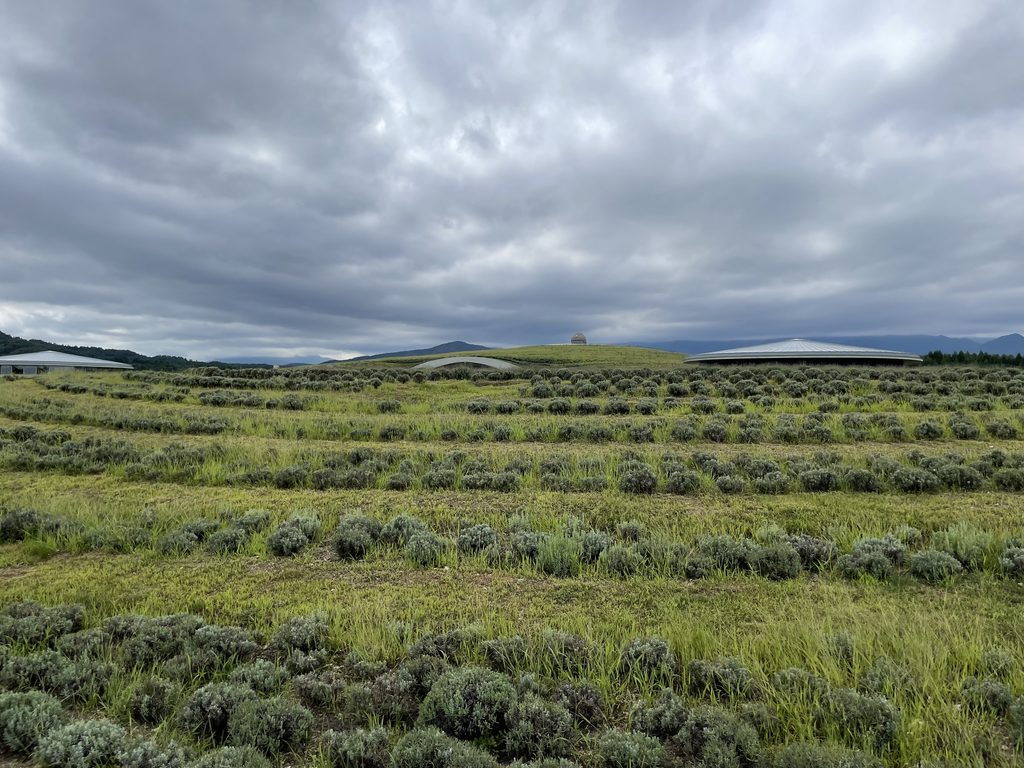
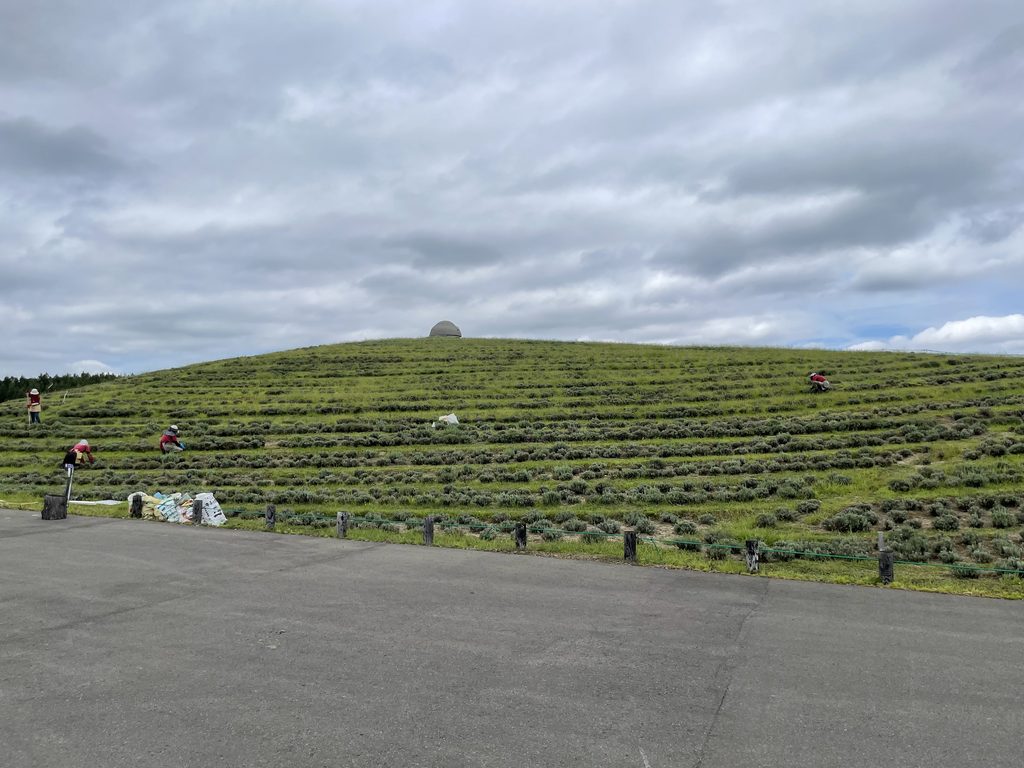
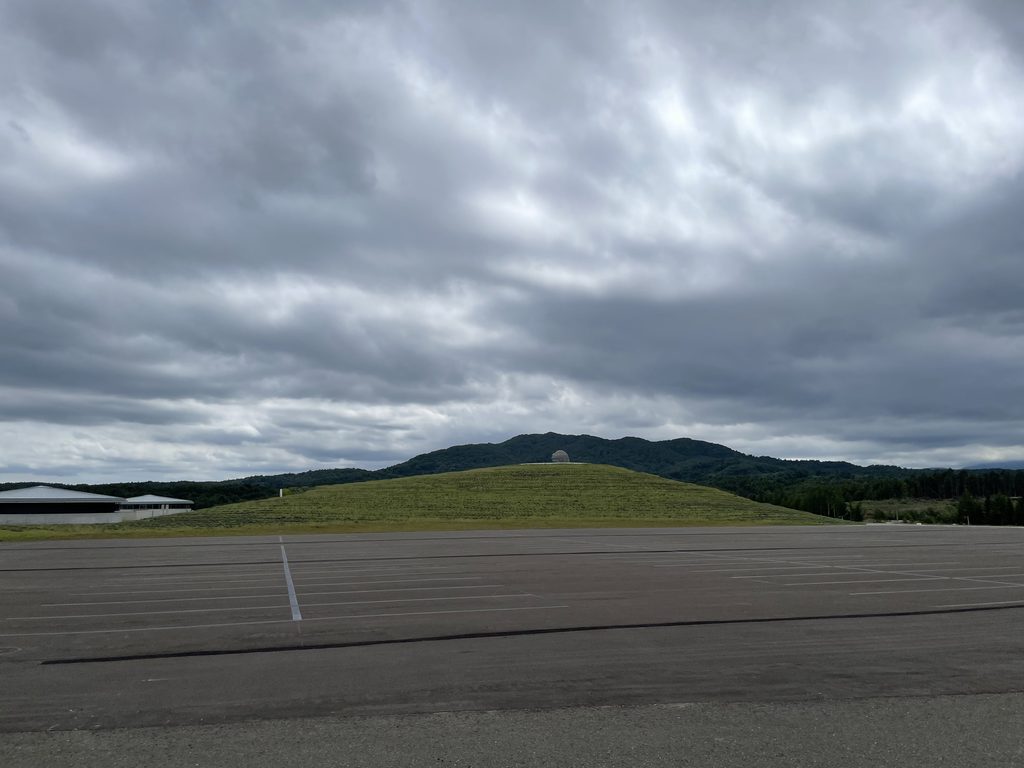
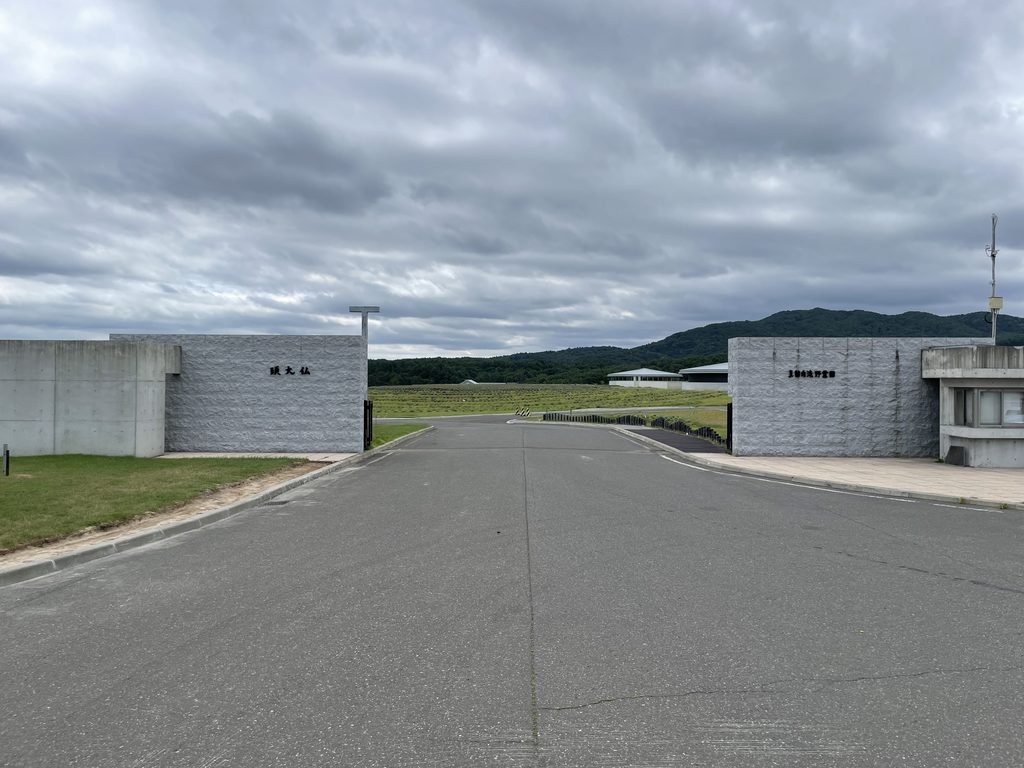
真駒内滝野霊園の広大な敷地を進んでいくと、頭大仏は一般的な巨大仏のように全身を遠くから見せることがない。丘の上に現れるのは頭部だけであり、身体の大部分は地形の中へ隠されている。高さ13.5mという巨大な石像でありながら、そのスケールを最初から直接見せるのではなく、見える範囲をあえて限定することで、むしろ見えない部分への想像を強く働かせる構成になっている。
Moving through the vast grounds of Makomanai Takino Cemetery, one does not encounter the full figure of the Buddha in the manner of a conventional monumental statue. Only the head appears above the hill, while most of the body remains concealed within the landscape. Although the statue itself is enormous, its scale is not revealed immediately. By restricting how much can be seen, the design encourages the imagination to reconstruct what lies beneath the surface.
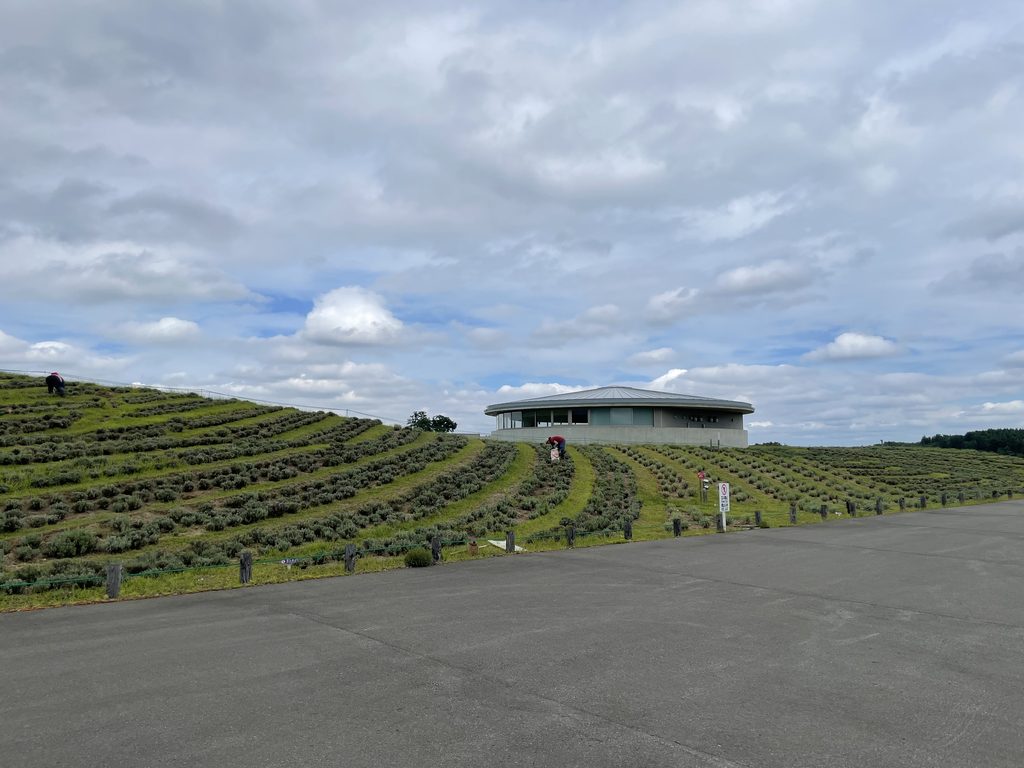
この風景は、もともとこの場所に立っていた大仏を安藤が建築とランドスケープによって再構成した結果として生まれたものである。計画以前の大仏は広い霊園の中にそのまま全身を見せていたが、安藤はその存在をより静かに、より印象深く感じさせるために、身体の大部分を丘の中へ隠し、頭だけを地上に残した。巨大なものをさらに強く見せるために、視覚的な情報を増やすのではなく減らすという発想が、この作品の出発点になっている。
This view is the result of Ando’s decision to reinterpret an existing monument through architecture and landscape. Before the project, the Buddha stood exposed within the cemetery. Rather than making it more prominent through additional height or ornament, Ando covered much of the figure with a planted hill and left only the head visible. The strength of the monument was therefore increased not by adding visual information, but by removing it.
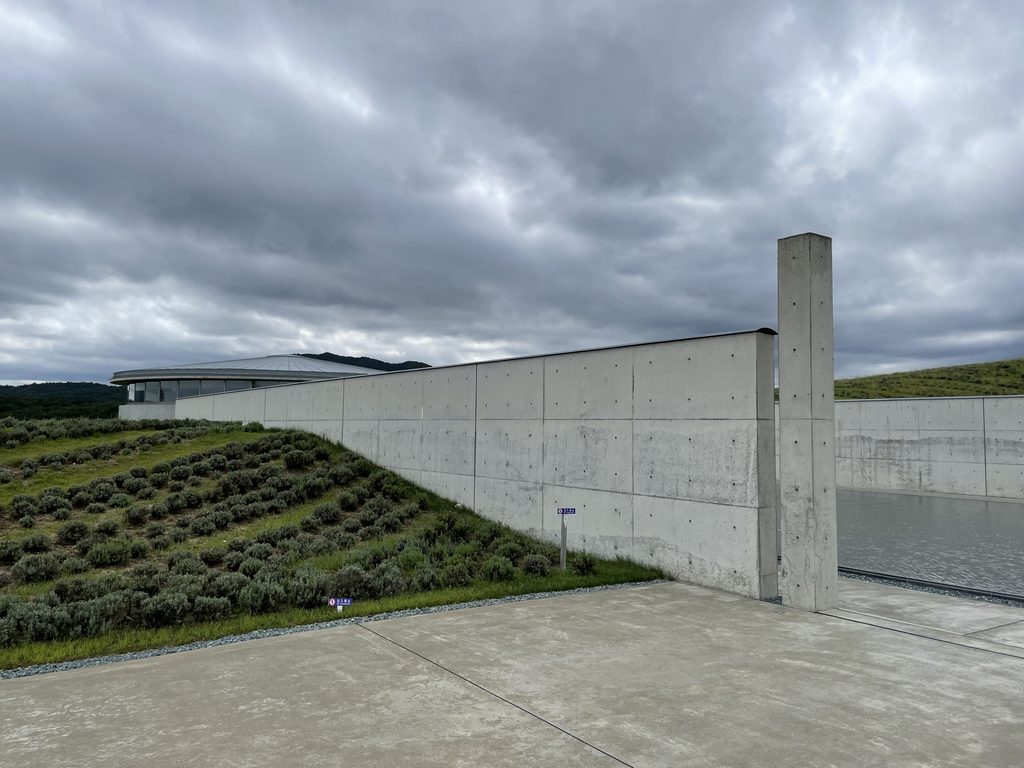
丘の上に浮かぶ頭部だけを見ていると、その下に巨大な身体があり、さらにその周囲を円形のコンクリート空間が取り囲んでいることを、まだ身体的には理解できない。見えている部分が少ないからこそ、訪れた人は自然にその内部を想像し、これから向かう場所への期待を持つようになる。建築が何かを追加する前に、まず「見えない部分」をつくることで、大仏のスケールが視覚ではなく想像力の中で膨らんでいく。
From the outside, the visitor still cannot fully understand that the enormous body of the Buddha and a circular concrete space lie beneath the hill. Precisely because so little is visible, the unseen portion begins to occupy the imagination. Before architecture explains anything, it creates an absence, allowing the scale of the monument to expand mentally beyond what is actually shown.
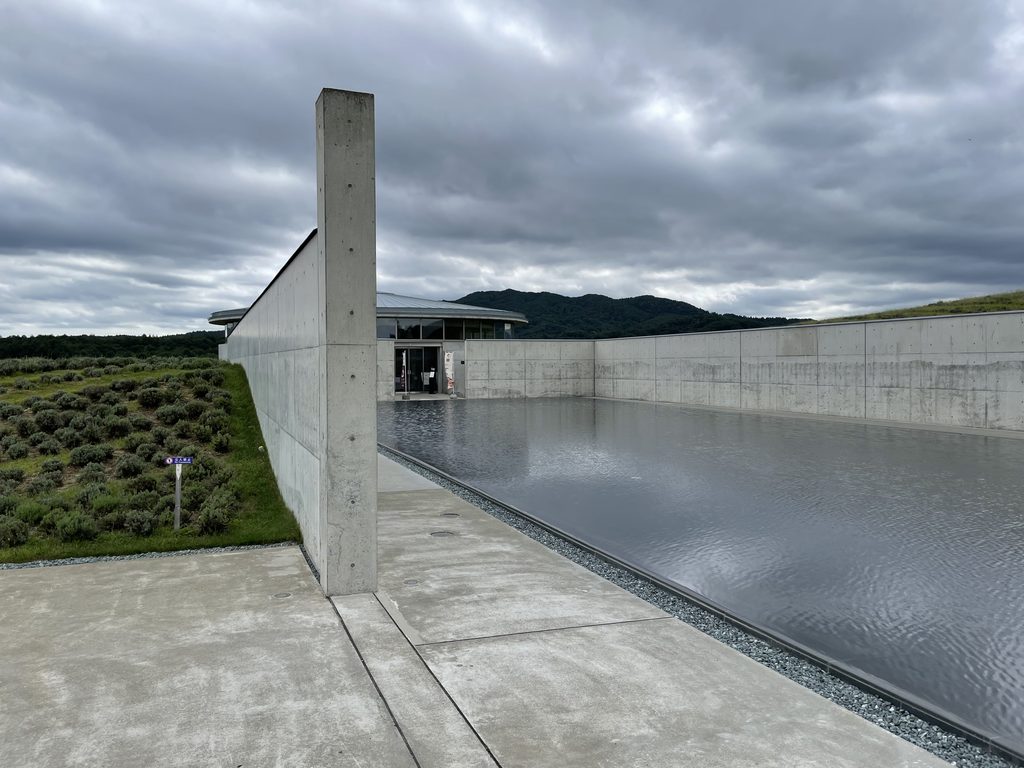
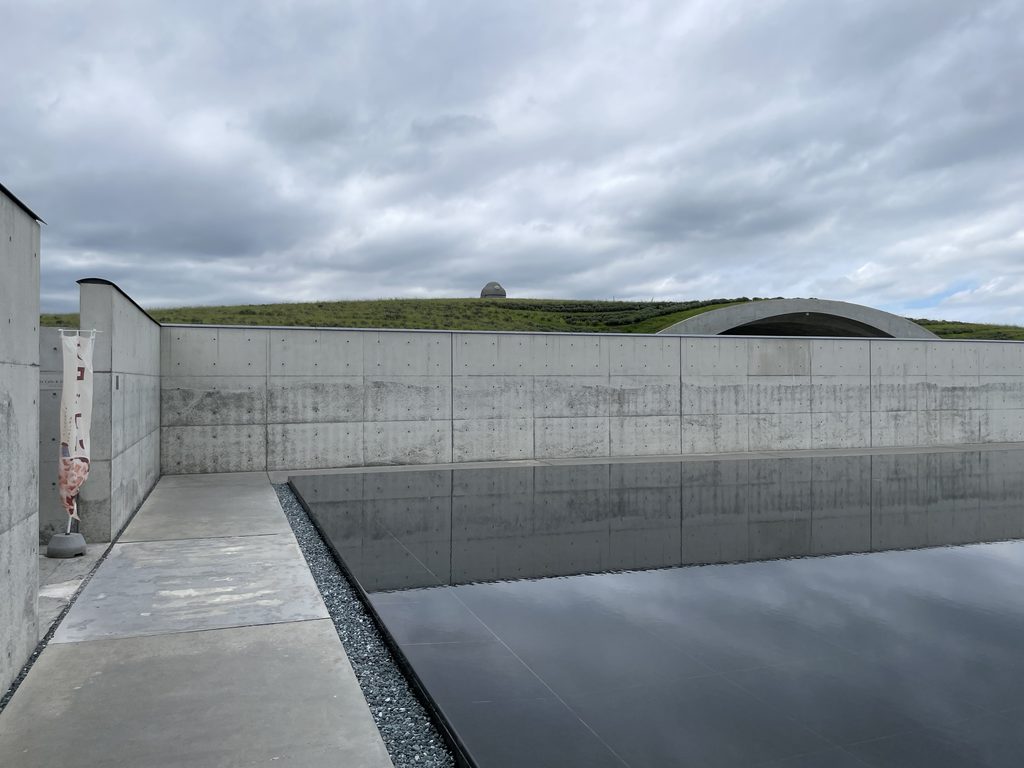
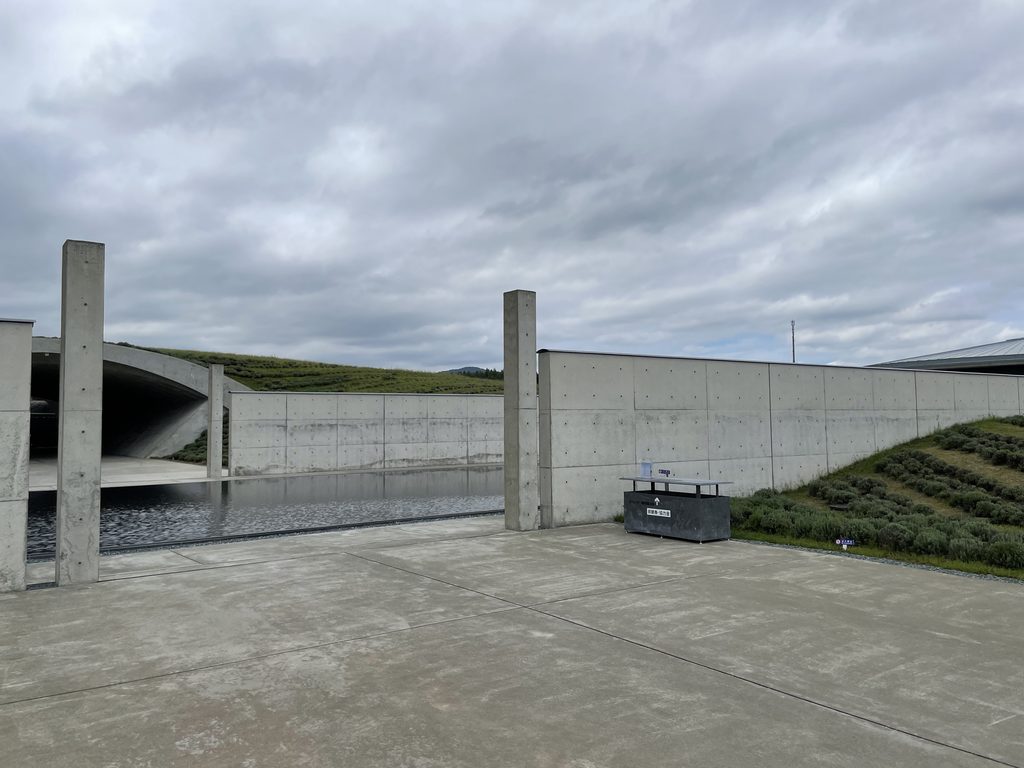
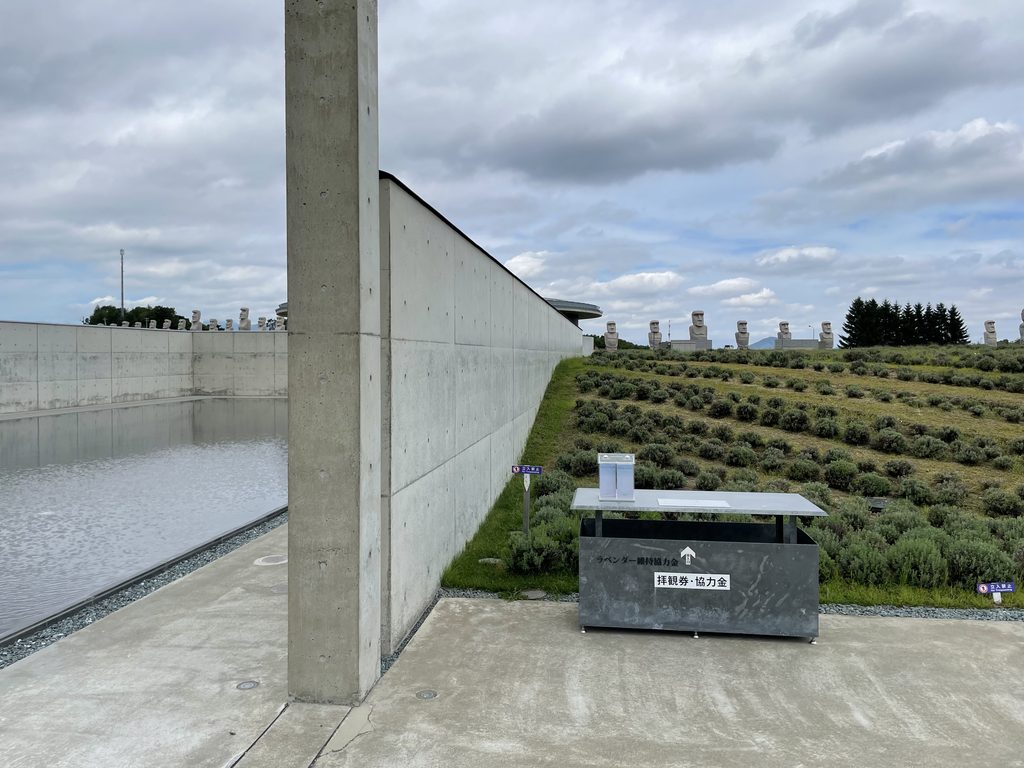
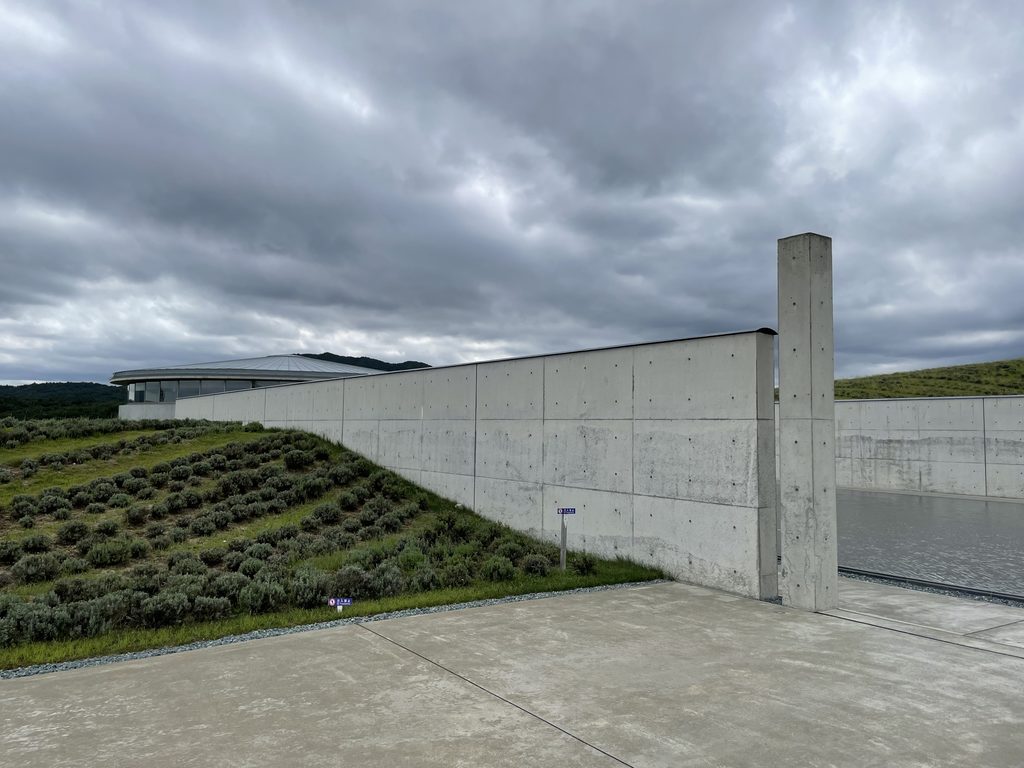
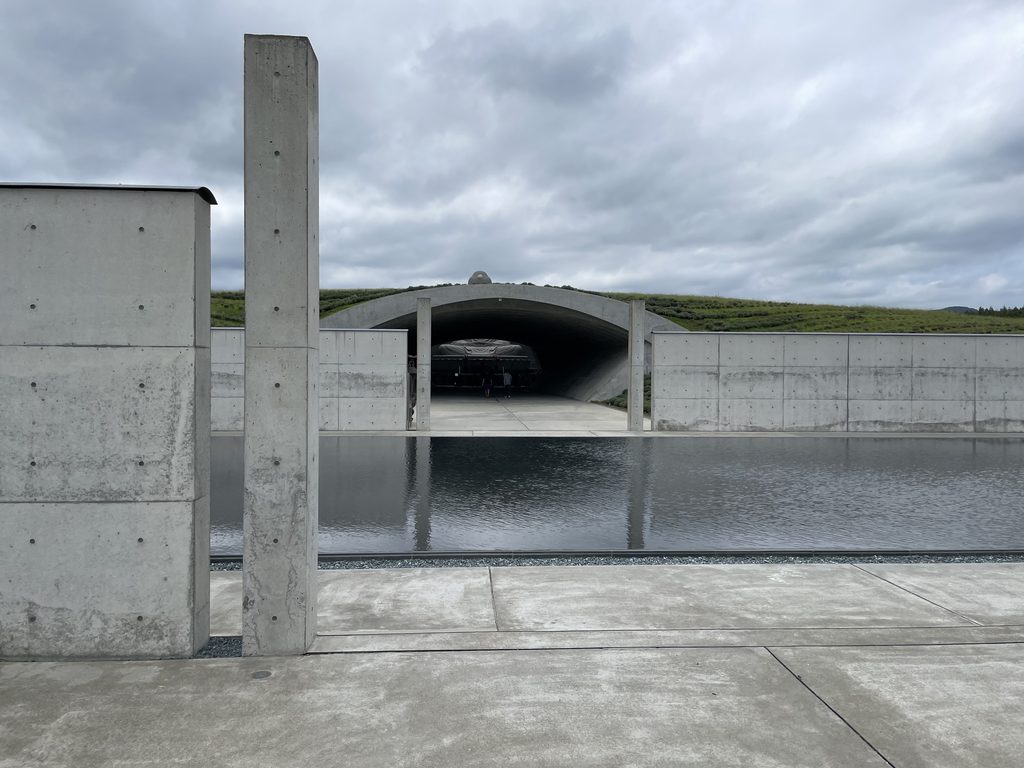
さらに近づいても、大仏の全身がそのまま現れるわけではない。コンクリートの壁が水平に伸び、水庭とともに人の進行方向を調整するため、遠くからは見えていたはずの大仏が、かえって近づくほど視界から消えていく。目的地を知っているのに、その姿を簡単には確認できないという距離の変化が、単なるアプローチを一つの建築体験へ変えている。
Approaching the hill does not immediately resolve this uncertainty. Horizontal concrete walls and a water garden begin to control movement, and the Buddha that had been visible from farther away gradually disappears from sight. The closer one comes physically, the less the object can be seen, creating an inversion between distance and visibility.
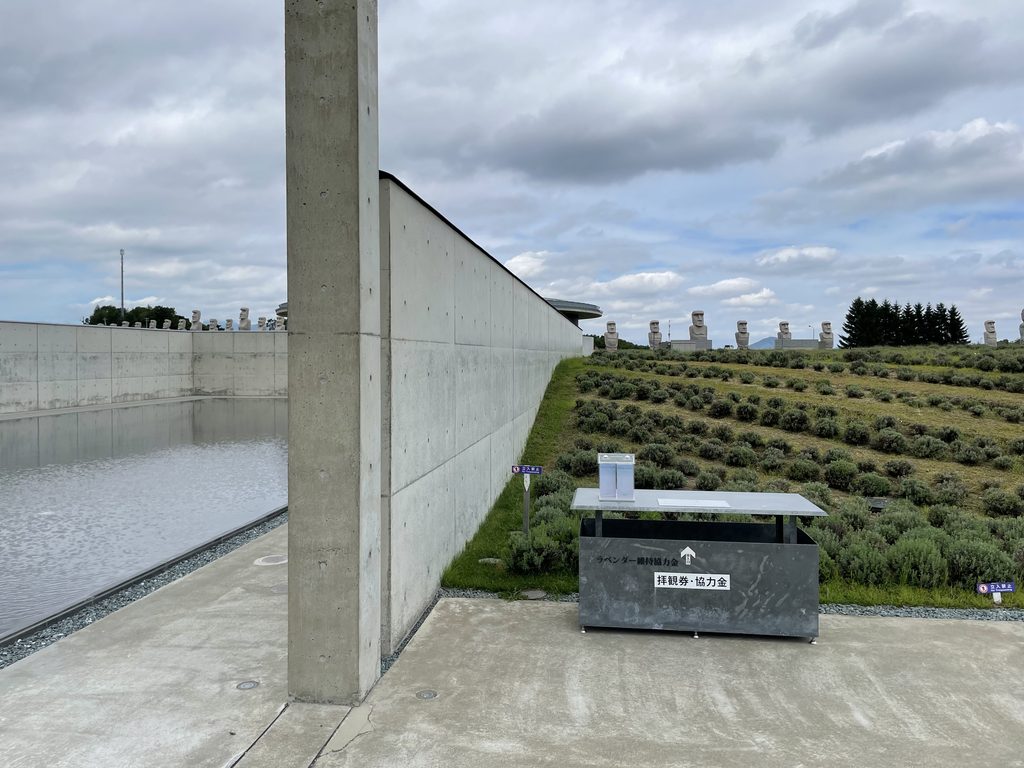
頭大仏の体験は、大仏を見ることから始まっているようでいて、実際にはその姿を少しずつ見失うことから始まっている。最初に頭部だけを見せ、その後に全体を隠し、再び別の形で現すという一連の操作によって、大仏は最初からそこにあるにもかかわらず、訪れた人にとっては何度も違う存在として現れてくるのである。
The experience of Hill of the Buddha therefore begins not with fully seeing the statue, but with progressively losing sight of it. The head first appears alone above the hill, then even that image is withheld, before the Buddha later returns in an entirely different spatial condition. Although the statue itself never moves, architecture causes it to appear repeatedly as if newly encountered.
2. 水を迂回し、まっすぐ進めない時間
A Detour Around Water, and the Time of Not Arriving Directly
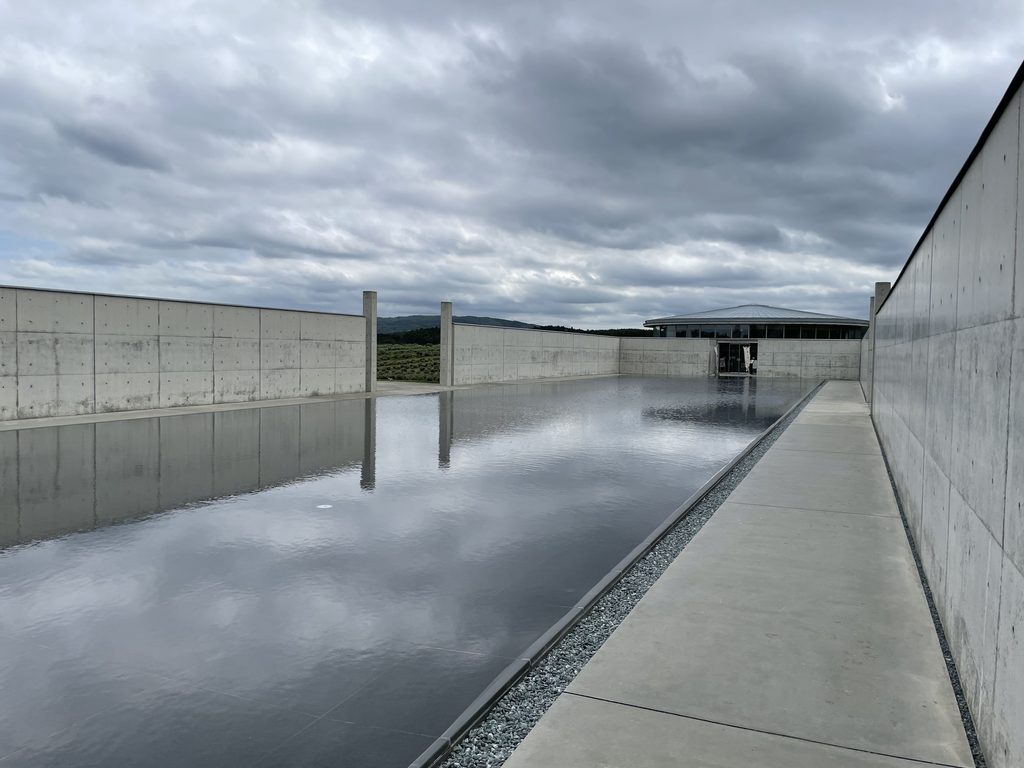
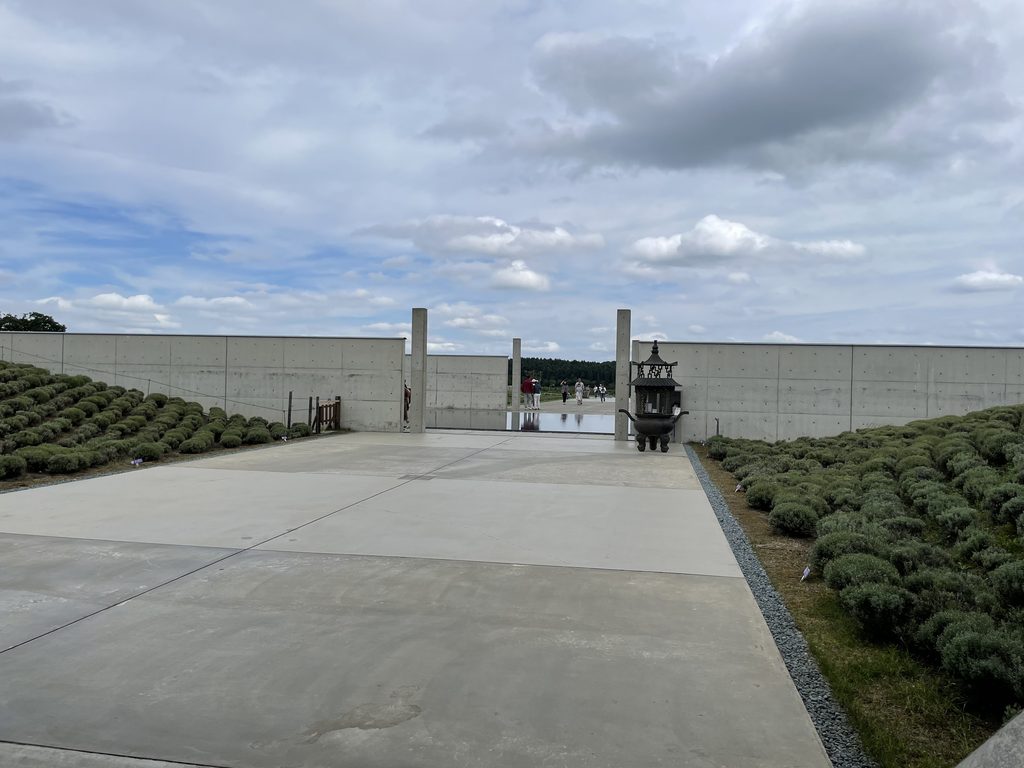
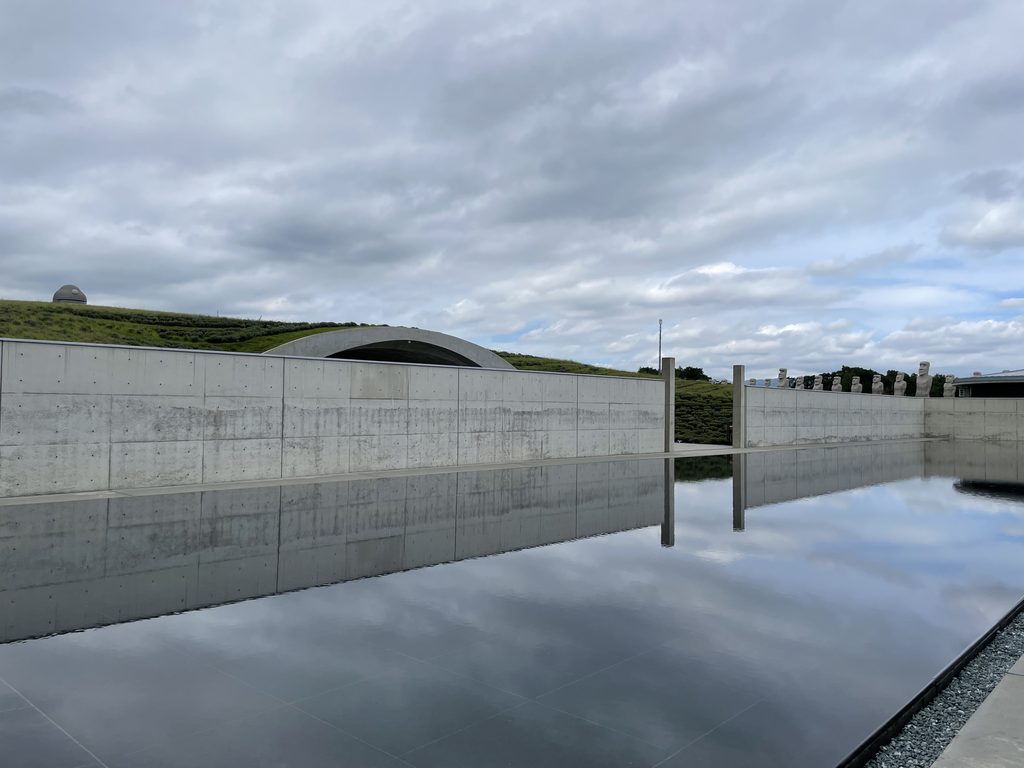
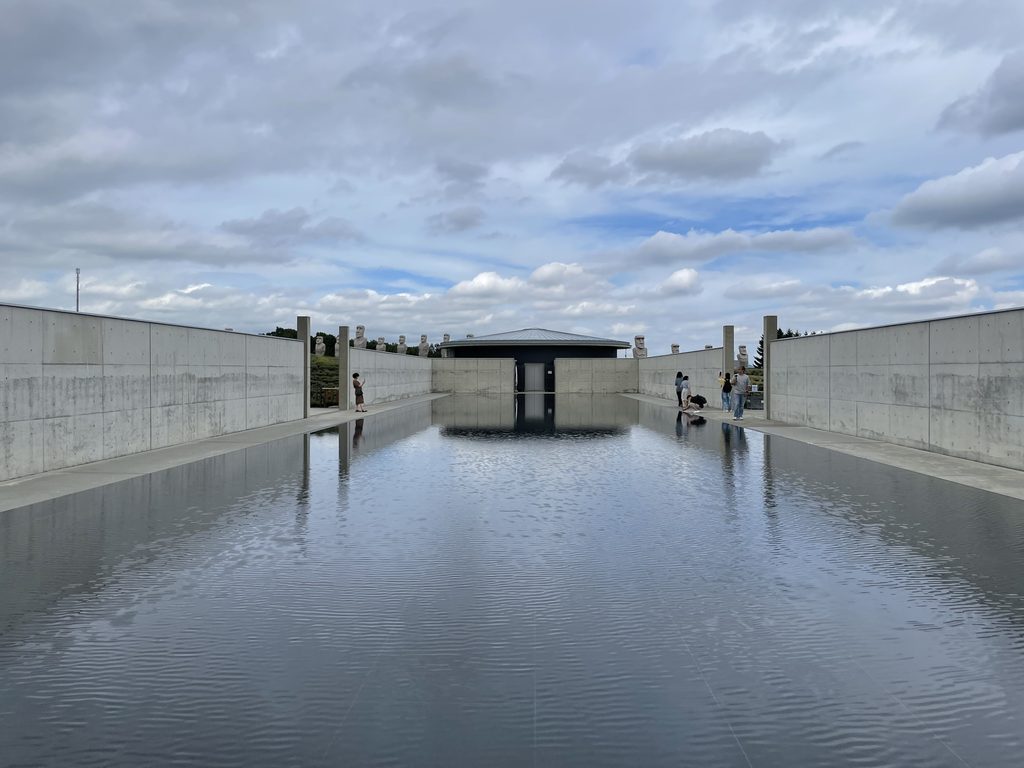
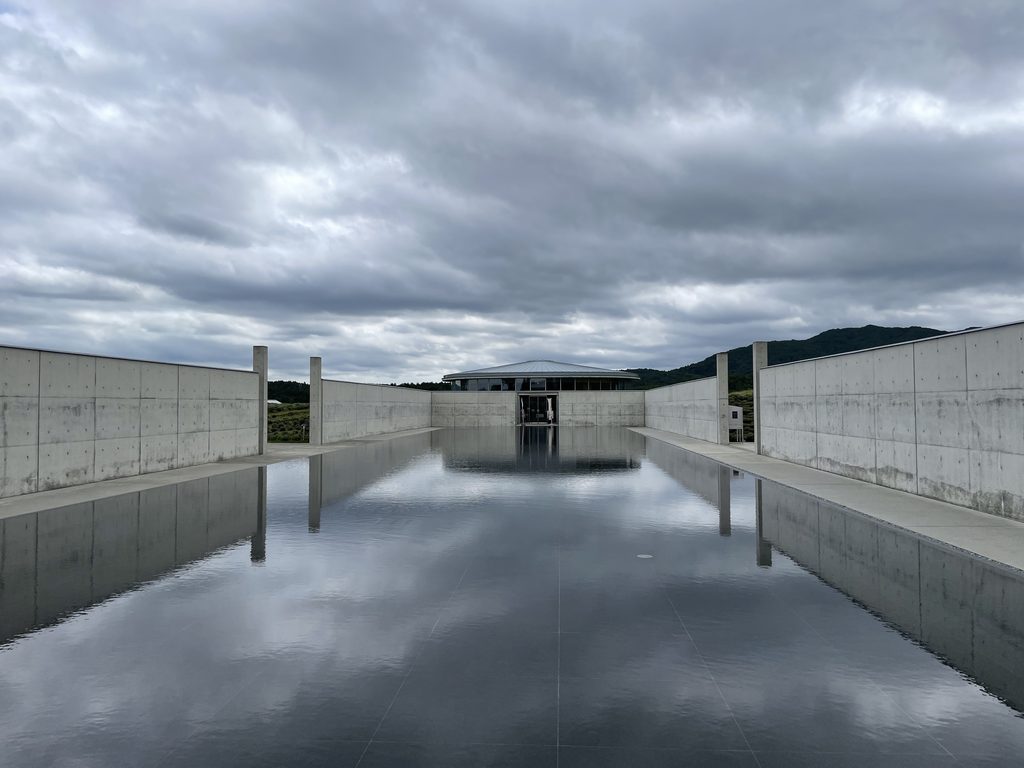
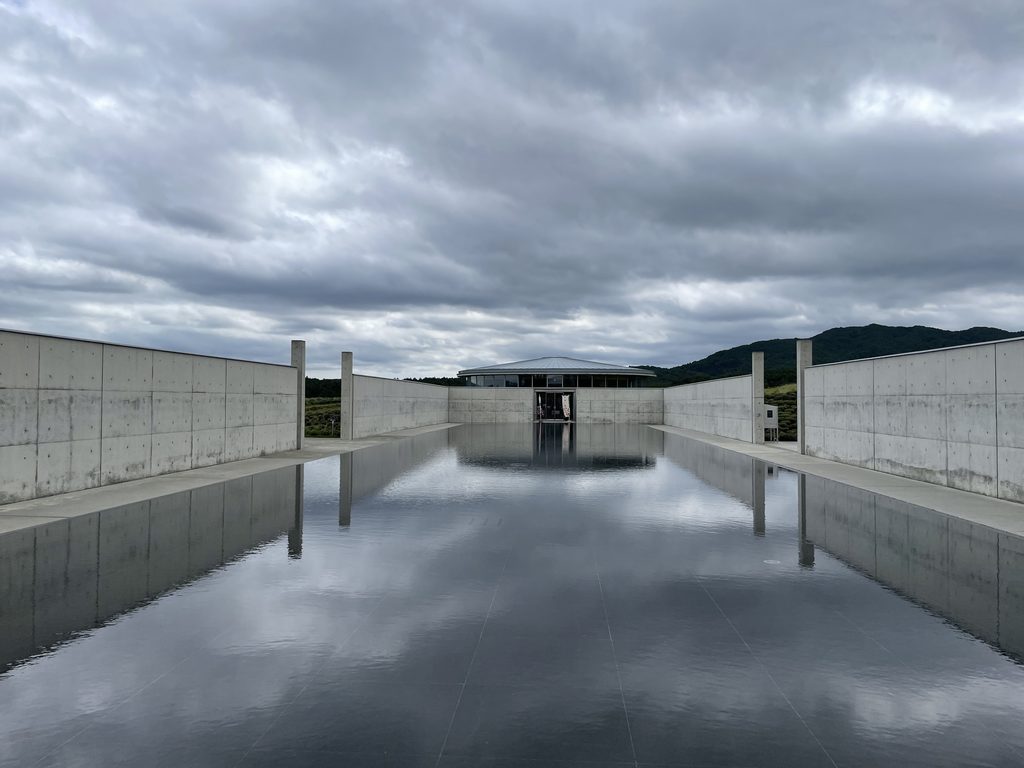
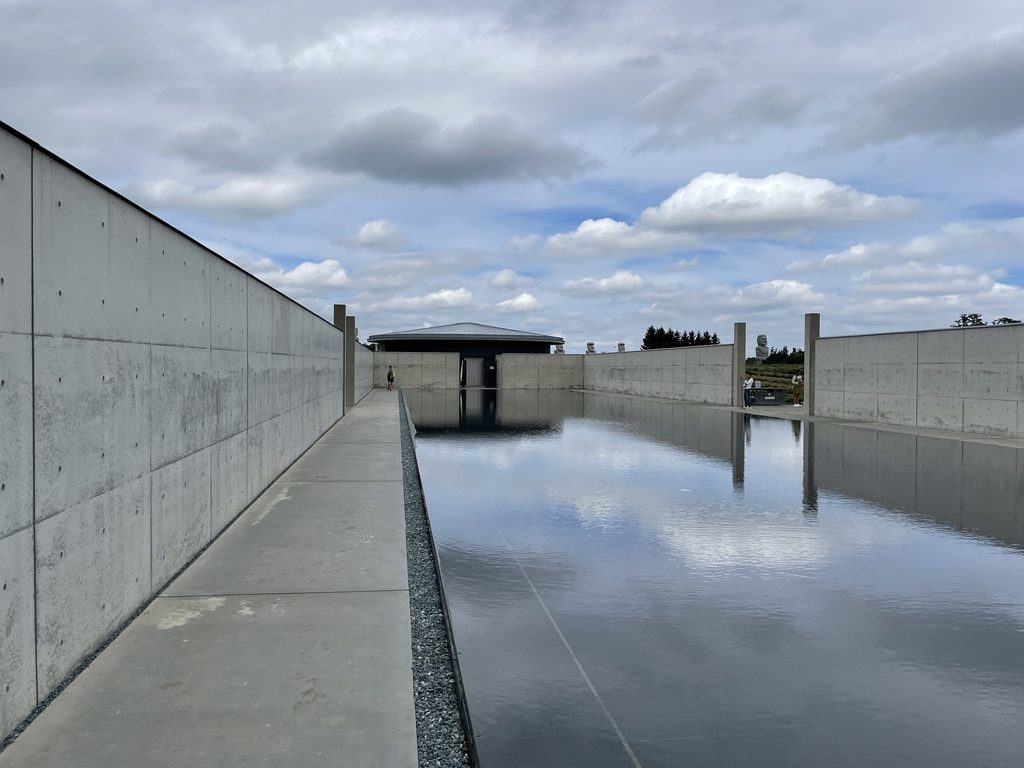
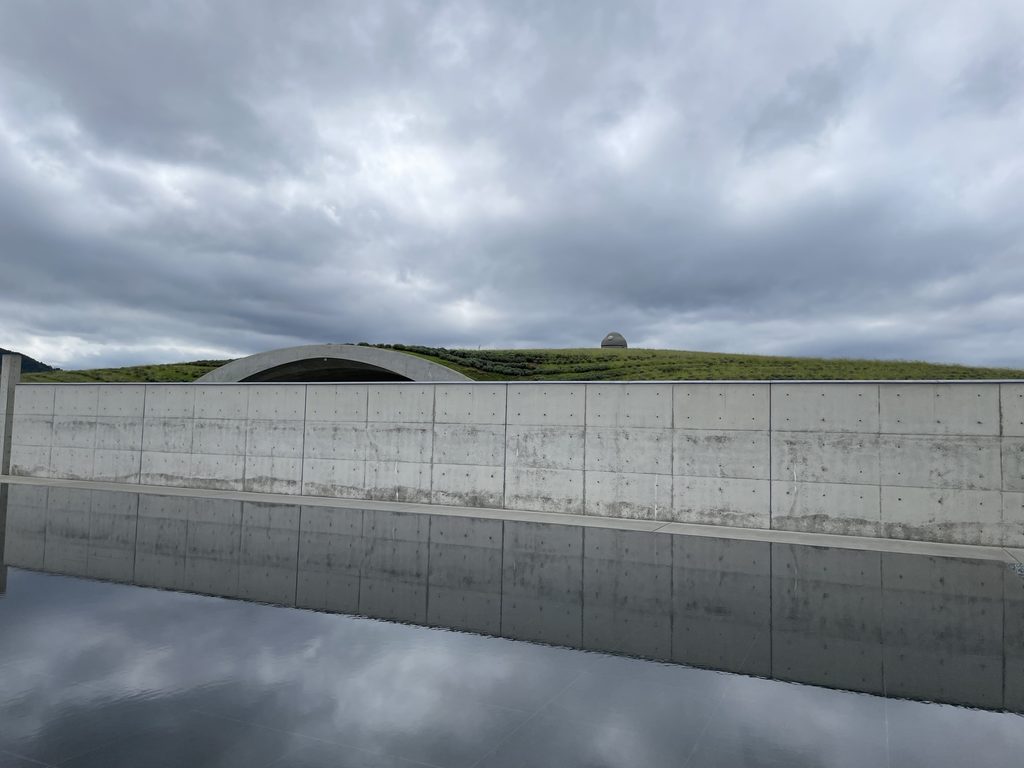
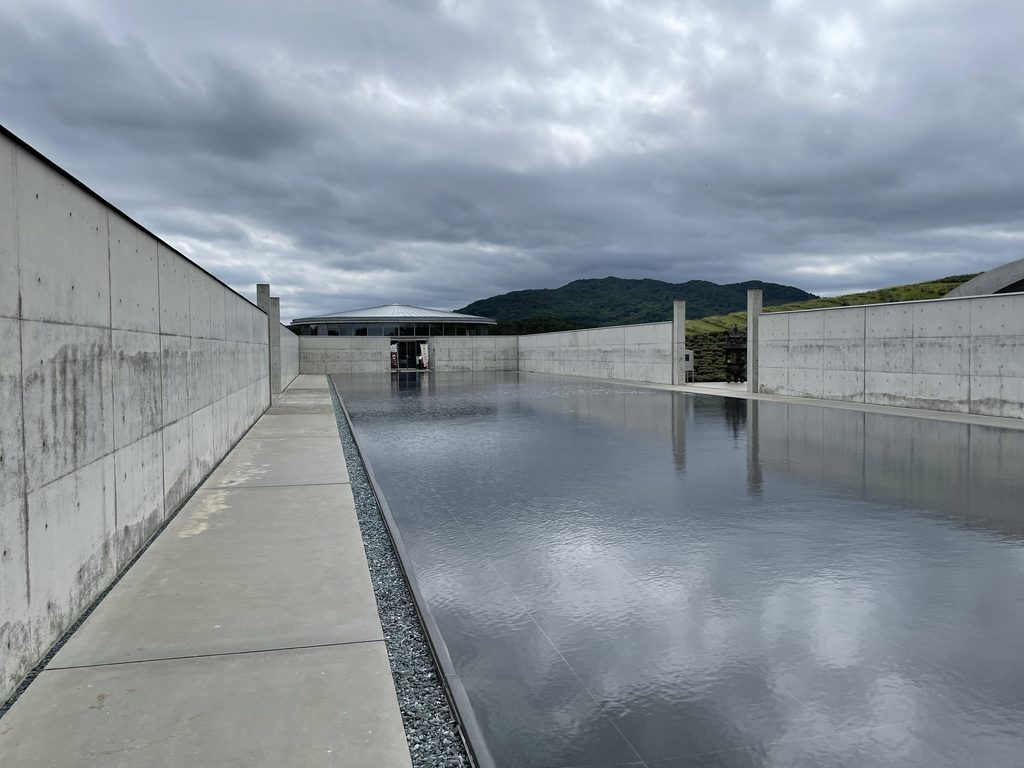
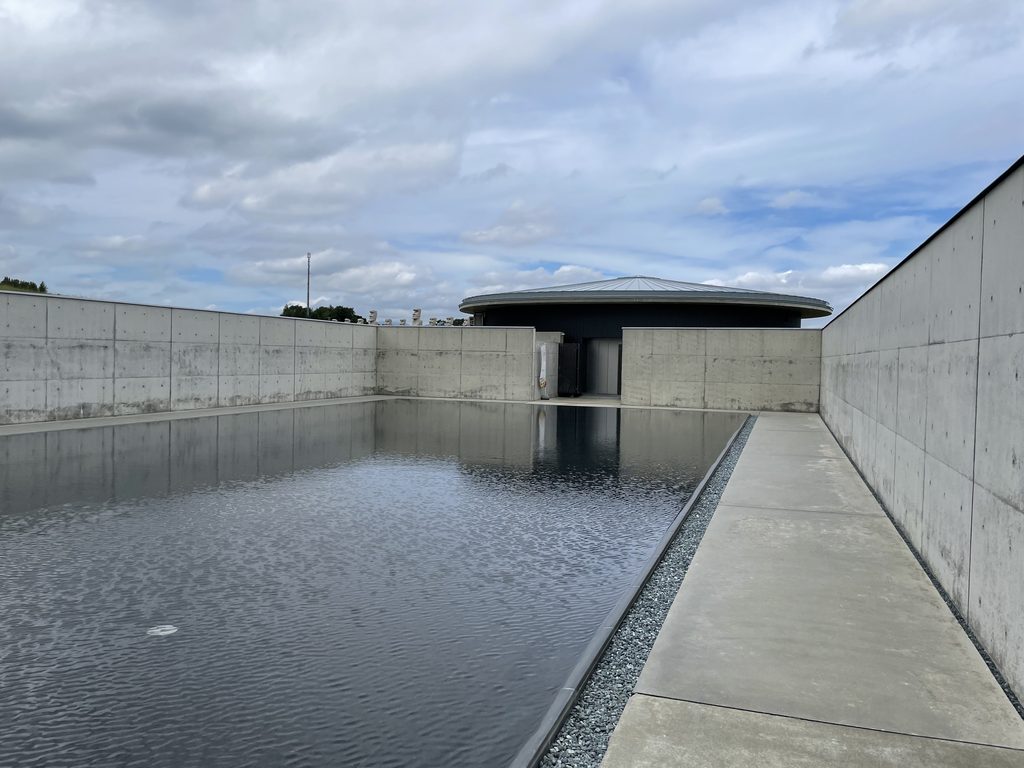
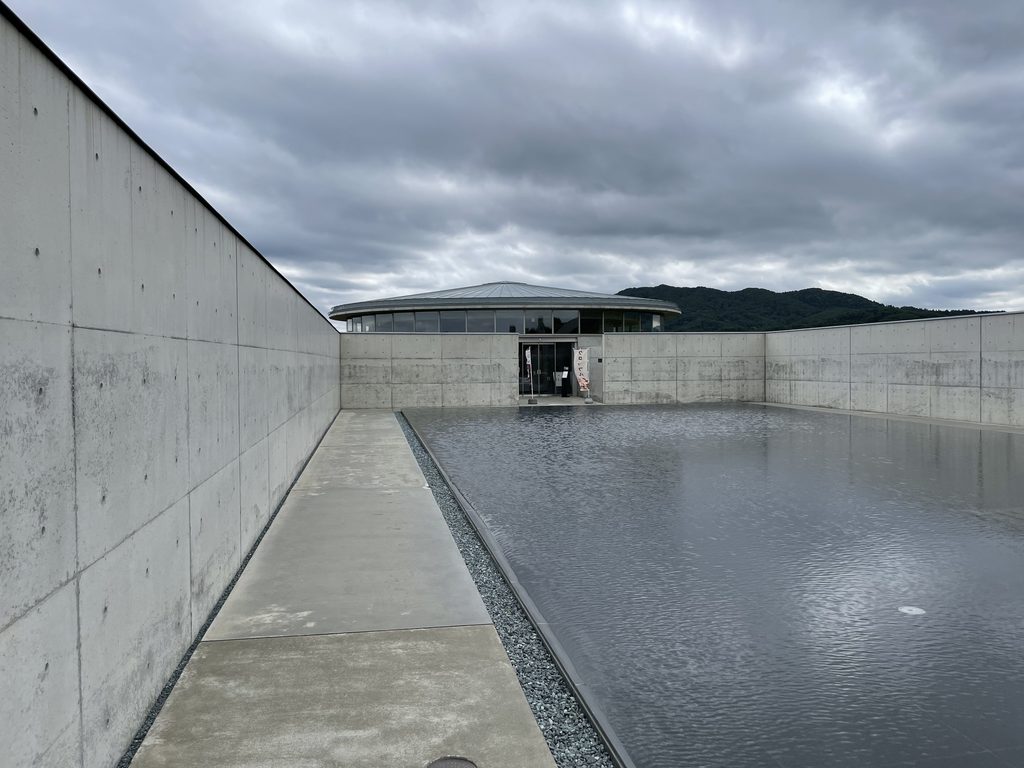
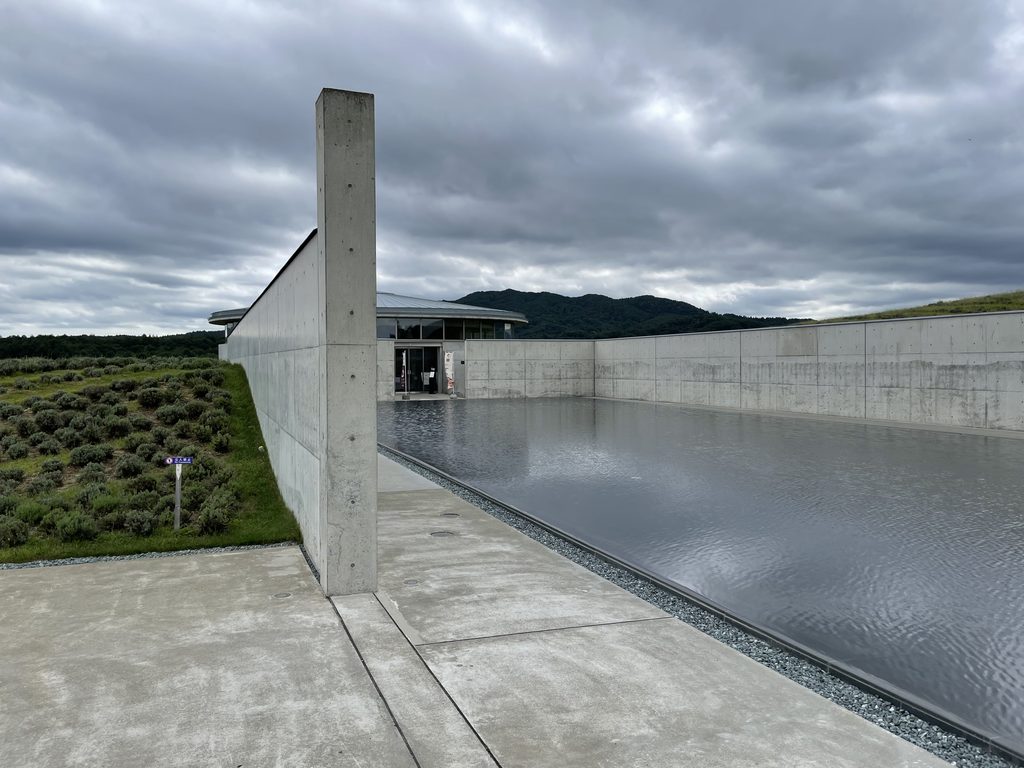
大仏へ向かう途中には水庭が設けられており、訪れた人は目的地へ一直線に進むことができない。目の前に向かうべき方向があるにもかかわらず、身体は水面を避けるように進路を変え、コンクリートの壁に沿って歩くことになる。大仏への距離を物理的に短くするのではなく、あえて遠回りさせることで、到達までの時間そのものが伸ばされている。
A water garden lies along the approach, preventing visitors from proceeding directly toward the Buddha. Although the destination is clear, the body must change direction, move around the water, and continue alongside concrete walls. Rather than shortening the physical distance to the monument, the architecture deliberately extends the time required to reach it.
安藤忠雄の建築では、目的地をあらかじめ見せながらも、そこへ最短距離で向かわせない構成が繰り返し現れる。壁や水が人の進行方向を変え、その迂回によって歩く速度や意識が変化する。頭大仏でも、水庭は単なる景観要素ではなく、日常的な歩行から人を切り離し、これから大仏と対面するための時間へと身体を移行させる役割を担っている。
Ando frequently employs routes in which a destination may be known or even partially visible, yet cannot be reached by the shortest path. Walls and water redirect the body, altering pace and attention through detour. At Hill of the Buddha, the water garden does not function merely as scenery; it helps separate the visitor from ordinary movement and gradually shifts attention toward the act of approaching.
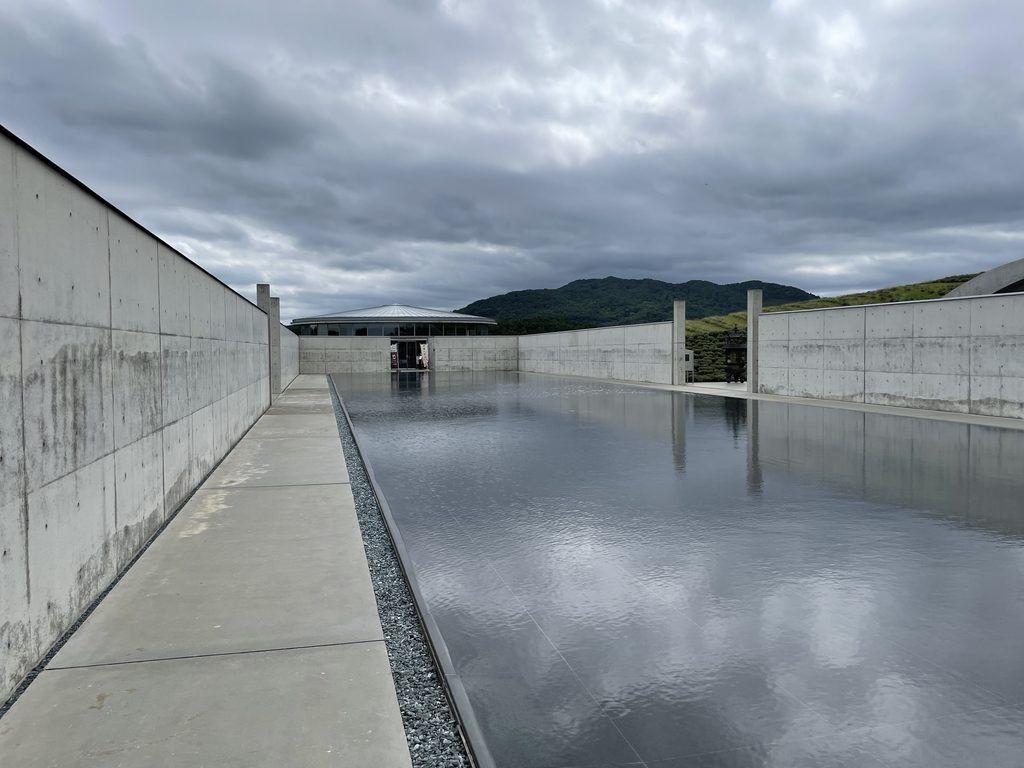
水面は周囲の空や光を映し込みながら、開放的な地上の風景と、これから入っていく暗いトンネルとの間に静かな間をつくっている。コンクリートの壁と水面はどちらも人の進行を直接止めるものではないが、その配置によって歩く方向と速度を変え、意識を大仏そのものから、そこへ至る過程へと移していく。
The surface of the water receives the sky and light, creating a quiet interval between the openness of the landscape above ground and the darker interior that lies ahead. Water and concrete do not physically block the route in an absolute sense, but their arrangement adjusts direction and speed, shifting attention away from the Buddha as an object and toward the process of reaching it.
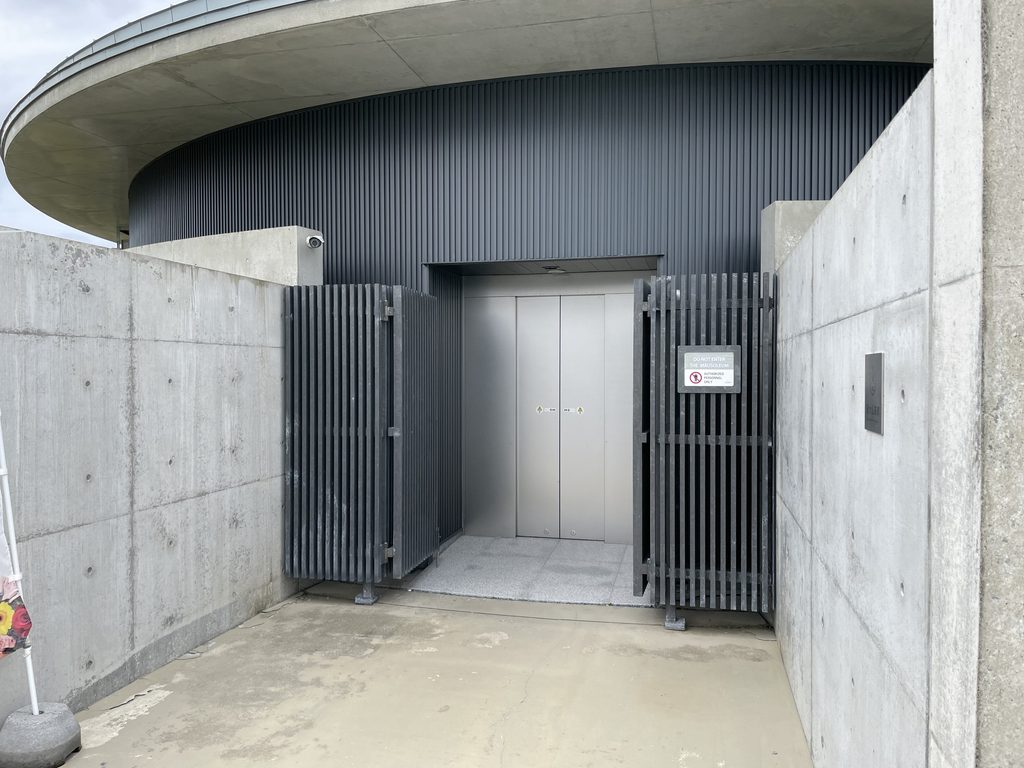
この作品では、大仏の周囲だけを切り取って「建築」と考えることができない。丘の上に頭部を見つけるところから、水を回り込み、壁に沿って進み、暗いトンネルへ入るまでが一つの連続した体験として構成されている。安藤は大仏そのものの形を変えるのではなく、人がどの距離から、どの順序で、どのくらいの時間をかけてそれを見るのかを設計することで、大仏の存在の仕方そのものを変えている。
For this reason, the architecture cannot be understood only by examining the rotunda around the Buddha itself. The experience begins much earlier, with the first distant view of the head, continues through the detour around water, and leads toward the entrance of the tunnel. Ando does not change the form of the Buddha; instead, he changes the distance, sequence, and duration through which people encounter it, and in doing so transforms the way the statue exists in perception.
3. 光を残して、コンクリートの暗がりへ
Leaving the Light Behind and Entering Concrete Darkness
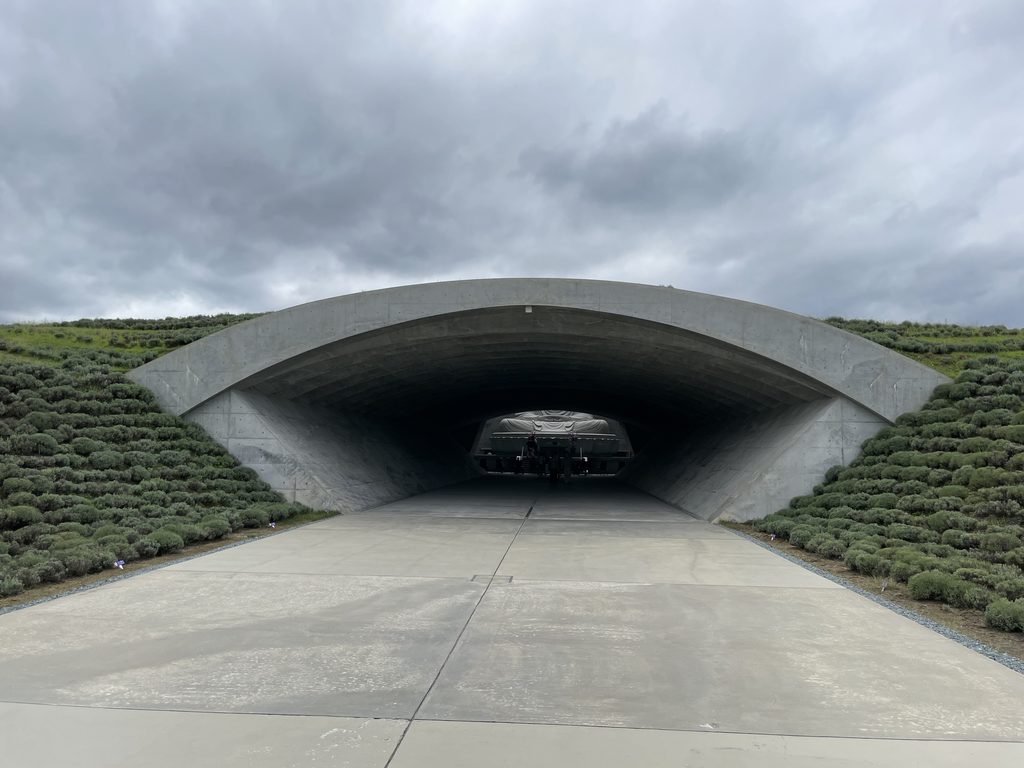
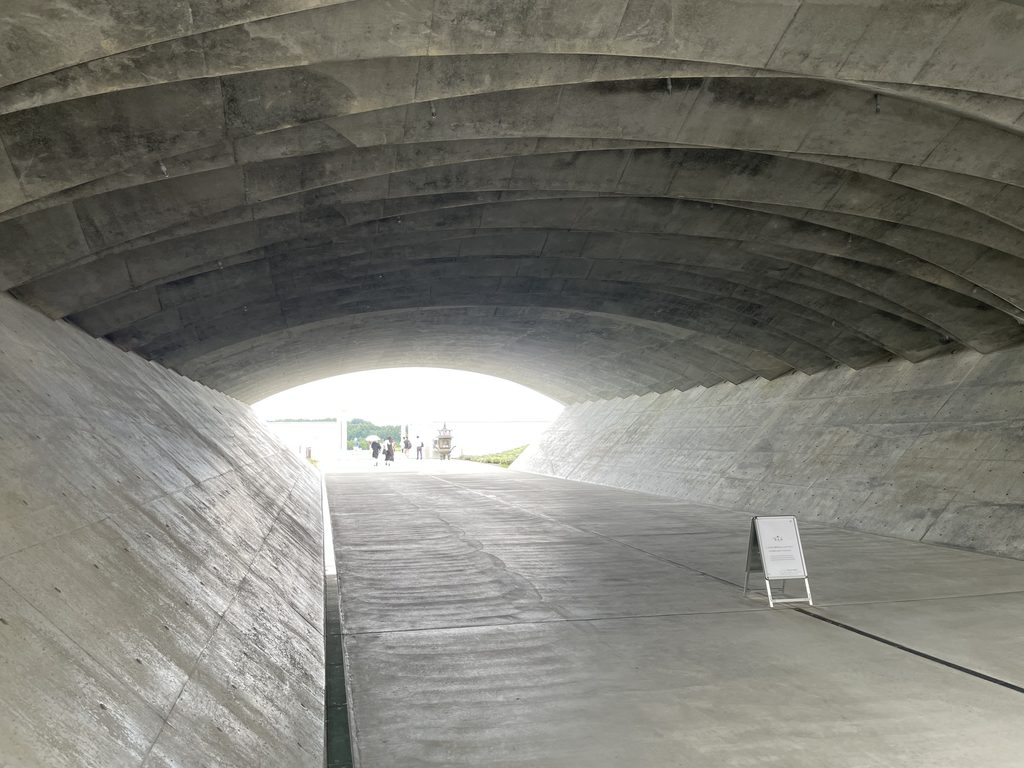
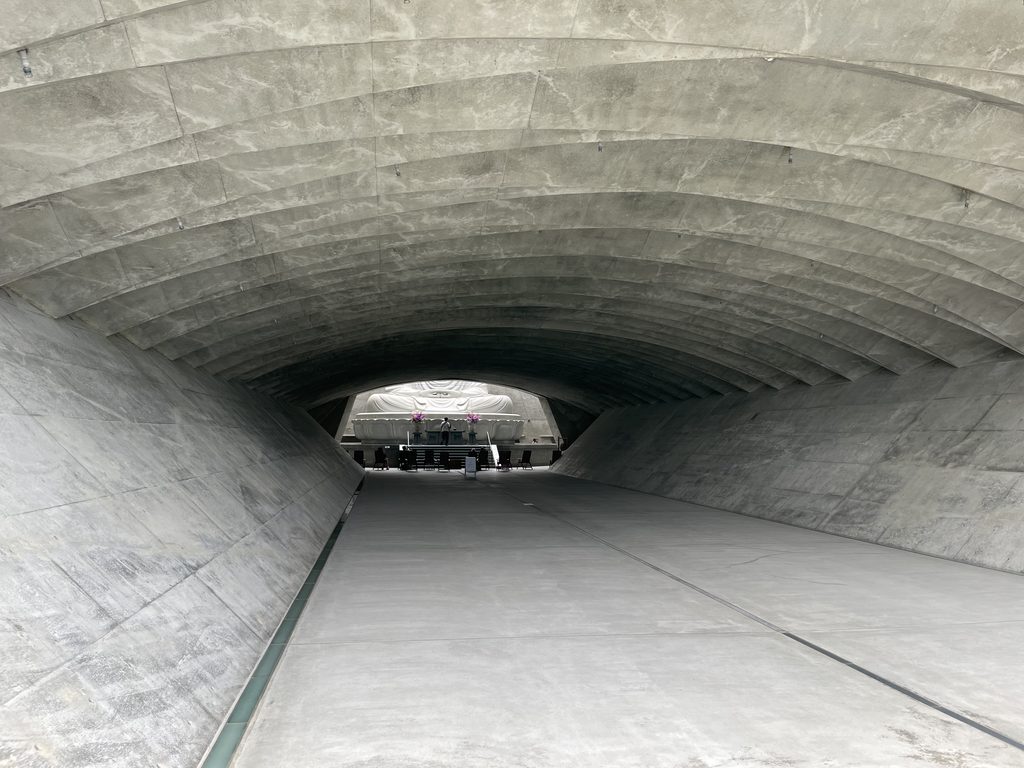
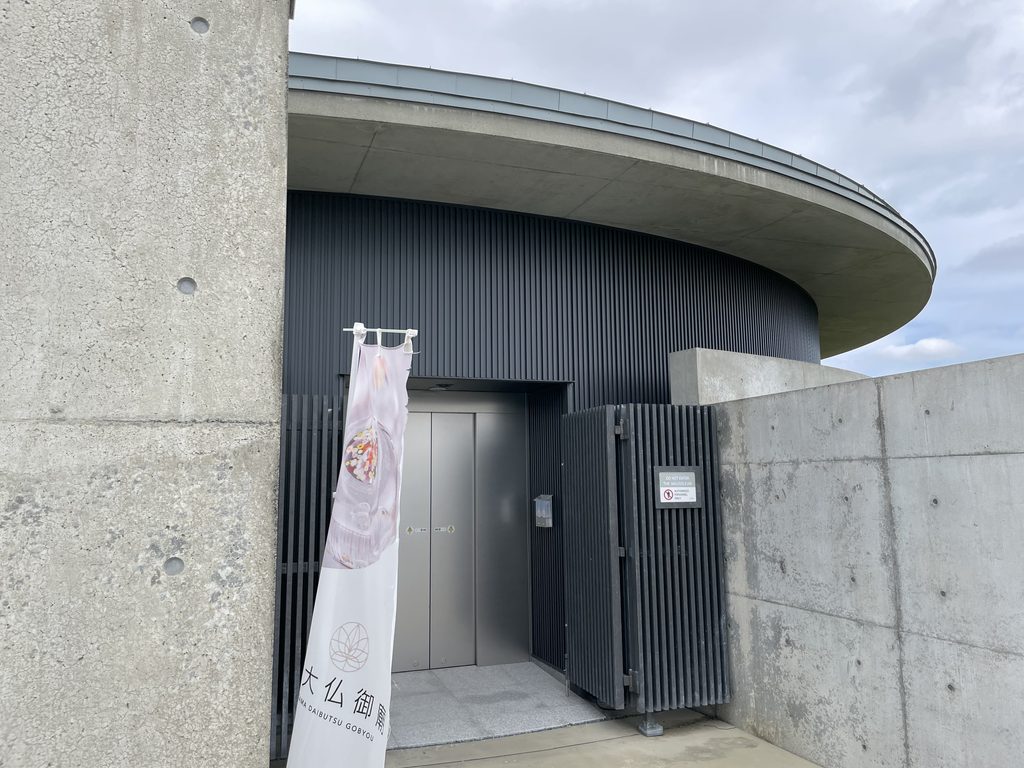
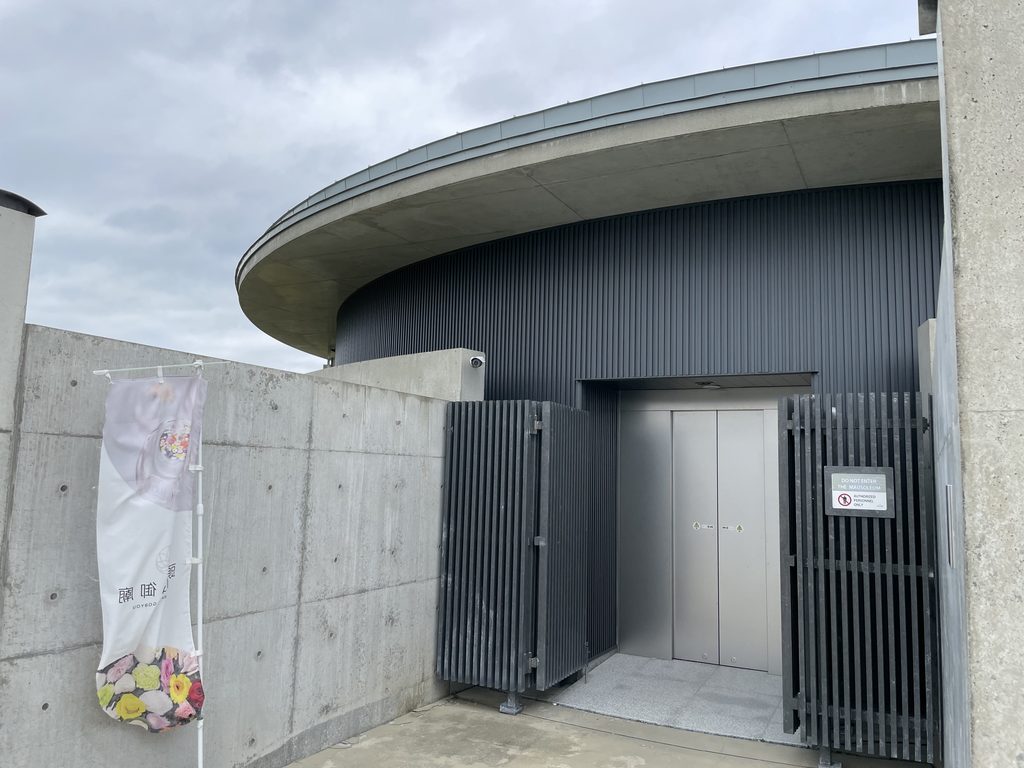
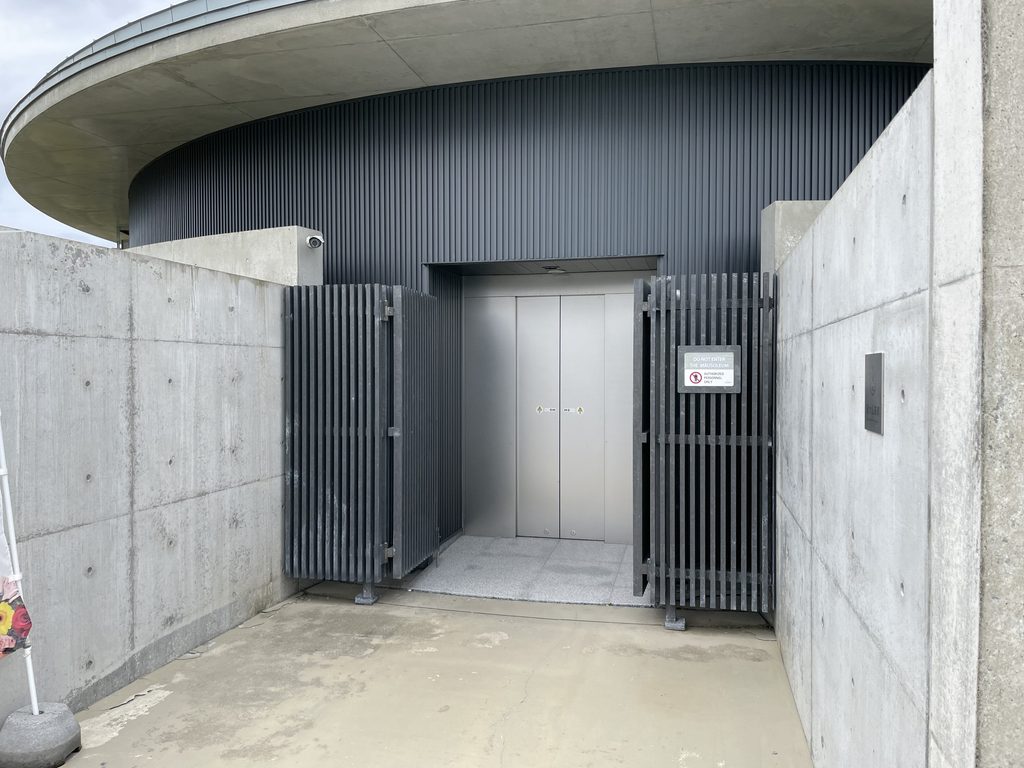
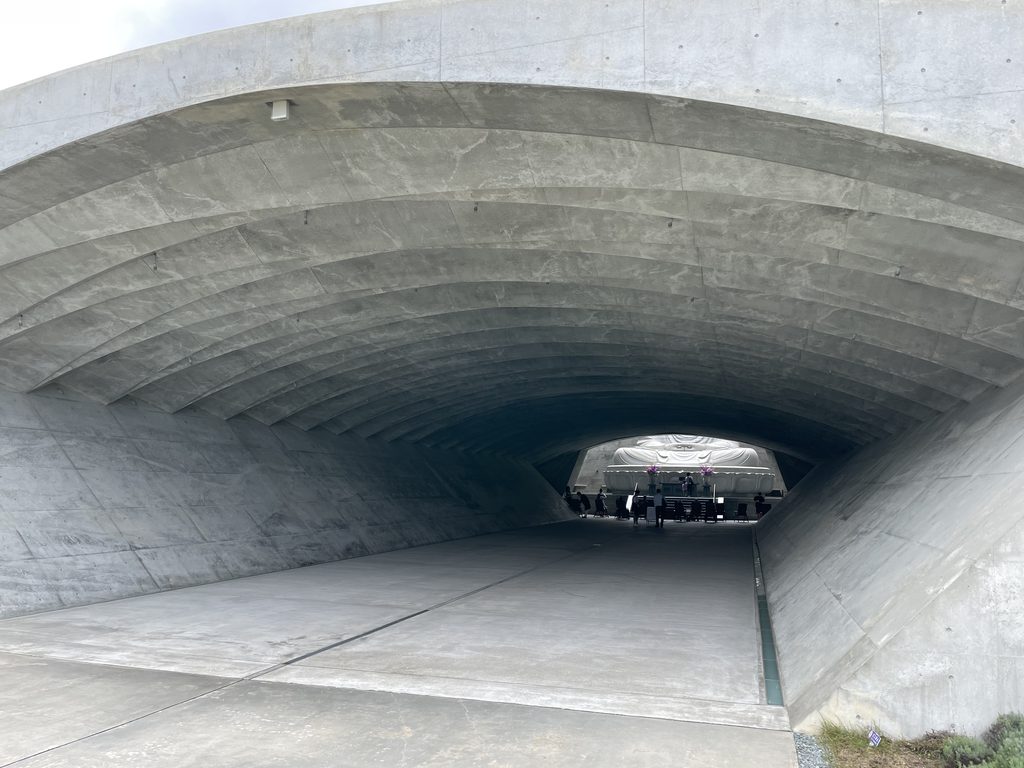
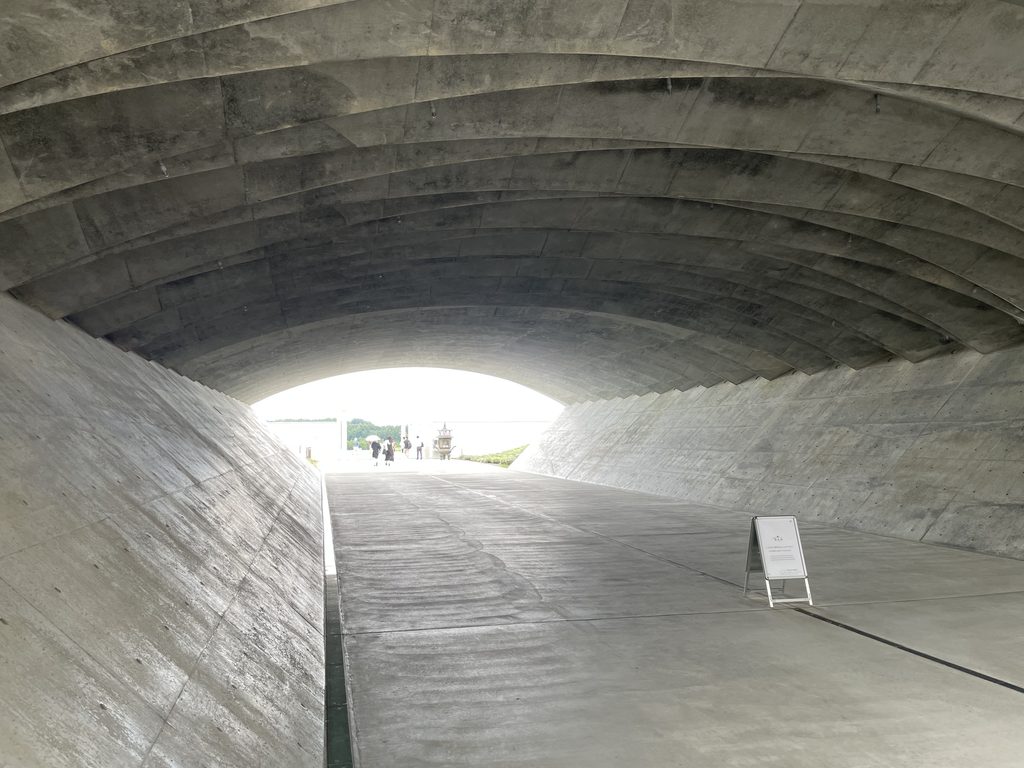
水庭を回り込んだ先には、丘の内部へと続く約40mのトンネルが現れる。入口は低く抑えられ、その奥を一度に見通すことはできない。広大な空と丘の風景の中を歩いてきた身体が、ここで初めて地形の内部へ取り込まれ、周囲の環境との関係が大きく変化する。
Beyond the water garden, a tunnel approximately 40 meters long enters the interior of the hill. Its entrance is kept low and does not allow the destination to be understood at a glance. After walking beneath the open Hokkaido sky, the body is gradually absorbed into the topography, and the relationship with the surrounding landscape changes abruptly.
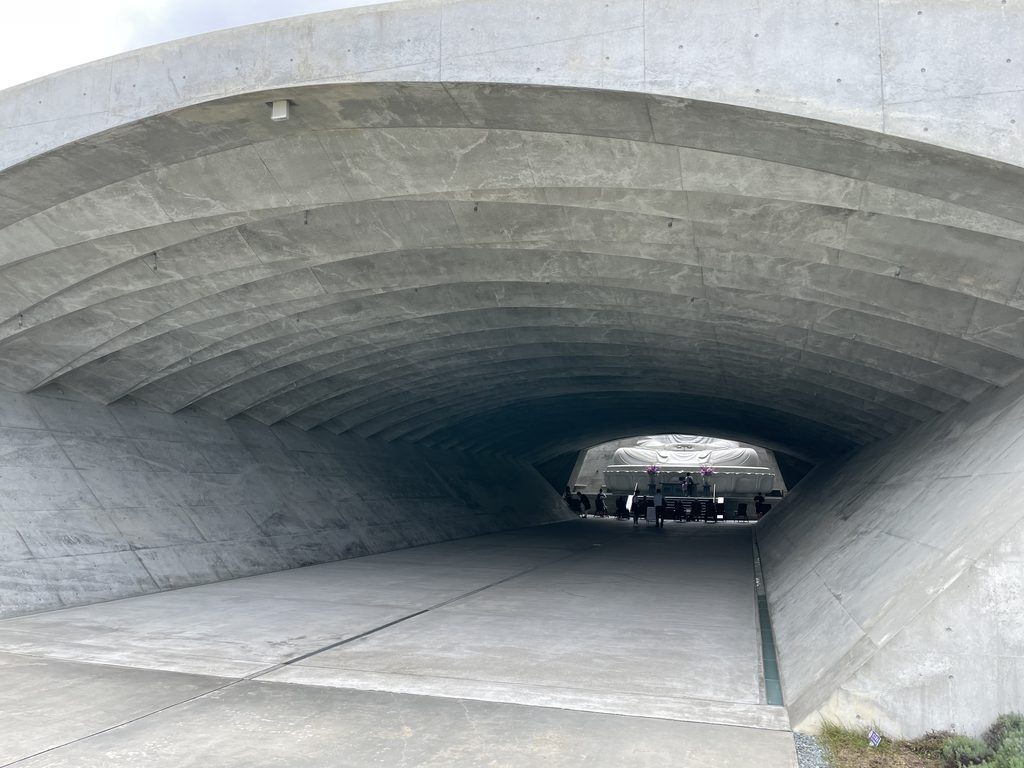
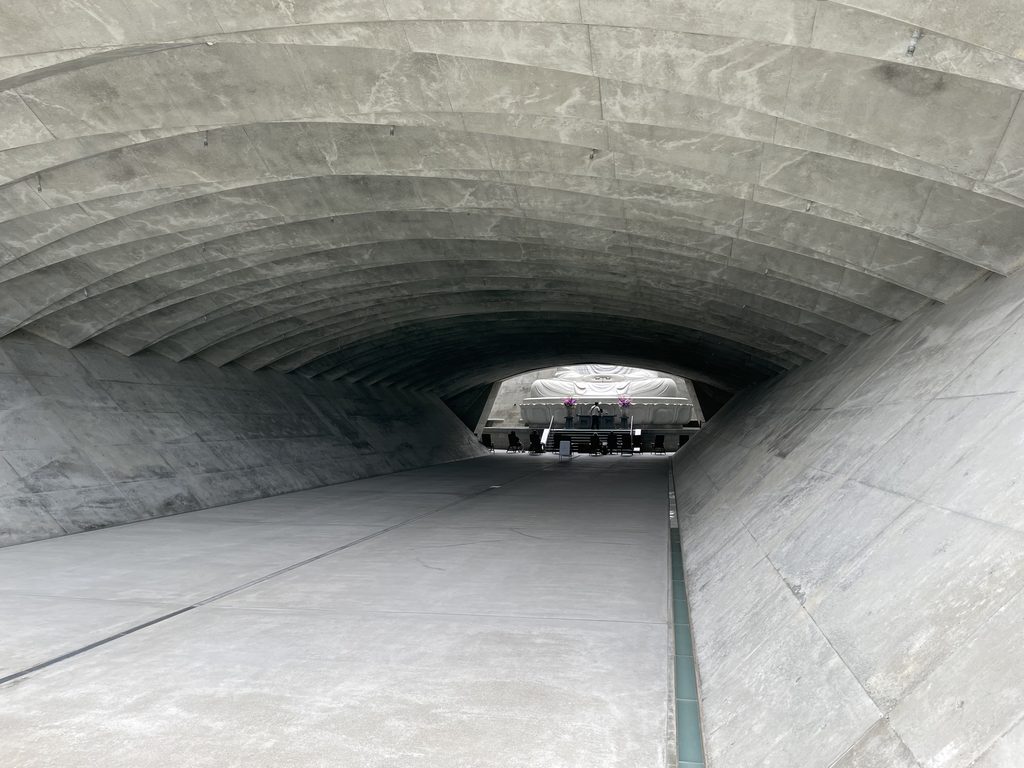
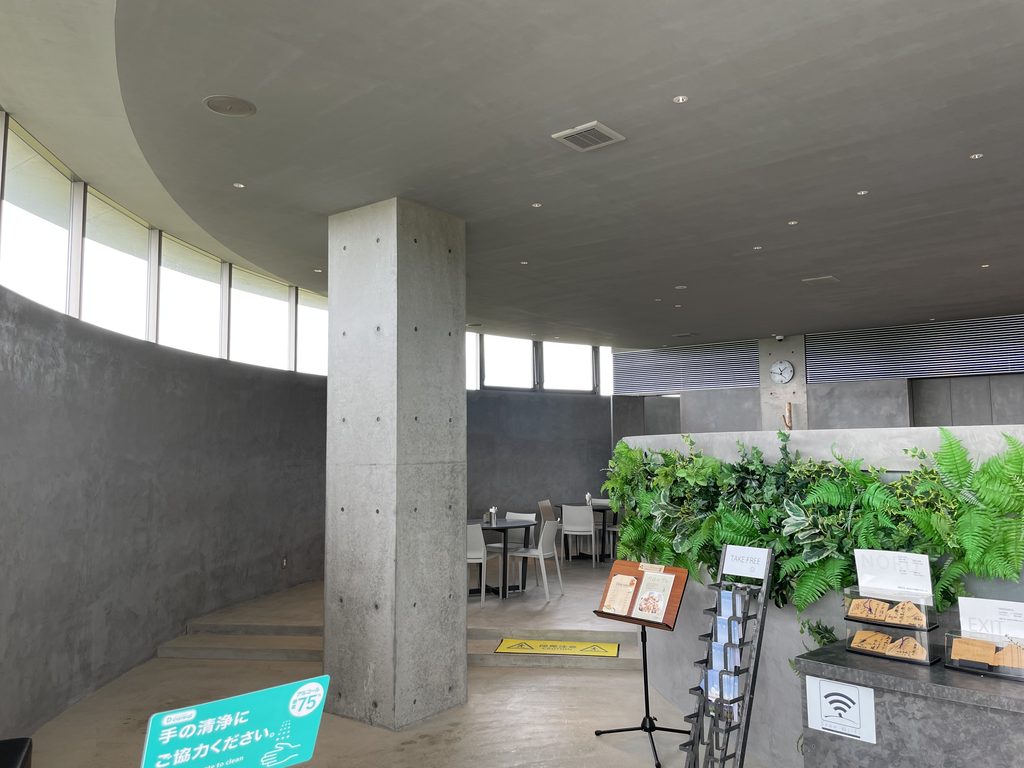
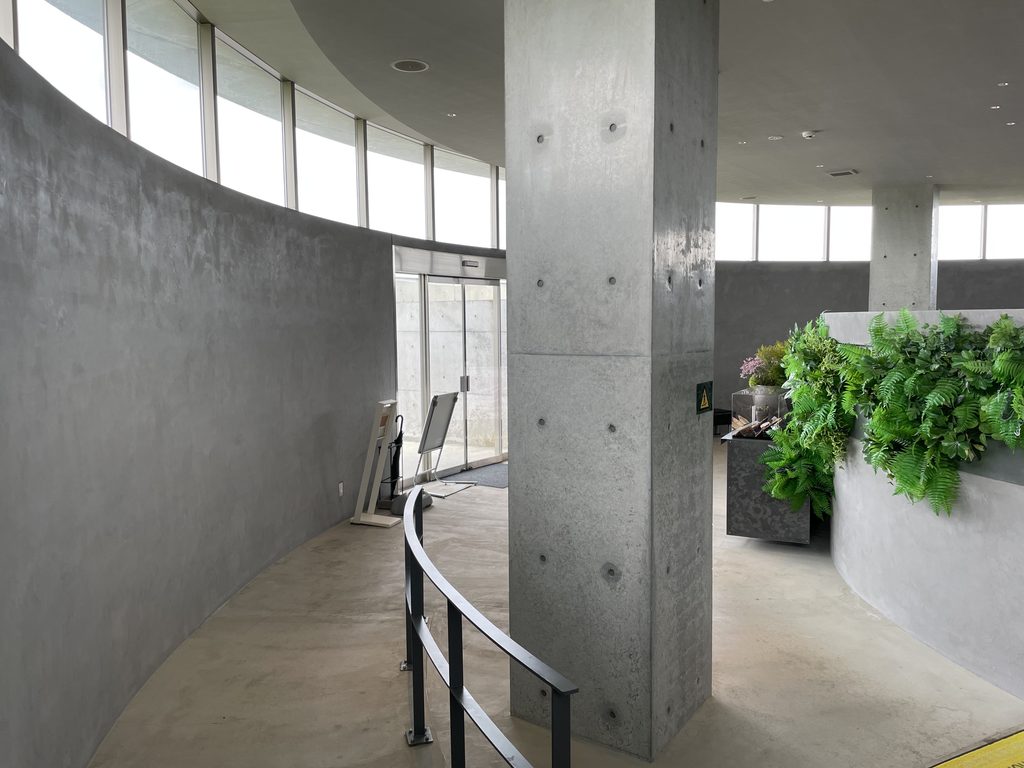
トンネルへ入ると、外部で感じていた空の広がりや丘のスケールはほとんど視界から失われ、周囲を占めるのは打放しコンクリートの壁と天井だけになる。明るい屋外から内部へ入ったことで視覚情報が急激に減り、意識は遠景ではなく、自分の歩行や壁との距離、内部の光の変化へ向かうようになる。
Inside the tunnel, the broad sky and scale of the hill largely disappear from view. Exposed-concrete walls and ceiling occupy the field of vision, reducing the amount of visual information and shifting attention away from distant scenery toward the body, the closeness of surfaces, and subtle changes in light.
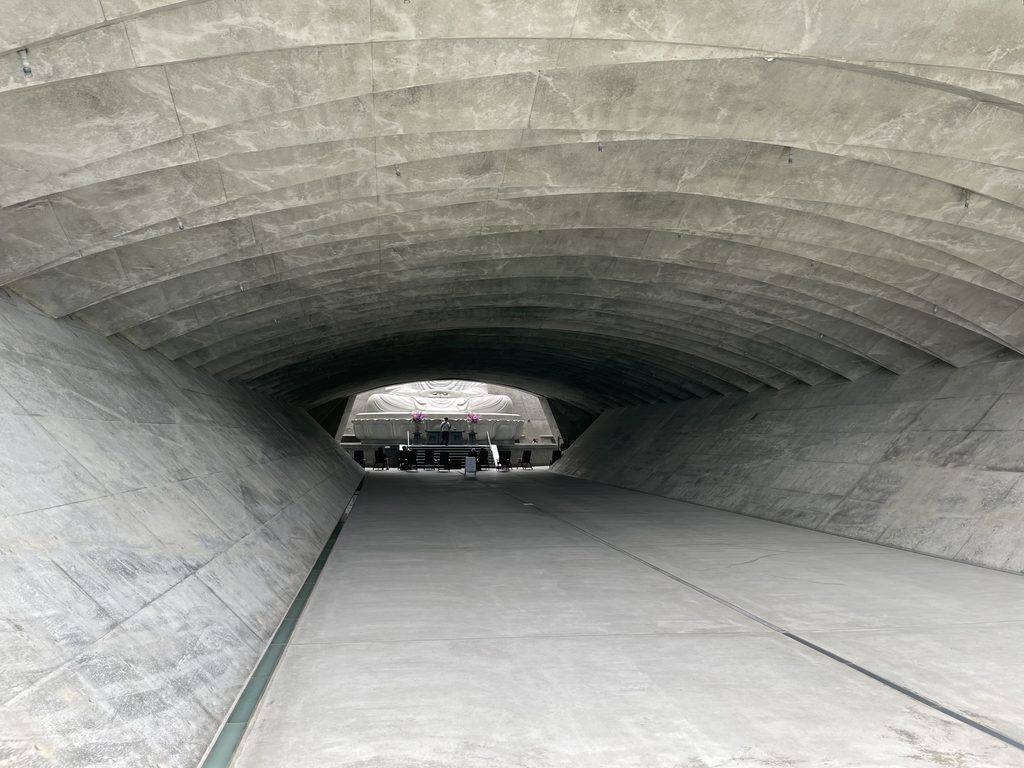
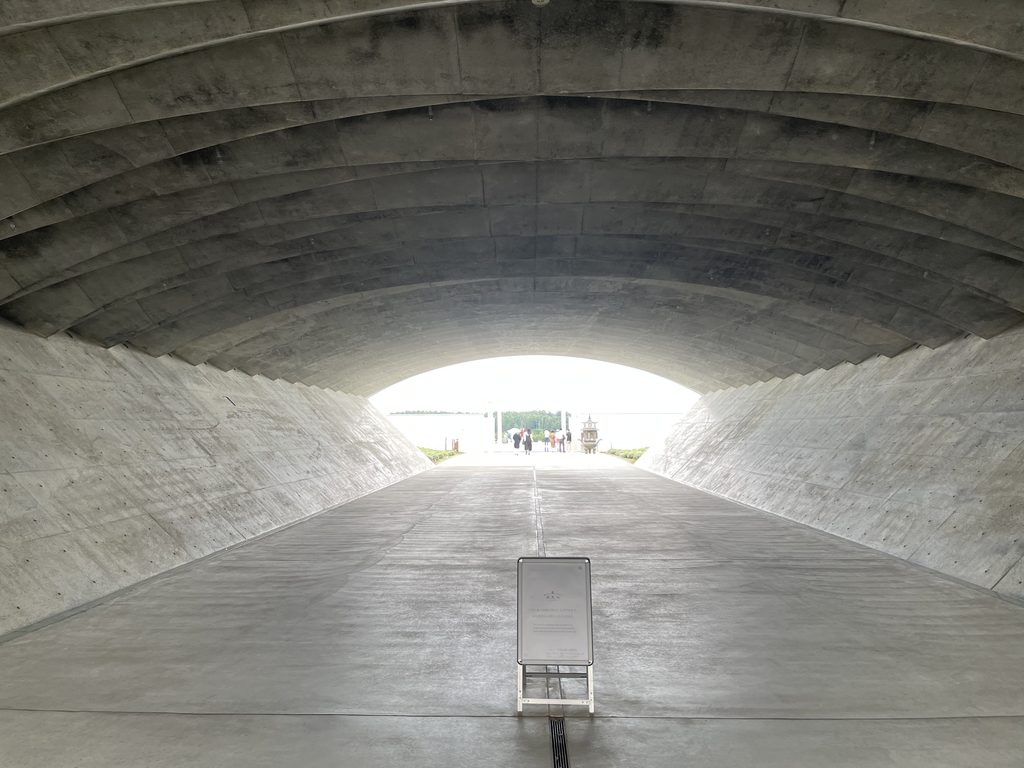
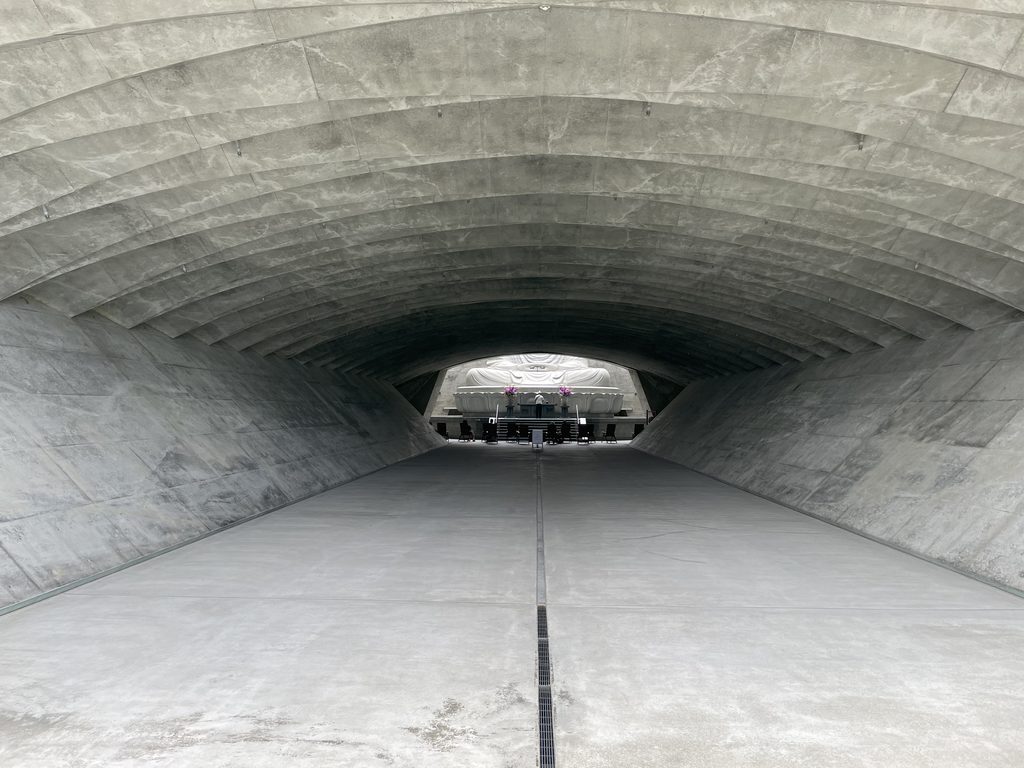
完全な暗闇ではなく、トンネルの先には小さな光が残されている。その光の中に大仏が存在することは感じられるものの、距離があるため全身を明確に捉えることはできない。目的地そのものを見せるのではなく、そこに何かが待っているという気配だけを残すことで、暗い内部空間の奥行きがより強く意識される。
The space is not completely dark. A small point of light remains at the far end, suggesting the presence of the Buddha without revealing it fully. Rather than displaying the destination directly, the architecture leaves only an indication of what lies ahead, intensifying the depth of the tunnel and the anticipation of arrival.
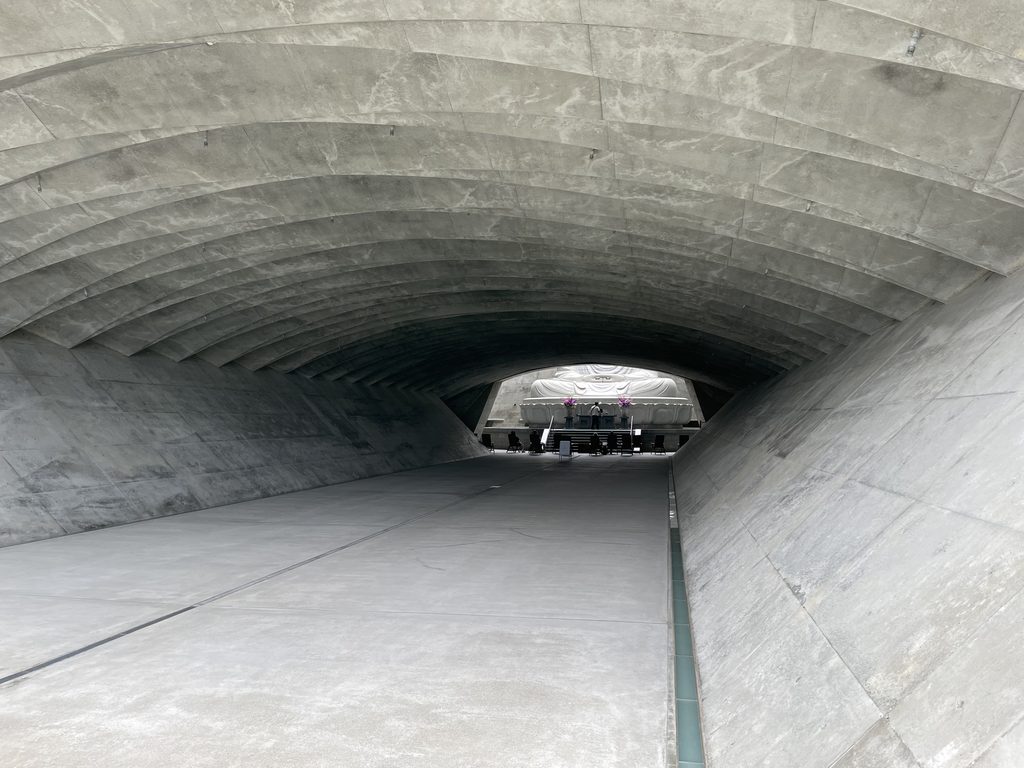
歩みを進めるにつれて、出口の光は少しずつ大きくなり、その中心に大仏の姿が現れ始める。外部では丘の上に頭部だけが見えていた大仏が、今度は暗いコンクリートのフレームの中から徐々に全身を取り戻していく。その変化は一瞬の演出ではなく、約40mを歩く身体の時間とともに進行するため、見ることそのものが一つの出来事として感じられる。
As one continues forward, the opening of light gradually expands and the Buddha begins to emerge within it. The same statue that had previously appeared only as a head above the hill now slowly regains its full body from within a frame of darkness. This change unfolds over the duration of the walk, transforming the act of seeing into an event with temporal depth.
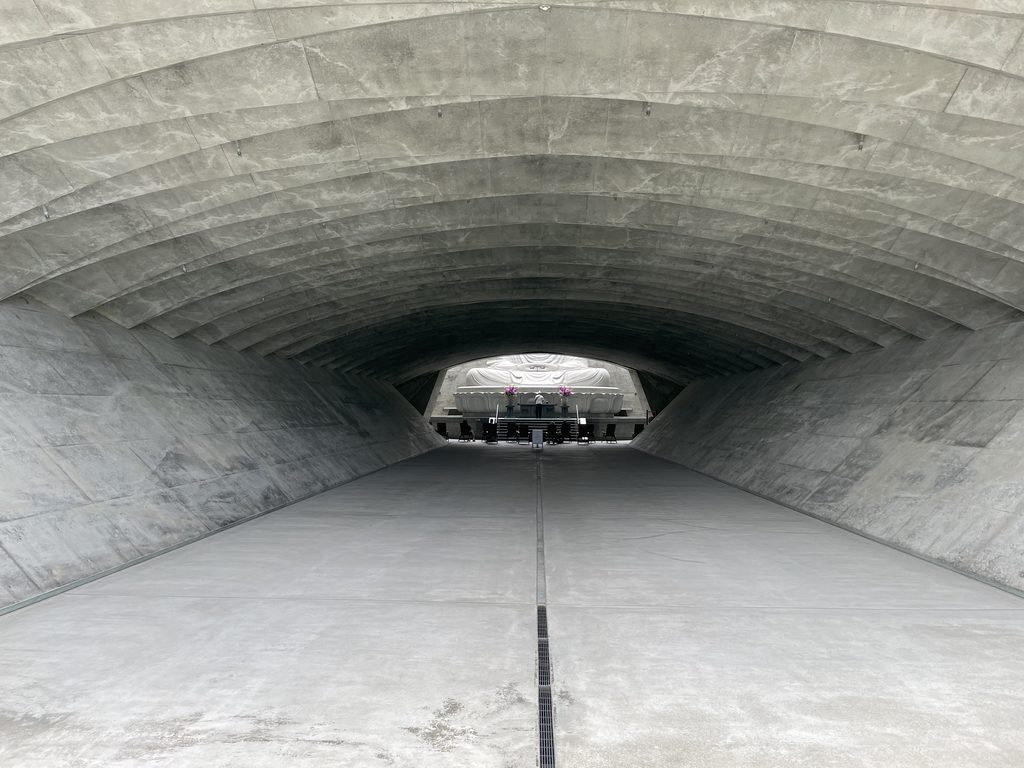
安藤はこの空間の発想について、インドや中国の石窟で、暗い空間の奥に光を受ける仏像を仰ぎ見た体験とのつながりを語っている。頭大仏のトンネルも同様に、暗闇を単なる通路の条件として使うのではなく、光を受ける大仏との対面をより強くするための前段階として組み込んでいる。
Ando has described the inspiration for this sequence in relation to his experiences of Buddhist cave temples in India and China, where statues are encountered in darkness and perceived through controlled light. The tunnel at Hill of the Buddha similarly uses darkness not simply as the condition of an underground passage, but as a preparation for the moment when the statue reappears.
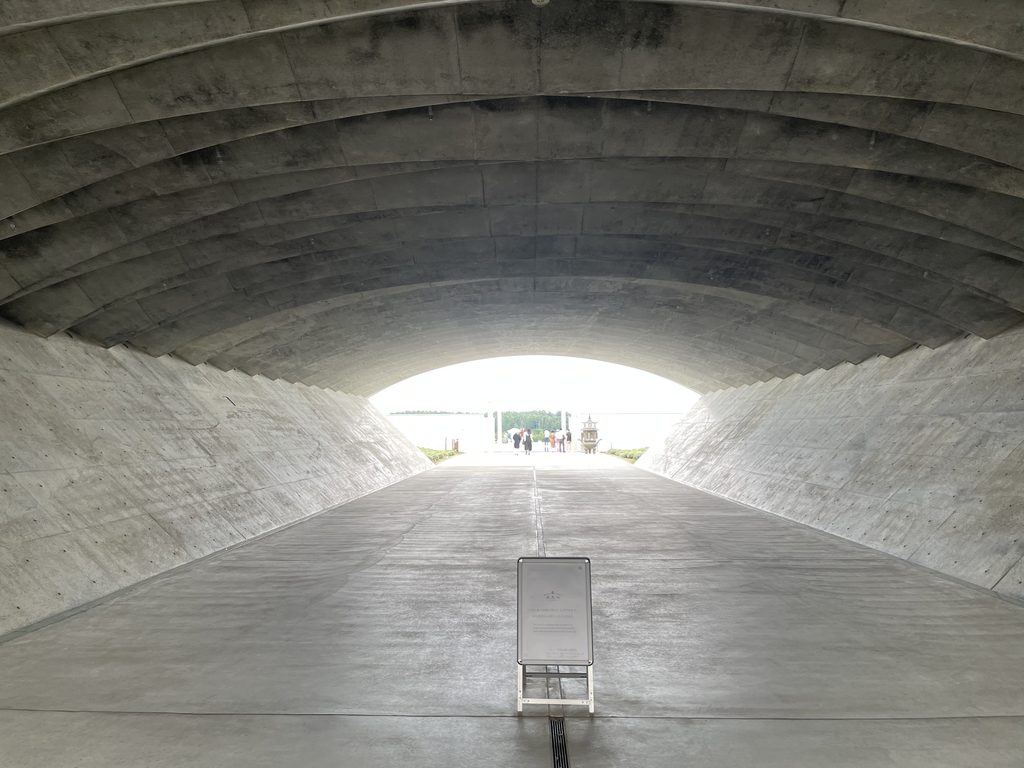
屋外ではすでにその存在を知っていた大仏が、トンネルの中では再び「まだ十分には見えないもの」へ戻っている。そこから一歩ずつ距離を縮めることで、大仏を見る行為は視覚的な確認ではなく、身体と時間を伴う体験へと変わっていく。暗さは大仏を隠すためだけにあるのではなく、その後に現れる光と巨大な像を受け止めるために、人の感覚を整える空間として働いている。
Although the Buddha’s existence has been known from the beginning, inside the tunnel it becomes once again something not yet fully visible. By approaching it step by step, the act of seeing shifts from recognition to experience. Darkness does not merely conceal the statue; it prepares the senses to receive the light and scale that will follow.
4. 暗闇の先で、大仏が空を背負う
Beyond the Darkness, the Buddha Carries the Sky
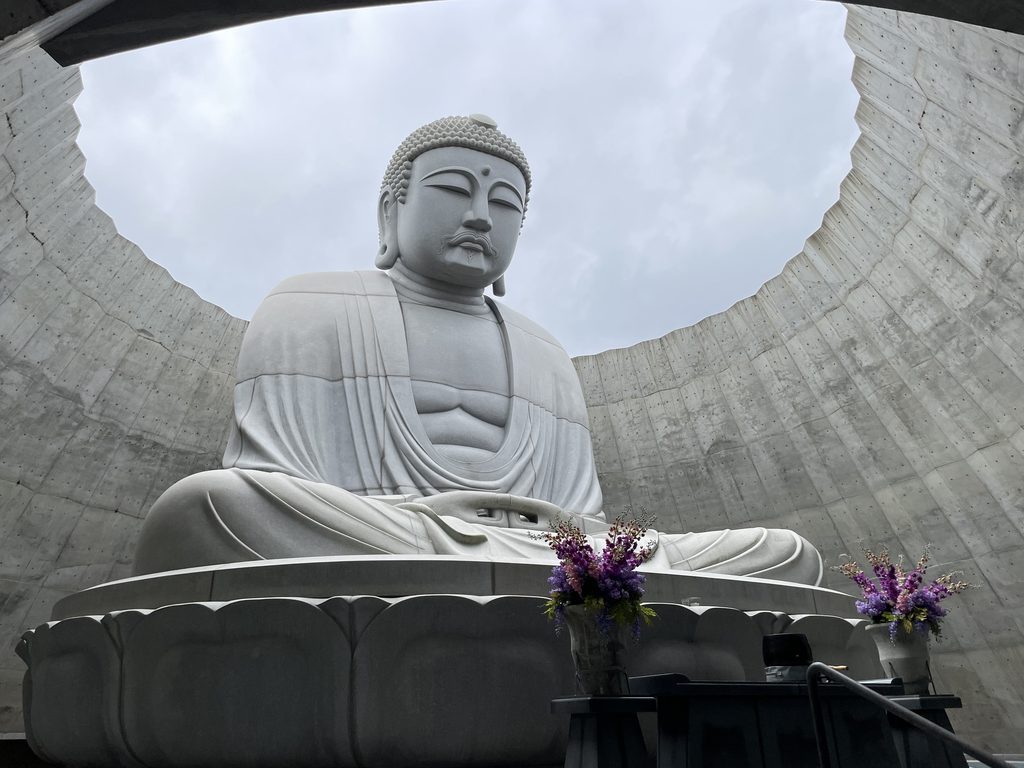
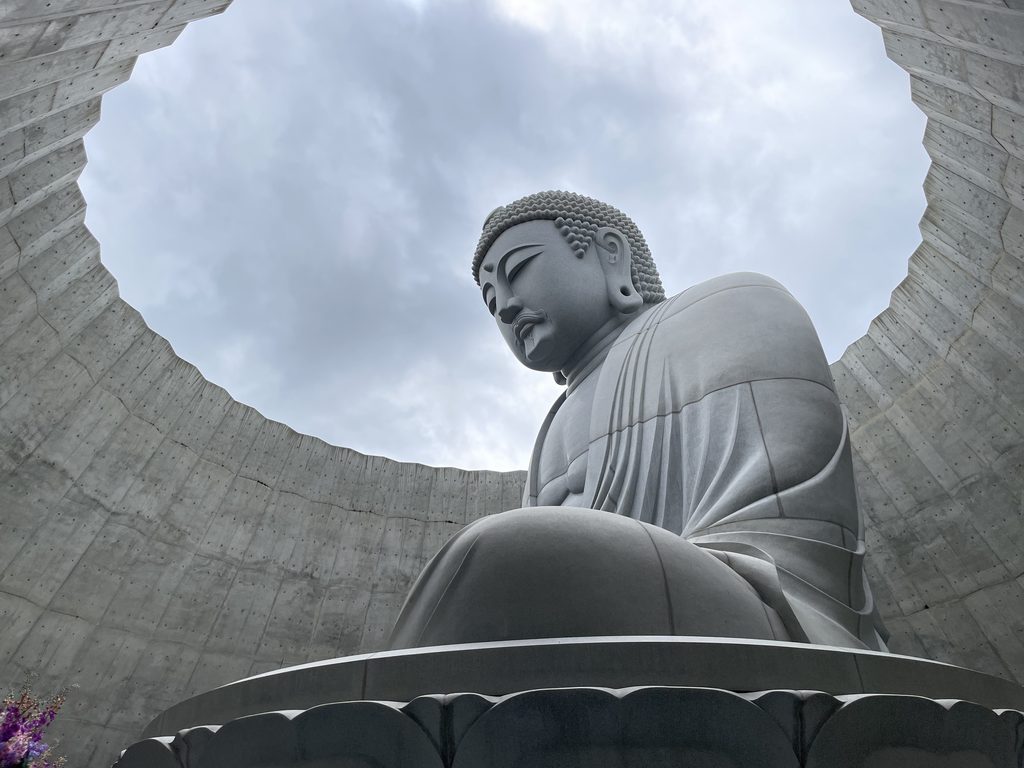
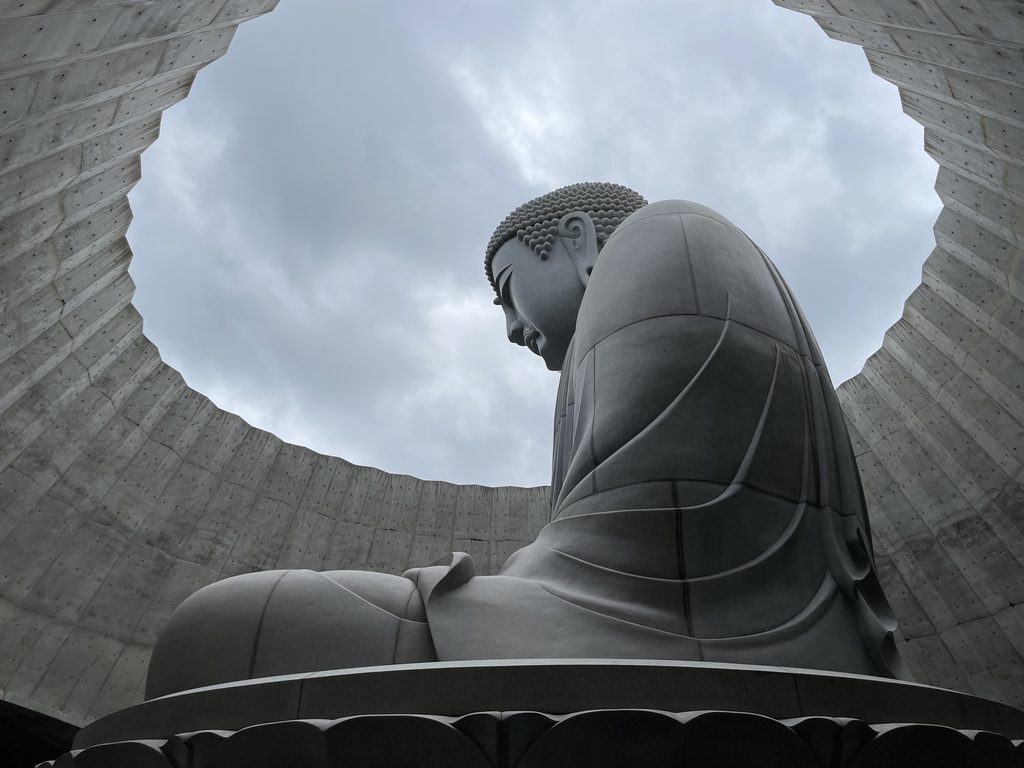
トンネルの終端へ近づくと、暗いコンクリートの向こうに大仏の姿が次第に大きく現れる。ここまでの動線では視線がほぼ水平方向へ導かれてきたが、大仏の足元へ到達すると身体は自然に上を向き、視線は石像の巨大な身体をたどりながら、さらにその上へと引き上げられていく。
Approaching the end of the tunnel, the Buddha gradually grows within the field of vision. Until this point, movement has been guided primarily along a horizontal axis, but upon reaching the base of the statue, the body naturally turns upward, and the gaze follows the immense figure toward the sky above.
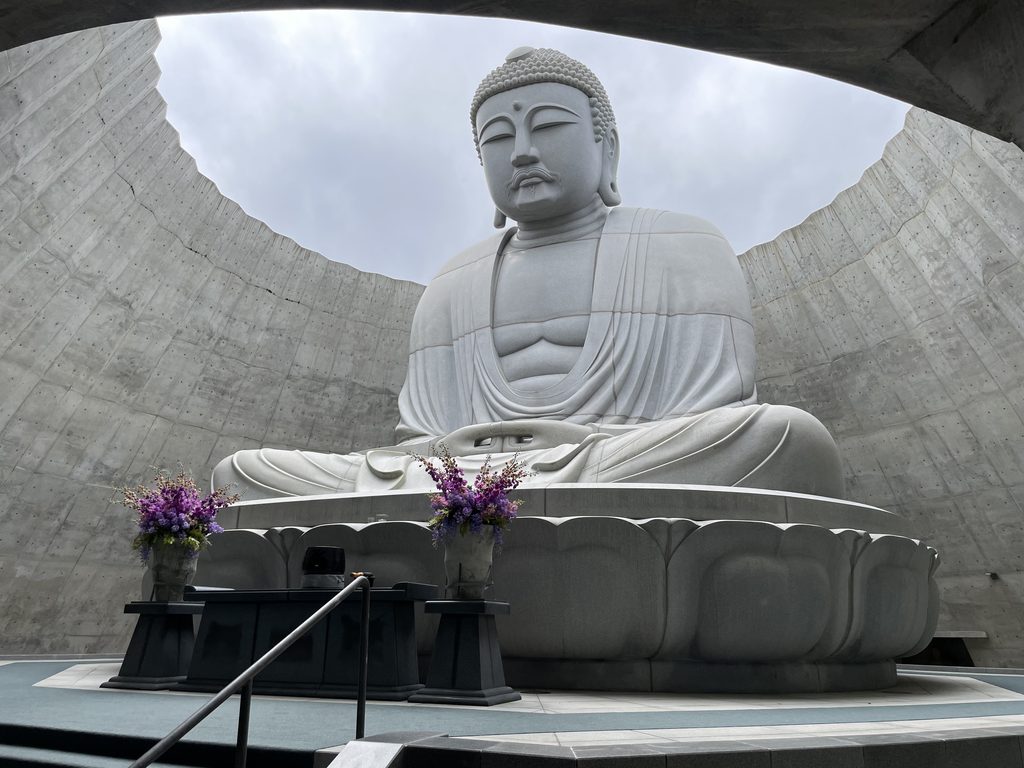
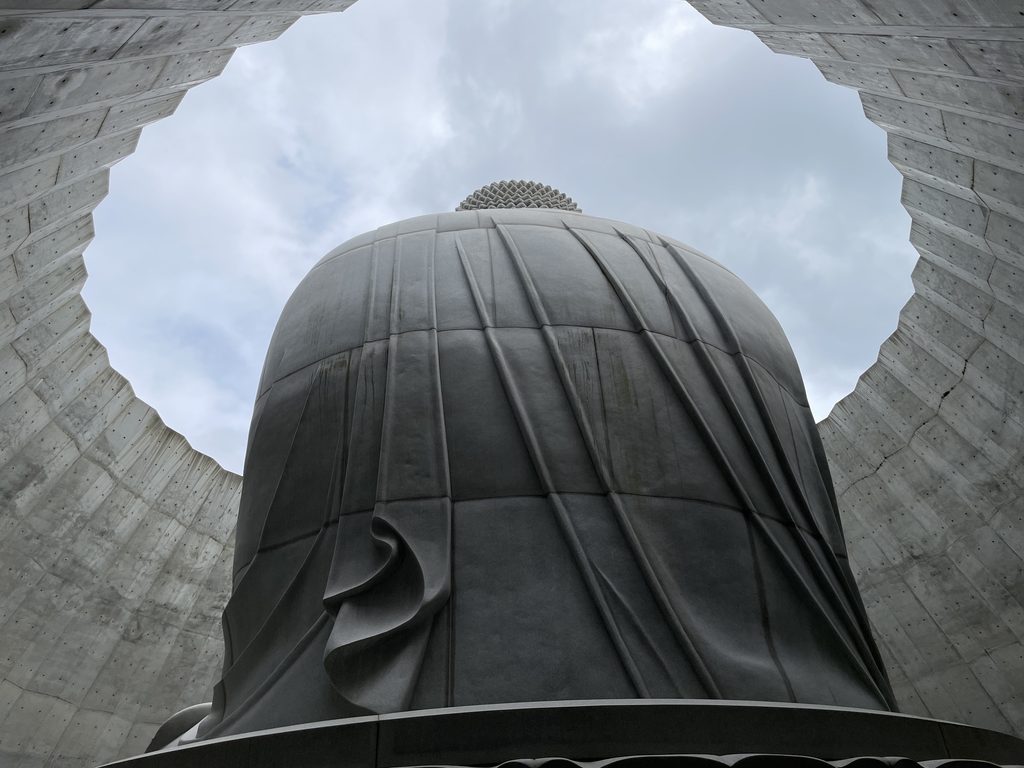
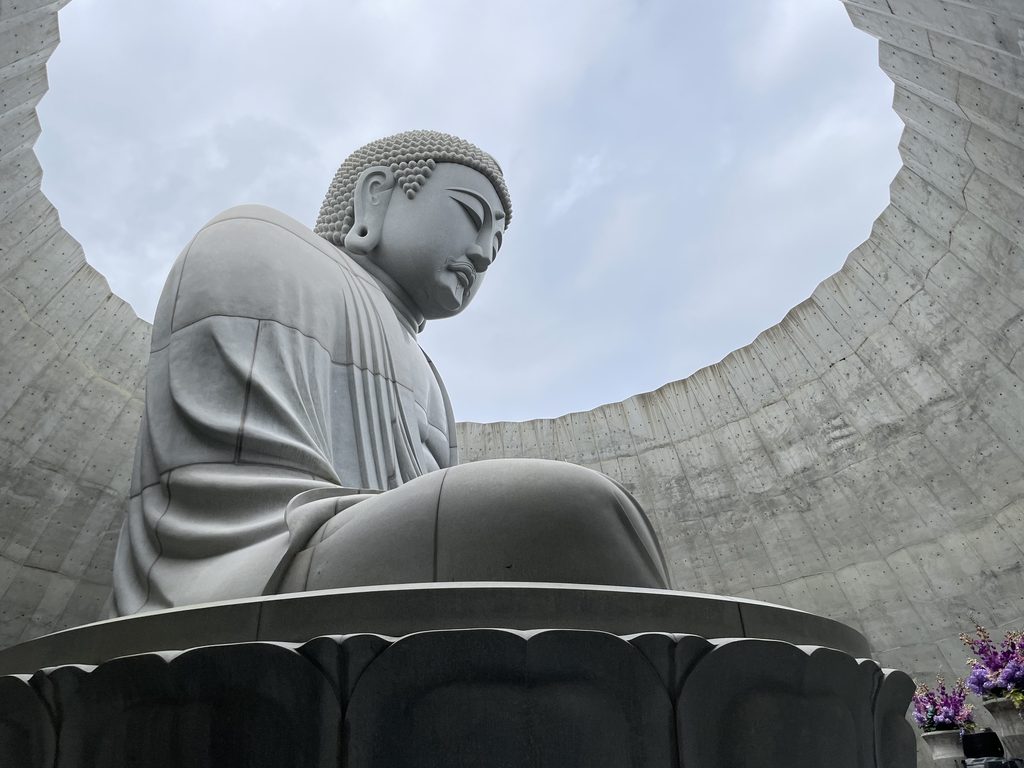
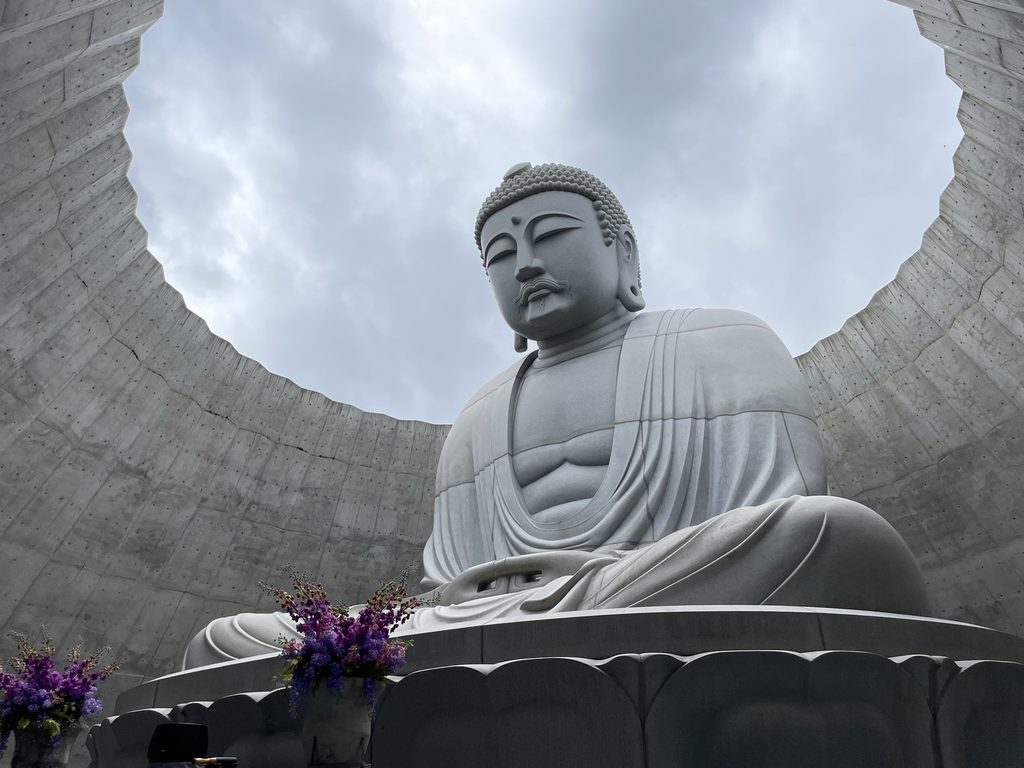
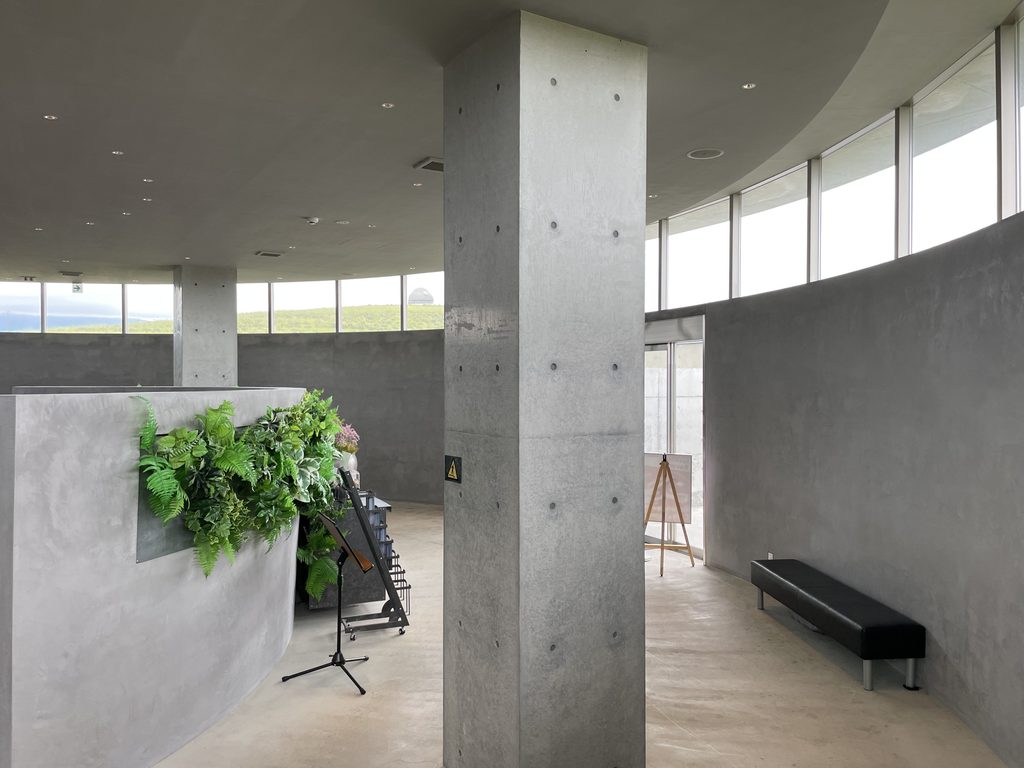
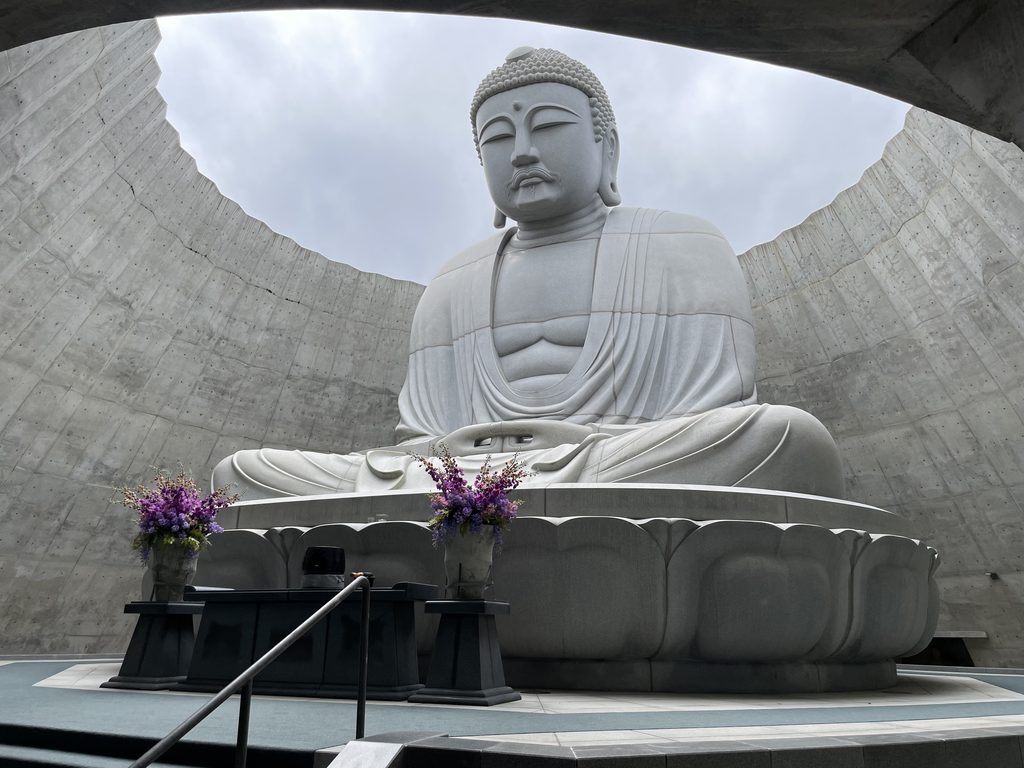
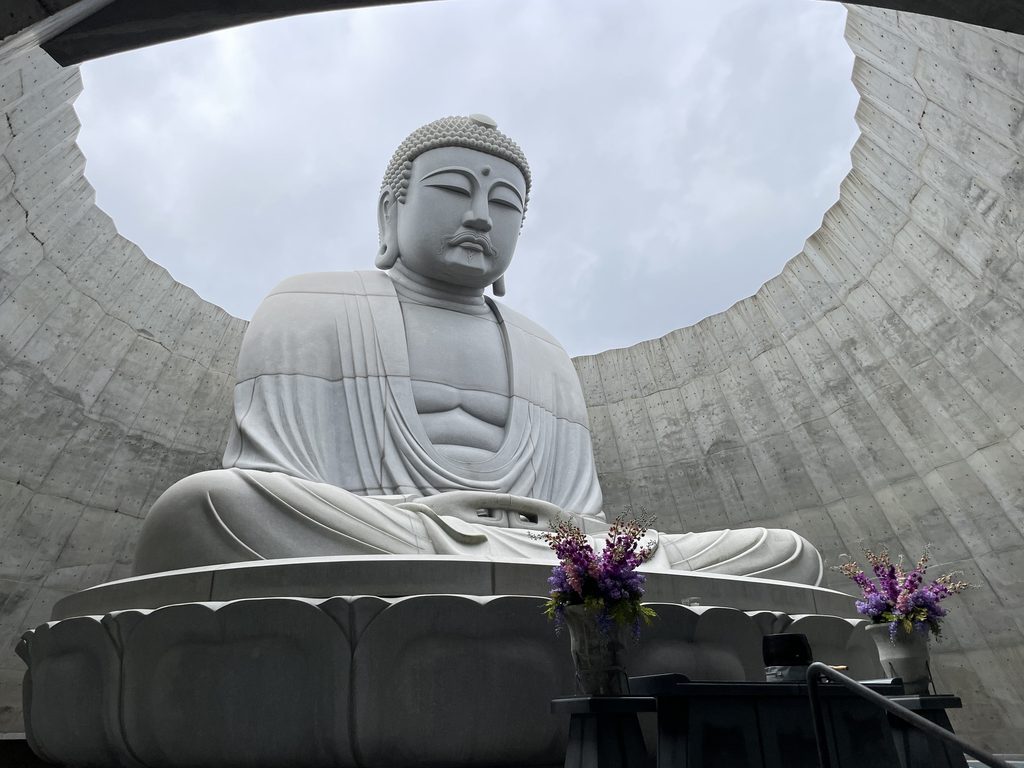
ロタンダへ出た瞬間、大仏の全身とともに頭上の空が一気に開かれる。大仏を囲う円形のコンクリート壁には屋根がなく、その上部に切り取られた空が、建築の天井そのもののように現れる。暗いトンネルを通ってきた直後だからこそ、石像の大きさと空の明るさの両方が、外部から直接見る以上の強さを持って感じられる。
Emerging into the rotunda, the full body of the Buddha appears together with an open circle of sky. There is no roof above the surrounding concrete wall; instead, the sky itself occupies the uppermost portion of the space. After the enclosed darkness of the tunnel, both the scale of the statue and the brightness overhead acquire an intensity that would be difficult to produce through size alone.
この構図は、頭大仏という作品の特徴を最も端的に示している。巨大な石像、打放しコンクリートの円環、そして空という三つの異なる要素が、垂直方向に一つの空間を形成している。大仏は円形の建築に囲まれているが、同時にその上部が完全に開かれているため、閉鎖された室内に収められているという印象はなく、むしろ空へ向かって立ち上がっているように見える。
This composition expresses the central character of Hill of the Buddha with remarkable clarity. Monumental stone, an exposed-concrete ring, and open sky are brought together within one vertical space. Although the Buddha is physically enclosed by the circular wall, the open top prevents the experience from feeling like a conventional interior; the figure seems instead to rise directly toward the sky.
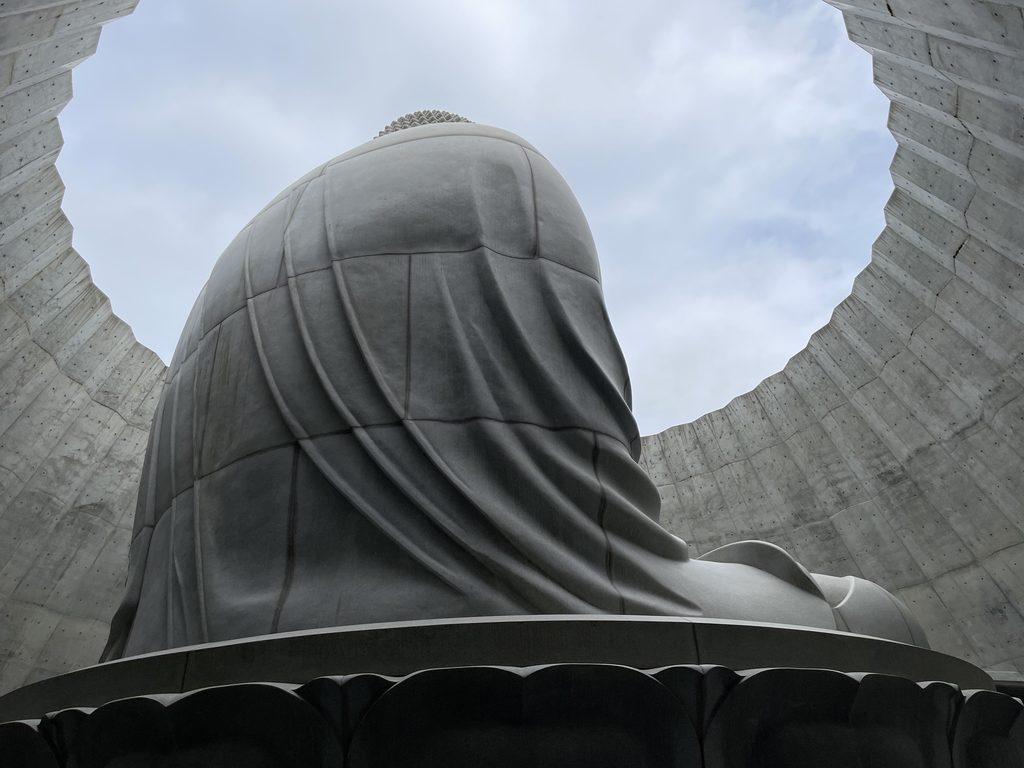
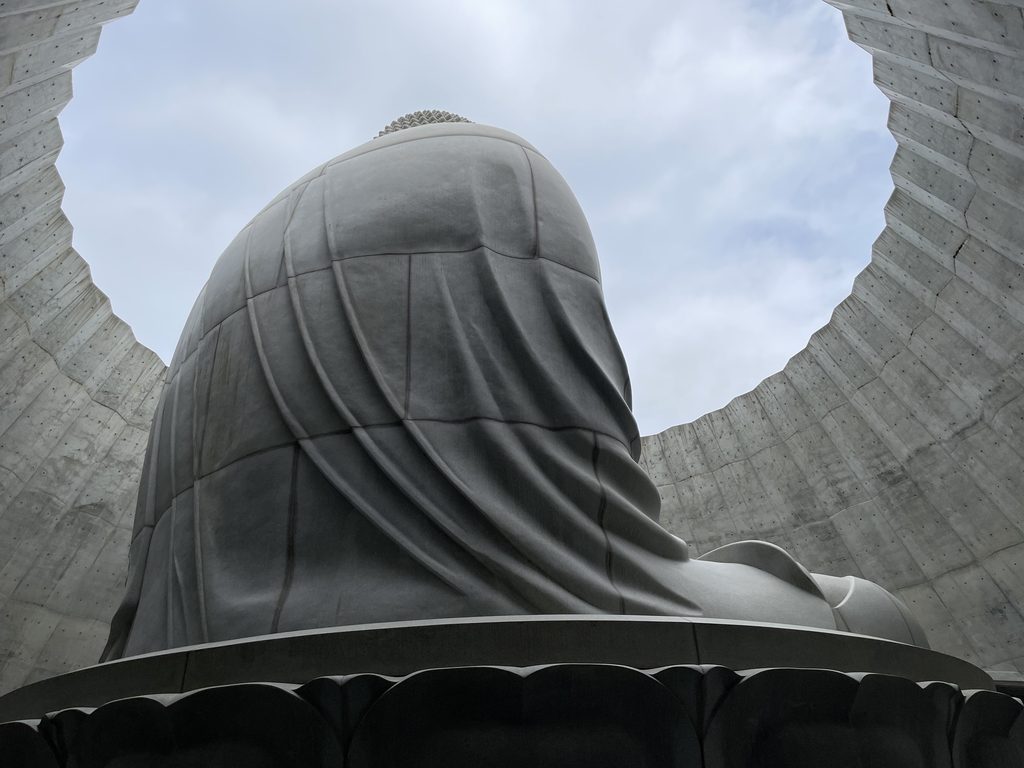
見る位置を変えると、大仏の輪郭の背後に現れる空の形も変化する。コンクリートの円環は石像を物理的に囲うと同時に、空を一枚の背景として切り取り、その輪郭を明確にするフレームとして機能している。建築が大仏を閉じ込めるのではなく、大仏と空との関係を新たにつくり直しているのである。
As the visitor moves, the shape of the sky behind the Buddha changes continuously. The concrete ring does not merely contain the statue; it frames the sky and clarifies its outline. Architecture therefore reconstructs not only the relationship between visitor and Buddha, but also the relationship between the Buddha and the sky.
外部からは頭部だけしか見えなかった像が、ここでは圧倒的なスケールで身体の正面に立ち上がる。しかし、その巨大さを強く感じさせているのは大仏そのものの寸法だけではない。遠くで頭部を見つけ、水を迂回し、暗いトンネルを約40m歩いてきたという前後の体験があることで、同じ石像との距離が心理的にも大きく変化している。
The statue that previously appeared only as a distant head now stands at overwhelming scale directly before the body. Yet this sense of monumentality cannot be explained by dimensions alone. The earlier view from afar, the detour around water, and the roughly 40-meter passage through darkness all contribute to a psychological distance that is suddenly collapsed upon arrival.
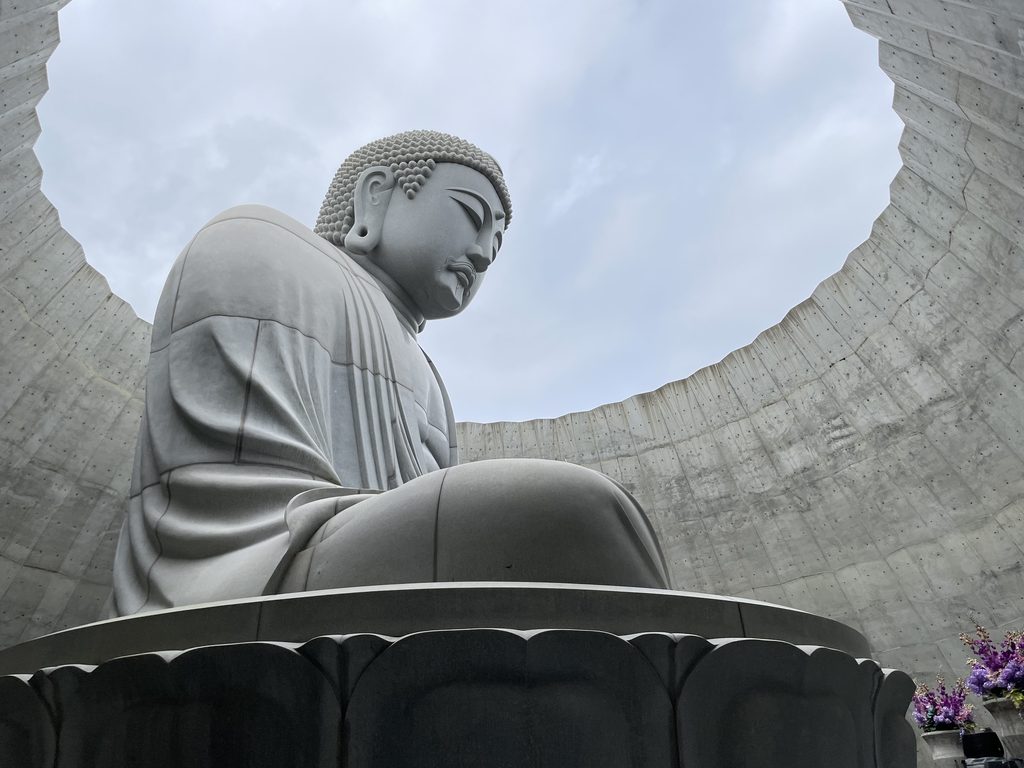
頭大仏では、建築が対象へ新しい造形を付け加えることによって存在感をつくるのではなく、見るまでの条件を整えることで、すでにそこにあったものを別の強度で体験させている。大仏の全身を最初から見せず、暗闇を経て最後に空とともに現すというシークエンスが、その巨大さだけでは説明できない強い印象を生み出している。
At Hill of the Buddha, architecture does not intensify an existing object by adding new ornament or competing form. Instead, it structures the conditions under which the object is encountered. By withholding the full figure, delaying arrival, and finally revealing the Buddha together with open sky, the project allows what was already present to be experienced with entirely new force.
5. 円形の壁が、空そのものを建築に変える
A Circular Wall Turns the Sky Itself into Architecture
大仏を囲むロタンダに立つと、視線は石像だけでなく、その背後と頭上に広がる空へ自然に引き上げられる。円形のコンクリート壁は周囲の風景の多くを遮り、見える範囲を大仏と空に限定するため、普段であれば背景として意識しにくい雲の動きや光の変化までが、空間を構成する重要な要素として感じられる。
Standing within the rotunda, attention is naturally drawn not only to the Buddha but also to the sky above and behind it. The circular concrete wall blocks most of the surrounding landscape and limits the field of vision to the statue and the opening overhead. Clouds, shifting light, and weather—elements that usually remain background conditions—therefore become active components of the space.
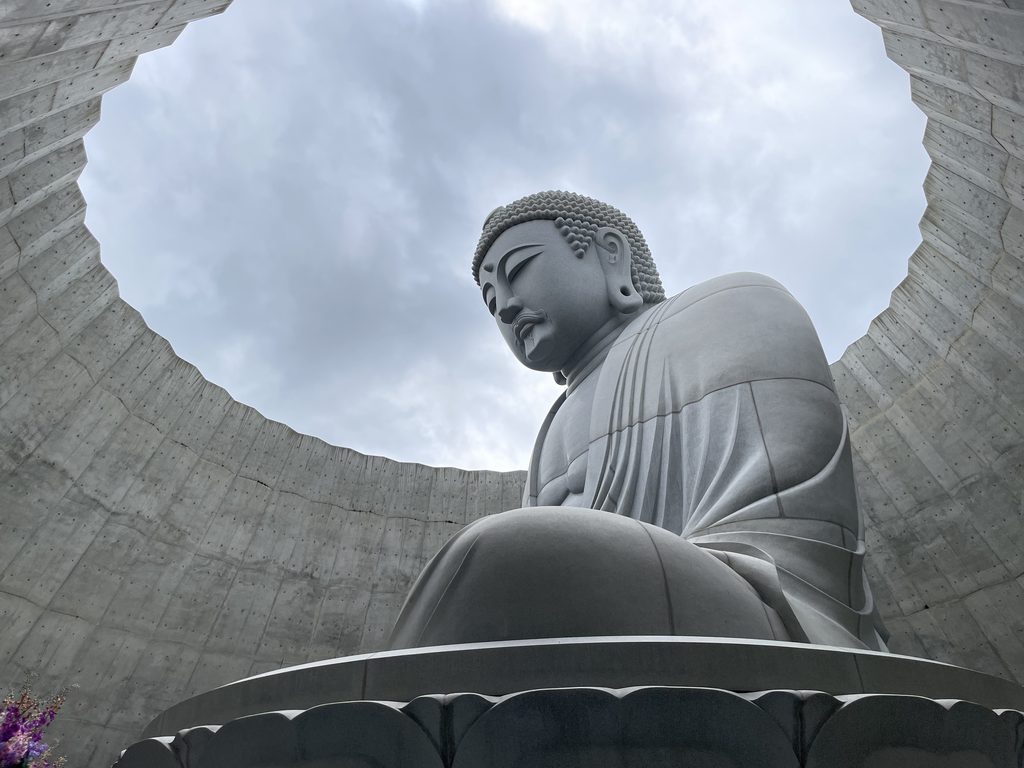
この場所には屋根がないため、晴天の強い光だけでなく、曇り空の重さ、雨、雪、風といった北海道の自然条件がそのまま入り込む。室内のように環境から守られた礼拝空間ではなく、その日の気候や季節によって大仏との対面の印象が変化する場所としてつくられていることが分かる。
Because there is no roof, the rotunda receives Hokkaido’s weather directly. Bright sunlight, heavy cloud, rain, snow, and wind can all enter the space and alter the character of the encounter. This is not a sacred interior protected from nature, but a place in which the condition of the day becomes inseparable from the experience of the Buddha.
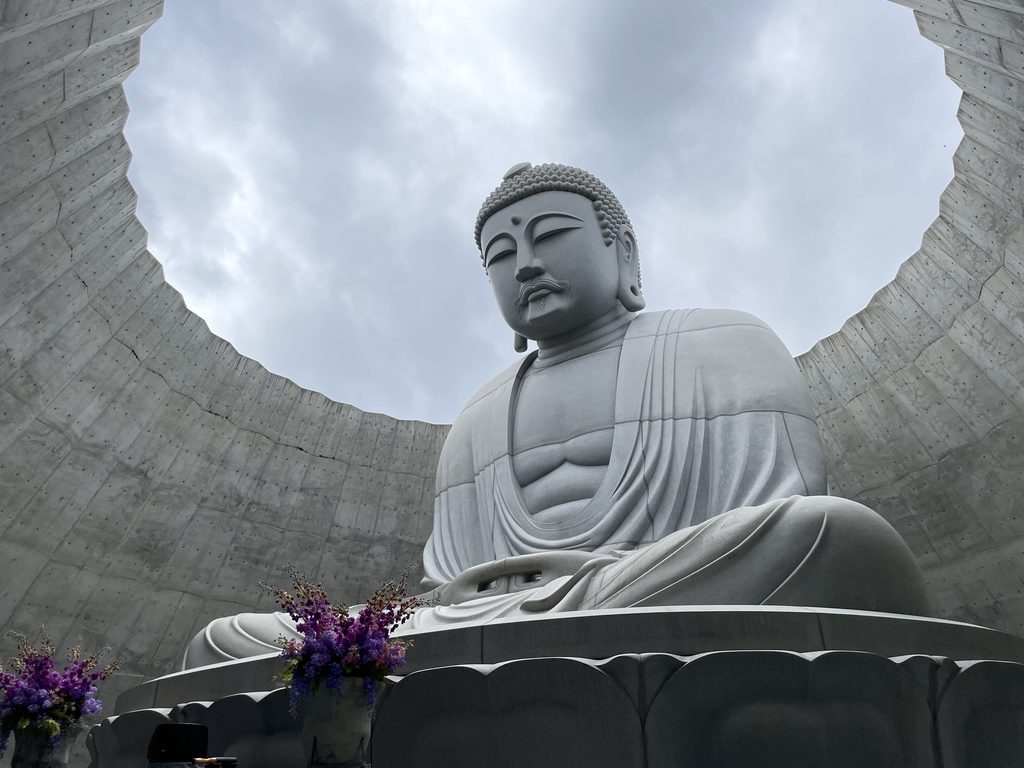
打放しコンクリートの円形壁は、空とは対照的に動かない。厳密な幾何学を保つ人工物と、雲や光によって絶えず状態を変える自然が隣り合うことで、それぞれの性質がより鮮明になる。コンクリートが自然の形を模倣しているわけではなく、むしろ人工的な輪郭をはっきり示すことで、その上に広がる空の自由さや変化を意識させている。
The exposed-concrete wall remains geometrically fixed in contrast to the sky above it. The meeting of an exact artificial circle and an atmosphere that changes continuously sharpens the character of both. Concrete does not imitate nature; rather, by remaining unmistakably artificial, it makes the movement and freedom of the sky more visible.
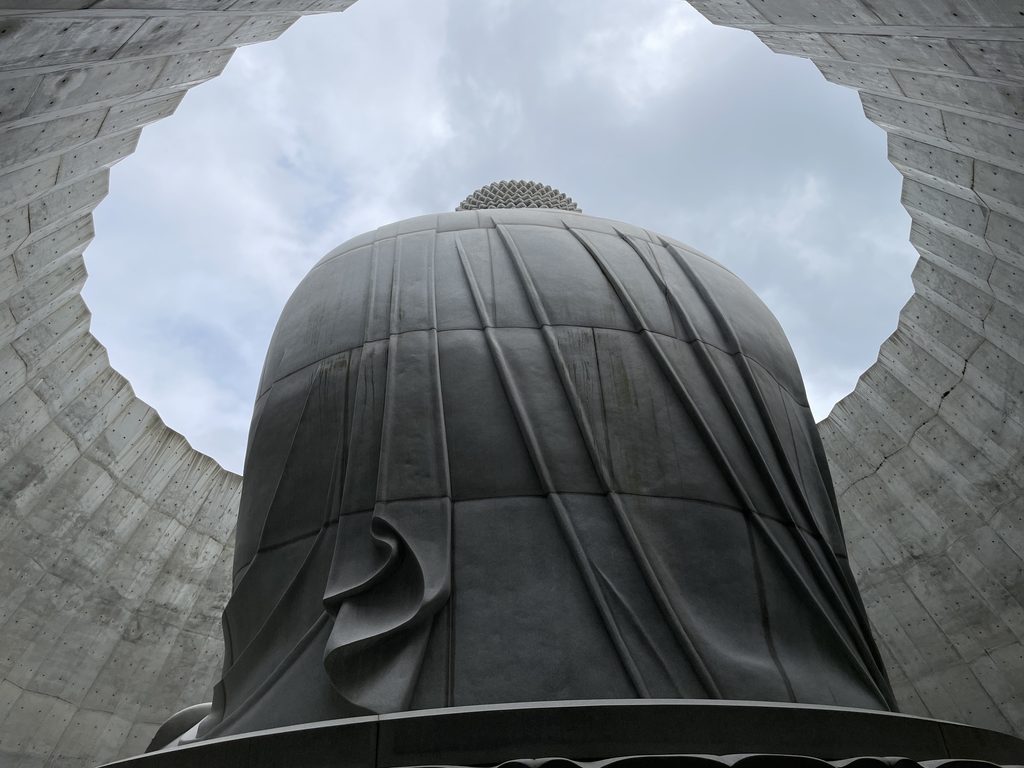
大仏の近くを歩くと、見る位置によって石像と空の比率が少しずつ変わり、円形壁の輪郭も異なる形として現れる。一つの正面だけに完成した構図が用意されているのではなく、人がロタンダの中を動くことで、大仏、コンクリート、空の関係が連続的に変化する余地が残されている。
As one moves around the Buddha, the proportion between statue and sky shifts, and the contour of the circular wall changes with viewpoint. The architecture does not prescribe a single finished composition. Instead, it allows the relationship among Buddha, concrete, and sky to transform continuously through the visitor’s movement.
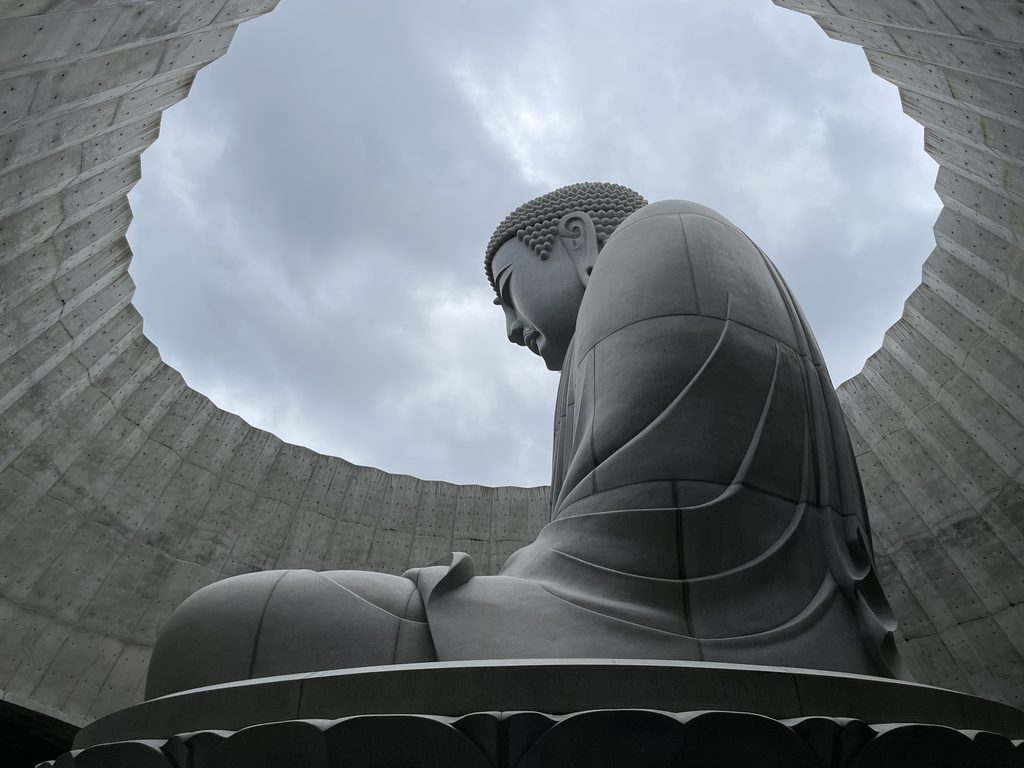
巨大な大仏を囲うためにつくられた空間でありながら、最終的にはその大仏のさらに上にある空へ視線が向かうことも、この作品の面白さの一つである。コンクリートは空を閉ざすのではなく、円形に限定することで、空そのものを強く意識させる。その瞬間、普段は背景として存在している自然が、建築によって一つの明確な空間要素へ変換されている。
Although the rotunda was created to surround a monumental statue, it ultimately draws attention beyond the Buddha toward the sky itself. Concrete does not close the sky off; by limiting it to a circular opening, it turns something normally perceived as an indefinite background into a sharply defined spatial element. Through architecture, the sky itself becomes newly visible.
6. 建築を埋めることで、風景をつくる
Burying Architecture to Create a Landscape
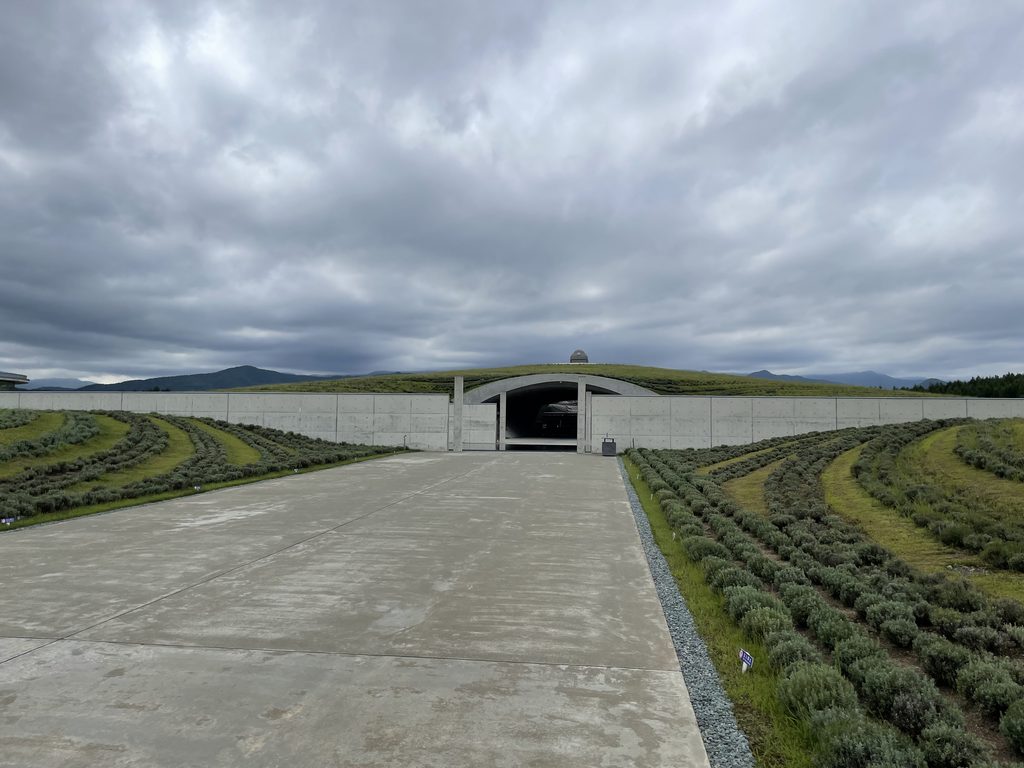
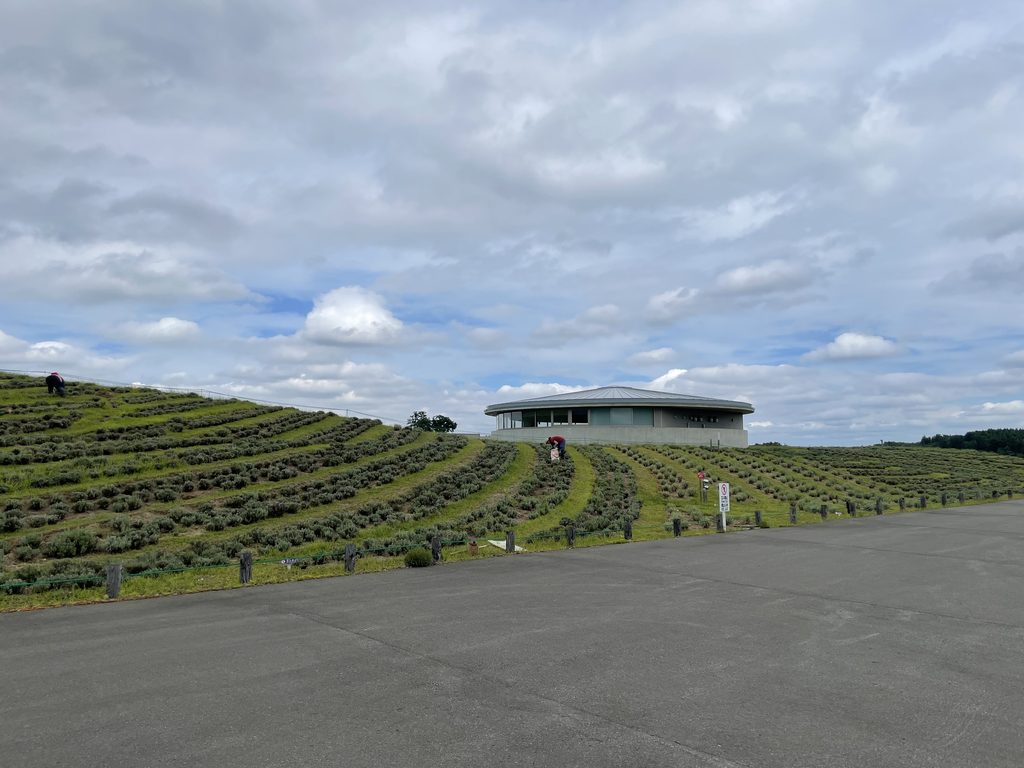
頭大仏の外観で最も特徴的なのは、ロタンダや約40mのトンネルといった相当な規模の建築が、地上からはほとんど一つの建物として見えないことである。コンクリートの構造体は丘の内部へ埋め込まれ、その表面を植物が覆うことで、外から認識されるのは建築物というより新しくつくられた地形である。
Another defining aspect of Hill of the Buddha is that a substantial architectural structure—the rotunda and approximately 40-meter tunnel—barely appears as a building from the outside. Most of the concrete is embedded within the hill, and planting covers the surface, causing the project to read externally as topography rather than architecture.
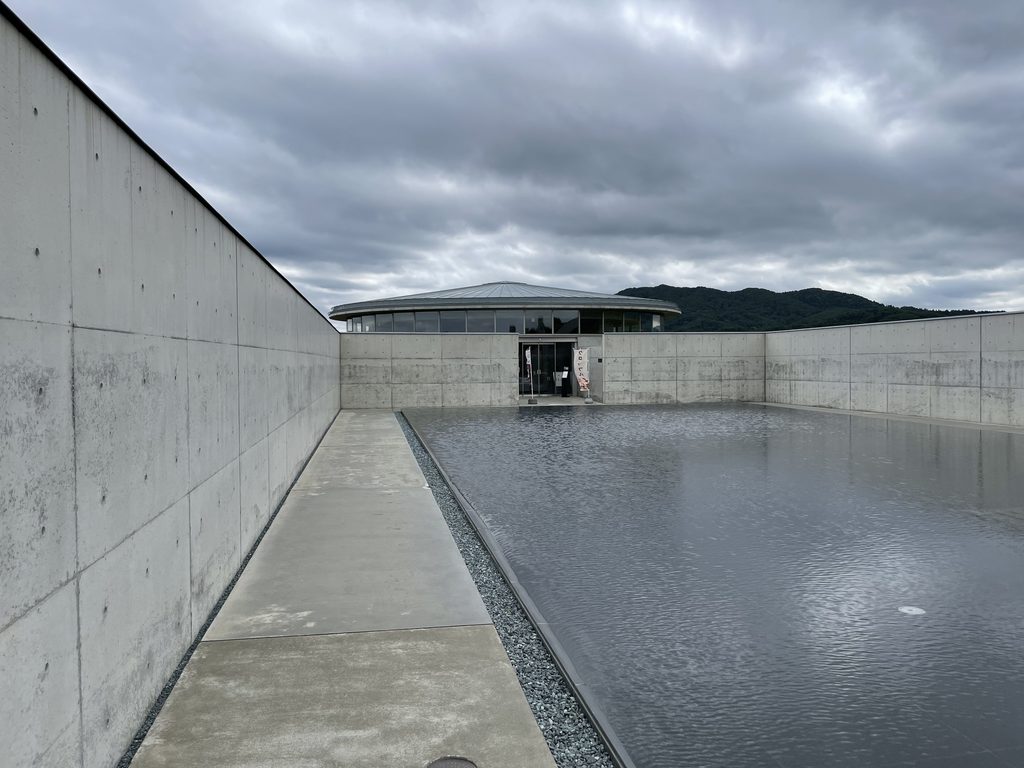
丘には大量のラベンダーが植えられ、春には緑、夏には紫、秋には色を失った植生、冬には雪に覆われた白い地形へと姿を変える。建築そのものの形は変わらなくても、その表面を覆う植物や雪によって外観の印象は大きく変化し、完成した一つの固定的な姿ではなく、季節を受け入れるランドスケープとして存在している。
The hill is planted with a vast field of lavender and changes dramatically throughout the seasons: green in spring, purple in summer, muted after flowering, and white beneath winter snow. Although the underlying structure remains fixed, the visible character of the project continually changes through vegetation and climate, allowing it to function as a landscape that receives time rather than as a single immutable exterior.
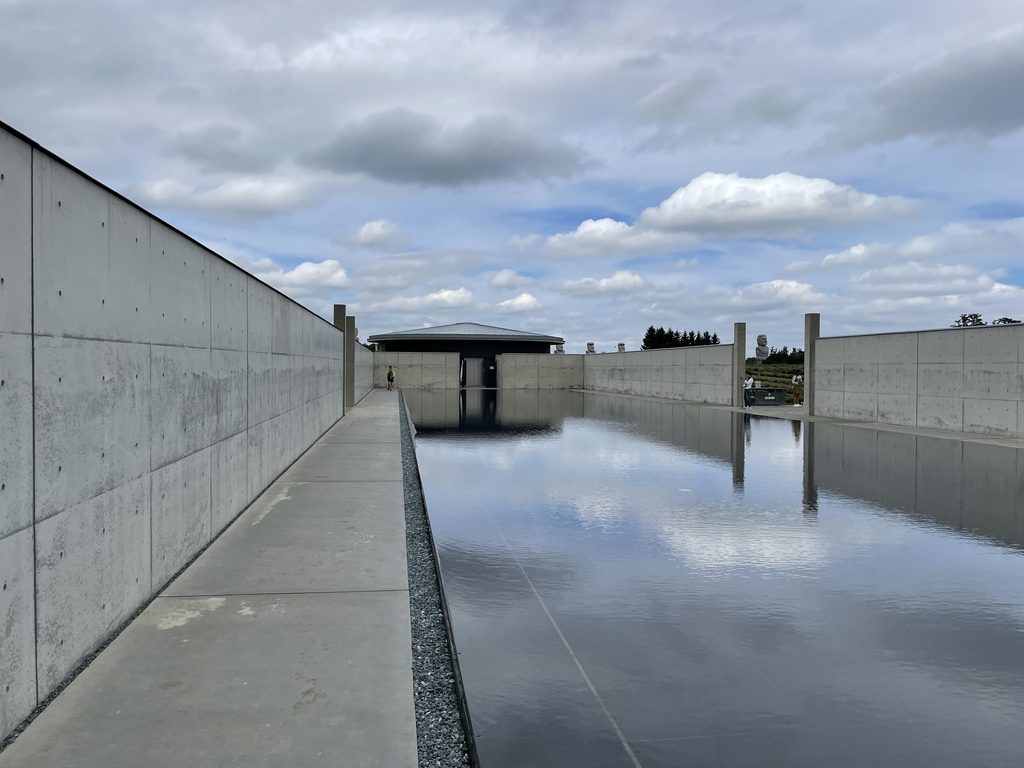
一般的に巨大な宗教像は、周囲からよく見える場所へ置かれ、その高さや大きさによってランドマークとしての存在感をつくる。しかし頭大仏では、大仏も建築も大部分を地形の中へ隠している。高く見せるのではなく埋めることで存在を強くし、遠くからは頭部だけが現れるという極めて限定された風景をつくる方法は、巨大な対象を扱う一般的な発想とは逆方向にある。
Monumental religious statues are often positioned to be seen from great distances, using height and exposure to establish themselves as landmarks. Hill of the Buddha takes the opposite approach. Both the architecture and most of the statue are hidden within the ground. Monumentality is intensified through concealment, and the distant image is reduced to the smallest possible fragment: the head alone above the hill.
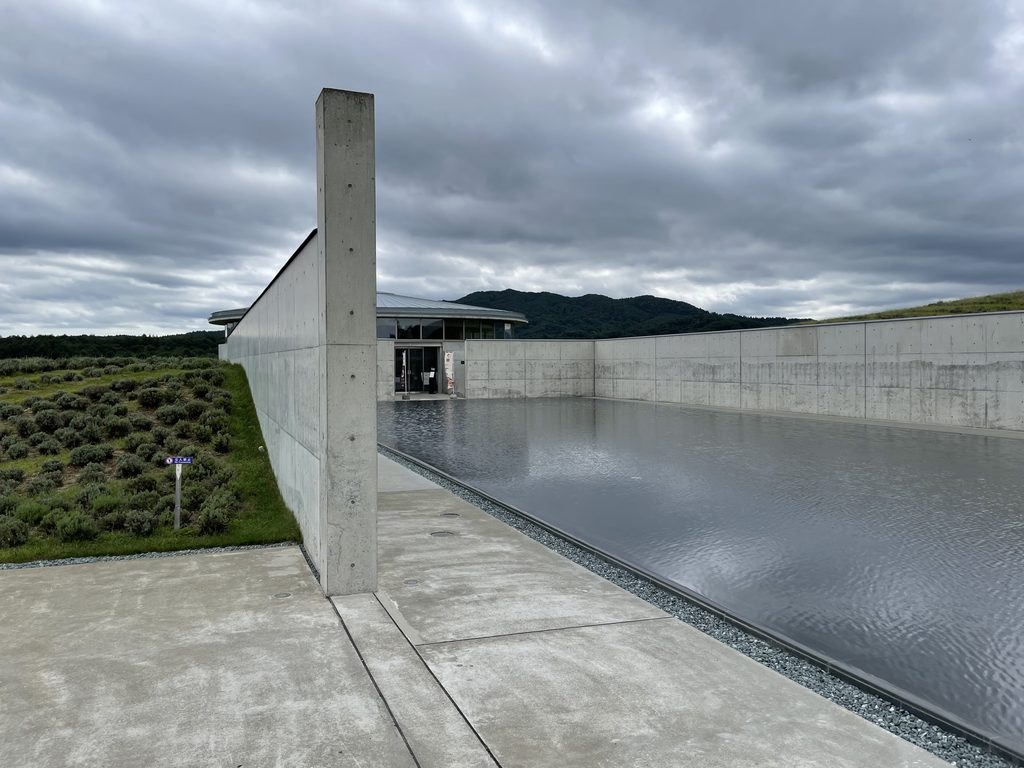
丘、コンクリート、大仏、空はそれぞれ別の要素でありながら、一つだけを切り離してこの作品を説明することは難しい。丘があるから頭部だけが地上に現れ、トンネルが地形の内部にあるから暗闇を通過し、ロタンダが丘を貫いて上方へ開かれているから、大仏の背後に空が現れる。建築とランドスケープがそれぞれ独立しているのではなく、人が歩く一つのシークエンスを共有している。
The hill, concrete, Buddha, and sky are distinct elements, yet none can fully explain the project in isolation. The hill allows only the head to remain visible; the tunnel can be dark because it is embedded within that hill; the rotunda penetrates the topography and opens upward, allowing the sky to appear behind the Buddha. Architecture and landscape therefore do not exist as separate layers but share a single sequence of movement and perception.
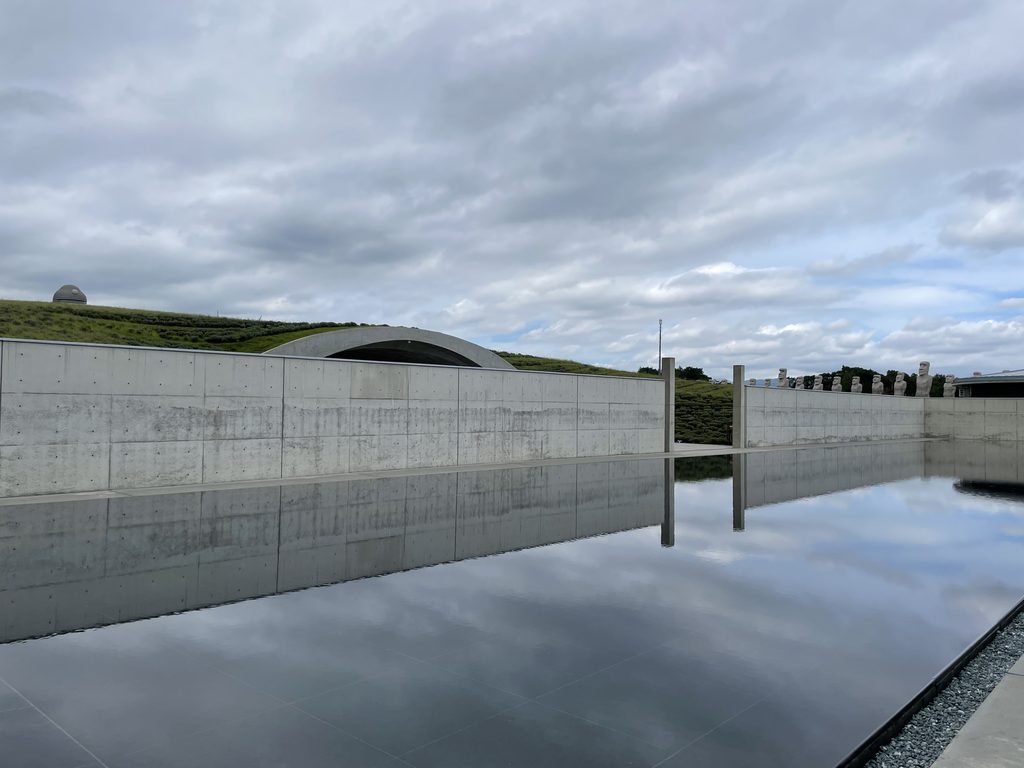
頭大仏では、建築を自然の中へ目立たせることよりも、建築そのものを地形へ変換することで、新しい風景がつくられている。それは自然に溶け込んで消えることを目指したものではなく、人工的につくられた丘とコンクリートによって、既存の大仏と北海道の空や植生との関係を再構築するという、建築とランドスケープの境界を越えた設計である。
At Hill of the Buddha, architecture does not seek prominence within the landscape. Instead, it becomes the landscape, using an artificial hill and concrete infrastructure to reconstruct the relationship between an existing monument and the climate, vegetation, and sky of Hokkaido. The result occupies a territory between architecture and landscape rather than belonging comfortably to either category alone.
7. もう一度外へ出ると、「頭だけ」の意味が変わる
Returning Outside, the Meaning of “Only the Head” Changes
大仏と対面し、再びトンネルを通って外へ出ると、最初に見た「丘の上に頭だけが現れる風景」の意味が少し変わっている。訪れる前には、巨大な大仏を丘で覆った印象的な造形として見えていたものが、内部を歩いたあとでは、その下に約40mのトンネルと円形のロタンダ、大仏の巨大な身体、そして空へ開かれた空間を内包する地形として見えるようになる。
After encountering the Buddha and passing back through the tunnel, the familiar image of the head rising above the hill acquires a different meaning. Before entering, it may have appeared primarily as a striking visual idea. After walking through the interior, the same hill can now be understood as a landscape containing a 40-meter tunnel, a circular rotunda, the enormous body of the statue, and an open connection to the sky.
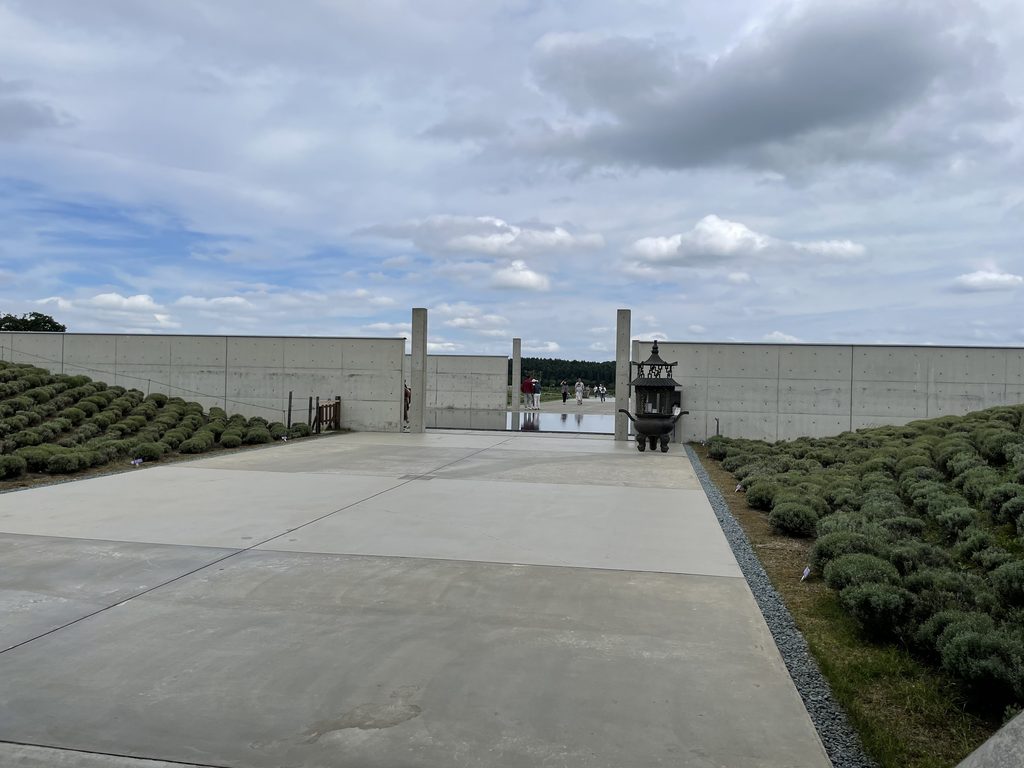
建築を見る体験では、目の前にある形そのものだけでなく、その形に至るまでに何を経験したかによって、同じ風景の見え方が変わることがある。頭大仏では、外からはほとんど見えない内部を実際に歩いたことで、再び外観を見たときに、視覚には現れていない部分まで自然に想像できるようになっている。
Architecture can alter not only what is seen in front of us, but also how the same object is perceived after an experience has taken place. At Hill of the Buddha, walking through an interior that is largely invisible from outside allows the visitor to imagine spaces that are no longer physically visible after returning to the landscape.
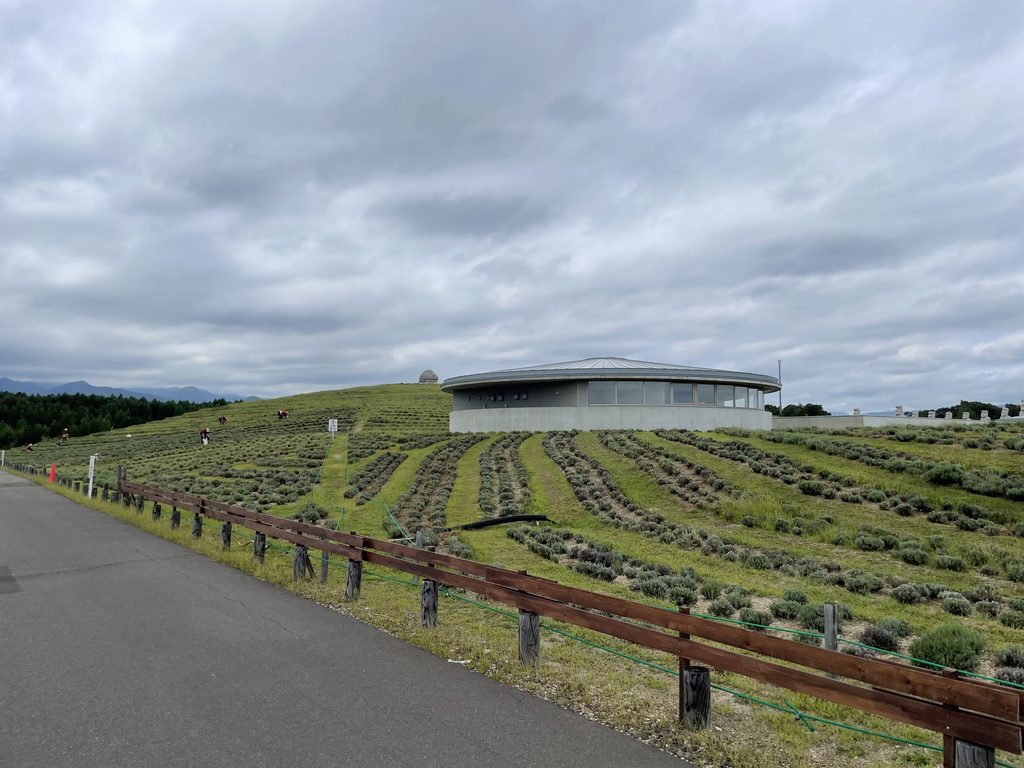
この変化は、作品の出発点である「隠す」という操作と深く結びついている。最初は隠されているからこそ見たいと思い、内部へ入り、暗闇を通って大仏の全身と出会う。そしてすべてを見たあとに再び外へ戻ると、今度は頭だけしか見えない姿の中に、先ほど経験した空間全体を重ねて見ることができる。見えるものと見えないものの関係が、訪問の前後で反転していくのである。
This transformation is directly related to the project’s original strategy of concealment. At first, what is hidden produces curiosity. The visitor enters, passes through darkness, and encounters the entire figure. Once everything has been seen, returning outside creates the opposite effect: the head alone now evokes the spaces beneath it. The relationship between visible and invisible is reversed over the course of the visit.
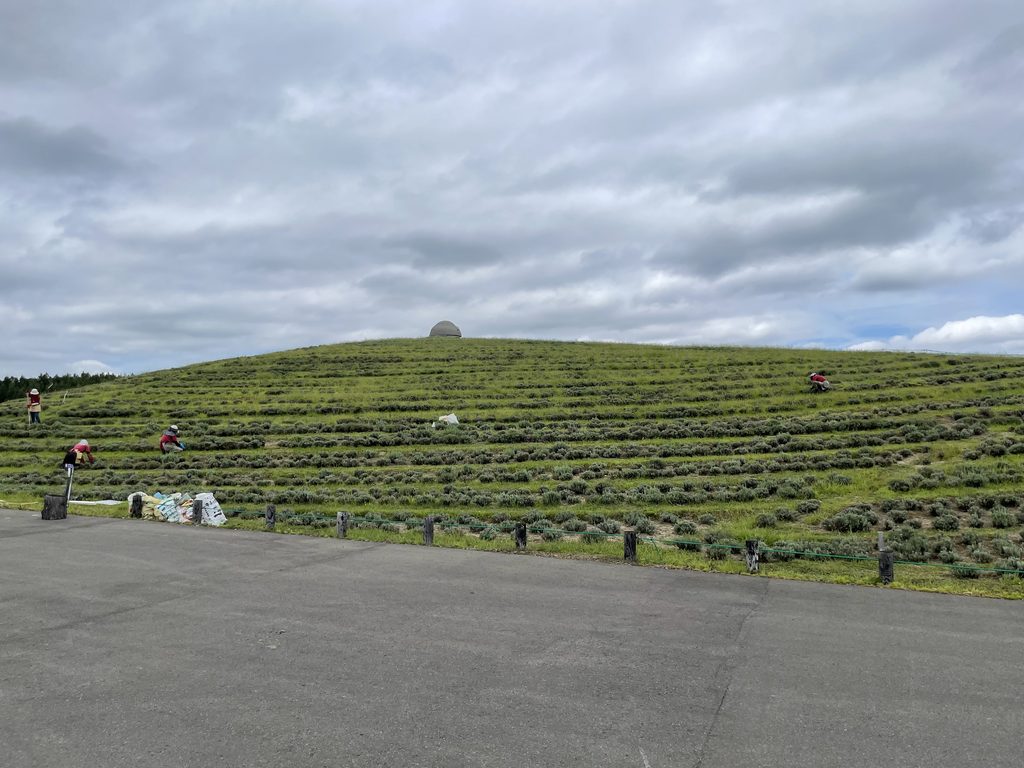
頭大仏は、巨大な石像に新しい外装を与えた建築ではない。すでにそこに存在していた大仏を、丘、水、コンクリート、暗闇、光、空、そして歩く時間によって読み替え、人と大仏との距離を再設計した作品である。外から見える造形以上に、その内部を歩いたあとで同じ風景の意味が変わることこそ、この建築の本質に近いように思う。
Hill of the Buddha is not a new architectural shell placed around a monumental statue. It is a project that reinterprets an existing Buddha through hill, water, concrete, darkness, light, sky, and the duration of walking. More than the form of the concrete itself, its deeper achievement lies in redesigning the distance between a person and an object that had already been there all along.
My Impression
頭大仏を訪れる前から、丘の上に大仏の頭だけが現れる写真は知っていた。安藤忠雄が巨大な大仏を丘で覆った作品だということも理解していたので、実際に現地へ行けば、その独特な外観を見ることが一番大きな体験になるのだろうと思っていた。しかし実際に歩いてみると、強く印象に残ったのは完成された外観そのものではなく、大仏との距離が何度も変化し、そのたびに同じ像の見え方まで変わっていくことだった。
最初は丘の上に頭部が見えている。それだけで大仏の存在は明確に分かるのに、近づいていくと水庭やコンクリートの壁によって進行方向を変えられ、かえってその姿が視界から消えていく。さらにトンネルへ入ると、それまで広がっていた北海道の空や丘のスケールも失われ、目の前には打放しコンクリートの暗い空間だけが残る。目的地へ近づいているはずなのに、視覚的には一度大仏から遠ざかっていくような感覚があり、その距離の逆転がとても印象的だった。
Before visiting Hill of the Buddha, I already knew the familiar image of the Buddha’s head rising above the hill. I also knew that Tadao Ando had covered the enormous statue with an artificial landscape, so I expected that seeing this unusual exterior in person would be the central experience of the visit. What remained with me most strongly, however, was not the completed image itself, but the way the distance between myself and the Buddha repeatedly changed—and how each change altered the way the same statue was perceived.
At first, the head is clearly visible above the hill. The presence of the Buddha is unmistakable, yet as one approaches, the water garden and concrete walls redirect movement and gradually remove the statue from sight. Entering the tunnel causes an even greater separation: the vast Hokkaido sky and the scale of the hill disappear, leaving only a dim concrete passage ahead. Physically, the visitor is moving closer to the Buddha, but visually the architecture creates a temporary sense of moving away from it.
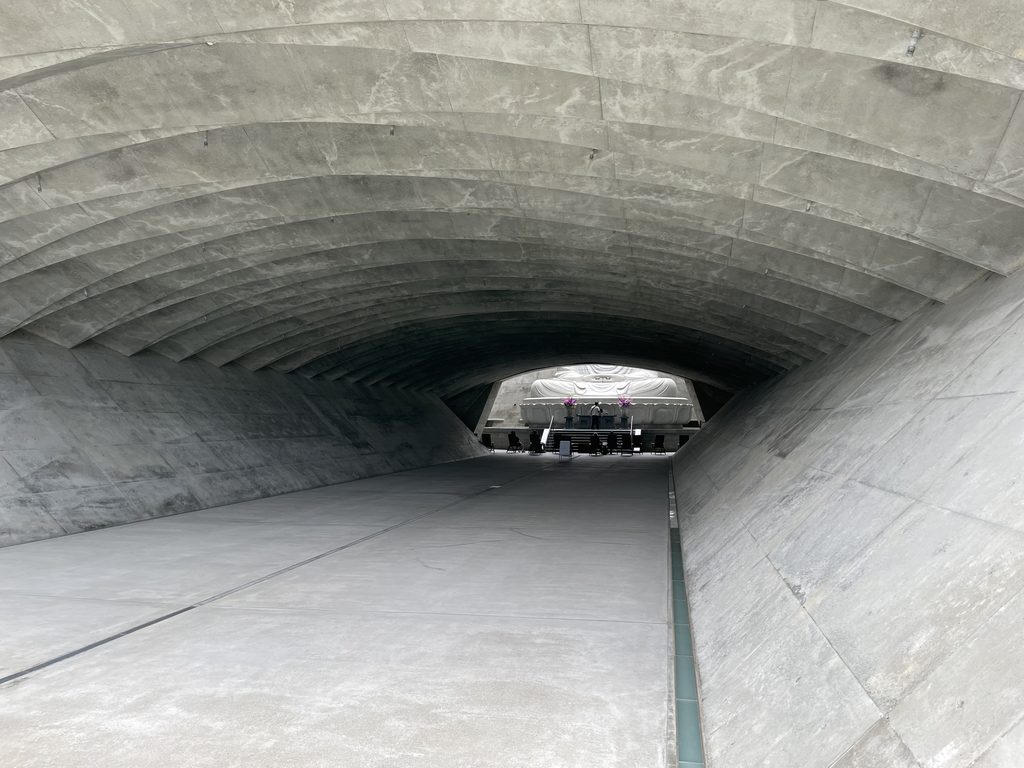
暗がりを進んでいくと、遠くに残された光が少しずつ大きくなり、その中から大仏の姿が現れ始める。外ではすでに頭部を見ているため、存在そのものは知っているはずなのに、ここでは初めて大仏に出会うような感覚があった。巨大な石像をただ目の前に置くだけでは、おそらくここまで強い印象にはならなかったと思う。見えていたものを一度失い、暗い空間の中で少しずつ距離を縮めていく時間があることで、同じ大仏が別の存在として立ち上がっていた。
ロタンダへ出て、大仏の足元から見上げたときの構図も強く記憶に残っている。
As the darkness continues, the point of light at the end of the tunnel slowly expands and the figure of the Buddha begins to emerge. Although I had already seen its head outside, this felt almost like encountering the Buddha for the first time. I doubt that the same statue would have produced the same intensity if it had simply been exposed in front of me from the beginning. Losing sight of what had already been visible, then approaching it gradually through darkness, gave the same object a completely different presence.
The moment of looking upward from the base of the Buddha within the rotunda also remained particularly vivid.
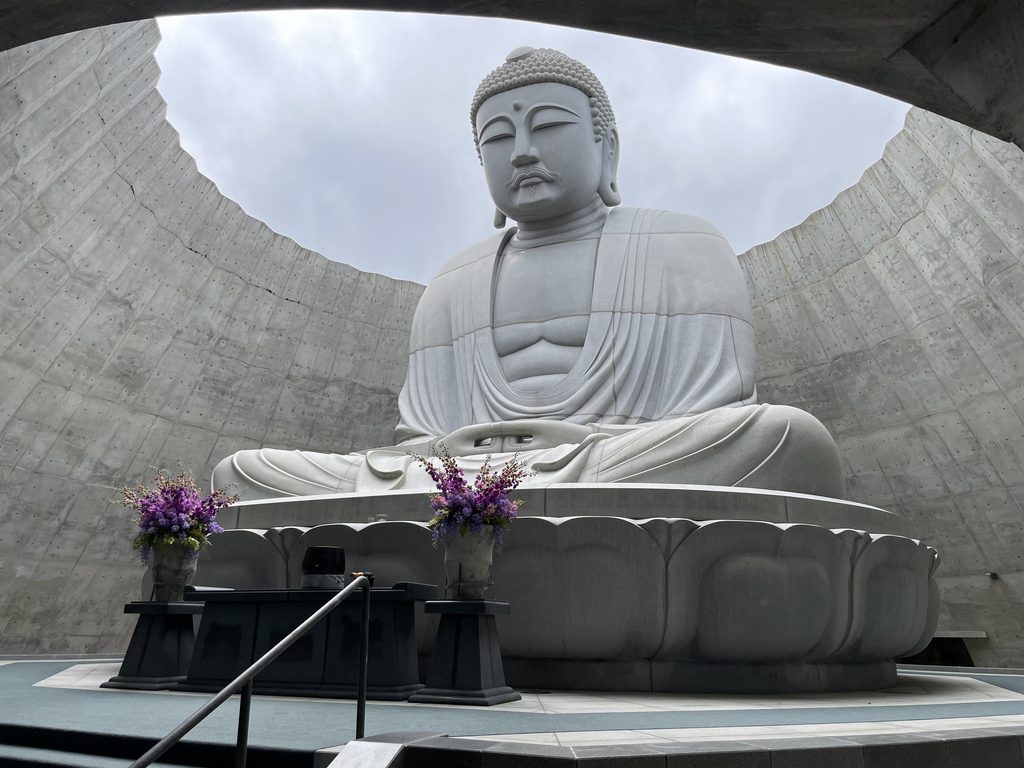
頭上には屋根がなく、円形のコンクリート壁の向こうにその日の空が広がっている。訪れた日は雲の多い天候だったが、その重い空が大仏の背後に現れることで、石像、コンクリート、自然光が一つの空間として感じられた。晴れの日であればもっと強い光が入り、冬なら雪がそのままロタンダへ降り込むのだろう。同じ建築であっても、大仏との出会いは季節や天候によって毎回違うものになることが想像できた。
この場所を歩いて改めて感じたのは、安藤忠雄が既存の大仏そのものにはほとんど手を加えず、その周囲の条件を変えることで、大仏の存在感をまったく別のものにしているということだった。丘によって身体を隠し、水によって遠回りさせ、トンネルによって光を減らし、最後に円形の空を与える。造形としては非常に大胆でありながら、最終的に意識の中心に残るのは建築ではなく、以前からそこに存在していた大仏である。
水の教会を訪れたときには、安藤建築を見に行ったはずなのに、最後には水や森を見ることになった。頭大仏でも、それに少し似た感覚があった。ただしこちらでは、自然そのものを発見し直すのではなく、すでにそこに存在していた一つの対象を、建築を通してもう一度発見し直すという感覚がより強い。
外へ戻り、丘の向こうに再び頭だけが見える姿を眺めると、最初に見たときとは明らかに印象が違っていた。
There is no roof overhead, only the sky beyond the circular concrete wall. The day I visited was heavily clouded, and the weight of that sky behind the Buddha allowed stone, concrete, and natural light to merge into one spatial experience. On a clear day the light would be entirely different, while in winter snow must fall directly into the rotunda. I could easily imagine how the same architecture would produce a different encounter with the Buddha according to season and weather.
What became increasingly clear as I walked through the project was that Ando had done very little to the Buddha itself. Instead, he transformed its presence by redesigning everything around it. The body is hidden by the hill, movement is delayed by water, light is reduced inside the tunnel, and finally the statue is given an open circle of sky. The intervention is remarkably bold as a piece of landscape and architecture, yet what remains at the center of attention is not the architecture but the Buddha that had stood there before.
At Church on the Water, I had gone to see Ando’s architecture and eventually found myself looking instead at water and forest. Something similar happens at Hill of the Buddha, but the emphasis is different. Here, it is not nature itself that is rediscovered, but an existing object that becomes newly perceptible through architecture.
Returning outside and seeing only the head above the hill once again, the view no longer felt the same.
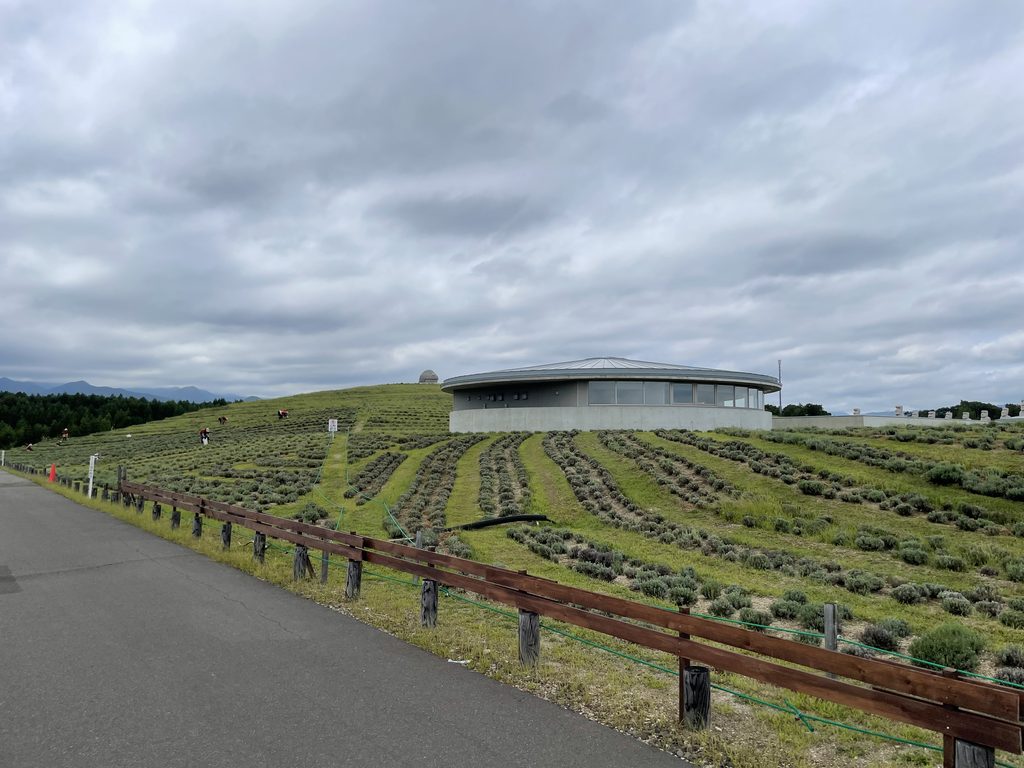
その下に巨大な身体があり、その周囲に円形のコンクリート壁があり、そこへ続く暗いトンネルが丘の内部に延びていることを、すでに自分の身体で知っているからである。外から見えているものは相変わらずわずかなのに、その見えない部分まで含めて風景を想像できるようになっていた。
頭大仏を訪れる前は、「巨大な大仏を丘で覆い、頭だけを見せる」という非常に強い造形的アイデアに目が向いていた。しかし実際に歩いたあとでは、そのアイデア以上に、人が何を見るかだけでなく、何を見ない時間を過ごすかまで設計されていることが印象に残った。見えていたものを一度失い、その不在を経験したうえで再び対面することで、以前からそこにあった大仏の存在が、訪れる前よりも深く感じられる。
頭大仏は、巨大な対象を新しくつくった作品ではなく、すでにそこに存在していたものとの出会い方そのものを、建築によってつくり直した作品なのだと思う。
I now knew, through my own body, that beneath that small visible fragment lay the enormous body of the Buddha, the circular concrete rotunda, and the dark tunnel extending through the hill. Very little was visible from outside, yet I could now imagine the invisible spaces contained within the landscape.
Before visiting, I was drawn to the striking idea of covering a monumental Buddha and leaving only its head exposed. After walking through the project, however, what impressed me more was the extent to which the architecture was designed not only around what visitors would see, but also around the time in which they would see nothing at all. Losing sight of the Buddha, moving through darkness, and encountering it again made something that had always been there feel newly present.
Hill of the Buddha is not a work that creates a new monumental object. It is a work that uses architecture to reconstruct the way we encounter an object that already existed.
Archive Gallery