【安藤忠雄建築】西田幾多郎記念哲学館|迷い、上り、見上げながら、「考えること」を体験する建築(Ishikawa Nishida Kitaro Museum of Philosophy|An Architecture for Experiencing the Act of Thinking)
建築概要
Overview
- 名称:石川県西田幾多郎記念哲学館
- 設計:安藤忠雄
- 所在地:石川県かほく市内日角井
- 竣工:2002年
- 用途:博物館・哲学館
- Name:Ishikawa Nishida Kitaro Museum of Philosophy
- Architect:Tadao Ando
- Completed:2002
- Location:Uchinichisumi, Kahoku, Ishikawa, Japan
- Type:Museum / Museum of Philosophy
石川県によって建設され、現在はかほく市が管理運営する、日本で唯一の哲学をテーマとした博物館である。西田幾多郎の遺品や資料を展示するだけでなく、「考えること」そのものを体験する施設としてつくられている。建物内部はあえて複雑に構成され、来館者自身が迷い、考えながら進む。館内には静かに思索するための空間も設けられている。
Built in Ishikawa Prefecture and now operated by Kahoku City, this is Japan’s only museum devoted specifically to philosophy. Rather than simply displaying Nishida’s personal belongings, writings, and historical materials, the museum was conceived as a place where visitors could experience the act of thinking itself. Its circulation is deliberately complex, encouraging visitors to lose their sense of direction at times and decide for themselves where to go next. Throughout the building are quiet spaces intended for contemplation.
1.迷い、上り、見上げながら、「考えること」を体験する建築
An Architecture for Experiencing the Act of Thinking
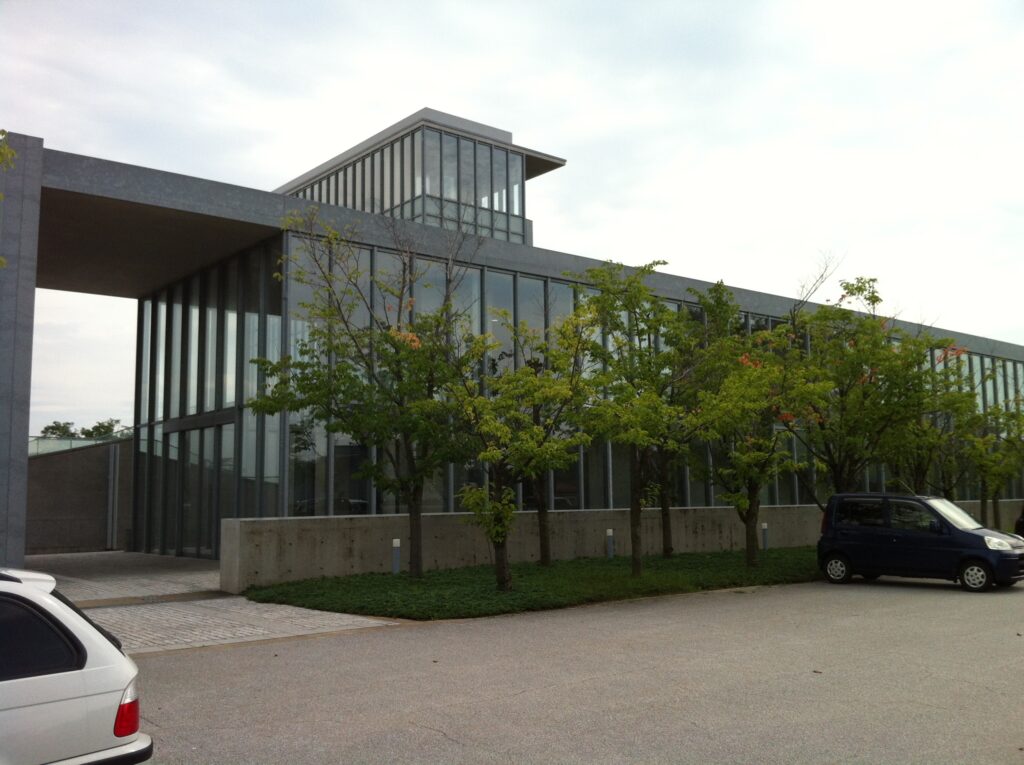
石川県かほく市。日本海に近い丘の上に、ひときわ垂直に立ち上がるガラスとコンクリートの建築がある。石川県西田幾多郎記念哲学館。『善の研究』で知られ、独自の哲学体系を築いた西田幾多郎の業績と思想を伝える、日本で唯一の「哲学の博物館」である。西田は現在のかほく市に生まれ、生涯の約半分を石川県で過ごした。
設計は安藤忠雄。公式に語られているこの建築のテーマは、非常にシンプルだ。「考えること」。しかし実際に歩いてみると、その言葉が単なるコンセプトではないことが分かる。まっすぐ進めない。先が見えない。突然空が現れる。階段を上り、円形の空間へ入り、また方向を変える。ここでは建築を理解しようとする行為そのものが、自分で考え、道を選ぶ体験になっていた。
On a hill in Kahoku City, Ishikawa, not far from the Sea of Japan, a striking composition of glass and concrete rises vertically above the surrounding landscape. This is the Ishikawa Nishida Kitaro Museum of Philosophy, dedicated to the life and thought of Kitaro Nishida, the philosopher known for An Inquiry into the Good and for developing an original philosophical system that became one of the foundations of modern Japanese philosophy. Nishida was born in what is now Kahoku City and spent approximately half of his life in Ishikawa.
The museum was designed by Tadao Ando around an unusually simple theme: “thinking.” Yet walking through the building makes it clear that this is far more than an abstract concept applied to the architecture. The route is not always straightforward. The destination is often hidden. The sky suddenly appears. Stairs rise around curved concrete walls, directions change, and moments of stillness interrupt movement. Here, the effort to understand the building itself becomes an experience of choosing, questioning, and thinking.
2.丘の上から始まる建築
Architecture Beginning on a Hill
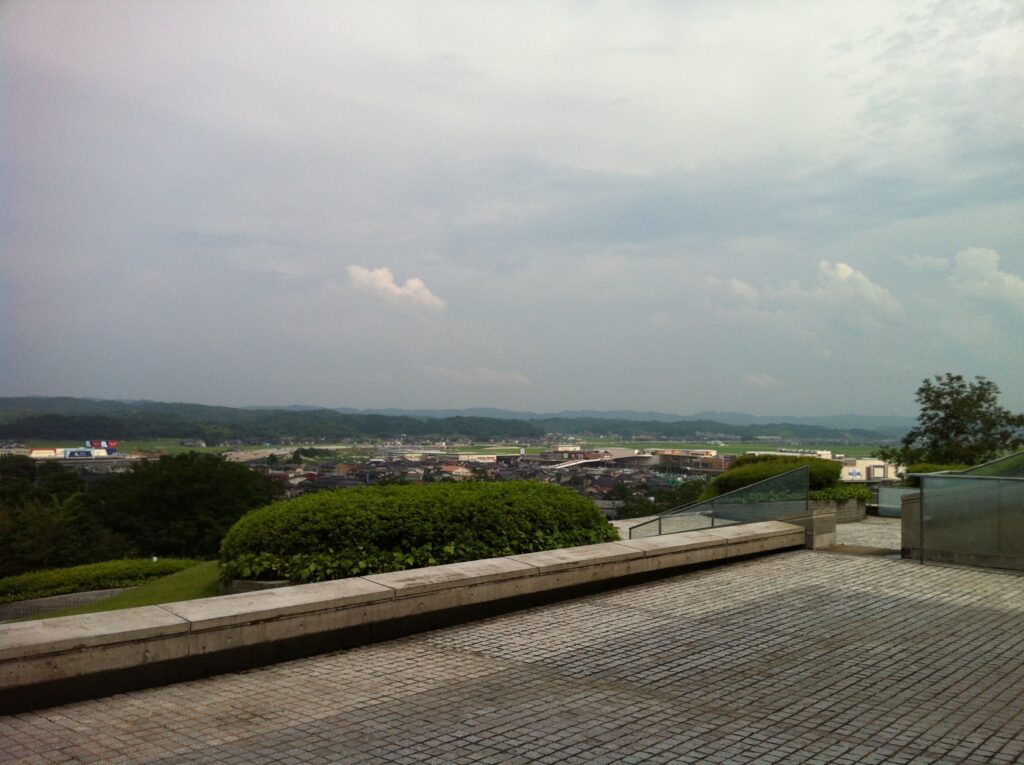
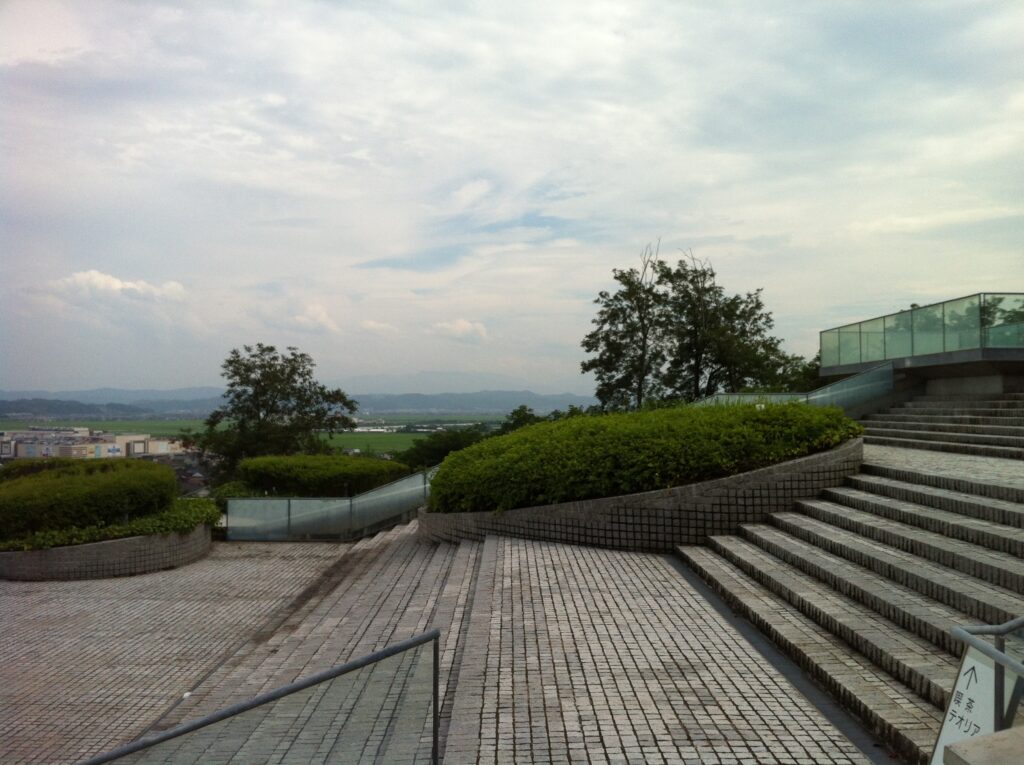
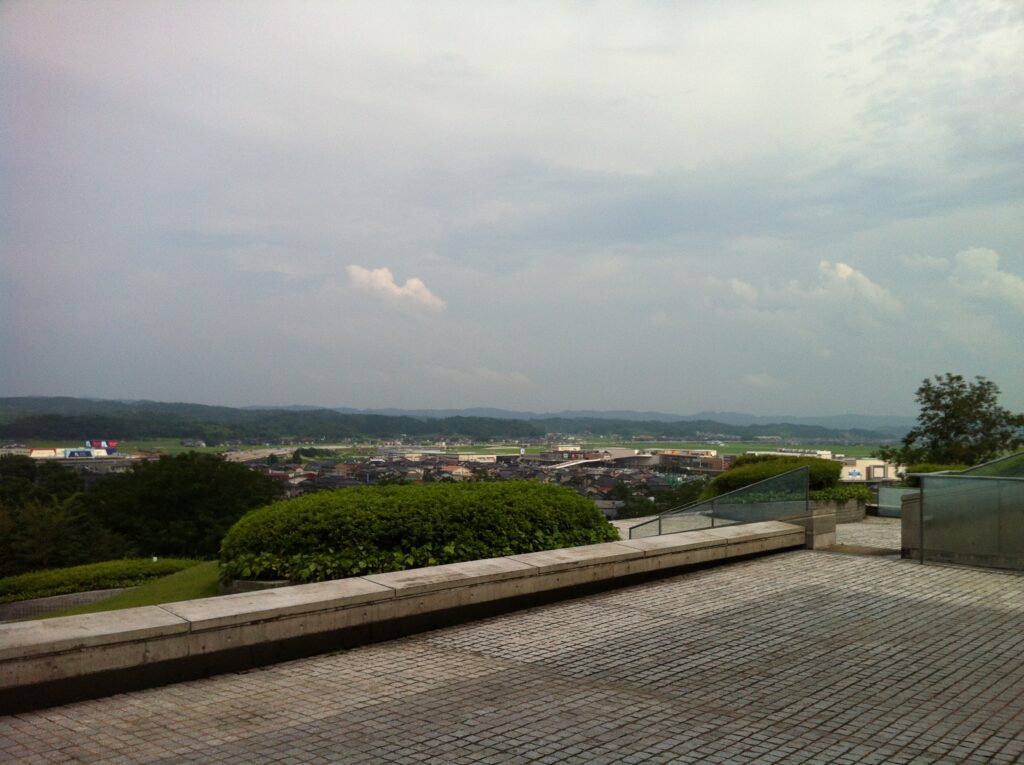
この場所でまず印象に残るのは、建物そのものよりも周囲の広がりだった。高台から遠くまで石川の街並みが見渡せ、その先へ空が続いている。
建築を都市の中へ閉じ込めるのではなく、この大きな風景を背景に置く。そのことが、これから内部で体験する閉じたコンクリート空間との強い対比になっている。
One of the first things that remained in my memory was not the building itself, but the vastness of the surroundings. From this elevated site, the cityscape of Ishikawa stretches into the distance beneath an expansive sky.
Rather than enclosing the architecture within an urban setting, the building is placed against this broad landscape. That openness later creates a powerful contrast with the enclosed concrete spaces experienced inside.
3.まっすぐ進ませない
Refusing the Straight Path
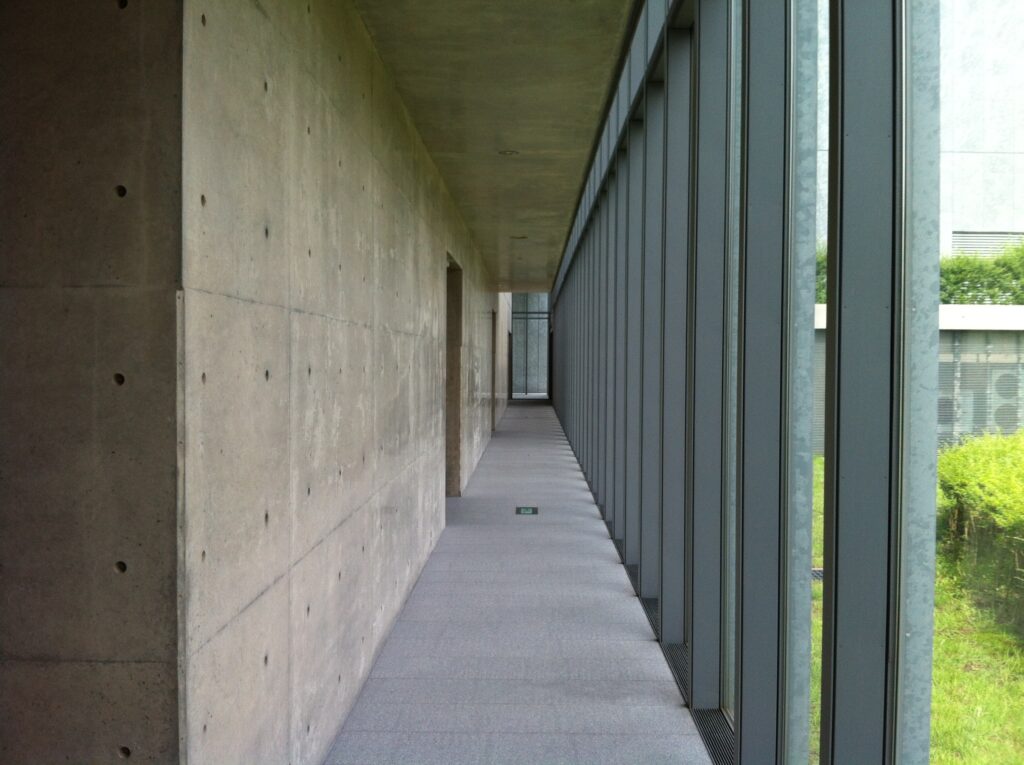
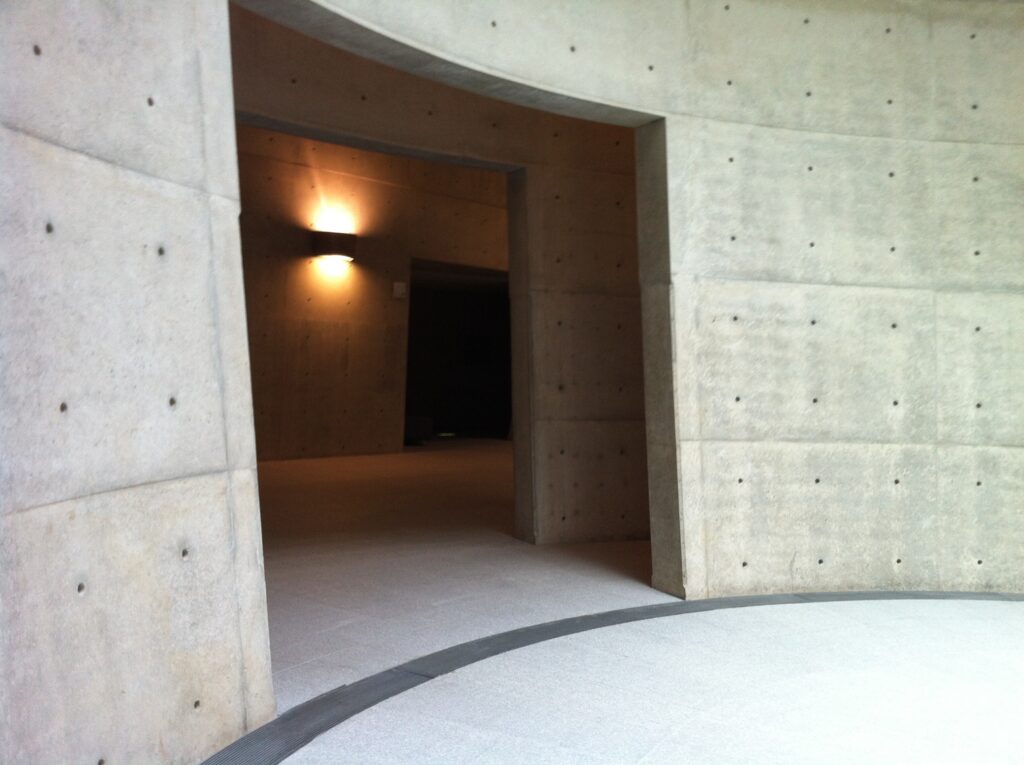
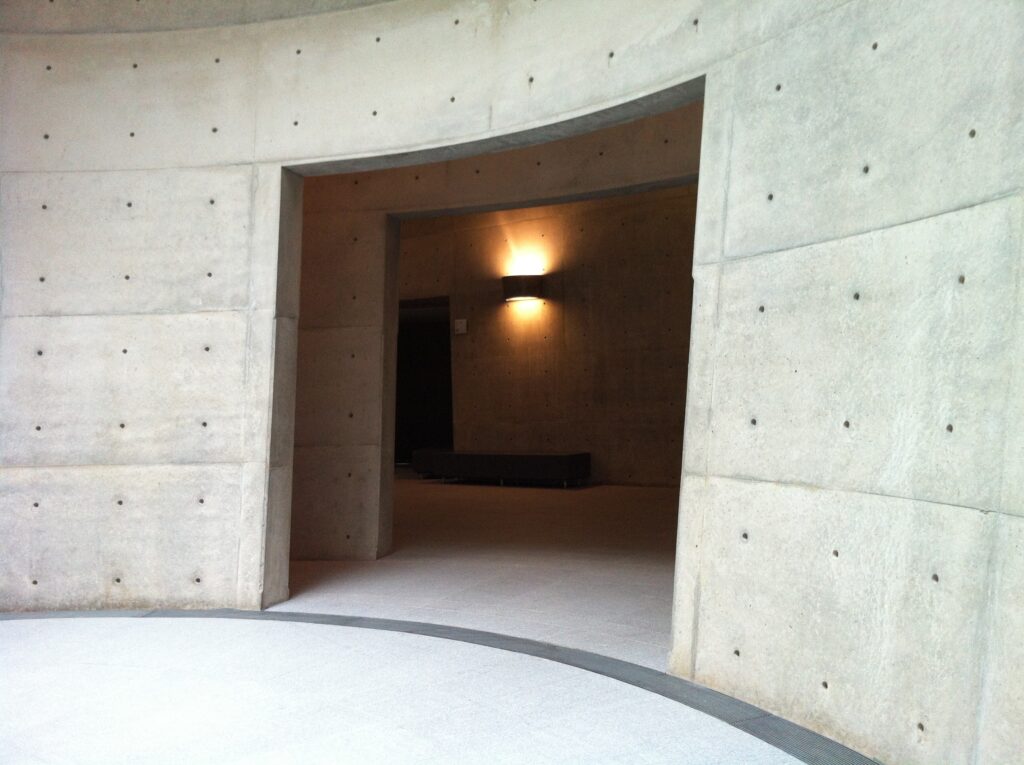
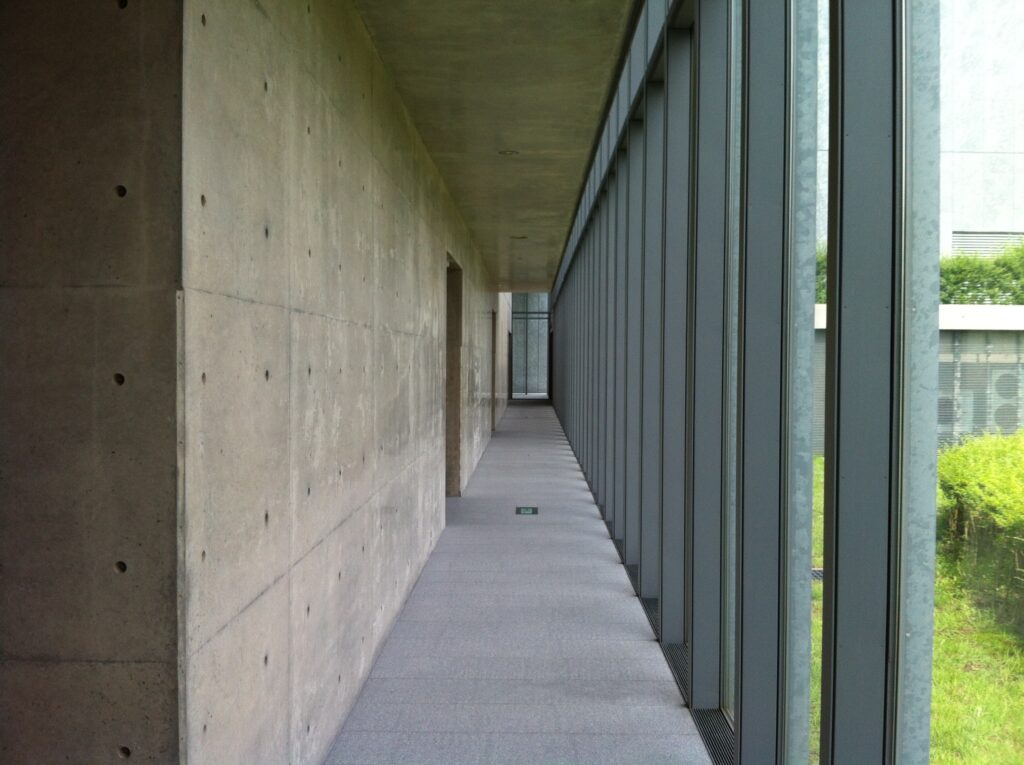
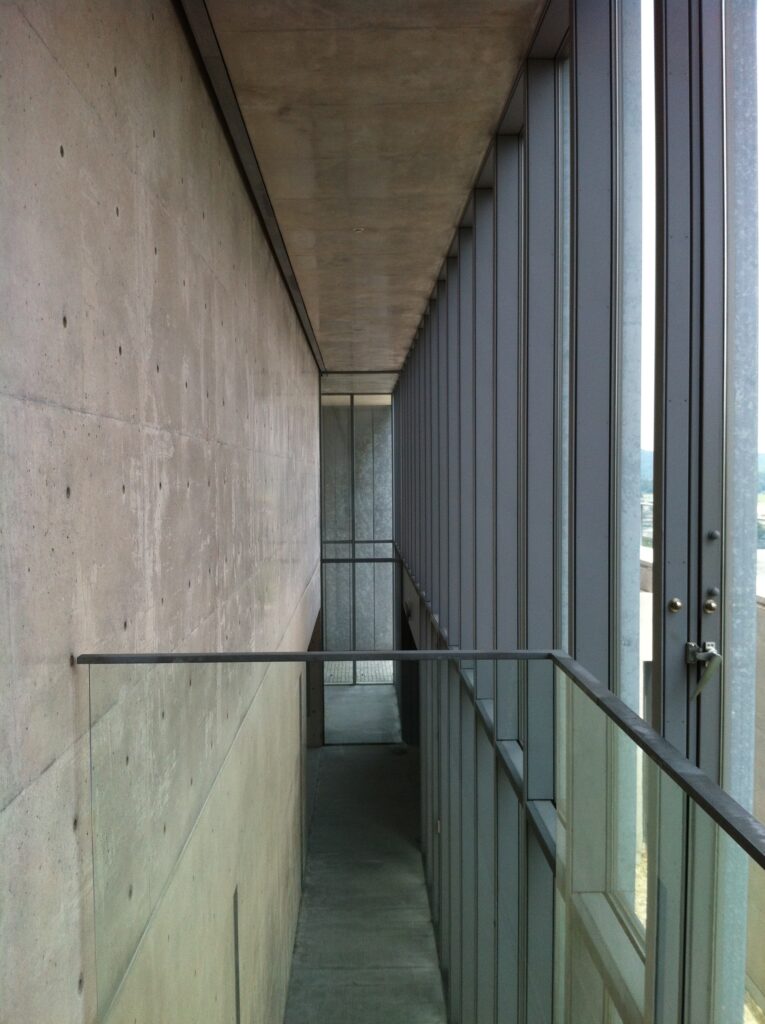
内部へ進むと、コンクリートの壁とガラスに挟まれた長い通路が現れる。極めて単純な空間に見えるが、視線の先まで建築全体を理解することはできない。
かほく市が紹介する「思索の道」も、駐車場から建物まであえて直線にはつくられていないという。館内も同様に迷路のように構成され、自分で次に進む方向を考えることが意図されている。
Moving into the architecture, a long passage appears between concrete walls and glass. It seems extremely simple, yet even here it is difficult to understand the building as a whole or to know exactly what lies ahead.
Even the “Path of Contemplation” leading from the parking area toward the museum was intentionally designed not to follow a direct line. The same idea continues inside, where circulation takes on a maze-like quality and visitors must think about the direction in which they want to proceed.
4.一本の線の先へ
Toward the End of a Line
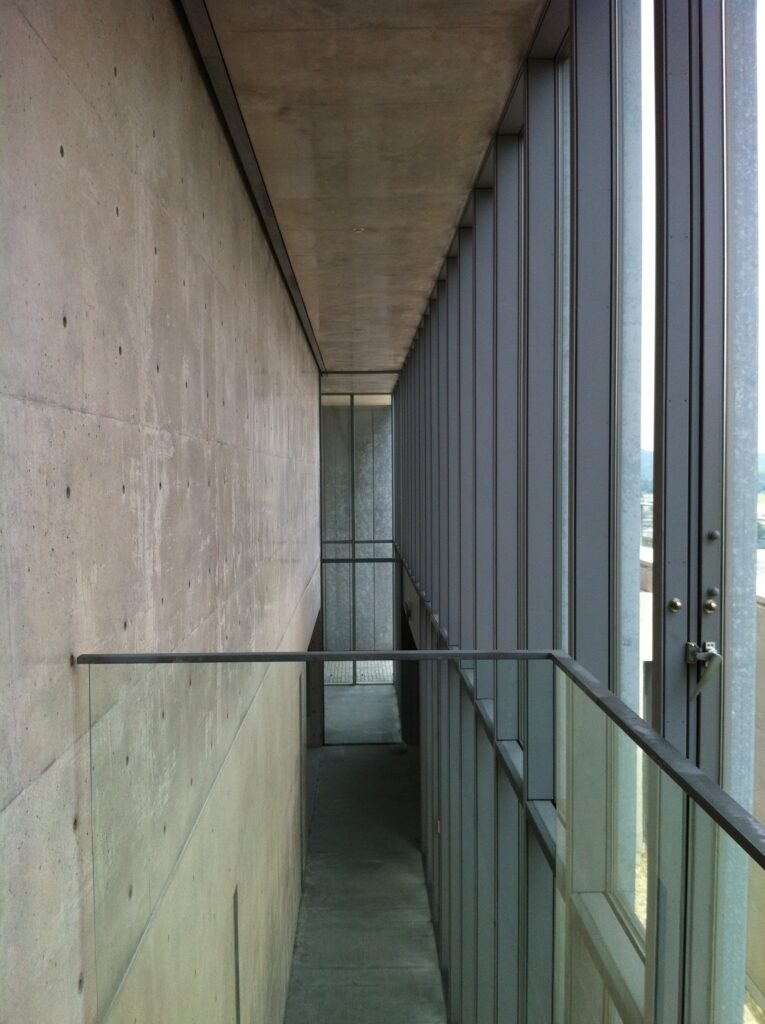
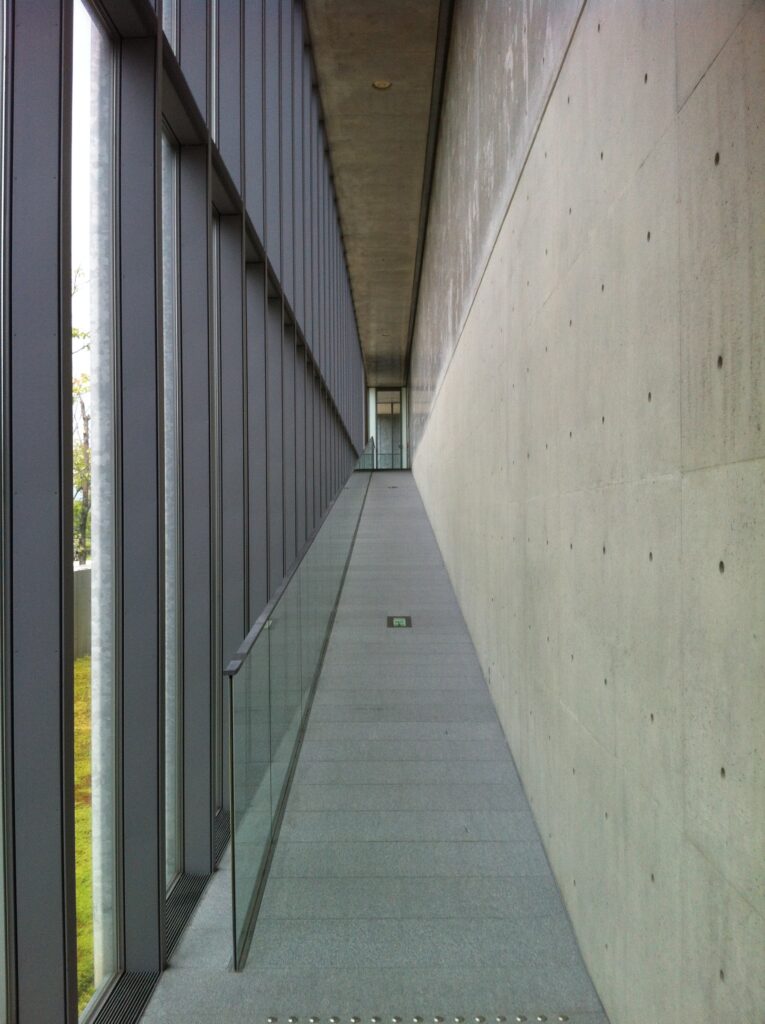
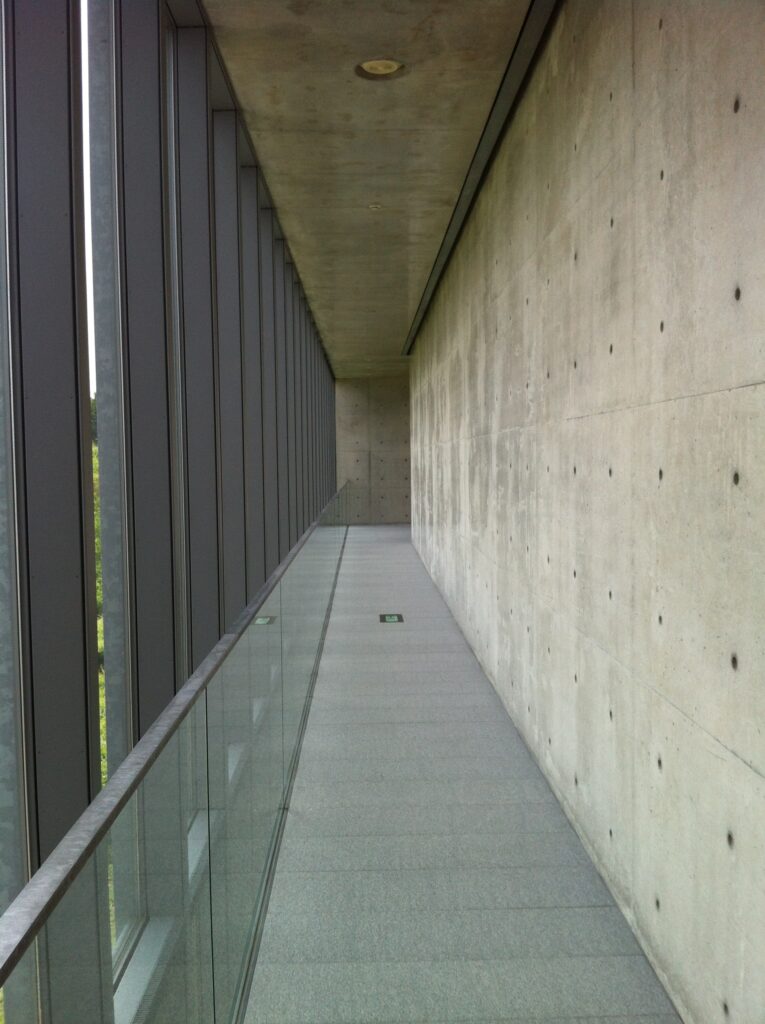
頭上には細いガラス屋根が水平に伸び、その下をコンクリートの壁が導いていく。光は入っているのに、開放的ではない。外部と内部の中間のような、不思議な場所だった。
A slender glass roof extends horizontally overhead, while concrete walls guide the route beneath it. Daylight enters, yet the space never feels completely open. It exists somewhere between interior and exterior.
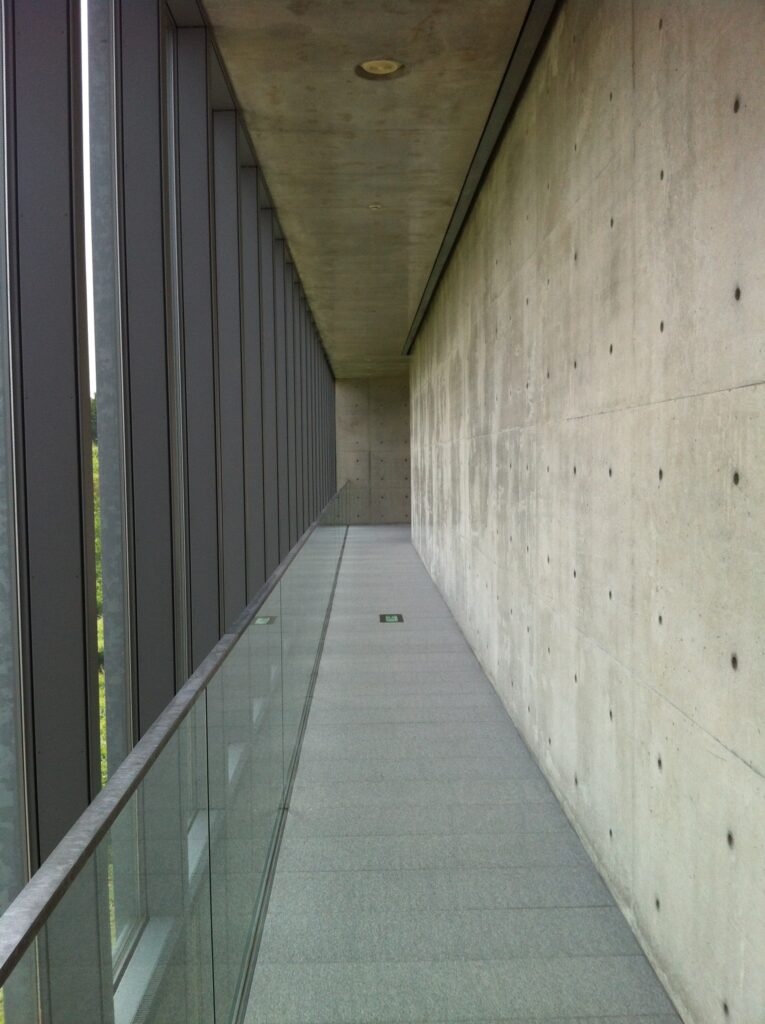
さらに進むと、床、壁、ガラス屋根のすべてが遠くの一点へ向かって収束する。装飾も展示物もない。ただ空間の方向だけが強く示されている。
何もないからこそ、自分が歩いていることを強く意識する。哲学を「読む」前に、建築によって立ち止まり、進み、考える状態へ切り替えられていく。
Further ahead, the floor, walls, and glass roof converge toward a distant point. There is no decoration and no exhibition object demanding attention. Only the direction of the space remains.
Precisely because there is so little visual information, I became more conscious of the simple fact that I was walking. Before encountering philosophy as information or text, the architecture was already shifting my state of mind toward slowing down, moving, and thinking.
5.空だけを見せる
Showing Only the Sky
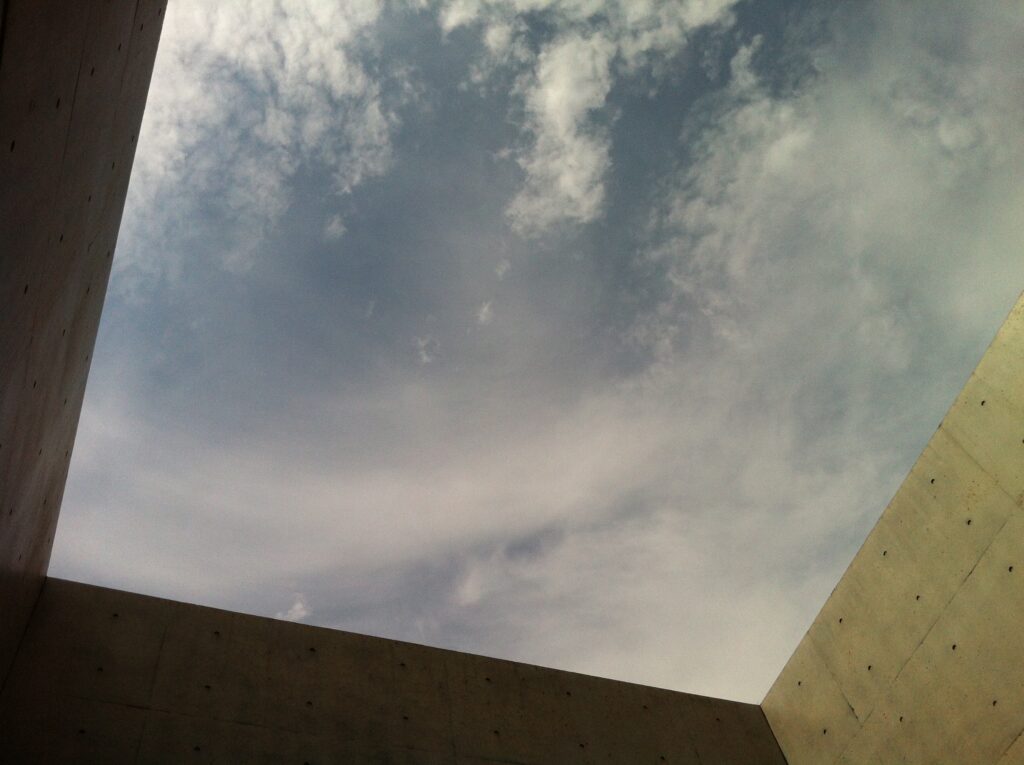
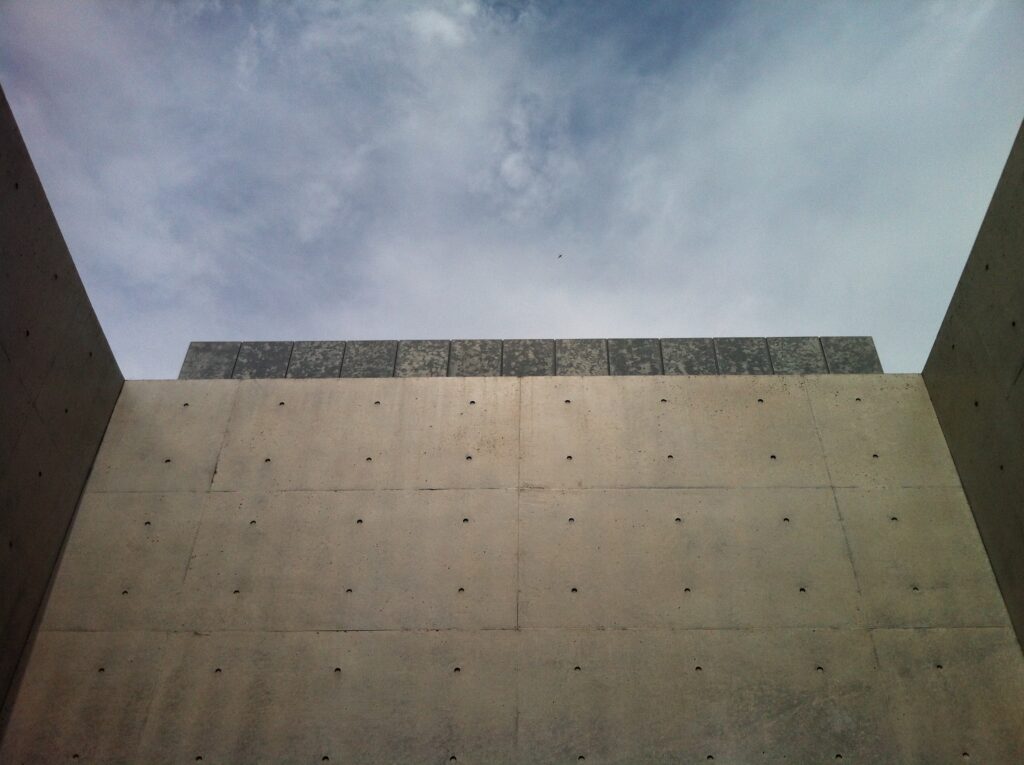
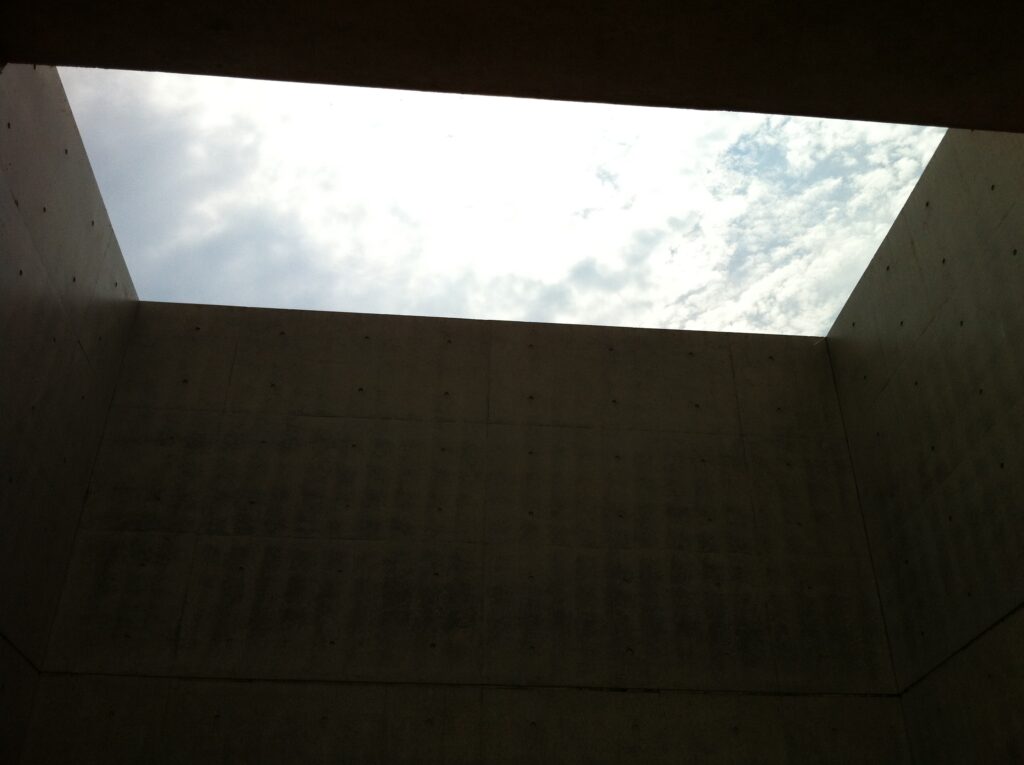
突然、頭上に空が現れる。四方をコンクリートに囲まれ、切り取られた空だけが見える。
外にいれば何気なく見ているはずの空が、建築によって境界を与えられた瞬間に、強い存在になる。安藤建築では何度も経験してきた手法だが、「考えること」をテーマとするこの場所では、その静けさが特に似合っている。
Suddenly, the sky appears overhead. Surrounded by concrete on all sides, only a carefully framed fragment of blue remains visible.
Out in the open, the sky is something we hardly need to notice. Yet the moment architecture gives it a boundary, its presence becomes much stronger. This is a familiar device in Tadao Ando’s architecture, but in a building devoted to thinking, the resulting silence feels particularly appropriate.
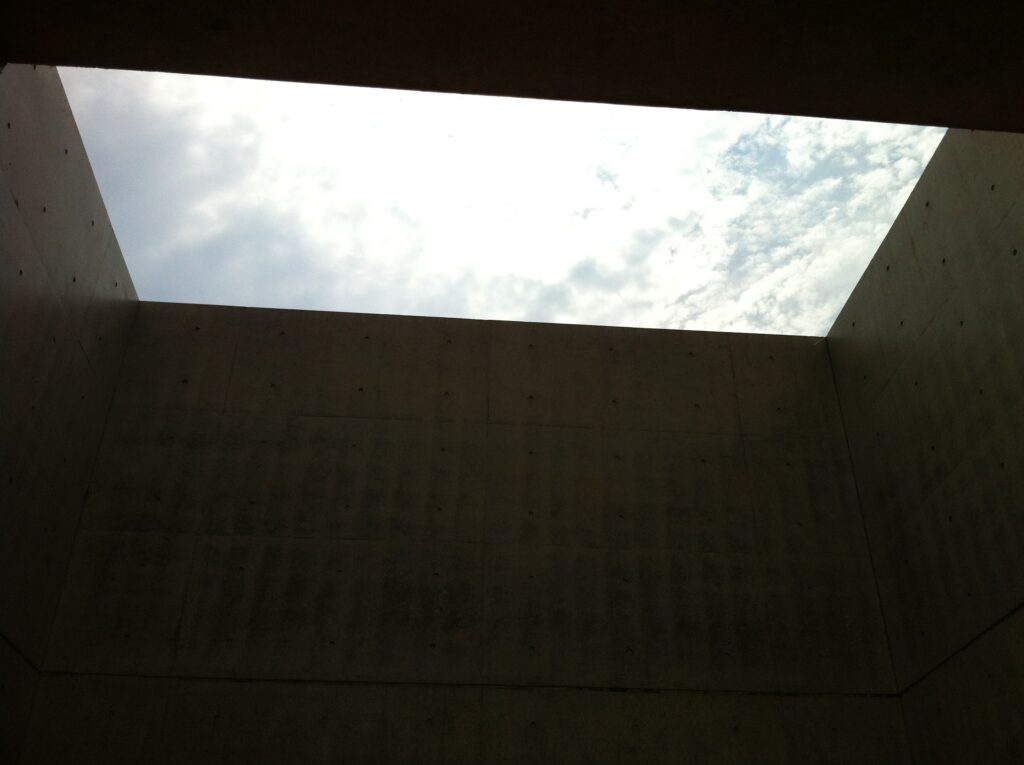
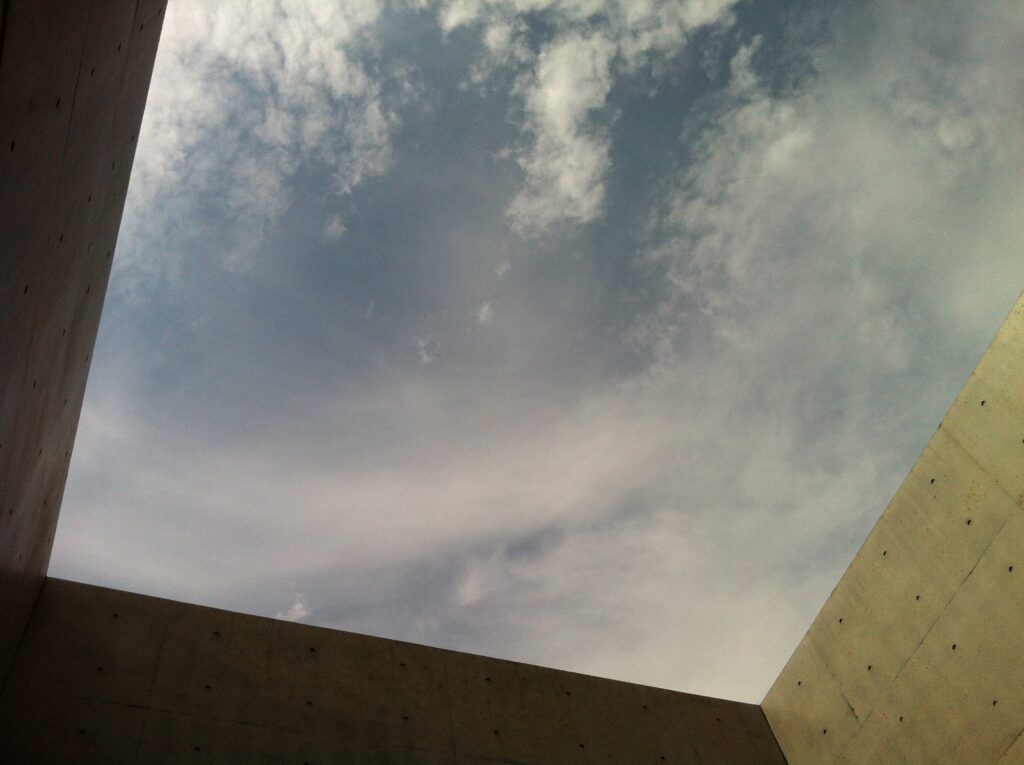
別の角度から見ると、空間はさらに抽象的になる。コンクリートの壁と光、そして空。それ以外の情報がほとんど消えている。
何を見るべきかを建築から説明されるのではなく、何もない場所に自分自身を置かれる。その余白が、この哲学館では重要なのだと思う。
Seen from another angle, the space becomes even more abstract. Concrete walls, light, and sky remain, while almost all other information disappears.
The architecture does not tell you what you should be looking at. Instead, it places you within an almost empty space. That sense of emptiness and possibility seems essential to this museum.
6.直線から曲線へ
From Straight Lines to Curves
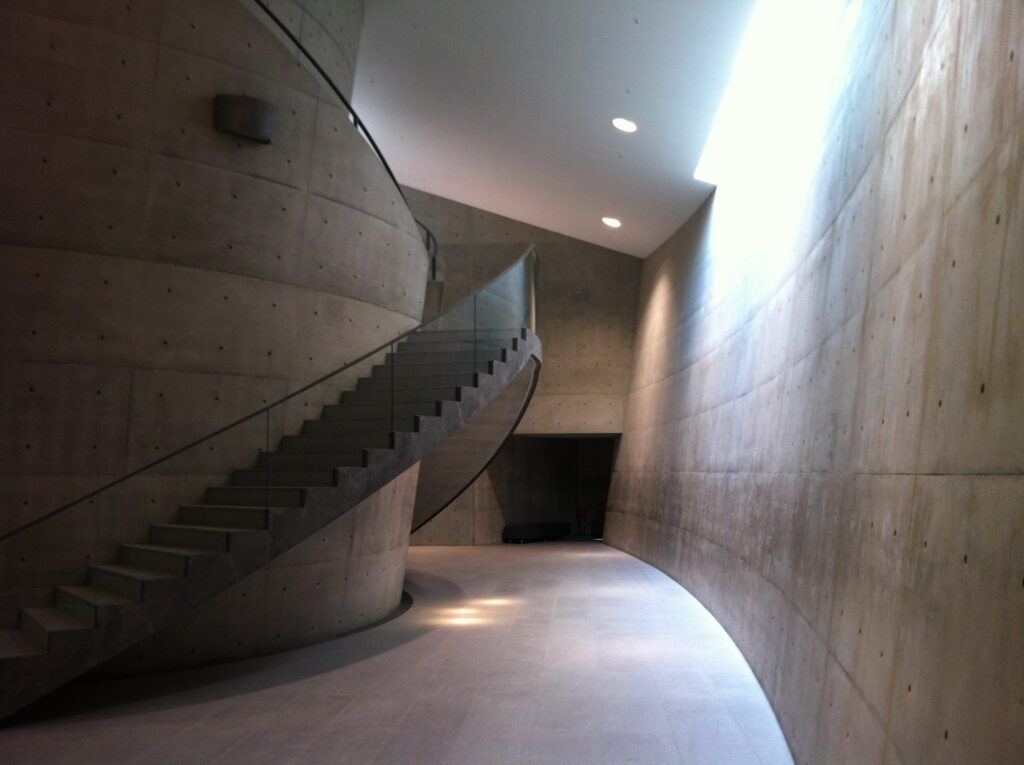
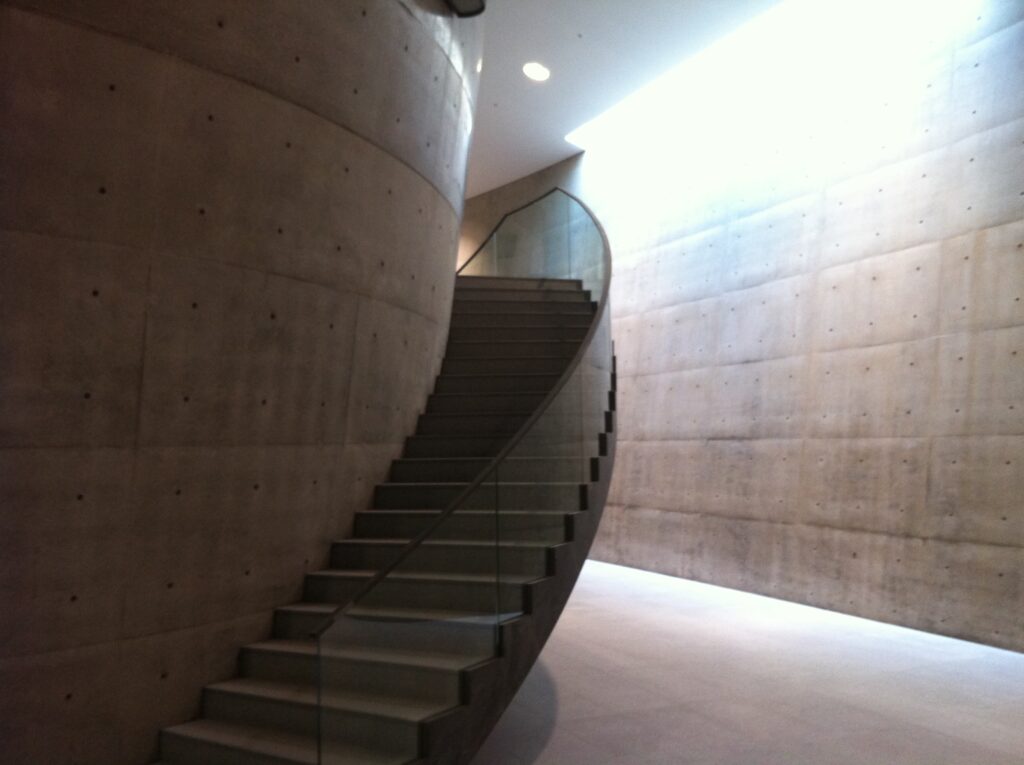
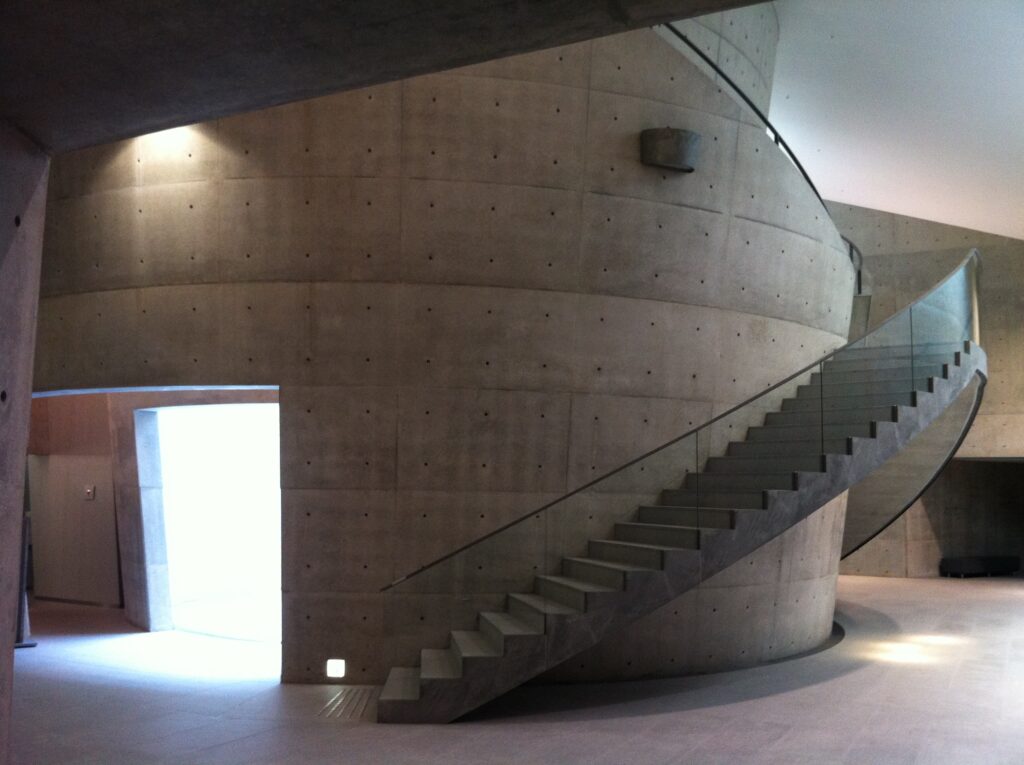
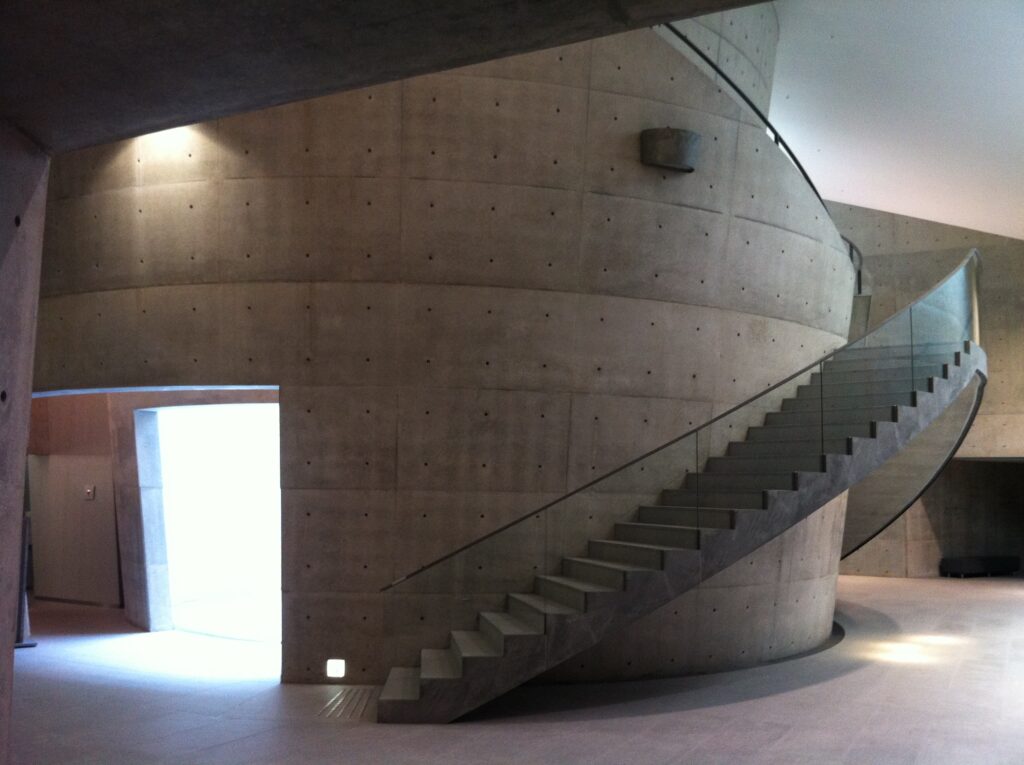
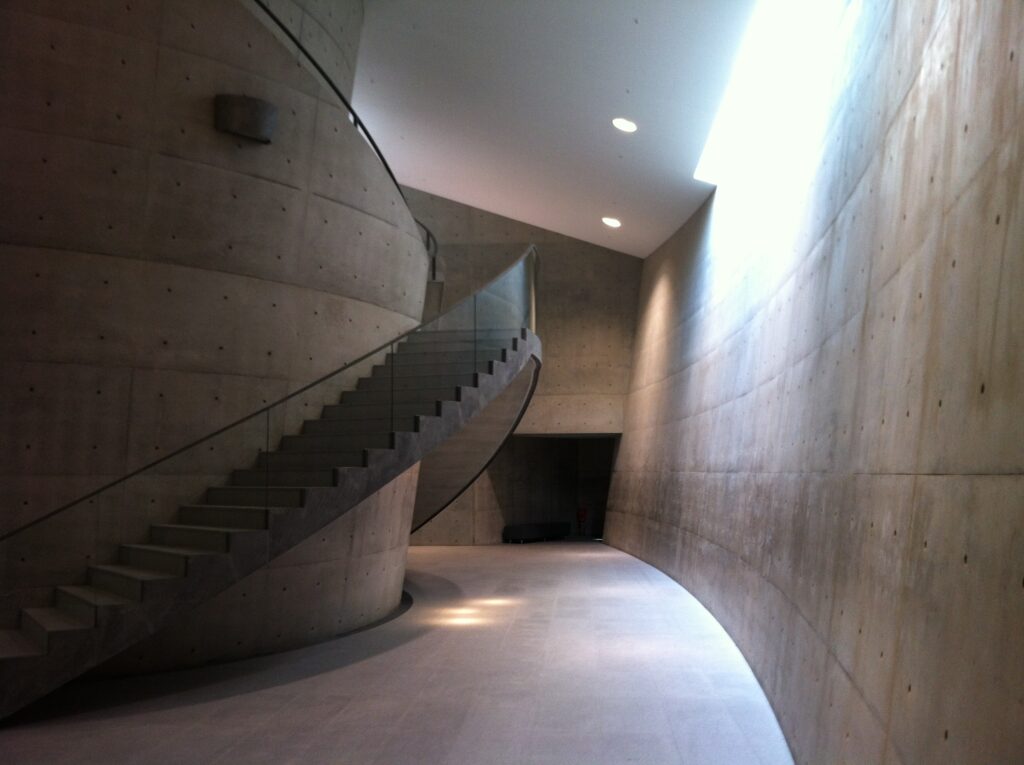
そして建築の表情が一変する。巨大な円筒状のコンクリート壁に沿って、細い階段が上へ伸びていく。
それまで体験してきた長い直線の通路とはまったく違う。身体の方向を変えながら、曲面に沿って上昇する。上から落ちる光が階段を照らし、進む方向を示している。
今回の写真の中でも、特に西田幾多郎記念哲学館らしい一枚だと思う。
Then the character of the architecture changes completely. A narrow staircase rises beside an enormous cylindrical concrete wall.
The long straight passages experienced earlier disappear, replaced by movement around a curve. The body changes direction as it ascends, while light falling from above illuminates the stairs and quietly indicates the route forward.
For me, this is one of the photographs that most strongly captures the character of the Ishikawa Nishida Kitaro Museum of Philosophy.
7.円筒の周囲を上る
Climbing Around the Cylinder
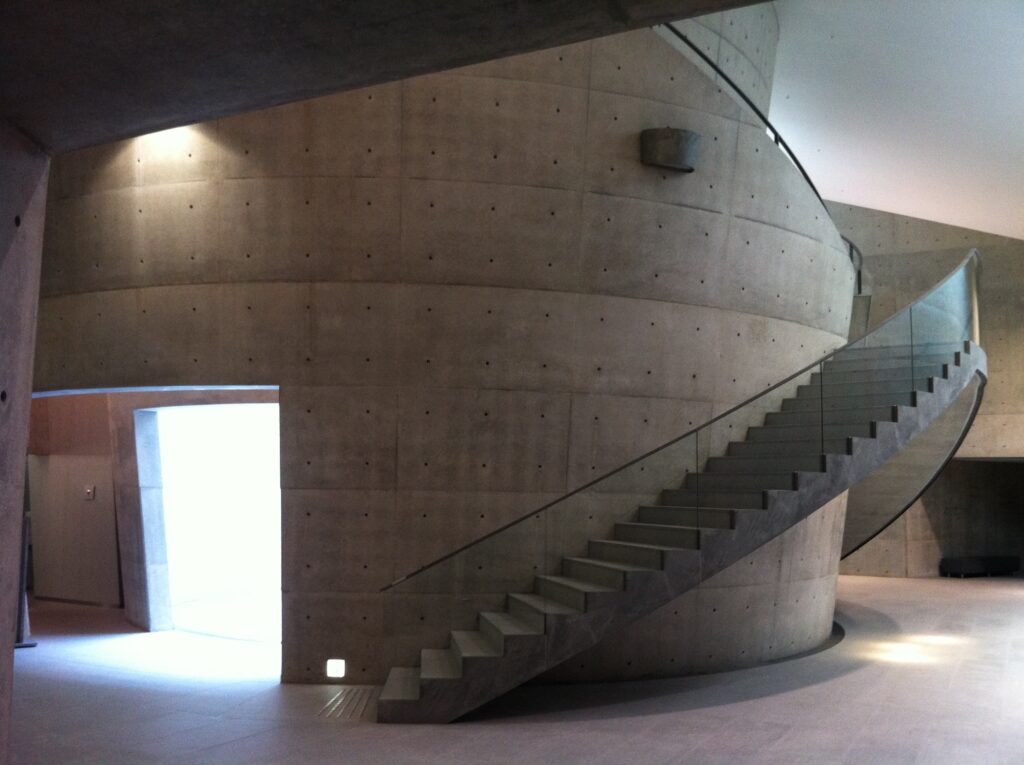
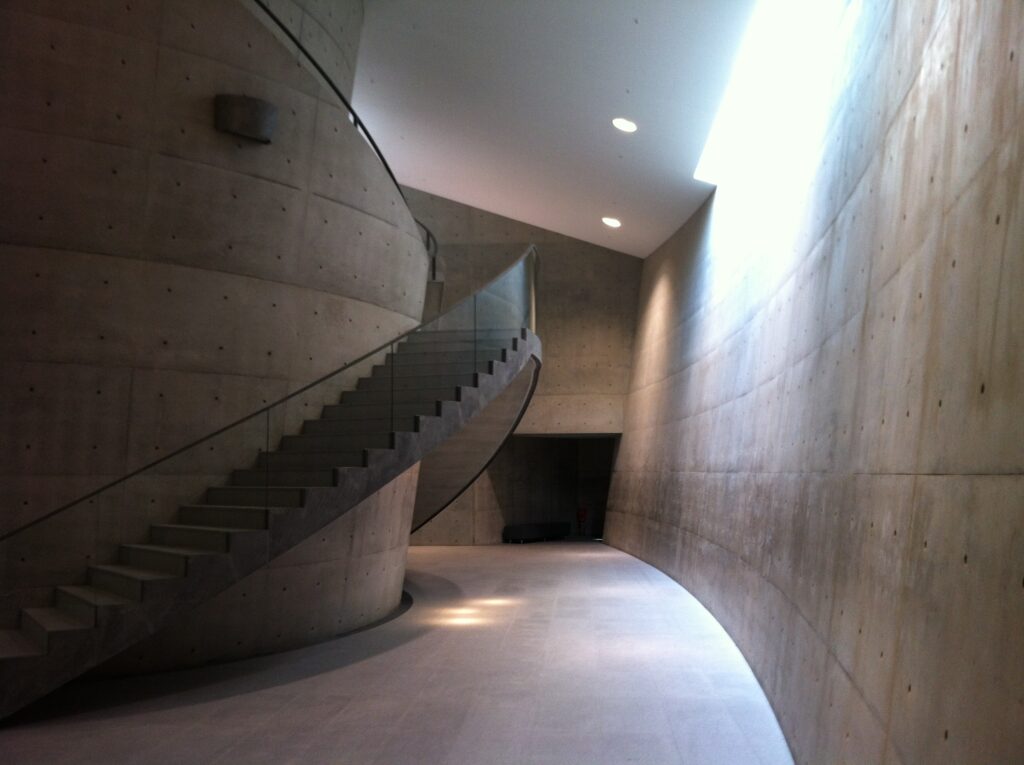
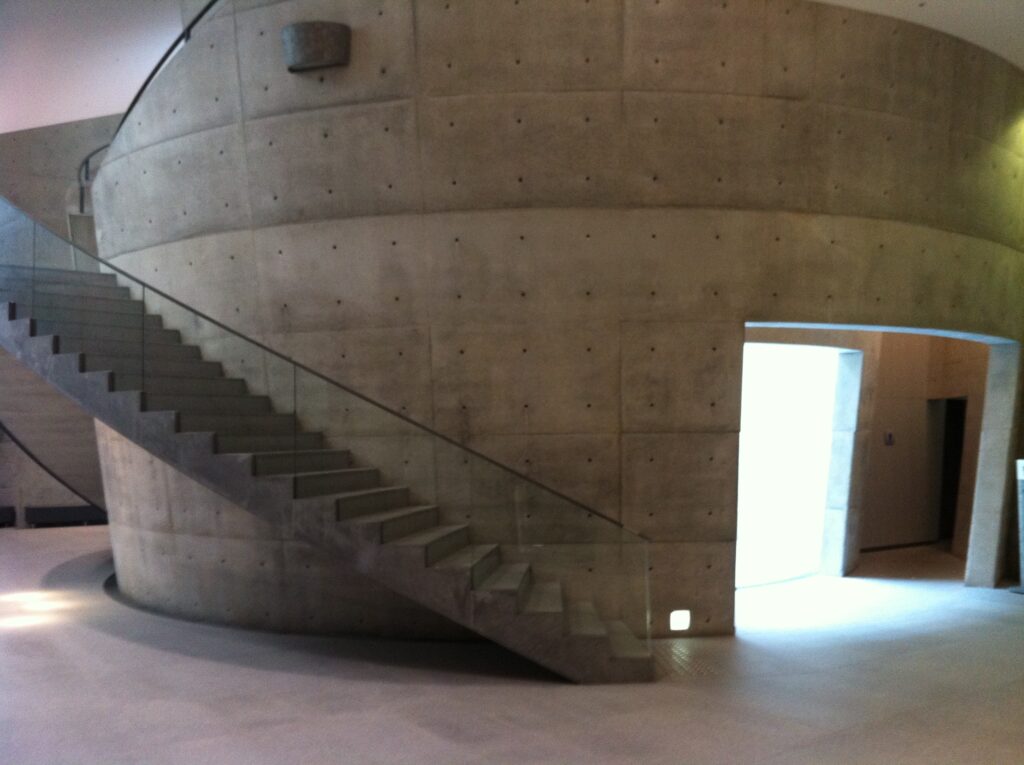
少し離れて見ると、円筒と階段の関係がよく分かる。階段は単に上階へ移動するためのものではなく、巨大な円の周囲を身体でなぞるための装置になっている。
最短距離で目的地へ連れていかない。回り、上り、方向を変える。その時間自体が建築体験になっている。
Seen from farther away, the relationship between the cylindrical wall and the staircase becomes clearer. The stairs are not simply a practical means of reaching another floor. They allow the body to trace the perimeter of an enormous circle.
The building refuses to take you to your destination by the shortest route. You turn, climb, and repeatedly change direction. The time spent doing so becomes part of the architectural experience.
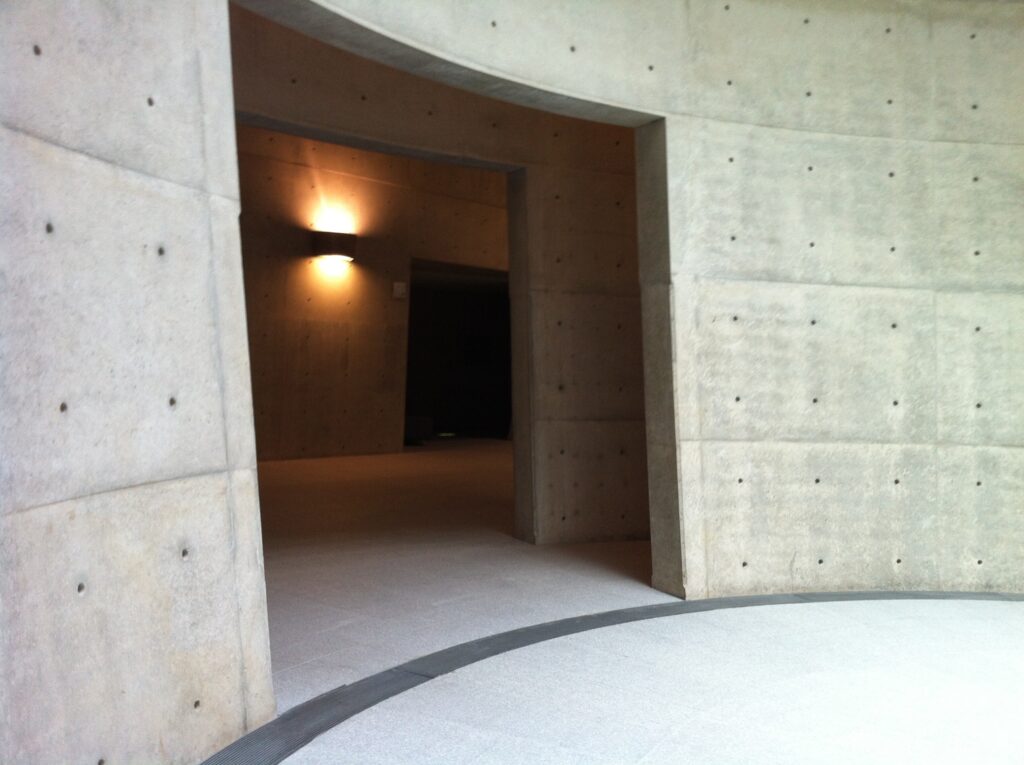
8.そして見上げてみる
Looking Up
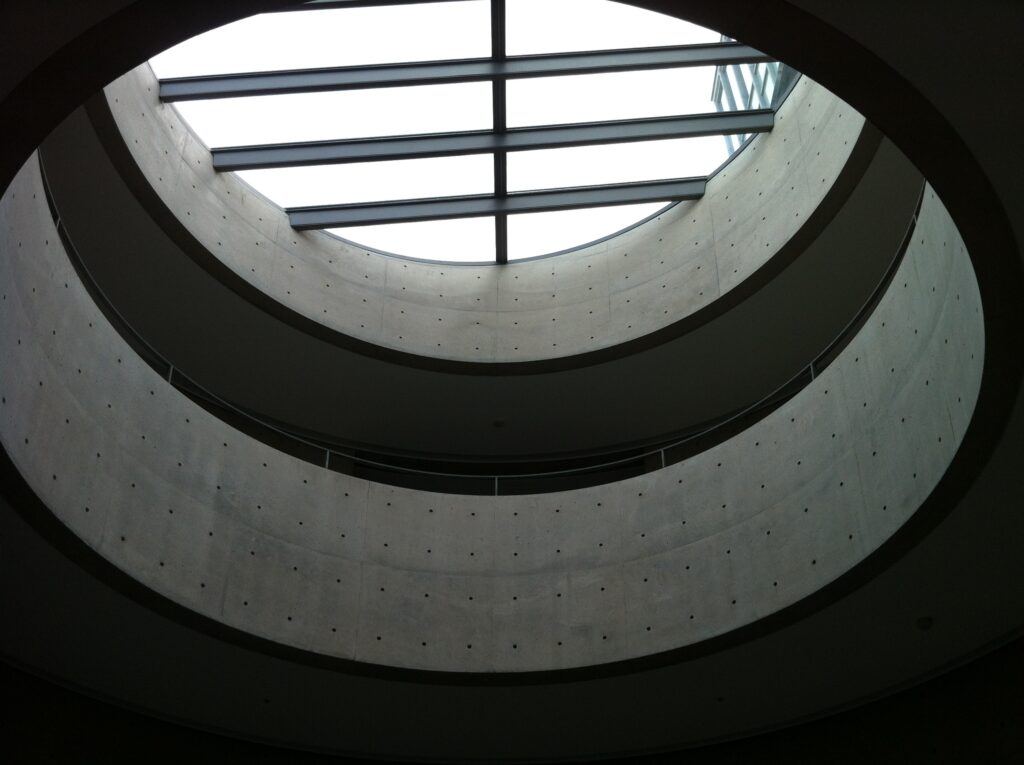
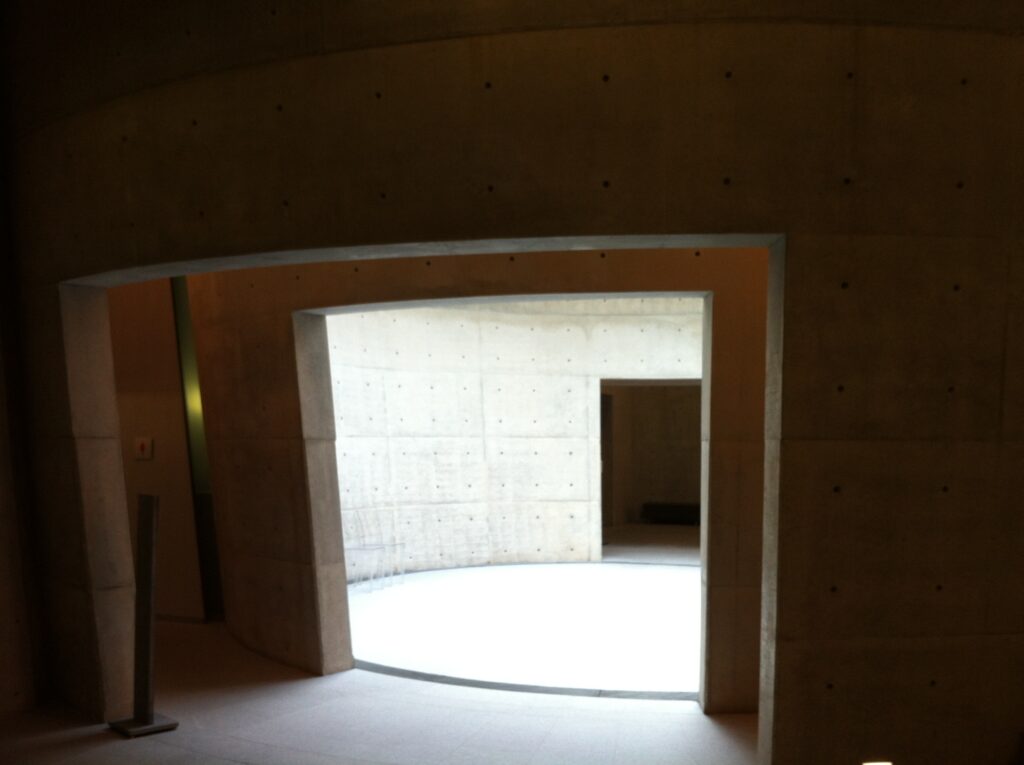
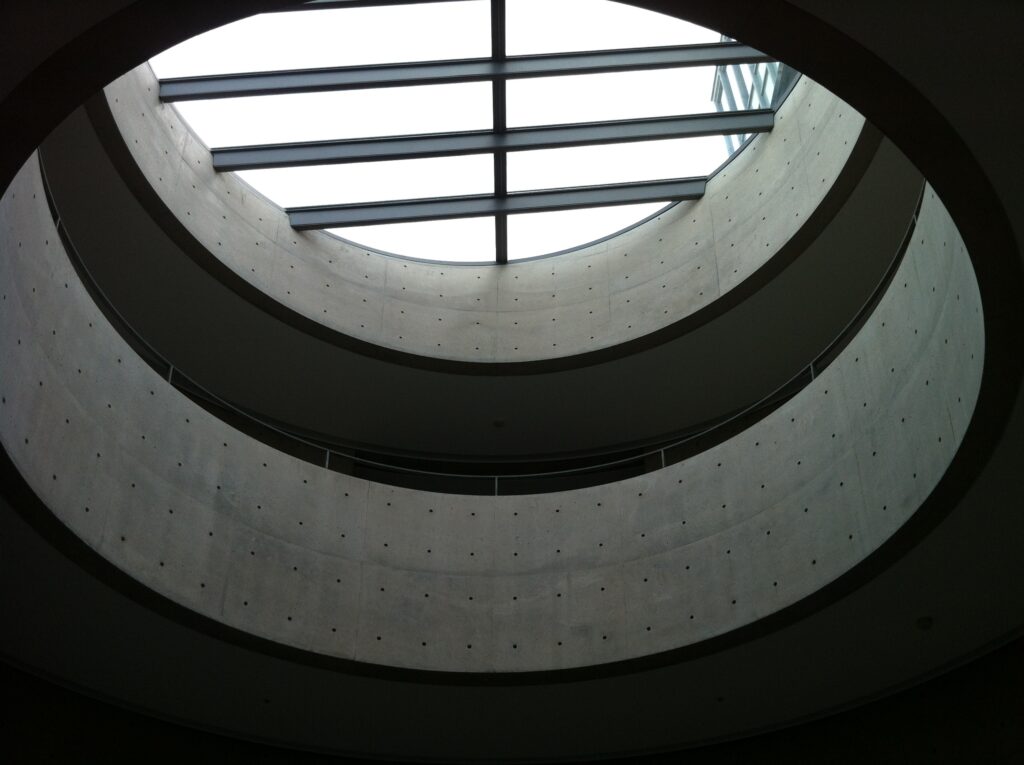
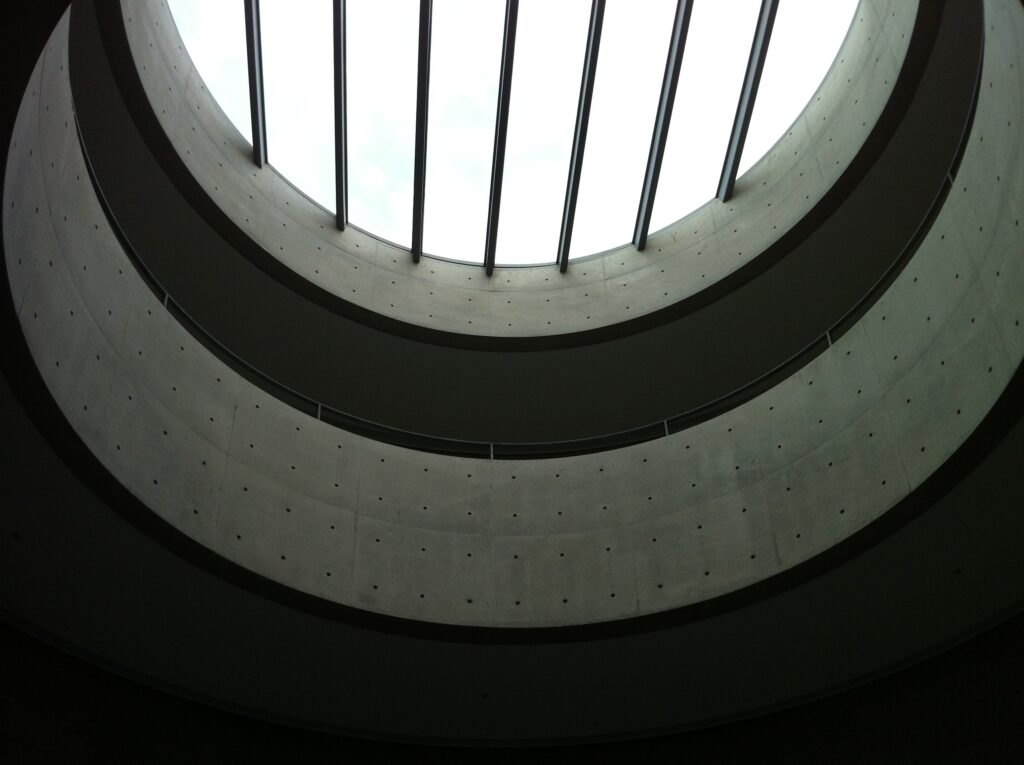
円形空間の底から頭上を見ると、視線は自然に円の中心へ吸い込まれる。コンクリートの輪の向こうに、ガラスと光が見える。
ここでは何かを展示する必要さえないように感じた。自分がどこに立っているのか、どちらを向いているのか、上に何があるのか。身体と空間の関係そのものを意識させられる。
Standing at the bottom of the circular space and looking upward, the eye is naturally drawn toward its center. Beyond the ring of concrete, glass and light appear above.
Nothing needs to be exhibited here. The architecture makes you conscious of where you are standing, which direction you are facing, and what exists above you. The relationship between body and space itself becomes the subject.
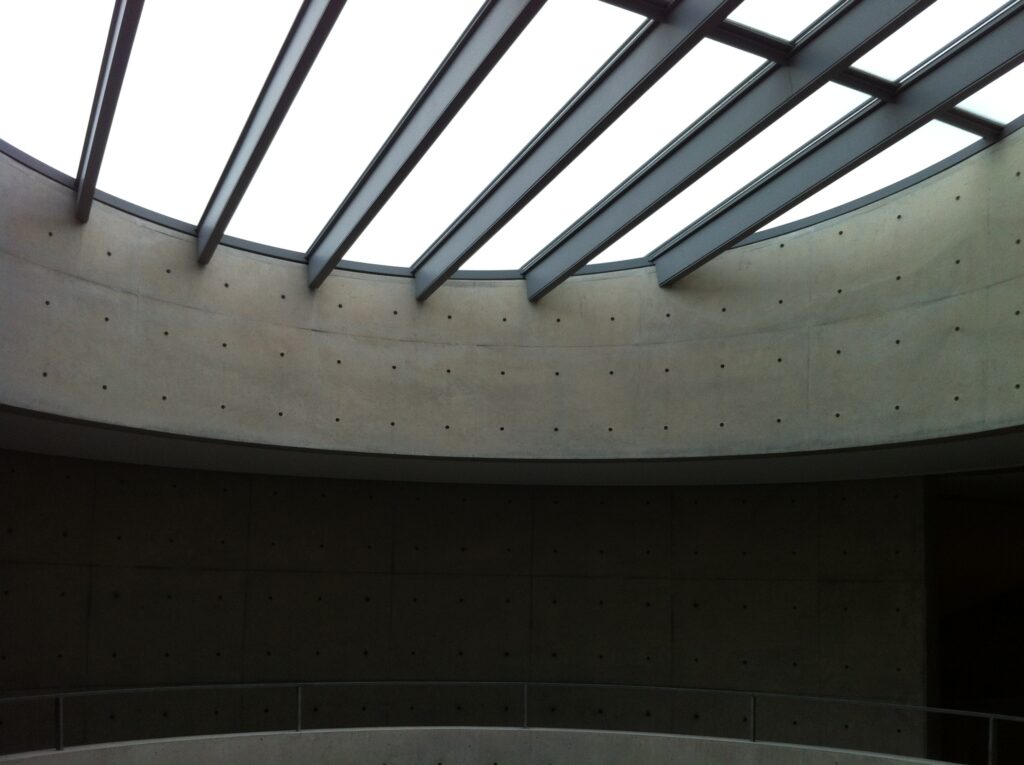
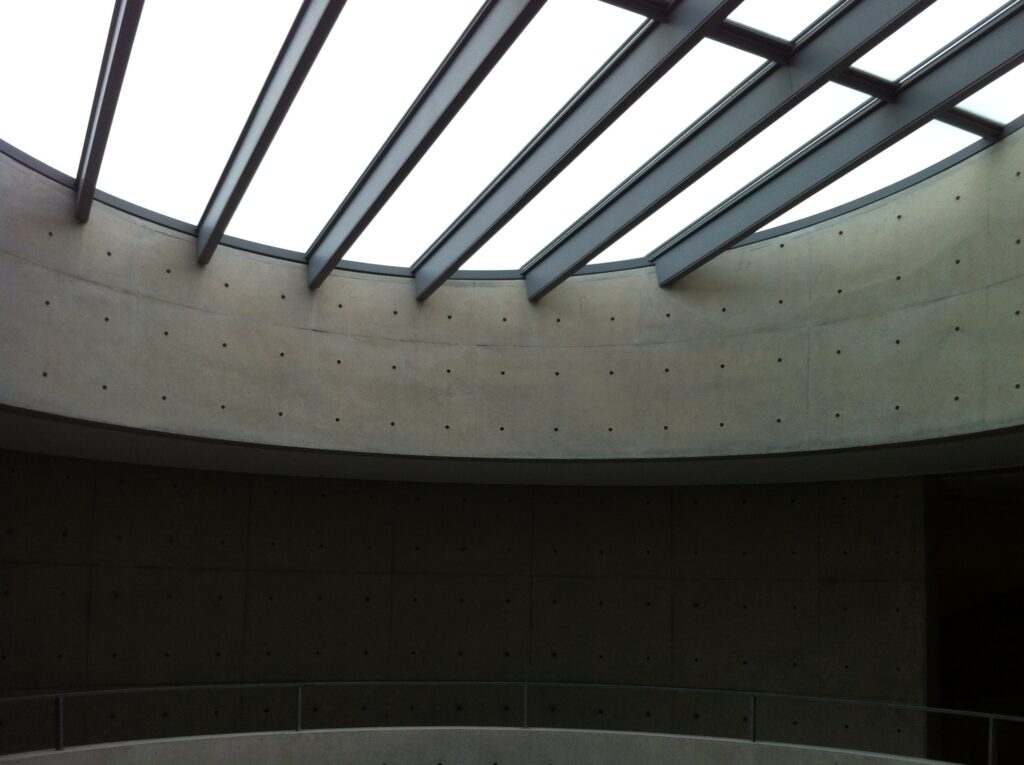
さらに上へ進むと、同じ円形空間が違う姿を見せる。頭上の格子を通して光が落ち、円筒の内側に明暗をつくる。
一つの形を一つの場所から見せるのではなく、自分の位置が変わることで建築の意味も変わる。この建築では、見ることと歩くことが切り離されていない。
As the route continues upward, the same circular space takes on a different appearance. Light filters through the structure above, creating changing patterns of brightness and shadow along the inner surface of the cylinder.
Rather than presenting one form from one ideal viewpoint, the architecture changes as your own position changes. Here, seeing and walking cannot be separated.
9.閉じた空間から、再び風景へ
From Enclosure Back to the Landscape
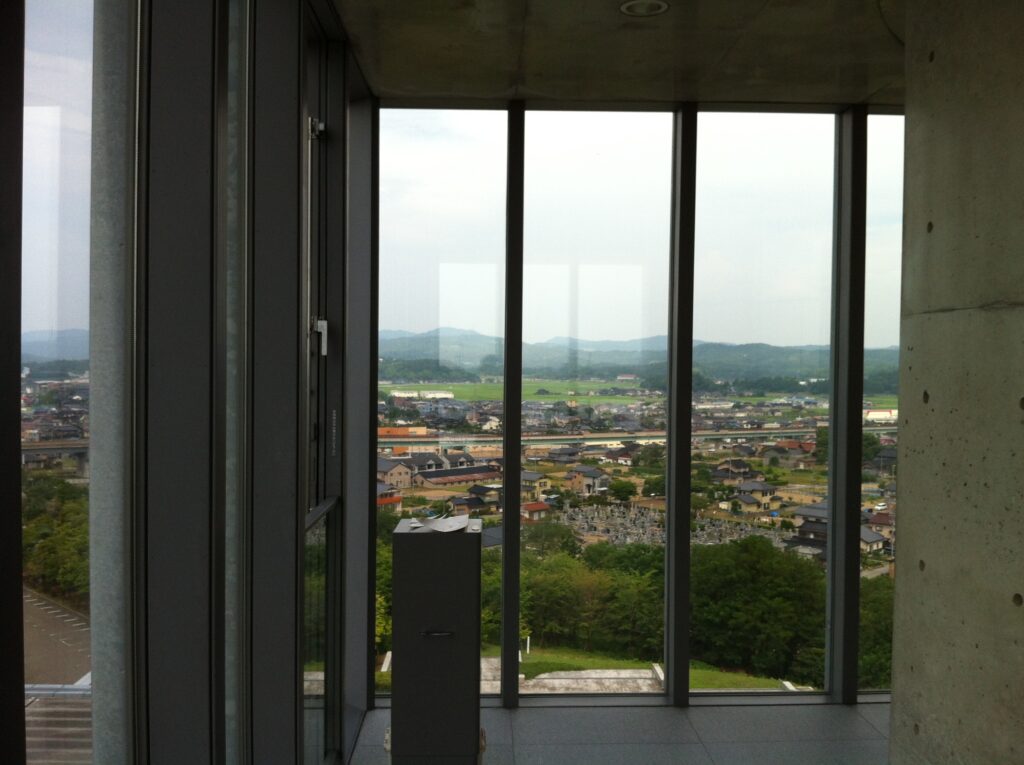
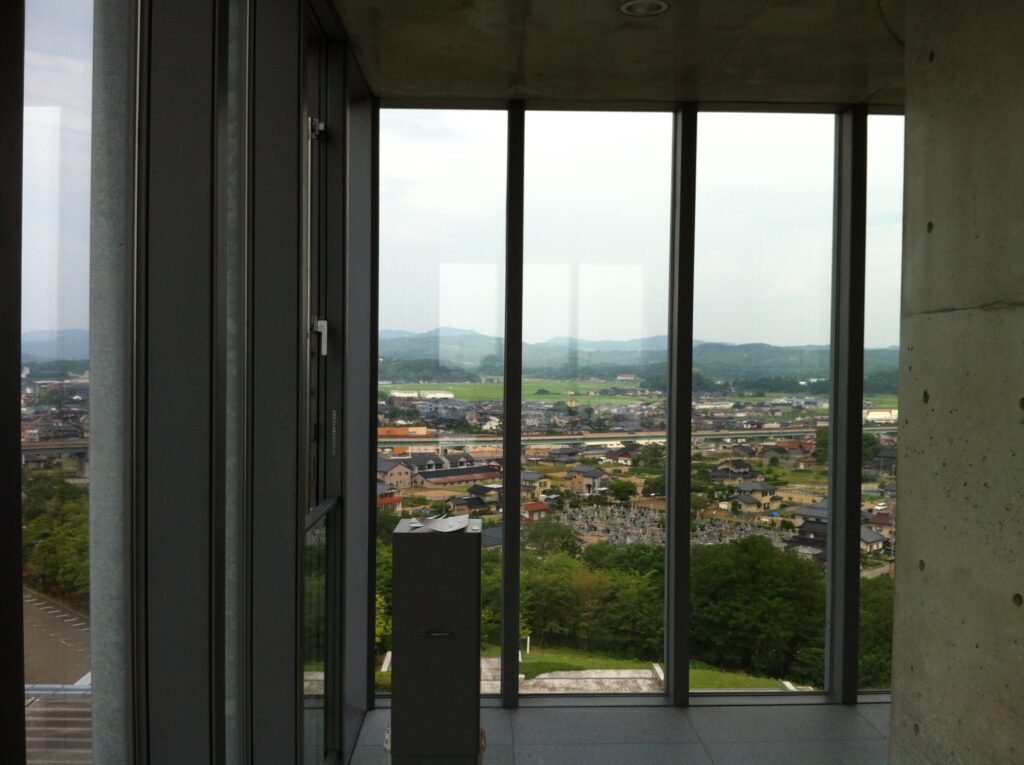
上階へ到達すると、それまでの閉じたコンクリート空間とは対照的に、大きなガラスの向こうへ風景が開く。
地上で見た石川の街並みが、今度は高い場所から再び現れる。閉じる、迷う、上るという時間を経た後だからこそ、この眺望がより強く感じられた。
Upon reaching the upper level, the experience changes again. After the enclosed concrete spaces below, a large glass surface suddenly opens toward the landscape.
The cityscape of Ishikawa, first seen at ground level, returns from a higher viewpoint. After the time spent enclosed, searching for direction, and climbing upward, the openness of this view feels far more powerful.
10.建築が風景を分割する
Architecture Dividing the Landscape
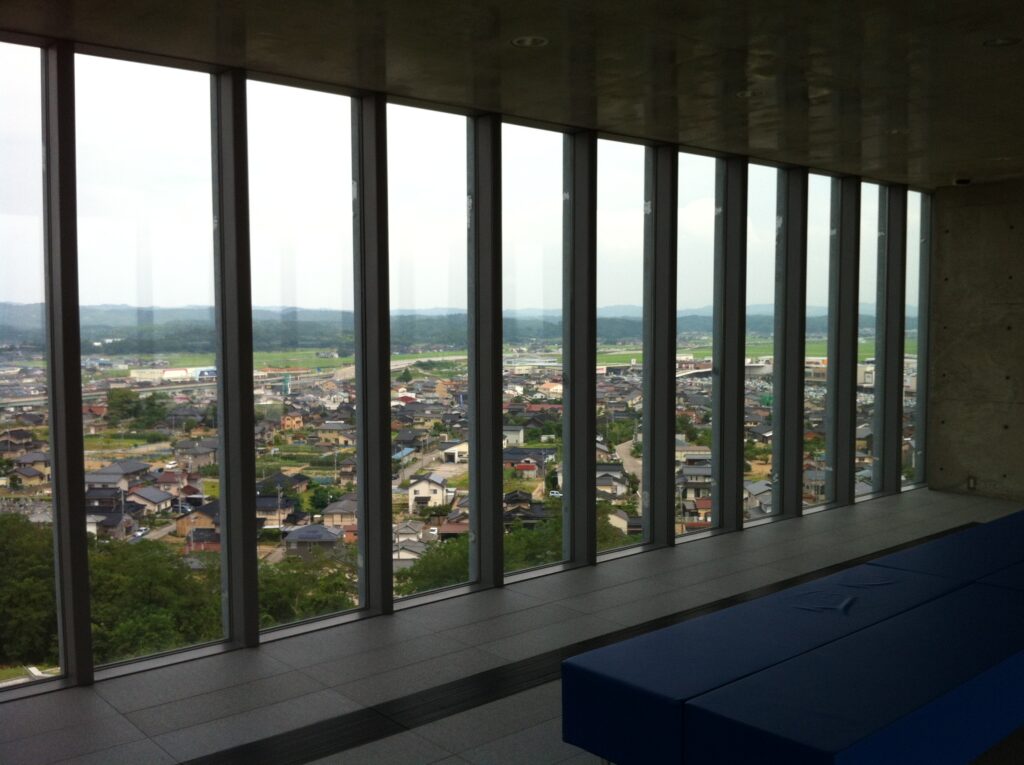
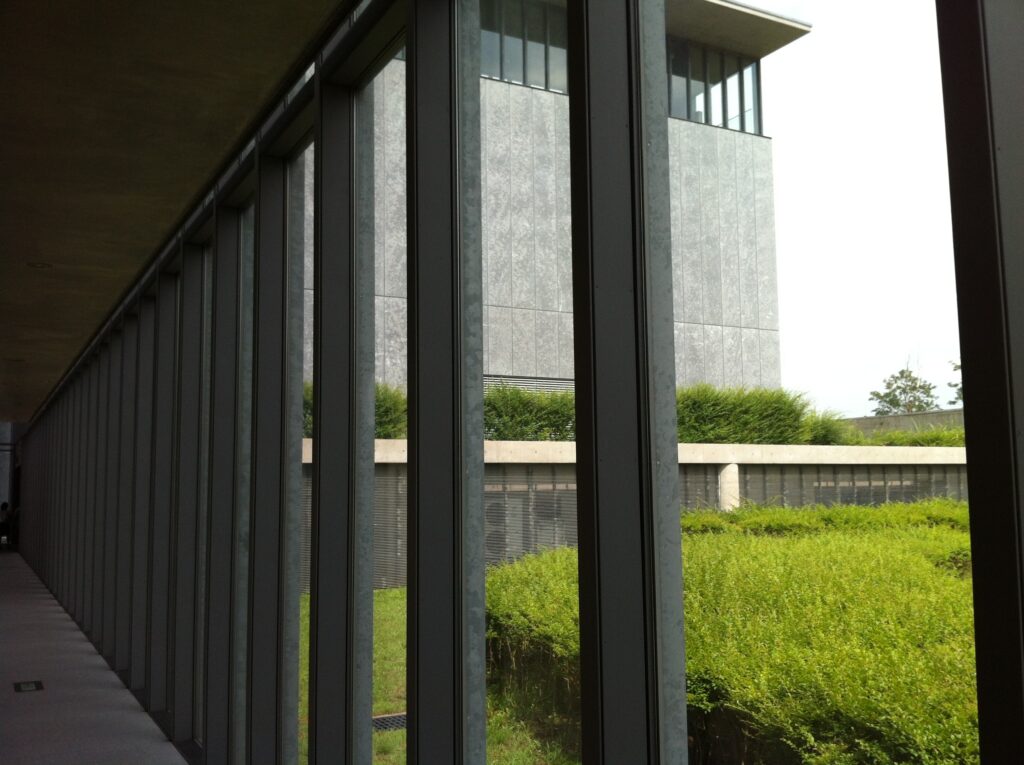
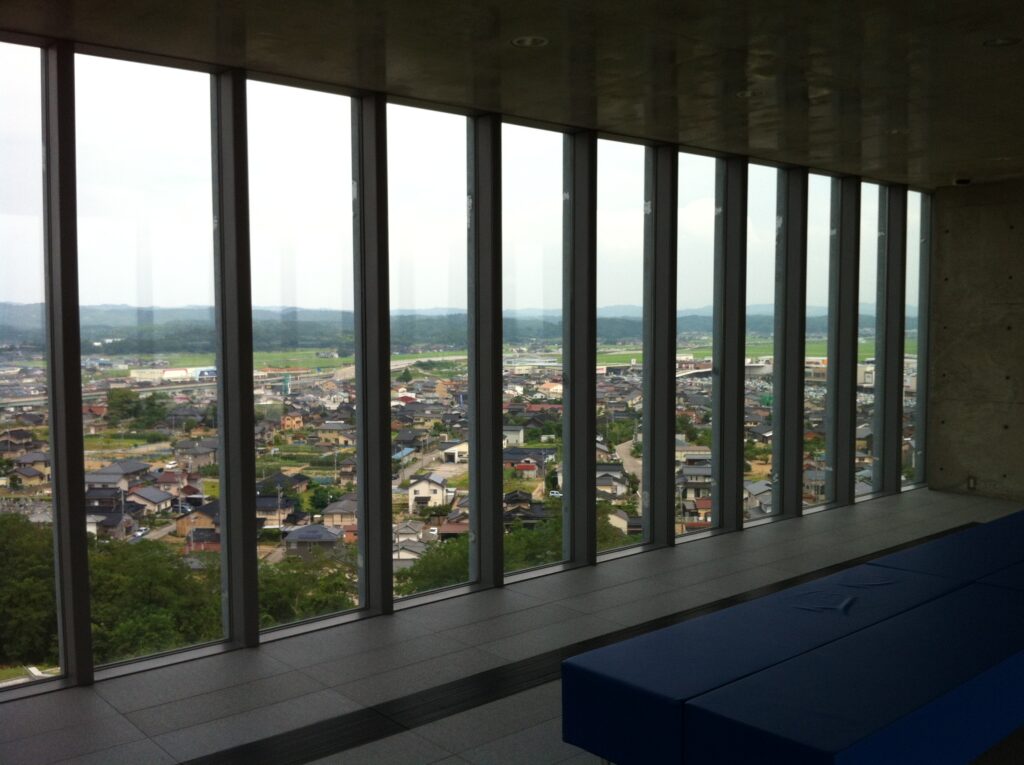
ガラスの前には細い垂直材が規則正しく並び、その間から街と空を見る。大きな風景をそのまま一枚の窓として見せるのではなく、建築が細かく分割している。
一本一本の隙間から異なる景色が見える。視線を動かすことで、同じ風景が少しずつ変わっていく。
Slender vertical elements stand in front of the glass, dividing the city and sky into a sequence of narrow views. Rather than presenting the landscape through a single uninterrupted picture window, the architecture breaks it into fragments.
As the eye moves from one opening to another, the same landscape changes slightly. Even here, seeing is not entirely passive.
11.自分が歩いてきた場所を見る
Seeing Where You Have Been
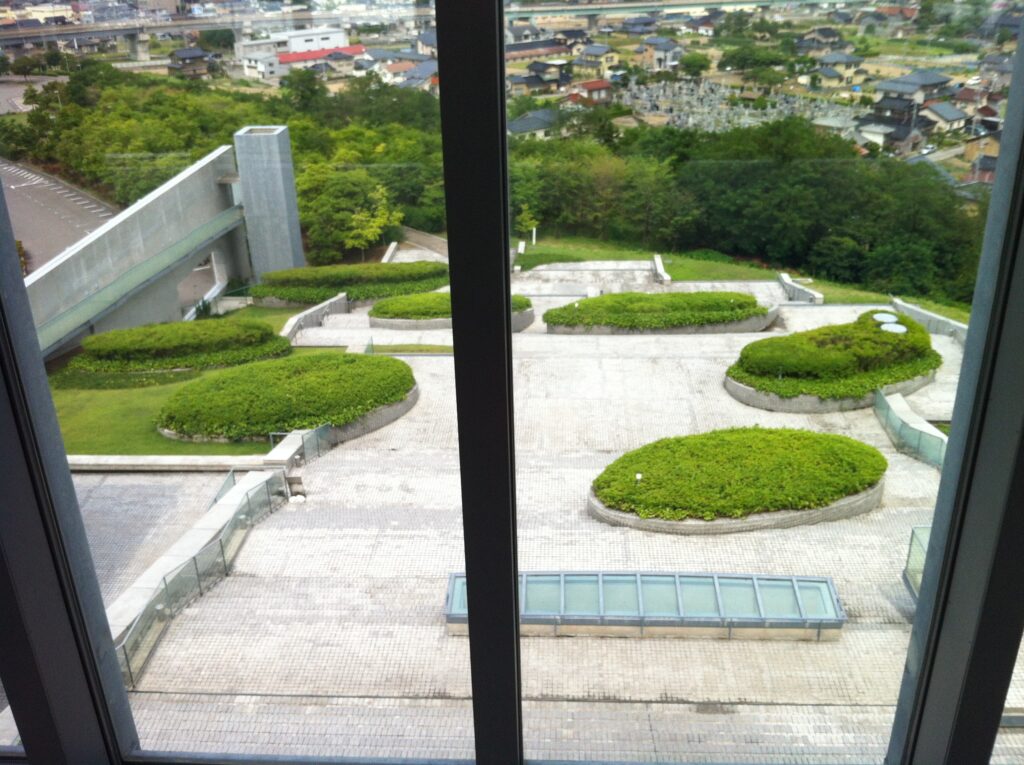
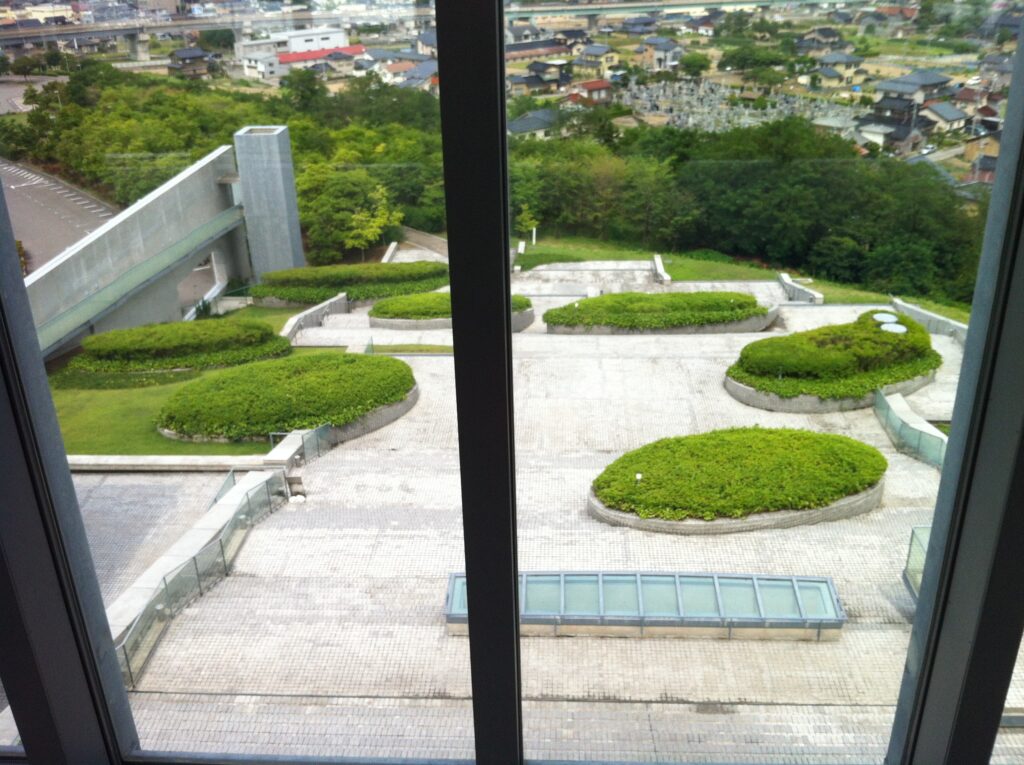
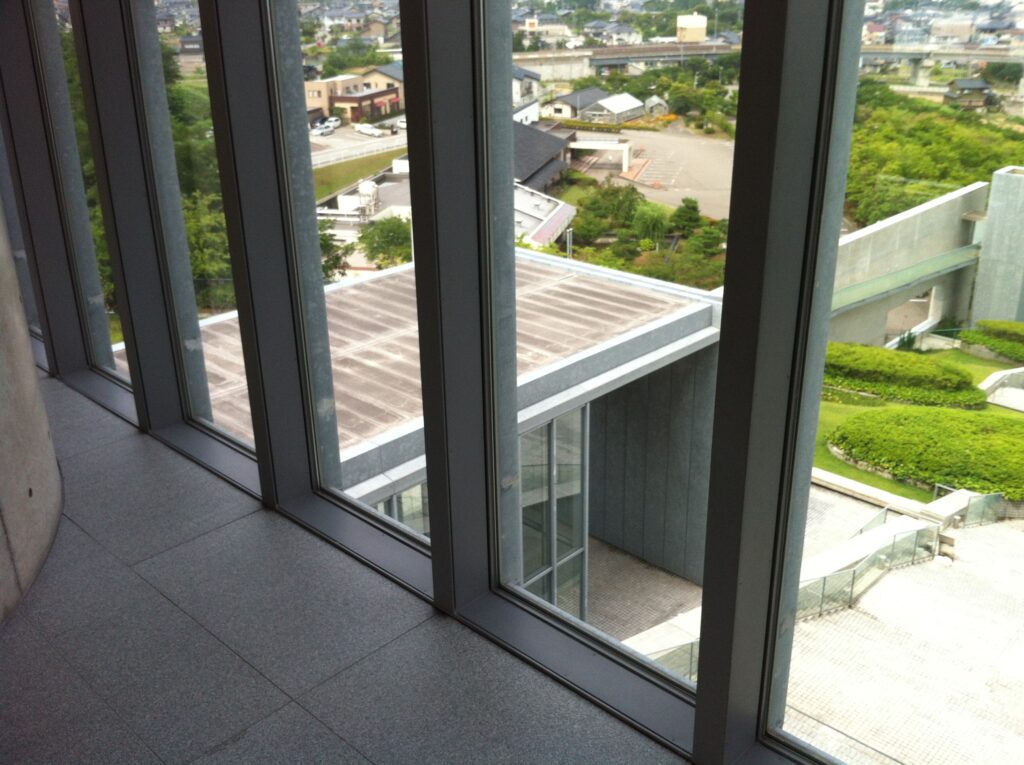
高い位置から下を見ると、それまで自分が歩いてきた庭やコンクリートの構成が初めて俯瞰できる。
歩いている最中には分からなかった関係が、視点を変えることで突然理解できる。この瞬間は、今回の建築体験を象徴しているようにも感じた。
最初から答えを見せない。迷わせ、歩かせ、最後に別の視点を与える。まるで「考える」という行為そのもののようだった。
Looking down from above, the garden and concrete spaces that I had previously walked through finally become visible as a larger composition.
Relationships that were impossible to understand while moving through them suddenly become clear after changing viewpoint. This moment seemed to summarize something fundamental about the entire building.
The architecture does not reveal the answer at the beginning. It allows you to become uncertain, makes you walk, and eventually gives you another perspective from which to reconsider what you have already experienced. In that sense, the building itself begins to resemble the process of thinking.
12.何もしないための場所
A Place for Doing Nothing
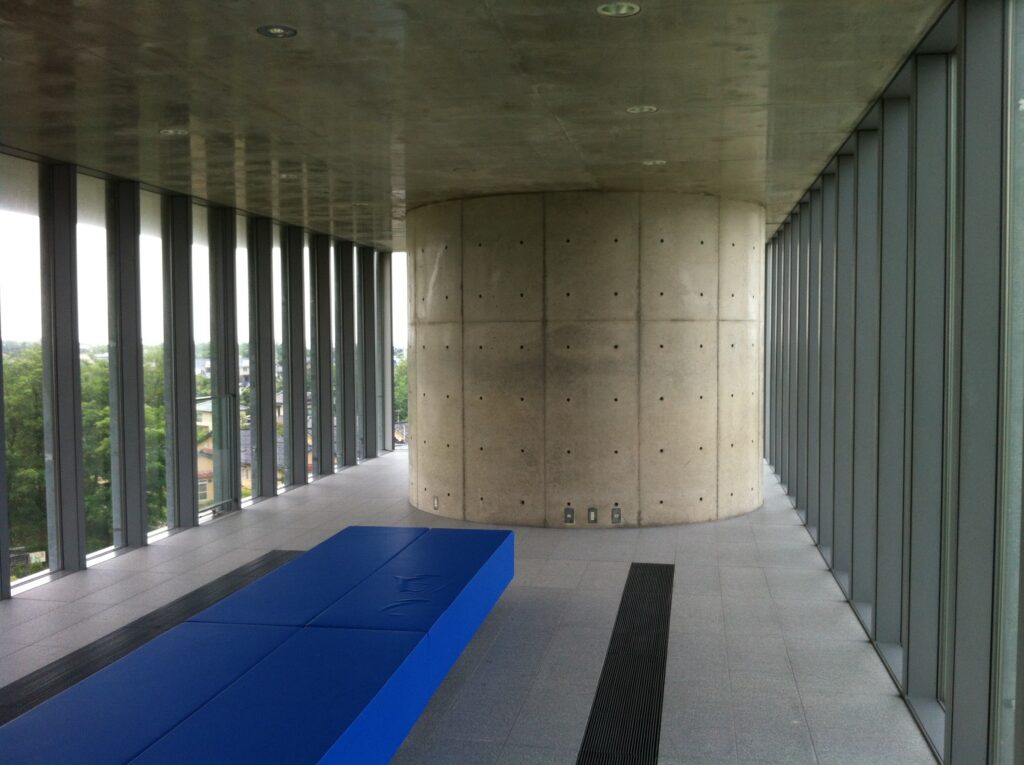
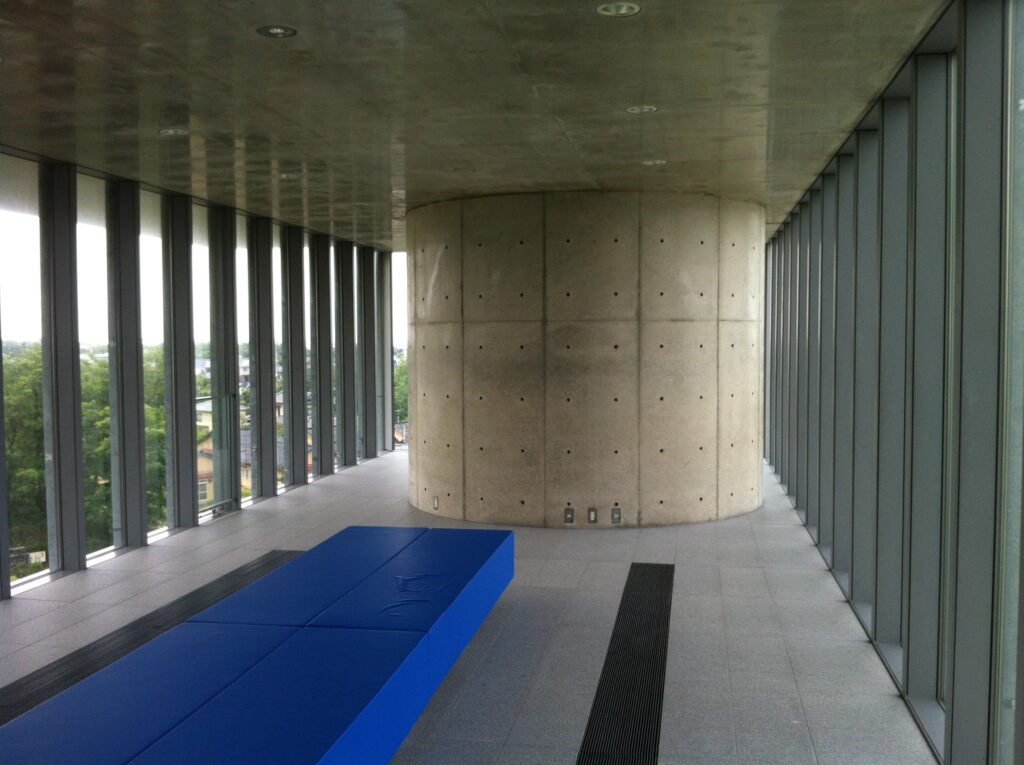
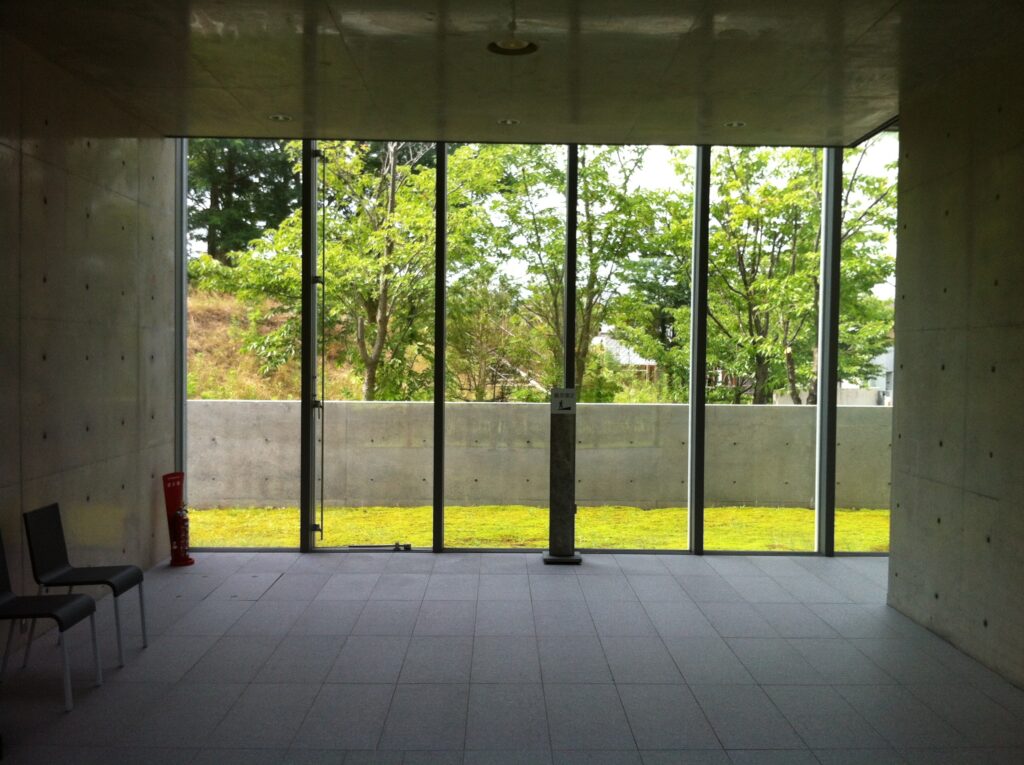
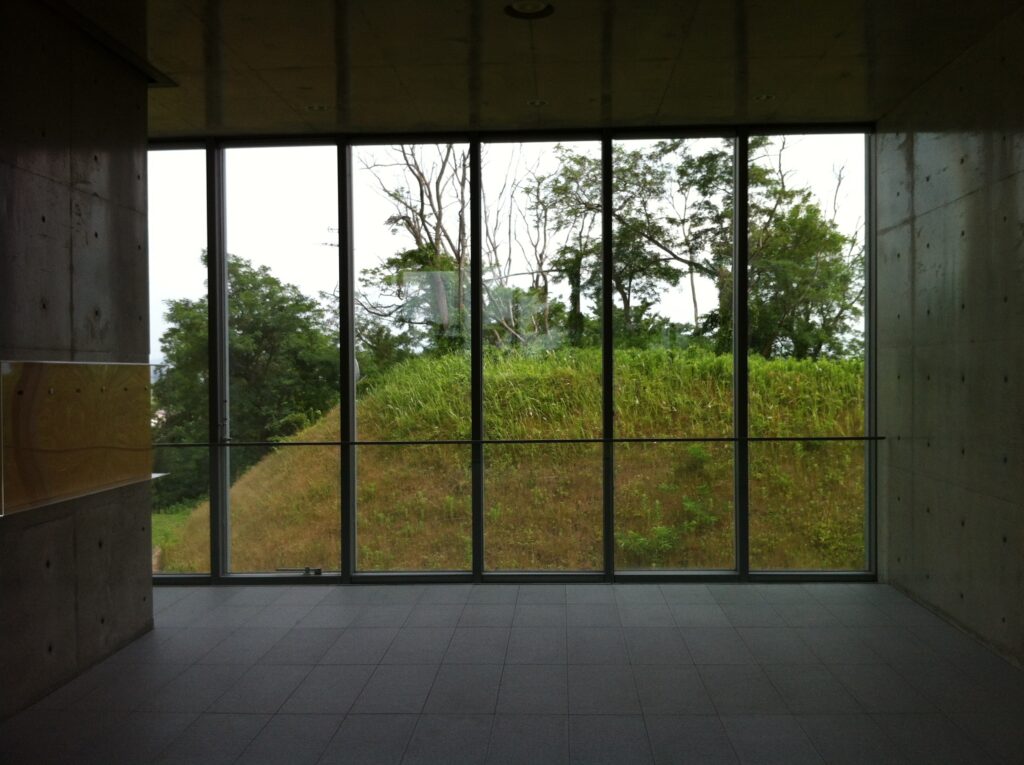
そして、この建築には静かに座るための場所がある。ガラス越しに風景が見え、室内には最低限のものしか置かれていない。
哲学館公式は館内に「考えるにふさわしいスペース」が随所にあり、瞑想のための空間も設けられていると説明している。哲学を情報として学ぶだけではなく、自分自身が考える時間を持つ。そのために建築が使われている。
There are also places in this building where the most important activity is simply to sit. Beyond the glass lies the landscape, while the room itself contains very little.
The museum includes spaces specifically intended for contemplation. Philosophy is therefore not treated only as information to be learned from exhibits. Visitors are also given time and space to stop and think for themselves.
In a museum, this absence of activity feels almost radical. Nothing demands attention. Nothing needs to be completed. Architecture simply provides a place in which thought can occur.
13.建築と土地
Architecture and the Land
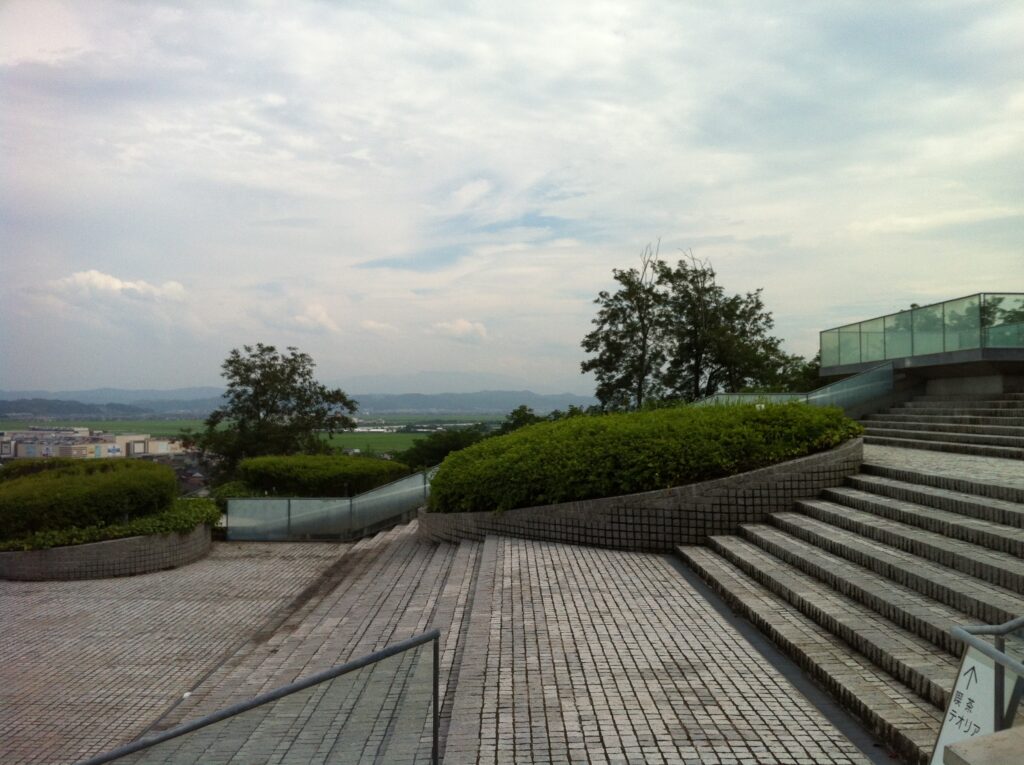
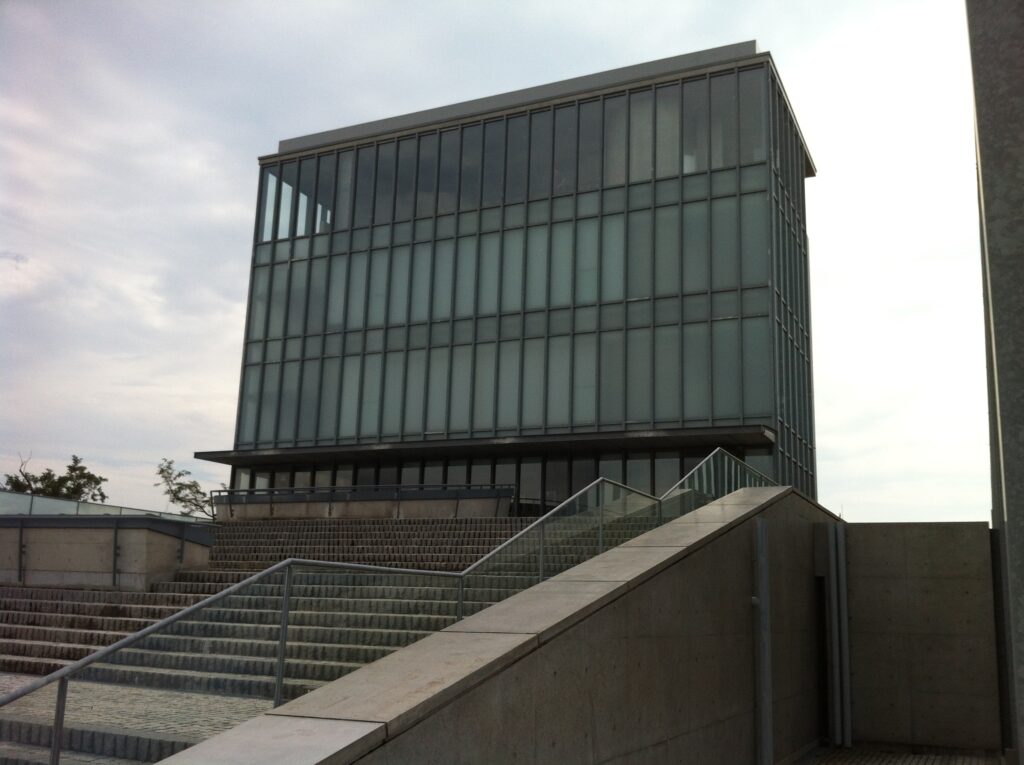
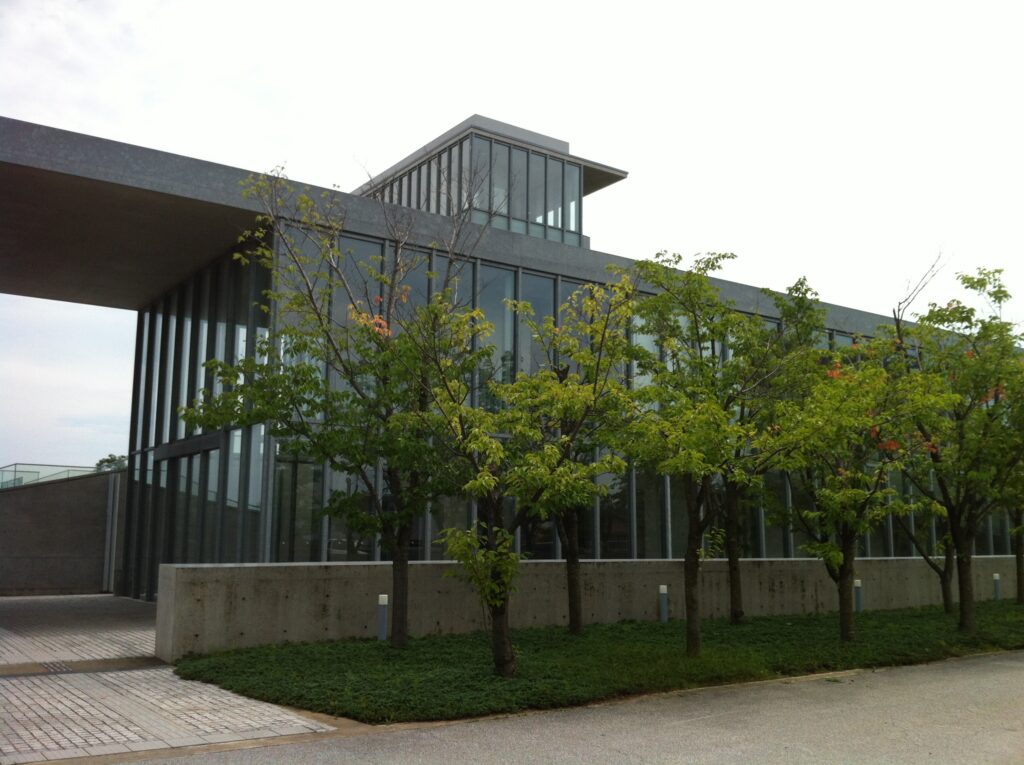
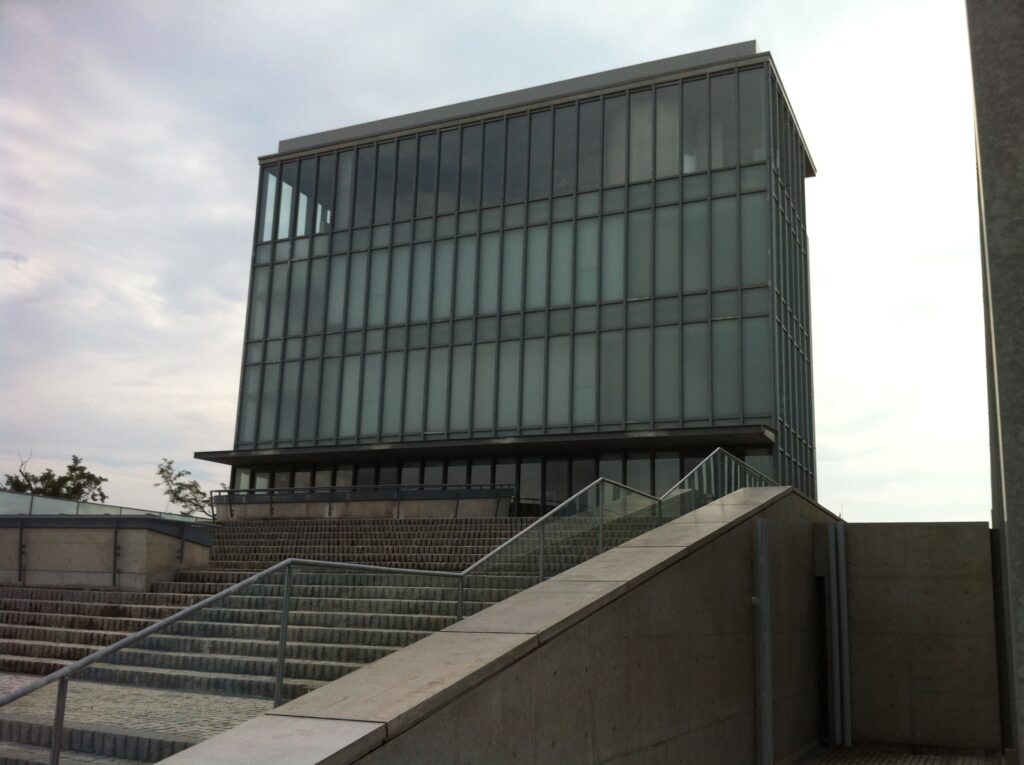
再び外へ出ると、建築と周囲の地形が一つの風景として見えてくる。コンクリートは強い存在感を持っているが、低層部分は地形に沿うように広がり、その上にガラスのヴォリュームが立ち上がる。
Returning outside, the relationship between the building and the terrain becomes visible again. Although the concrete possesses a strong physical presence, the lower portions spread along the site while the glass volume rises vertically above them.
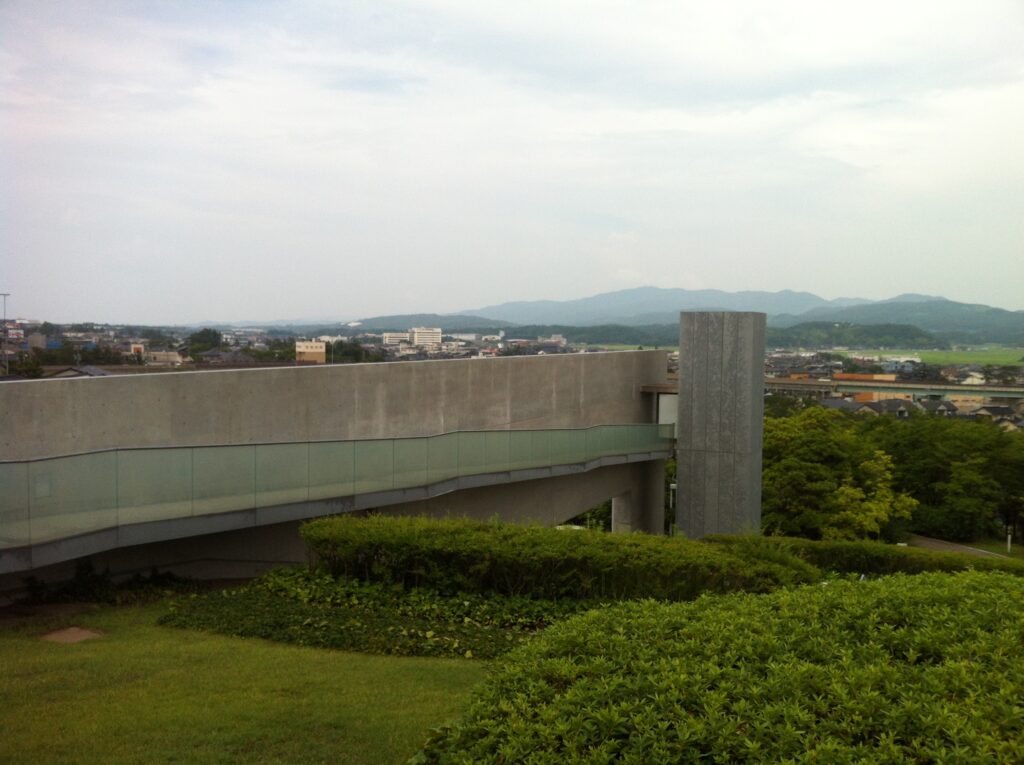
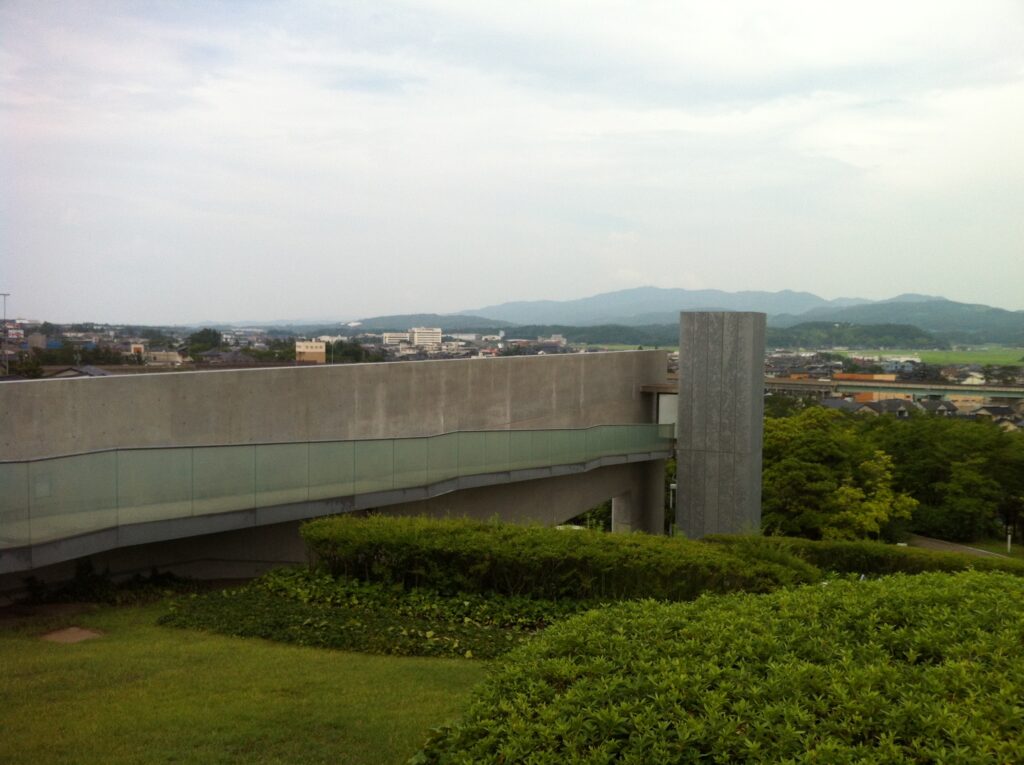
遠くの山、街、空、そして建築。内部で体験した抽象的なコンクリートの世界とは対照的に、外には具体的な土地の風景が広がっている。
西田幾多郎がこの地域に生まれ、生涯の約半分を石川県で過ごしたことを考えると、この眺望も単なる美しい景色ではないように感じる。西田の思想を記念する建築が、彼の故郷の風景の中に置かれている。
Mountains in the distance, the city, the sky, and the architecture all enter the same view. After experiencing the abstract world of concrete inside, the exterior returns you to the specific landscape of Ishikawa.
Considering that Kitaro Nishida was born in this region and spent approximately half of his life in Ishikawa, the view seems to carry meaning beyond its visual beauty. A museum dedicated to his philosophy stands within the landscape of his own origins.
My Impression
石川県西田幾多郎記念哲学館を歩いていて印象的だったのは、「哲学」という目に見えないものを、建築が直接説明しようとしていないことだった。
長い通路を歩き、行き先を探し、コンクリートに切り取られた空を見上げ、巨大な円筒の周囲を回りながら階段を上る。どこへ行けばよいのか一瞬迷う場所もある。しかし、その迷う時間さえ、この建築では意図された体験なのだと思う。
そして上までたどり着くと、それまで閉じられていた視界が一気に開き、石川の街と空が現れる。さらに振り返れば、今まで自分が歩いてきた建築を上から見ることができる。歩いている最中には理解できなかったものが、場所を変えることで初めて見えてくる。
「考える」ということも、おそらく似ている。一つの場所から答えを見つけるのではなく、迷い、立ち止まり、視点を変え、ときには同じ場所を別の角度から見る。
石川県西田幾多郎記念哲学館は、哲学を展示するためだけの建築ではない。迷い、歩き、上り、見上げ、そして立ち止まることで、「考える」という行為そのものを身体で体験させる建築だった。
What stayed with me most strongly while walking through the Ishikawa Nishida Kitaro Museum of Philosophy was that the architecture never attempts to explain something as invisible as “philosophy” directly.
I walked through long passages, searched for the next route, looked up at a sky framed by concrete, and climbed stairs around an enormous cylindrical wall. There were moments when I briefly wondered where I was supposed to go. Yet even that uncertainty seemed to belong to the intended experience of the building.
Eventually, after reaching the upper levels, the enclosed field of vision suddenly opened and the city and sky of Ishikawa appeared before me. Looking back down from above, I could also see spaces that I had already walked through. Relationships that had been impossible to understand while inside them became clear only after I had moved somewhere else.
Perhaps thinking works in much the same way. An answer is not always found from a single position. We become uncertain, stop, change our point of view, and sometimes return to the same question from another direction.
The Ishikawa Nishida Kitaro Museum of Philosophy is not simply an architecture for exhibiting philosophy. By making us lose our way, walk, climb, look upward, and finally stop, it transforms the act of thinking itself into a physical experience.
Archive Gallery
本文では紹介しきれなかった写真を掲載しています。
建築を歩きながら出会った光や空間、その場の空気を記録したアーカイブです。
Additional photographs from this visit.
A collection of details, perspectives, and moments that complement the main article.